Beneath the black pillars, a young guard counted the men entering the buried doorway, unaware that some would vanish beyond the reach of their companions.
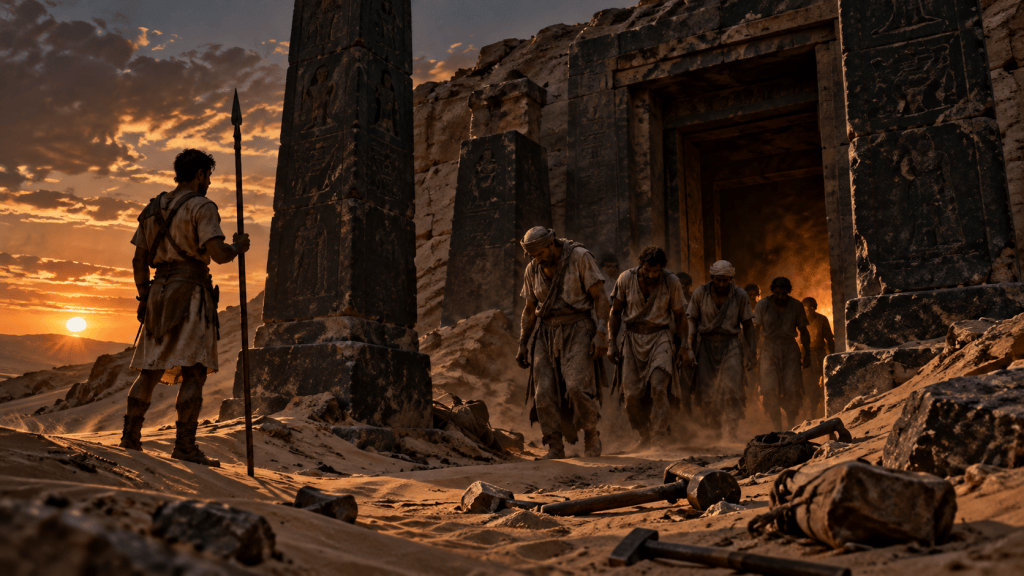
Timeline of Events
The Storm
A violent storm stripped sand from the western dunes, exposing black pillars and a buried doorway beyond the last cultivated fields.The Report
A field labourer discovered the ancient stonework. His account reached the city, bringing the newly exposed site to the attention of priests and officials.The Expedition
Stone-cutters and armed guards travelled west under priestly authority. The workers began clearing the entrance while a junior guard remained outside to record their numbers.The Withdrawal
Only half the men returned from the darkness. Tools lay abandoned, footprints were disturbed and blood marked the sand. The expedition withdrew, leaving the missing workers’ fate unresolved.
Only Half Came Back
The sand slipped over Ipu’s sandals as he carried the tally board along the line of stone-cutters gathered beneath the black pillars. Morning had gone in hauling water and keeping men clear of falling masonry. At the city gate, such a duty would have earned him less grit between his teeth. Still, he had waited half a year for an assignment beyond the walls, and he intended to bring his captain an accurate count.
“Count their feet if their faces trouble you,” said Henu, the older guard beside him, watching two cutters lever a slab aside. “They keep moving. You keep counting. Everyone remains employed.”
“I know how to count,” Ipu replied, scratching another mark into the wax. He glanced towards the labourers dragging stone from the doorway. “I am waiting for them to stand still long enough to prove it.”
The priest’s seal-bearer approached, lifting the hem of his robe from the sand. He inspected the opening the cutters had cleared, where shadow filled the space beyond the pillars. The wind swept along the ridge above them while the hollow itself remained strangely still. Touching the seal at his neck, he ordered the cutters inside and sent selected guards behind them.
Kebi, a broad-handed cutter who had shared dried figs with Ipu at midday, paused to tighten the leather around his mallet. He had spent their meal complaining about the price of flour.
“Put me down as one who came willingly,” Kebi said, a crooked smile showing beneath his dusty beard. “My wife will enjoy hearing it. She says I have to be pushed towards honest work.”
“Then come out willingly as well,” Ipu answered, making the final mark. Kebi laughed and followed the others into the shadows. Ipu watched the last guard disappear, drew his fingertip down the board and checked the total. Twelve had entered.
For a while the sounds of their work carried through the entrance. Stone struck stone, someone called for more light, and a quarrel rose over a tool passed the wrong way. Ipu took comfort in those familiar complaints. As afternoon thinned towards evening, the blows grew farther apart, until he found himself waiting for each one. Henu cleaned sand from his sandal fastening, though his eyes kept returning to the doorway.
The first man stumbled out as the sky reddened above the ridge. He dropped to his knees beside a pillar, clutching his bleeding arm. Others followed in a rush, one supporting a companion whose heels dragged through the sand. Ipu helped lower the man, then searched the dark entrance for the rest. Only six figures had emerged.
“Where is Kebi?” Ipu asked the wounded cutter, crouching beside him. “He was working with you.”
The cutter turned towards the doorway, lips moving before his voice came. “Behind us,” he said, tightening his hand over the torn sleeve. “I heard him call.”
Ipu started forwards, yet Henu reached the entrance first and barred his way with an outstretched arm. For the first time that day, the older guard’s voice had lost its humour.
“Stay here. Count who is standing.”
Ipu looked past him. A stone mallet lay in the sand near the pillar, its leather handle dark from a worker’s grip. Farther back, a bronze chisel caught the last daylight. He thought he heard movement within, faint beneath the wind sliding across the ridge.
“There are men inside,” Ipu said, closing his hand around his spear. “We have guards. We can bring them out.”
The seal-bearer stepped into his path, dust caught in the creases of his face. “The order is to withdraw. Help the wounded to the road.”
“And the others?” Ipu demanded, holding up the board. “What answer shall I carry back?”
The official studied the marks and looked away. “Write what returned.”
Henu helped the injured cutter stand, and Ipu went beside them as the diminished party climbed the ridge. He kept the board close to his chest, shielding the wax from his sleeve. Twelve marks stood in one column, six in the other. The missing men had names, trades and families waiting for them, yet the only certainty he could carry home was the space between those numbers. Behind him, the tools remained scattered below the black pillars, and the last light left the doorway while he was still watching it.
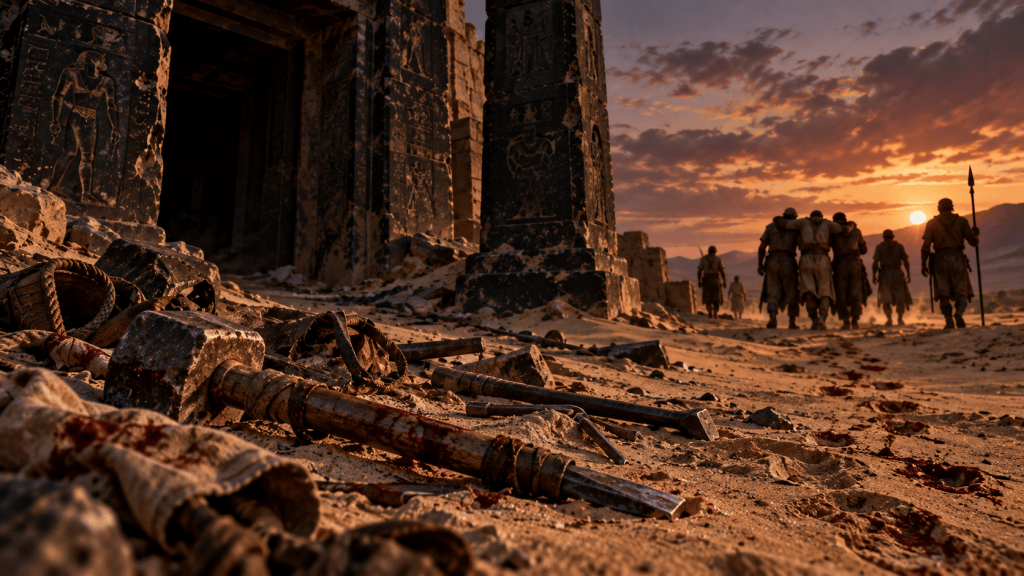
Abandoned mallets and chisels lie in blood-marked sand beneath the black pillars, left behind when Ipu and the surviving expedition withdrew, leaving six men’s fates unknown.
Inspiration Behind the Story
The disappearance of the stone-cutters offers a way to approach the buried doorway through the ordinary people caught in its consequences. Ipu begins with a simple duty: count the workers entering the ancient tomb and account for their return. As the day passes, that responsibility becomes something far more personal. Every missing man has a life beyond the expedition, with family, work and people expecting him home.
The abandoned tools, wounded survivors and disturbed sand connect this Chronicle to the evidence later discovered in Jackal at the Threshold. Yet the greater mystery remains beyond the black pillars. Through Ipu’s experience, the story explores the conflict between obedience and conscience, and how a few marks on a tally board can become the first surviving record of something the city will struggle to understand.
Related Book Series
Related Books of The Forgotten Gods of the Drowned Kingdom
Six men disappeared beyond the black pillars. Their companions returned with abandoned tools, blood in the sand and questions no surviving witness could answer.
In Book One: Jackal at the Threshold, tomb robber Neris follows rumours of the newly uncovered necropolis into the western dunes. What begins as a desperate search for treasure leads her towards ancient judgement, buried gods and a truth that will change her life.
The story continues in Book Two: The Scales Beneath the Sand, as the disturbance spreads beyond the desert into the city’s burial routes, sacred shrines and living streets. With the old powers stirring, Neris finds herself drawn deeper into a conflict whose consequences are only beginning to emerge.

Next Chronicle
News of the failed expedition reaches the river quarter, carrying fear into households whose men travelled west in search of honest wages. At the city work court, a stone-cutter’s wife searches the diminished line of returning workers for her husband. She wants answers from the guards and officials, while the men who survived struggle to explain what happened beyond the black pillars. As rumours spread through the streets, the absence of a body, a familiar voice and even a working tool begins to carry a terrible weight of its own.
Next: No Bodies, No Tools
Discover more from Simon J. Phillips
Subscribe to get the latest posts sent to your email.
