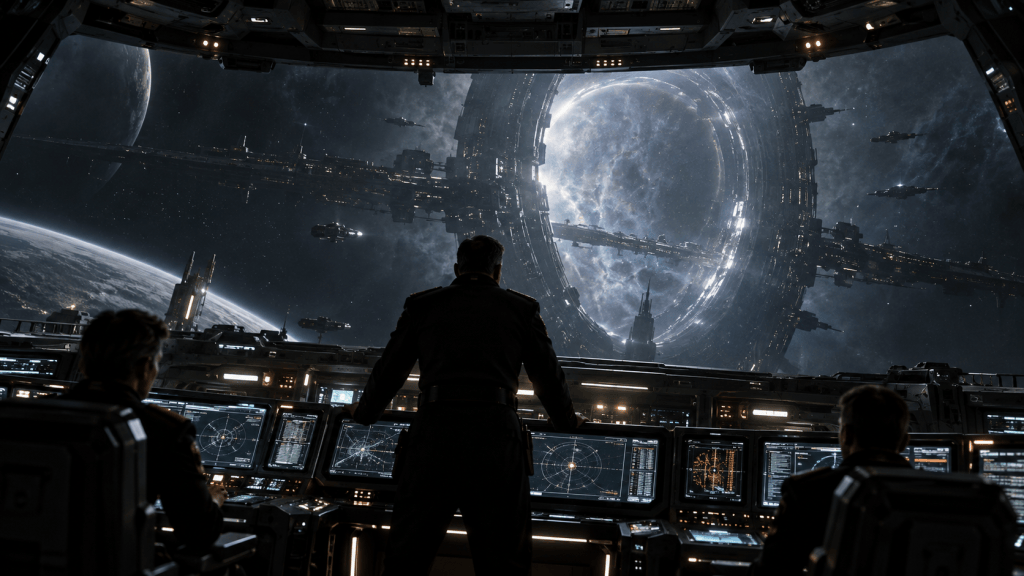
As the Nyx entered observation posture, Captain Halverson faced three reliable sensor readings that refused to describe the same gate.
Timeline of Events
After the Acceleration Interruption – Nyx Vindicator reduced emissions and entered observation posture near the gate.
Raw-Scan Pass – Predictive smoothing was removed from the gate’s sensor returns.
Observation Window – Lidar, spectral and gravitic readings remained individually coherent but mutually incompatible.
Command Assessment – Captain Halverson maintained a non-interference posture while the bridge worked to establish a reliable picture of the gate.
The Gate in Three Versions
Captain Halverson ran his thumb along the worn seam of the command chair as the last acceleration vibration drained from the deck. The Nyx Vindicator had settled into observation posture, her emissions reduced and her machinery quiet enough for him to hear the air moving behind the wall panels. The gate occupied the forward field, a vast circular presence whose edges shifted whenever the display tried to focus them. He had commanded through instrument failures before. Those usually came with a fault he could name.
With the bridge now quiet, Krell Vonn separated the sensor layers at the port station while Elias held the ship on its constrained vector. The composite lost its smooth outline and divided into three views, each carrying confident measurements. Halverson leaned forwards, trying to follow the same section of the structure across them, and found his eye arriving at a different place.
“Tell me which one deserves my signature,” Halverson said, resting his hand on the console.
Vonn widened the lidar return with two fingers. “This gives us a curved surface, sir. Very convincing, right up to where it ought to close.” He switched views, his dry amusement fading as the spectral image shifted colour. “This one agrees there’s something present. It has other ideas about where the surface goes.”
“And the third?” Halverson asked, watching the gravitic trace oscillate across the glass.
Elias steadied the unfiltered display. “It places the disturbance in the same region, Captain. Each pass shifts the centre. The model keeps producing a usable answer by giving itself more room to be wrong.”
Halverson studied the returns as the cooling system cycled beneath the floor. He could order a single position entered in the log and let the computers choose the least troublesome estimate. That would give his crew a point to steer around and the appearance of an encounter under control. He had seen tidy reports survive long after the judgement behind them proved unsound.
“If I accept the composite, what exactly am I accepting?” he asked Vonn.
Vonn rubbed his jaw before answering. “An average of three arguments, sir. The system can make it look civilised. I wouldn’t ask any of the witnesses to swear to it.”
Elias brought up the response envelope, leaving the raw feeds visible. “We can widen the tolerances and hold position. Every attempt to refine the picture drives another correction through the model. It keeps trying to reconcile measurements that refuse to converge.”
Halverson pressed his palm against the cool edge of the console. He could carry uncertainty into a report, yet his ship still needed an order its crew could obey. He rose and walked to the forward rail, where the gate spread beyond the glass, too large to judge against the sparse points of distant light.
“Observation only,” he told Elias, turning to include Vonn. “Maintain reduced emissions. Keep the raw returns separate and preserve every disagreement. No active test, no approach correction based on that composite.”
Elias acknowledged him with a measured nod and adjusted the handling limits. Vonn saved the separate records, leaving three incompatible outlines visible across the forward wall. The bridge resumed its working sounds, switches under fingertips, the whisper of ventilation and quiet exchanges confirming that the Nyx held steady.
Halverson had just settled back into the command chair when Vonn shifted sharply at the port station. “Captain, I’ve got another return,” he said, drawing a contact clear of the gate’s fractured outline. “Civilian configuration. Registry handshake is coming through.”
The vessel resolved into a freighter with a long hull and modular cargo spines, ordinary enough for any established transit route. Its identifiers populated cleanly, yet its plotted position held beside the gate at an alignment Halverson could scarcely understand. He watched Vonn run the registry through an independent check while Elias compared the contact’s orientation against the shifting structure.
“Registry’s valid,” Vonn said, glancing towards the command chair. “Same answer twice. I wish the position were as cooperative.”
Elias held the freighter beside the three raw gate views. “There’s no registered thrust or correction matching that alignment, Captain. The hull’s holding its orientation while our reference keeps moving.”
Halverson looked at the civilian profile suspended against the immense, unsettled ring. His order to observe had protected his ship from an uncertain structure. A civilian vessel had entered that same uncertainty, and a silent military watch carried responsibilities of its own.
“Low-power hail,” he said, leaning towards communications. “Tight beam. Keep us in observation posture and leave those raw scans running.”
Elias opened the channel and identified the Nyx Vindicator to the freighter. Halverson watched the carrier settle into a clean, steady line, then kept his eyes on the silent contact beside the gate.
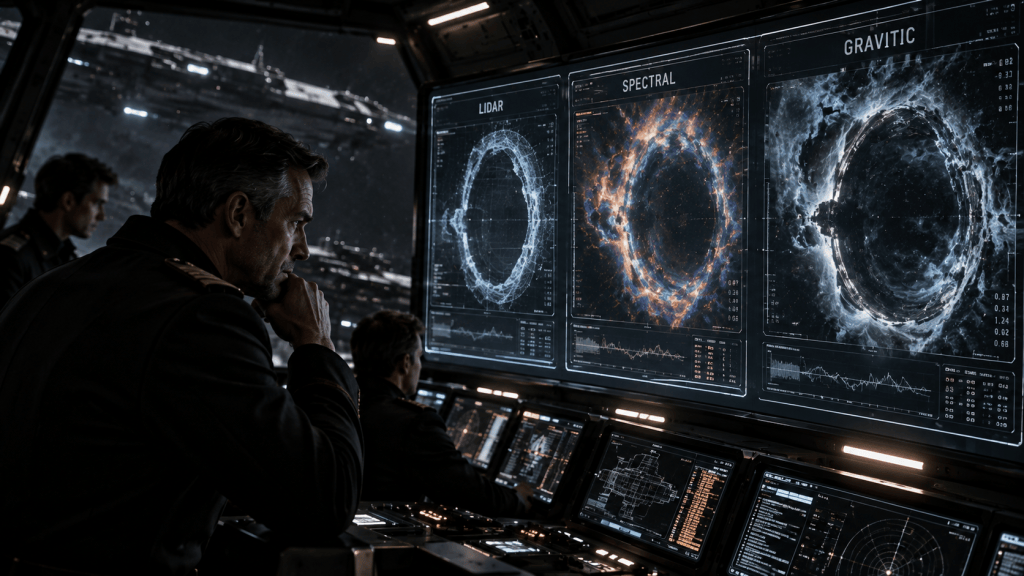
Captain Halverson studied three conflicting sensor interpretations of the gate, each presenting a valid reading while refusing to agree with the others.
Inspiration Behind the Story
This Chronicle began with a question about trust: what happens when instruments agree with their own measurements yet disagree with one another? Modern navigation depends on combining imperfect observations into a useful common picture. That process usually makes complex environments safer, especially for people whose decisions affect an entire crew.
Captain Halverson brought a different human pressure to the idea. An engineer can keep testing a discrepancy; a captain must decide which actions remain justified while the discrepancy persists. Authority offers little comfort when the evidence refuses to settle, and restraint becomes an active choice, carrying consequences for everyone under command.
I wanted the gate to feel unsettling through the ordinary demands of leadership, where a calm order can require more courage than an immediate response. The uncertainty remains, while the responsibility to act grows sharper.
Next Chronicle: Three Seconds Early
With the civilian freighter holding its impossible position beside the gate, the Nyx Vindicator attempts to establish communication through a seemingly reliable channel. Krell Vonn finds himself examining a series of routine protocol exchanges, each carrying valid identification and correctly formatted data. Yet the longer he studies the incoming traffic, the harder it becomes to reconcile what the instruments are recording with what the bridge crew are experiencing. As Captain Halverson presses for answers, Vonn begins questioning something he has always trusted: the sequence of a conversation.
Related Book or Series
The Reading That Stayed Green runs alongside the opening events of The Nyx Vindicator: Drift, showing the same gate-zone crisis through Krell Vonn’s experience while the book follows the wider incident aboard the Nyx. Button:Read The Nyx Vindicator: Drift
Discover more from Simon J. Phillips
Subscribe to get the latest posts sent to your email.
