The Scales Beneath the Sand: Anubis, Tomb Routes, and Egyptian Mythic Fantasy


The City Beneath the City

A river city carries its dead differently.

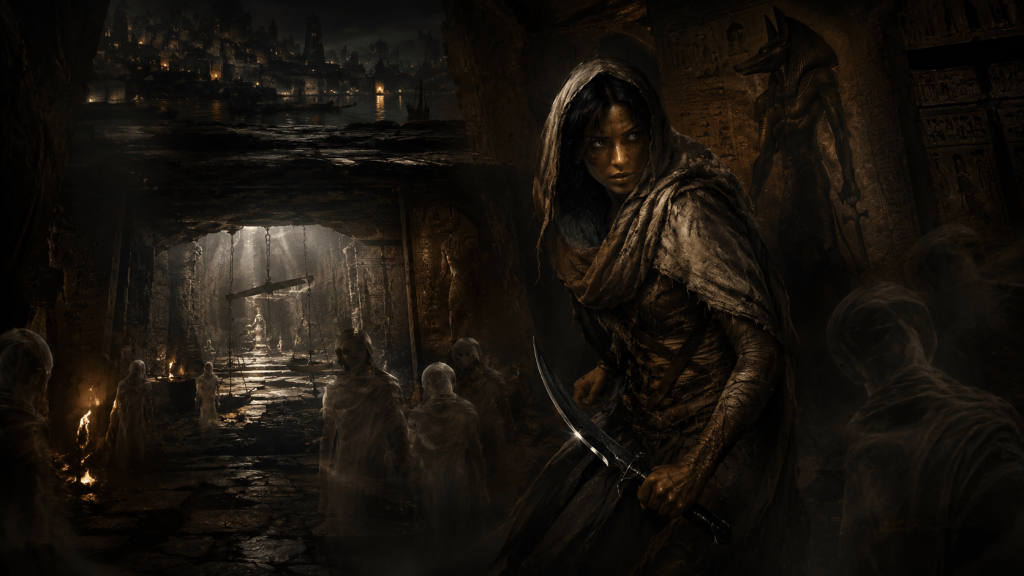
Above ground, life presses through the lanes in smoke, heat, fish-blood, old grain, cheap oil, medicine, shouted bargains, and the dull fatigue of people trying to make one more day hold together. Below those same streets, older systems remain. Tomb passages run beneath foundations. Faded shrines keep their painted eyes turned towards forgotten doors. Burial routes pass through stone chambers where the living once prepared the dead for their final journey.

That is where The Forgotten Gods of the Drowned Kingdom begins to deepen.

For readers drawn to Egyptian mythic fantasy, dark fantasy, and stories shaped by ancient gods rather than borrowed decoration, the river quarter matters as much as any temple or necropolis. It is where Neris lives. It is where she steals from tombs because medicine costs money, rent still comes due, and grief does little to feed a household. It is where the distance between sacred history and ordinary survival becomes painfully small.

Neris has already crossed a threshold that should have remained closed. She has returned carrying the uneasy sense that the dead can find her, that their unfinished burdens can gather at the edge of her thoughts, and that something in the dark has changed the shape of her life. She calls herself a bridge because the word gives her burden a use. A bridge joins two places. A bridge carries weight. A bridge does not need to ask who built it or why.

Yet every bridge can become a crossing point for something far more dangerous.

In The Scales Beneath the Sand, the second book in The Forgotten Gods of the Drowned Kingdom, the old routes beneath the river city begin to fail. Souls gather where they should pass cleanly. Sacred passages hold pressure where there should be release. The dead seem to hesitate before a crossing that has served them for generations.

That kind of wrongness belongs to more than haunting.

It belongs to interference.


When the Routes of the Dead Are Wounded
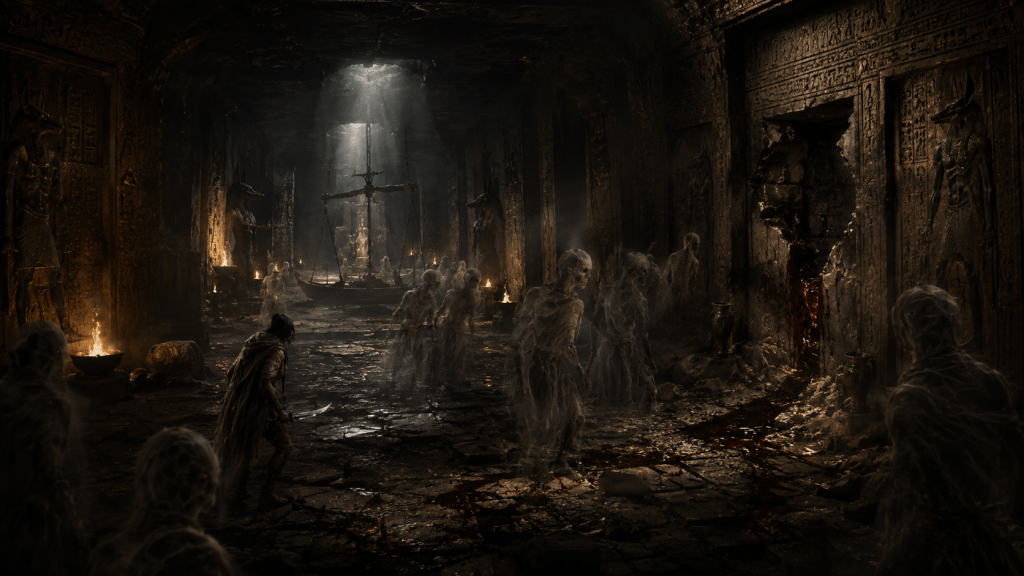
Tombs in Egyptian mythic fantasy should never feel like empty scenery waiting for an adventurer to enter them. They are architecture built around memory, judgement, ritual, identity, grief, and passage. A burial chamber holds the shape of the people who believed in it. A threshold carries the weight of those who crossed it before. A damaged shrine can become more than abandoned stone when its sacred purpose still remains close beneath the surface.

The buried spaces beneath Neris’s city work in that way.

They are not merely ruins. They are old systems of passage. Ferry chambers, weighing rooms, record houses, forgotten shrine courts, and narrow cut-stone ways still preserve the language of burial order. They remember what the dead are meant to do even when the living have stopped listening.

That makes the disturbance at the heart of The Scales Beneath the Sand more unsettling than an ordinary haunting. The dead are not simply restless. Their routes have been handled. Stone has been cut. Ash and blood have been worked into sacred spaces. Something has opened wounds inside the passages where the dead should move towards judgement.

The result is a form of underworld fantasy grounded in pressure rather than spectacle.

The danger begins in small signs. A spill of natron near a jackal-marked recess. Fresh blood in a place that should have been empty. A torn piece of blackened leather. Marks carved into old stone with enough force to make the sacred architecture itself feel violated. Neris follows those signs because she knows the human cost of walking away from something wrong. The dead follow her thoughts. Their fear becomes difficult to leave behind.

The city above continues unaware. People drink beneath reed awnings. Children cry in upper rooms. Fishmongers scrape scales into buckets as night settles over the quay. Yet underneath those ordinary lives, sacred order has begun to fracture.

That is where the hidden god-war first becomes visible.

Not through armies at a city gate. Not through gods tearing open the sky. Through the dead failing to rest.


Anubis at the Broken Threshold
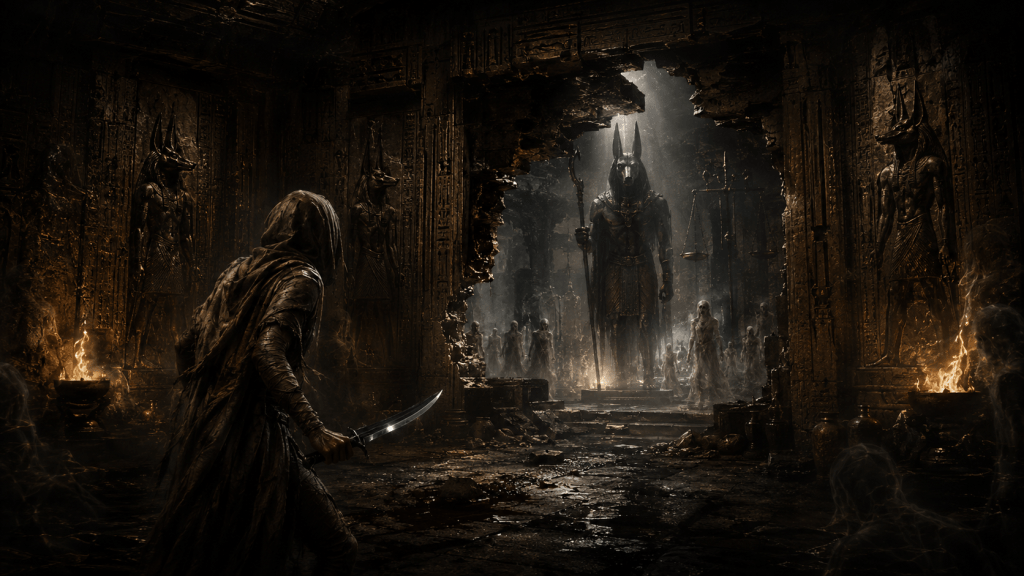
Anubis has always belonged at the edge of fear and judgement.

He is associated with tombs, funerary practice, embalming, the care of the dead, and the passage towards rightful judgement. His presence carries a particular weight because he is not simply a god of death. He stands at the point where death must be ordered, witnessed, and given its proper place.

That makes him a powerful centre for an Anubis fantasy story.

Neris’s connection to him offers no easy blessing. Her jackal talisman becomes a funerary blade only when the dead press too close or when a threshold has been disturbed. The weapon is intimate, cold, and made for narrow places. It belongs in stone corridors, flood-cut passages, old shrines, and the close terror of being unable to step far enough away from another person’s blade.

That distinction matters.

The divine weapon does not turn Neris into a polished fighter. She remains a survivor first. Her instincts come from tomb shafts, slum alleys, unstable stone, hidden routes, and the practical knowledge that escape can matter more than victory. She fights low, close, and desperately. She uses clutter, broken walls, ash, tight spaces, bad footing, and whatever the room gives her.

The funerary blade gives her a way to answer sacred wrongness. It does not erase fear from her body.

This is where the series separates itself from clean chosen-one adventure. Being marked by a god does not lift Neris above poverty, grief, injury, or uncertainty. It makes her visible to forces that already understand more about her than she understands about herself.

The burden comes first.

The meaning comes later.


The Hands Carrying the Gods’ War
The gods of The Forgotten Gods of the Drowned Kingdom do not begin by fighting openly.

Their conflict moves through human hands.

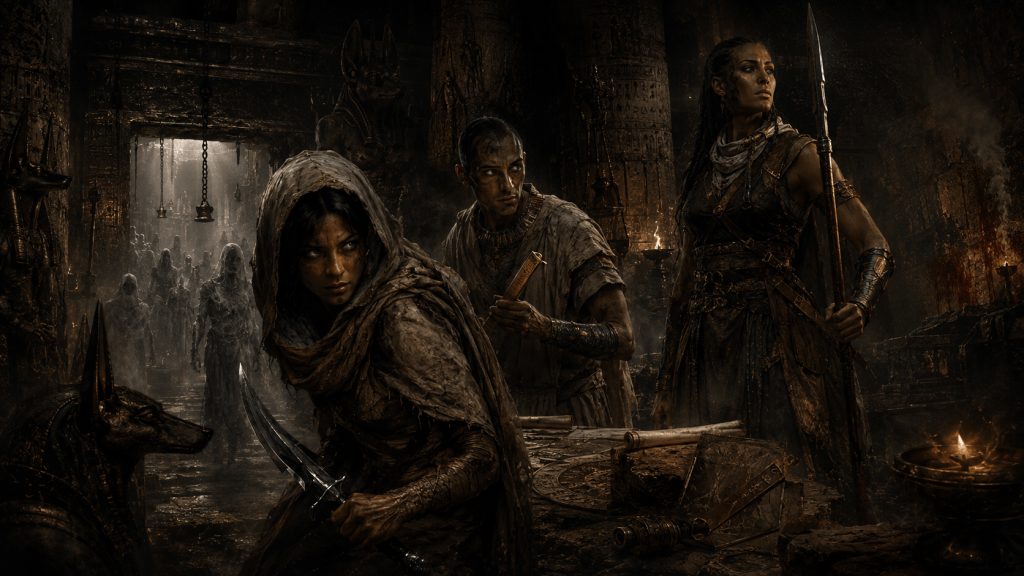
Chosen people carry relics shaped by divine domains. Their weapons reflect the gods who claim them. Their strengths are tied to endurance, discipline, training, fear, nerve, judgement, and the cost of surviving long enough to learn. That keeps the hidden war close to the body. Feet slip. Hands shake. Wounds open. Pride creates mistakes. A blade can be sacred and still fail in an untrained grip.

In The Scales Beneath the Sand, Neris learns that she is no longer alone inside this pressure.

Khamet enters the story through record houses, burial tallies, ferry counts, ledgers, ink-stained fingers, and maps of disturbed passage. His relationship to the dead comes through pattern and reckoning. Where Neris feels the wrongness in her skin and breath, Khamet sees broken measure. He watches the numbers around burial, crossings, oils, and names begin to separate from one another, then follows the distortion towards something buried beneath the city.

He is useful almost immediately.

He is also irritating almost immediately.

Their early connection is shaped by distrust, exhaustion, sharp replies, wounded pride, and practical necessity. Neither gives the other comfort. Neither enters the other’s life gently. That matters because the war has no interest in providing safe companions at the right moment. It brings people together when pressure leaves them no cleaner choice.

Meretneith arrives from a different part of that same world.

She is a veteran chosen of Neith, shaped by martial discipline, old war knowledge, and the unsentimental truth that survival demands more than instinct. Her presence changes the scale of the story because she reveals what long experience looks like. Every movement has purpose. Every correction lands where it needs to land. Her weapon is an extension of training rather than a spectacle.

For Neris, that becomes its own kind of humiliation.

Surviving is not the same as knowing how to fight.

A hard lesson begins with the feet.


The Scales Beneath the Sand

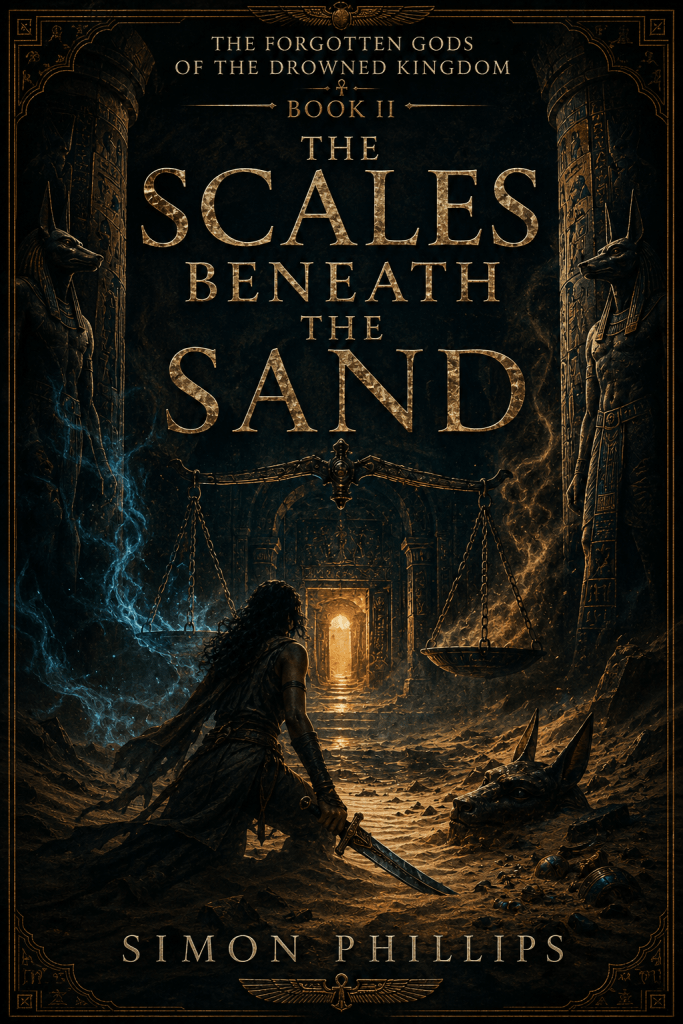
The title The Scales Beneath the Sand reaches towards the deeper tension of the series. Scales suggest judgement. Sand suggests burial, erosion, time, and the slow concealment of what people once believed was secure. Together they point towards a world where sacred order has been buried so long that even those living above it may no longer know what holds their city together.

Neris enters that buried order carrying the wrong tools for a war she never chose.

She has a funerary blade, a sick mother, a body already marked by grief, and a life rooted in streets where every coin must be counted before it can be spent. The hidden conflict enters through those ordinary pressures. It reaches for her because she has been claimed, though the claim means danger long before it means understanding.

The story remains focused on tombs, thresholds, divine weapons, and the uneasy movement of the dead, yet its centre stays human. The fear is not only that a sacred route may break. The fear is that the break will climb. It will move upward through the stone, into the lanes, into the rooms where people sleep, and eventually towards the few fragile lives Neris still believes she can protect.

That is the real weight of hidden god-war.

It begins in the places no one thinks to watch.

When the War Learns the Road Home

The strongest ancient gods fantasy does not need to announce its scale at once.

It can begin with a single wound in old stone.

It can begin with dead souls gathering at a closed passage.

It can begin with a woman carrying medicine home through a river city, sensing that something beneath the streets has started to call her name.

The first signs are rarely grand enough for anyone above ground to notice. A lamp gutters in a shrine that has stood neglected for years. A burial tally fails to match the names written beside it. An offering bowl lies overturned where no living hand should have passed. In the dark beneath the quarter, old routes begin to tighten around the dead, holding them in places meant only for crossing.

By the time fear has a name, the damage has already travelled.

The Scales Beneath the Sand stands at that moment of widening pressure. Neris has moved beyond the lonely belief that she is only a bridge between the living and the dead. The hidden conflict has found her. Other claimed people have entered her path. A predator has tested her strength and seen where her life is weakest.

She still carries the same burdens she carried before the dead began to answer her. Her mother still waits in a narrow room. Medicine still costs more than she can spare. The river quarter remains full of damp walls, thin lamps, crowded lanes, and people trying to protect what little has survived another difficult day. The divine has entered her life, yet it has offered no escape from any of that.

Instead, it has placed those fragile things in danger.

The city remains standing. The temples have not fallen. The gods have not yet stepped openly into the streets. Their names still belong to shrine walls, old stories, ritual words, and the fears people carry quietly through the night.

Even so, the balance has shifted.

Something beneath the city has learned that sacred order can be wounded. Something has begun to test the routes of the dead, the people marked by old gods, and the living ties that make those people vulnerable. Neris has survived the first movement of that pressure, though survival has only brought her closer to the truth waiting beneath it.

The war begins before anyone understands its full shape.

It begins in tomb dust, river stink, jackal shadows, broken thresholds, and the silence left behind when the dead fail to rest.

It begins beneath the sand, where old scales still wait for something to be weighed.
The Future Chronicle: The Expansion Project

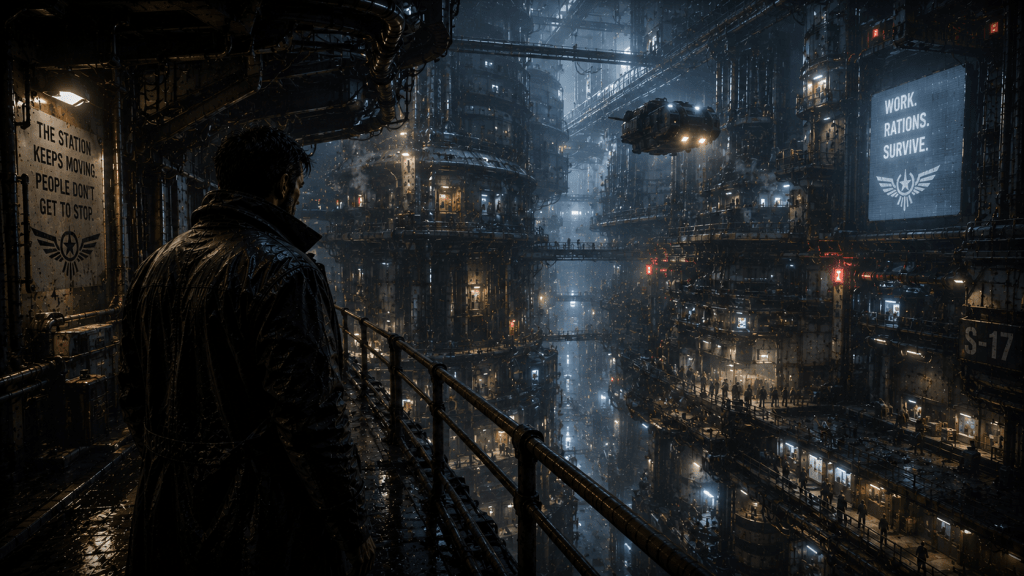
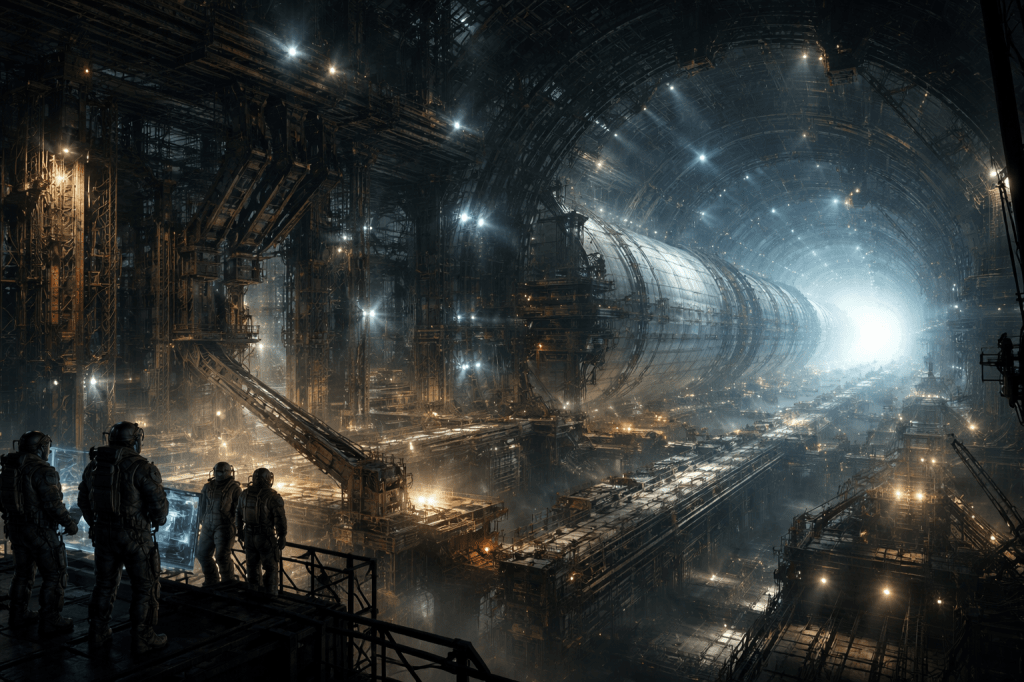
When new construction connected with Ashfall Station’s forgotten sectors, engineers discovered that the station had not been built as a single structure, but layered over something far older.


The First Frame of Expansion

The first structural frame arrived in silence, carried along Ashfall’s outer ring by a convoy of slow-moving construction tugs whose engines burned with a steady blue light against the darkness. From a distance, the framework appeared almost delicate, a skeletal lattice of reinforced trusses extending across open space, its geometry holding a precision the station itself had long since surrendered.

Inside the observation deck, Senior Structural Engineer Halren Voss stood with his hands resting against the glass and watched the frame draw closer with a focus that had sharpened over the course of the last cycle. The expansion had been approved months earlier and passed through Fleet infrastructure review with unusual efficiency, its purpose stated in clear terms that required little interpretation. Ashfall would expand its cargo capacity, reinforce its ageing structural spine, and extend its operational lifespan deeper into the Kestren system, all of which made sense on paper, even as the timing carried a quiet insistence that felt closer to instruction than maintenance.

The tugs aligned with the outer docking struts in careful sequence, each movement controlled through a series of micro-adjustments that compensated for Ashfall’s uneven rotational drift. Voss followed the alignment metrics scrolling across his comm display while noting the minor corrections required to stabilise the frame against the station’s existing mass, aware that even here, at the edge of expansion, Ashfall resisted precision, its structure carrying subtle deviations that no amount of recalibration ever fully resolved.

“Alignment within tolerance,” a voice reported behind him, the words settling into the background hum of the deck as part of a routine that had already begun to feel rehearsed.

Voss inclined his head without turning, his attention still fixed on the approaching frame as he spoke. “Log the variance. I want the full correction profile before integration begins.” The technician acknowledged before stepping away, leaving him alone with the slow, deliberate arrival of something new that seemed almost out of place against the station’s accumulated imperfections.

For a moment, the contrast unsettled him in a way he could not immediately define. The frame remained exact in its construction, its lines following specification without drift, each segment fabricated to tolerances Ashfall’s older sections could no longer match. Against it, the station revealed its age more clearly than any maintenance report ever had, layers of repair and reinforcement visible even at this distance, each applied at a slightly different angle and each solving a problem that had already replaced an earlier one.

The thought formed gradually as he watched, settling into place with quiet weight as he recognised that Ashfall had never been built as a single structure, but instead had grown over time, accumulating its form through necessity rather than design. Once that understanding surfaced, it refused to leave, colouring the way he now saw every junction, every seam, every correction layered over the last.

He turned away from the observation deck once the first frame locked into position, the heavy clang of magnetic couplings echoing faintly through the hull as the structure connected with the station’s outer ring. The sound travelled further than expected, carrying through the corridors with a depth that suggested the impact had been received by more than the immediate junction, as though something within the station had answered in return.

Construction always carried sound, yet this felt different in a way that lingered beyond the moment. Although Voss dismissed the impression, he found that it remained with him as he moved towards the access lift. His next task already formed in sequence, as integration required verification, and verification required proximity, drawing him down towards the mid-ring’s older support corridors where decades of incremental modification had taken place without comprehensive review.

The lift descended through layers of the station that grew progressively less refined, the lighting shifting from steady white to the familiar flicker of ageing strips that hummed with uneven power draw. Voss watched the deck indicators count down while noting the subtle changes in air pressure and temperature that marked each transition between sectors, each layer carrying its own atmosphere shaped by use, repair, and neglect.

When the doors opened, the corridor beyond carried the quiet weight of long use. Reinforcement ribs lined the walls at irregular intervals, their surfaces marked by overlapping weld seams that told the story of previous adjustments, while cable conduits ran exposed along the ceiling, their routing altered and rerouted so many times that no single path remained original, giving the space a sense of accumulated decisions rather than planned design.

He stepped out into the corridor and paused, allowing his eyes to settle into the lower light as a small team of engineers waited near the junction hatch, their tools arranged in careful order along the bulkhead. They straightened as he approached, their expressions attentive and restrained, as though the space itself encouraged caution and discouraged unnecessary movement.

“Status,” Voss said, his voice carrying just enough authority to settle the room without disrupting its quiet.

“Preliminary scan complete,” the lead technician replied. “Structural integrity within acceptable limits, though internal mapping diverges from archived schematics.” The phrasing carried a hesitation that suggested the words had been chosen with care.

Voss considered that for a moment, his gaze drifting towards the sealed hatch that marked the boundary between active infrastructure and the older layers beneath. “Define diverges,” he said, and the technician hesitated again before bringing up a projection on his handheld display.

“The original construction maps show a continuous support corridor beyond this point,” he explained. “Yet current scans indicate interruptions. Voids where material should exist.” The explanation settled uneasily in the confined space.

“Damage,” Voss said, the word offered as a possibility rather than a conclusion.

“Possibly,” the technician replied, “though the edges appear too regular for collapse,” and the distinction lingered between them with quiet weight.

Voss stepped closer to the hatch and ran his hand along the seam where the newer locking mechanism met the older structure, the metal cool beneath his fingers and smooth where it had been recently reinforced. Beneath that, he sensed the older material, a subtle difference in density that suggested a different fabrication process entirely, one that belonged to an earlier stage of the station’s development.

“When was this section last accessed?” he asked, keeping his tone even as he traced the seam.

“Records indicate closure during the second expansion phase,” the technician said. “Approximately forty years ago,” and the span of time settled into the corridor as something more than a number.

Forty years was long enough for a space to fall out of memory while still remaining part of the structure, long enough for records to lose context even when they remained intact. Voss felt that weight as he withdrew his hand and gave the instruction to open the hatch.

The team moved with practised efficiency, tools engaging with the locking mechanism as power was redirected to disengage the seal. The process took longer than expected, as the system resisted in small ways that required manual override at several stages, and when the final lock released, the hatch shifted inward with a low, reluctant sound that echoed into the space beyond.

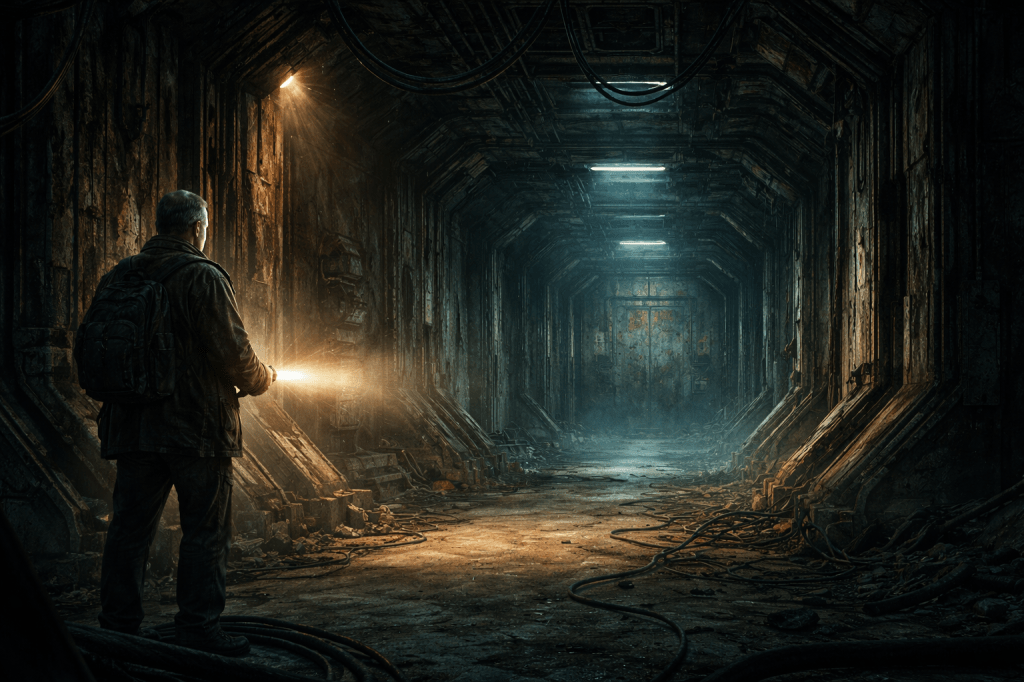
The corridor on the other side lay in darkness. Voss activated his light before stepping through, the beam cutting across a passage that extended further than the archived schematics had suggested. The walls bore the same reinforcement pattern as the active corridor, yet with weld seams that appeared older and less precise, their edges softened by time and exposure.

He advanced slowly, his attention fixed on the details that emerged within the light, and as he moved further into the corridor, the differences began to resolve into something more deliberate than simple variation. The floor plating shifted in alignment so that its edges met at angles that no longer corresponded to the station’s standard grid.

One of the engineers spoke quietly behind him, drawing attention to the same detail, yet Voss remained focused as he crouched and ran his light along the seam between two plates, the join holding firm and the structure remaining sound even as the orientation suggested an alternate reference point that the station’s current systems no longer recognised.

“Bring up the grid overlay,” he said, and when the technician complied, the discrepancy became immediately clear as the projected grid failed to align with the plating beneath their feet, revealing that the corridor followed a different structure altogether.

Voss rose slowly, the earlier thought returning with greater weight as he turned and scanned the corridor’s length, the beam of his light revealing further inconsistencies as junction points appeared where none should exist, and conduits entered the walls at angles that bypassed standard routing protocols before disappearing into spaces the maps no longer acknowledged.

The technician spoke again, his voice lower now, suggesting that these sections had been modified after initial construction. Voss answered quietly that the changes might have come before, and the possibility settled into the space with a silence that carried more meaning than any confirmation could have provided.

Behind them, the open hatch framed the brighter corridor of the active station, its light spilling into the darkness without fully dispersing it, and the boundary felt sharper now, marking more than a division between old and new as the integration plans began to shift in implication.

The technician began outlining the structural requirements for anchoring along this axis, explaining how the deviations would alter load distribution beyond projected tolerance. Voss listened before instructing him to hold, stepping further into the corridor as the pattern continued to unfold, each segment reinforcing the sense that the station’s deeper layers followed a logic no longer present in its current design.

The maps had recorded something else, or they had been altered, and the uncertainty carried its own weight as Voss reached the first junction and paused, his light tracing the outline of a sealed access panel set into the wall, its surface unmarked and smooth, reflecting the beam back at him in muted tones that revealed nothing of what lay beyond.

He placed his hand against it and remained still as a faint vibration passed through the metal, subtle enough to be dismissed as background activity, yet steady enough to hold his attention, the rhythm repeating with a precision that felt measured rather than incidental.

Voss kept his hand in place for a moment longer before withdrawing it, aware of the team watching him from the corridor behind, and when he spoke again, his voice carried the weight of a decision that extended beyond immediate procedure as he called for a full survey of the section, making it clear that integration would not proceed until they understood what they were connecting to.

The technician nodded, relief visible in the motion as though the instruction aligned with an unease he had been unwilling to voice, and Voss turned back towards the open hatch where the light from the active corridor spilled across the threshold, pausing for a moment between the older structure behind him and the newer station ahead.

The expansion had been designed to strengthen Ashfall, yet what it revealed suggested that the station’s foundation carried more than its current systems could account for, and whatever lay within those deeper layers had remained undisturbed until something new attempted to connect to it again.

The light flickered once as he stepped back through the hatch, the corridor beyond settling into its familiar hum while the darkness behind remained unchanged, holding its shape without resistance as though the brief intrusion had made no difference at all, and although Voss did not look back, he carried the pattern with him, its quiet repetition remaining long after the corridor returned to routine.

The expansion had only just begun, and Ashfall had already begun to answer.


Station Record: Expansion Junction Survey; Mid-Ring Structural Integration

Ashfall Station maintained extensive structural archives documenting the layered growth of the installation across successive decades of expansion above the mining world of Kestren-4. From its earliest function as an industrial transfer platform, the station evolved through repeated phases of reinforcement and outward development. Each stage embedded earlier infrastructure within newer construction. Over time, this created a dense internal framework in which modern systems frequently intersected with structural elements originating from the station’s initial industrial period.

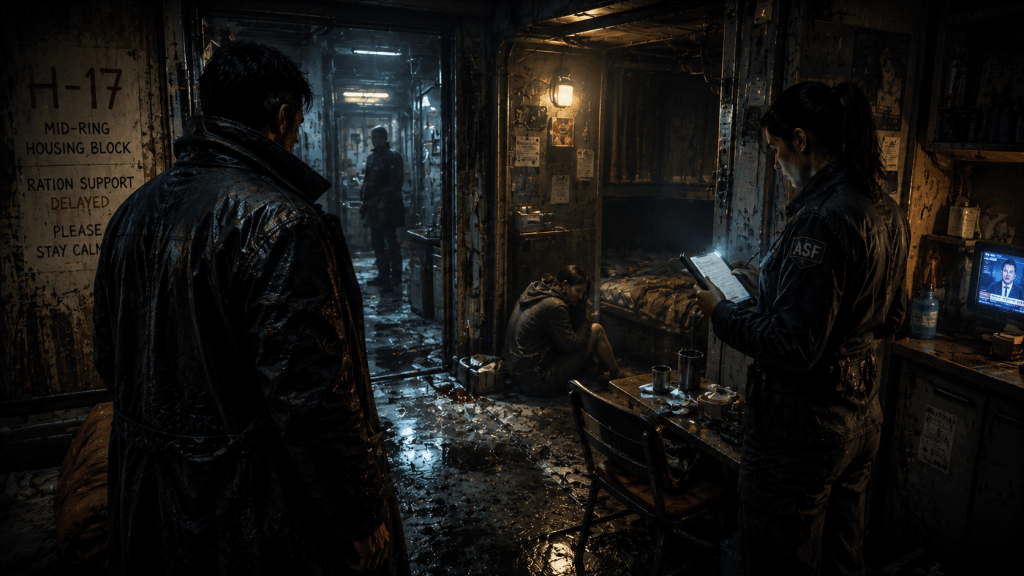
The mid-ring support corridors selected for the Expansion Project belonged to one of these transitional layers. These sections formed part of the station’s secondary structural network, designed to distribute load between the outer docking assemblies and the central habitation rings. While still active in a limited capacity, many of these corridors had undergone decades of incremental modification, resulting in a structural profile that differed in detail from the original construction schematics.

Fleet-approved expansion plans required several new structural frameworks to be anchored along these mid-ring junction points. The objective was to extend Ashfall’s cargo handling capacity while reinforcing stress-bearing segments of the station’s ageing superstructure. Integration of the new frameworks depended on accurate alignment with the existing load distribution grid, necessitating detailed engineering surveys of each proposed connection site prior to structural attachment.

During one such survey cycle, engineering teams assigned to a designated junction corridor reported inconsistencies between archived schematics and real-time structural scans. Initial mapping indicated that the corridor extended beyond its documented termination point, with internal geometry diverging from the station’s standard grid alignment. Sections of plating and subframe support appeared to follow an alternate structural orientation, suggesting modification outside recorded parameters.

Further inspection revealed that portions of the underlying framework could not be reconciled with any phase of construction listed within the station’s accessible engineering archives. The deviations presented as continuous structural elements rather than isolated damage or degradation, indicating that the corridor had either been reconfigured during an undocumented phase of development or preserved from an earlier configuration that had not been carried forward into modern records.

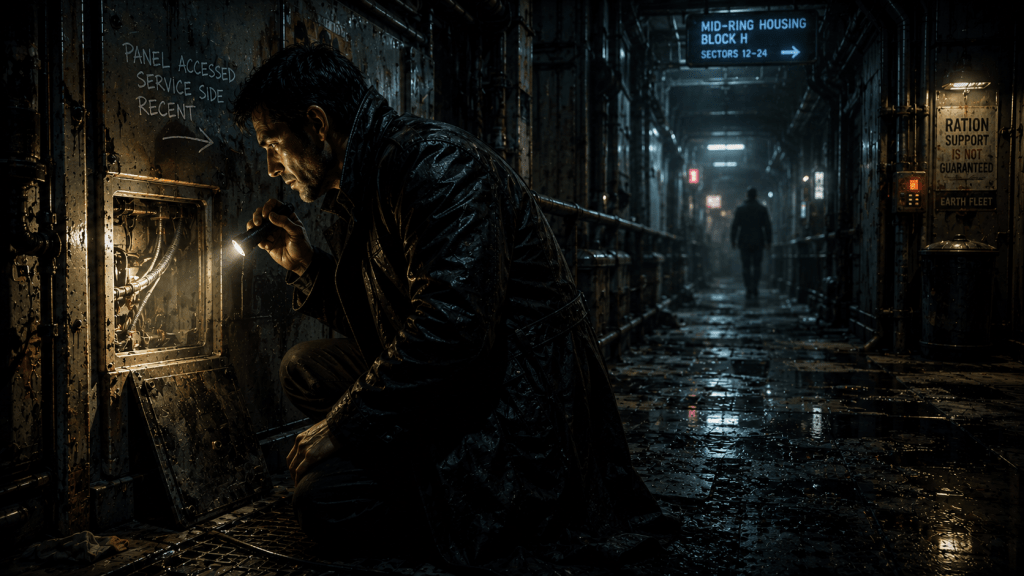
At a primary junction node within the surveyed section, engineers identified a sealed access panel embedded within the wall structure. The panel bore no identification markings and did not correspond to any registered access point within the station’s current infrastructure database. Surface analysis indicated that the panel had remained in place for an extended period, with no evidence of recent interaction or maintenance.

Manual contact with the panel during inspection produced reports of low-level vibrational activity within the surrounding structure. These readings were initially attributed to standard background operation within adjacent systems, though their regularity prompted further notation within the survey log. The source of the vibration could not be isolated through standard diagnostic procedures available to the engineering team at that time.

Following these findings, the engineering department submitted a request to delay structural integration at the affected junction point, pending further analysis. The presence of undocumented structural elements, combined with the discovery of a sealed access panel lacking registry reference, introduced variables that could not be accounted for within the original expansion parameters.

Archived records indicate that the request for extended survey and verification was transmitted through standard channels to Fleet infrastructure authorities shortly after the initial findings were logged. Integration procedures at the identified junction were subsequently placed under temporary suspension while awaiting further instruction.

No additional clarification regarding the structural discrepancies was appended to the public engineering archive for that cycle.


About the Creator

The Future Chronicle is written and curated by Simon Phillips, a writer of science fiction and speculative storytelling who explores the quiet edges of human expansion, where ageing stations, distant worlds, and forgotten technologies continue their slow existence beyond the reach of the central worlds.

Many of the stories presented in these Chronicles exist within a wider fictional universe that follows the lives of investigators, engineers, and frontier workers living far from the comfort of the inner systems, where the machinery of civilisation continues to function long after its original purpose has begun to fade.

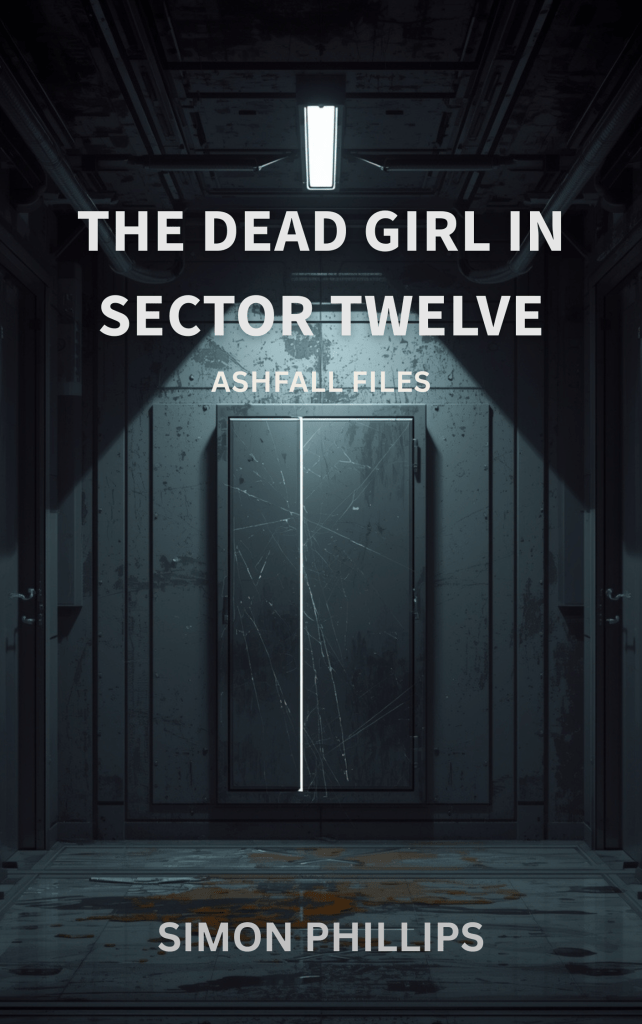
One such story unfolds aboard Ashfall Station, an ageing orbital installation whose corridors and industrial sectors form the setting for the science-fiction mystery novella Ashfall Station: The Dead Girl in Sector Twelve. What begins as a routine investigation gradually reveals that something hidden within the station’s structure may have been present for far longer than the official records suggest.

Readers who wish to explore the full investigation and its unfolding events can find the novella below.

Explore the book:
Ashfall Station: The Dead Girl in Sector Twelve

You can watch his YouTube channel here:
Author Simon Phillips


Continuing the Chronicle

The following Chronicle continues the reconstruction of the early expansion works carried out across Ashfall Station’s mid-ring support corridors, where engineering teams first began integrating new structural frameworks with sections of the station that had remained unchanged for decades.

At the time, the Expansion Project was recorded as a necessary reinforcement effort, intended to stabilise ageing infrastructure while extending the station’s cargo capacity across the Kestren system. Such work required frequent interaction with older structural layers, and it was not uncommon for engineering crews to encounter deviations between archived schematics and the station’s physical form. These irregularities were typically attributed to incremental modifications carried out during earlier phases of construction.

The survey conducted at the designated junction point revealed a more persistent inconsistency. Structural elements within the corridor followed an alignment that diverged from the station’s established grid, while underlying framework segments could not be traced to any documented phase of development within the accessible engineering archives. The discovery of a sealed access panel embedded within this section, absent from all modern records, suggested that portions of Ashfall’s deeper infrastructure had been altered, preserved, or removed from official documentation entirely.

Later examination of archived survey logs indicated that the findings recorded during this phase of the Expansion Project marked the first instance in which engineering teams encountered structural continuity that extended beyond the station’s recognised construction history.

Readers supporting The Future Chronicle can continue the record below.

Subscribe to continue reading

Subscribe to get access to the rest of this post and other subscriber-only content.

Egyptian Mythic Fantasy, Anubis, and the Burden of the Dead


Where the River Meets the Dead

The dead were never far from the living in The Forgotten Gods of the Drowned Kingdom. They pressed close through river stink, damp stone, old prayers, sealed doors, and the narrow spaces where poverty forced the living to touch what should have remained undisturbed. In this Egyptian mythic fantasy world, tombs were never simple ruins. They were sacred architecture, built around memory, judgement, passage, and the uneasy belief that the dead still had claims upon the world they had left behind.

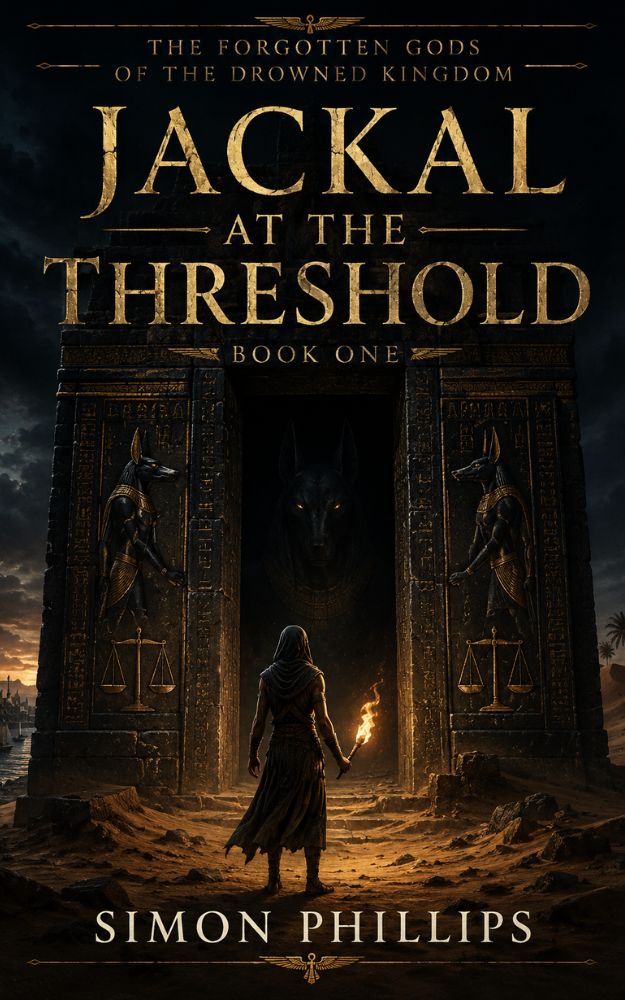
That closeness shaped Jackal at the Threshold, the first book in the series, before Anubis ever stepped fully into view. The story began in the river quarter, where Neris lived between hunger and guilt, between the need to keep her mother alive and the knowledge that her work among the dead had already cost too much. The noble terraces rose upriver in white stone, catching the last light of the day, while the slums below sank into shadow, smoke, mudbrick, and the rot lifted from the water by evening heat.

This is the root of the series. Egyptian mythology is not laid over the world as decoration. It is felt through burial practice, thresholds, funerary silence, jackal imagery, and the dreadful possibility that judgement may be waiting in places ordinary people have learned to rob, fear, or ignore. The gods do not begin as distant names from old stories. They begin as pressure in the stone, as warnings cut into doorways, as whispered talk of Anubis stirring when a boundary has been broken too often.


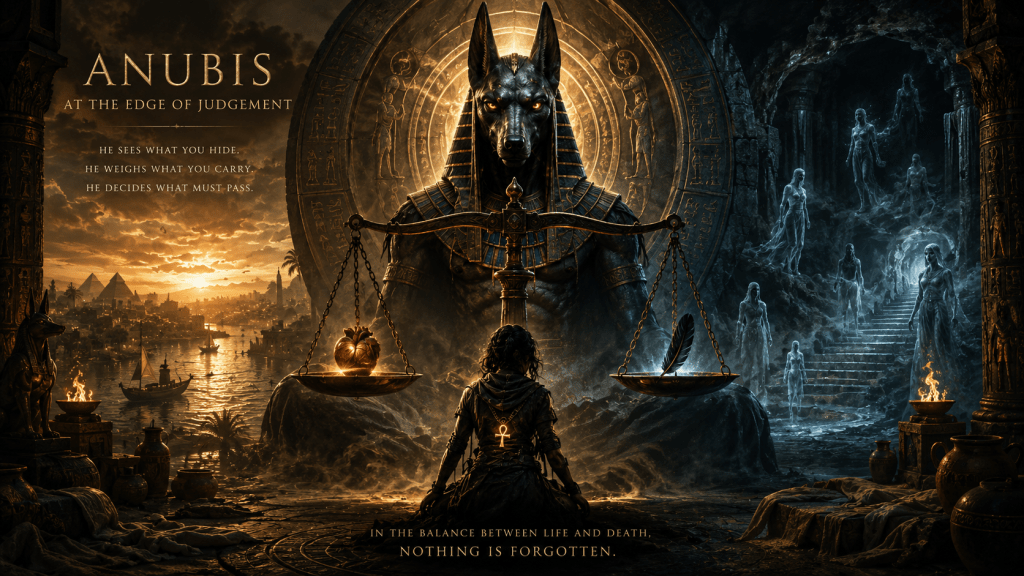
Anubis at the Edge of Judgement

Anubis belongs to thresholds. He stands at the edge between the living and the dead, between burial and desecration, between memory and judgement. In this dark mythological fantasy series, that role matters more than spectacle. He is not a generic shadow god, nor a simple patron offering power to a chosen hero. His presence is severe, patient, and bound to what has been done.

That is why Jackal at the Threshold begins with theft rather than battle. Neris is a tomb robber from the river slums, and her skill lies in stone, rope, darkness, narrow ledges, old mechanisms, and the ability to keep moving when fear should have stopped her. She steals from the dead because rent, food, medicine, and hunger have left little room for clean choices. Yet the story refuses to make survival into absolution. Poverty explains much. It does not erase everything.

Anubis enters through that tension. The western dunes uncover black stone after a storm. Workers enter and fail to return. Rumours move through the slums faster than certainty. A buried place, older than the known order of the city, waits beneath the sand. Neris goes because the world has trained her to see danger and value together. She knows the signs. She reads blood, abandoned tools, carvings, warnings, and silence. Still, need pulls harder.

When she crosses into the Drowned Kingdom, the tomb itself becomes an instrument of judgement. Jackals walk the walls. Scales wait in carved stillness. Hearts are shown in stone as if every secret has already been measured. The deeper Neris goes, the less the place feels like a tomb built for the dead alone. It becomes a boundary that remembers who has entered it, what they carried, and what they tried to leave unnamed.


Neris and the Cost of Survival

Neris is central because she is human before she is anything else. She is not a polished champion waiting for a divine weapon. She is a daughter, a thief, a survivor, and a woman shaped by a death she has never truly faced. Her brother’s collapse in a tomb shaft lies beneath every choice she makes. She saw the crack. She dismissed it. She sent him ahead. That single remembered moment gives the first book its deepest weight.

The power of this Egyptian mythology fantasy series comes from that kind of pressure. Divine judgement does not arrive in an empty life. It arrives where guilt has already made a home.

Neris’s mother keeps the story grounded in the mortal world. Her illness, the cost of healers, the bare room by the river, the careful division of four silvers between medicine, rent, and food all matter. These details prevent the mythic world from floating away into abstract gods and relics. Before Neris stands before Anubis, she stands before hunger. Before she touches the Threshold, she has already crossed moral boundaries in order to survive.

That makes her judgement more painful. Anubis does not condemn her simply because she is poor. He does not ignore the cruelty of a world where the dead are buried with gold while the living starve beside the river. Yet he draws her back to the moment where choice remained. The crack in the stone. The hurry. The brother who trusted her. The weight she carried and refused to name.

This is where the story changes. Neris returns the relic she came to steal. She confesses what she has hidden even from herself. Anubis marks her, and the burden he gives is no easy blessing. She will see when souls stray. She will hear unrest where others hear only night wind and water. What she disturbed will no longer pass unnoticed.


The Door Opened by Jackal at the Threshold

Jackal at the Threshold is the first entry in The Forgotten Gods of the Drowned Kingdom, and it works as a doorway rather than an explanation of the entire war. It brings the reader into a world of tombs, river-prayers, restless spirits, funerary dread, and divine attention without emptying the larger series of mystery.

The book belongs to Egyptian mythic fantasy because its supernatural force rises from recognisable sacred ground. The Drowned Kingdom is not simply an ancient ruin with treasure inside. It is a necropolis of judgement, silence, and unfinished passage. Its walls are carved with jackals, scales, hearts, stars, drowned kings, and warnings left by those who understood too late that the dead are not abandoned things.

The experience of entering the book is intimate rather than grand. The reader follows Neris through the alleys, the heat, the old smoke of her home, the desert road, and finally into cold black stone. Every movement carries the body with it: sand under sandals, torchlight bending across carved walls, breath misting in impossible cold, fingers testing ledges, muscles straining against fear. This is not a clean chosen-one adventure. It is a story about what happens when someone desperate crosses into death’s territory and is allowed to return.

By the end, Neris has stopped being merely a thief of the dead, yet she has not become safe, powerful, or fully informed. She believes she has become a bridge between the living and the dead. She has no understanding yet of the full hidden god-war moving beneath the surface of the world. That ignorance is essential. The first book closes with a woman changed by judgement, walking back into the same poor streets, with the same hunger still waiting, and a new awareness of the dead moving around her.


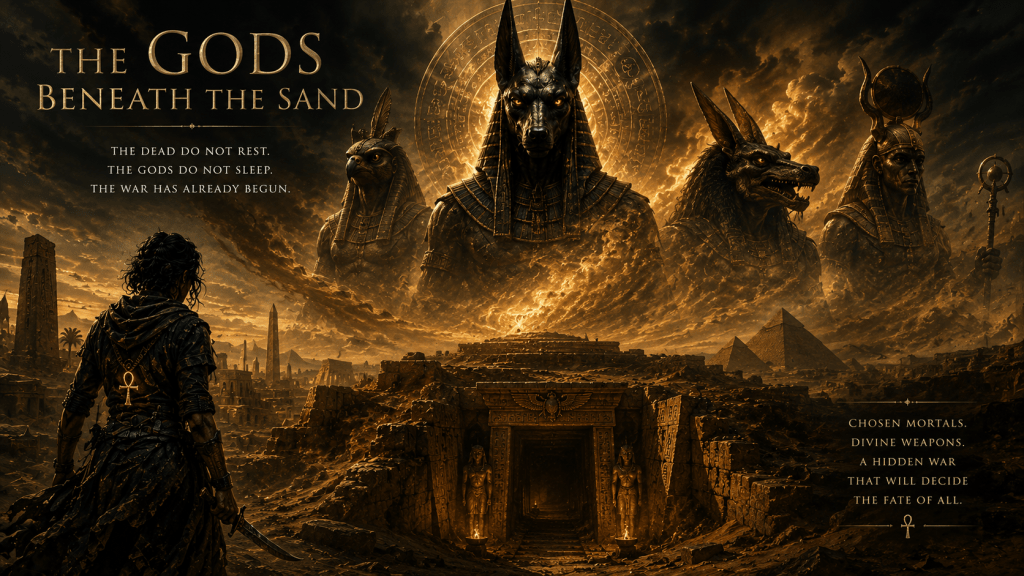
The Gods Beneath the Sand

The wider series will open slowly from that first burden. The Egyptian gods do not begin by shattering the sky. Their war begins through sacred wrongness. Burial routes falter. Souls fail to pass cleanly. Tombs open when they should remain sealed. Relics wake. Human beings are chosen, armed, watched, and used.

This is the hidden engine of The Forgotten Gods of the Drowned Kingdom. The gods avoid open war because such conflict would devastate the mortal world. Instead, they act through chosen humans bound to divine weapons. The weapon carries the force first. The human bearer becomes dangerous only through endurance, discipline, survival, and cost.

That rule keeps the series grounded. Neris does not rise because she has been handed effortless power. Her first Anubis-linked weapon is intimate, funerary, close-range, and judgement-bound. It belongs to tombs and thresholds, not battlefield spectacle. Its danger comes from what it is tied to: burial order, false return, broken passage, and the dead who have failed to rest.

Other gods wait beyond the first threshold. Set moves through disorder, desert violence, destabilisation, and predatory pressure. Thoth brings record, reckoning, hidden knowledge, and an intelligence that can be as dangerous as any blade. Neith carries ancient discipline, strategy, and martial severity. Horus represents visible legitimacy, kingship, and ordered force. Ra remains the remote solar authority whose weight shapes the divine hierarchy even before he steps forward.

Yet the series must always return to Neris. Gods may shift the board, but human lives carry the cost. The river slums, Hamat’s warnings, her mother’s illness, the memory of her brother, and the quiet work of guiding unsettled souls remain as important as any relic duel or divine decree. Without those things, the war would become spectacle. With them, it remains sacred, dangerous, and painfully human.


What Waits Beyond the Threshold

The first book leaves its deepest questions unanswered because the world has only begun to move. Neris has crossed the Threshold. Anubis has marked her. The dead now call to her when their passage fails. Somewhere beyond the city, old stone shifts beneath the sand, and attention stirs in places she cannot yet name.

That is the shape of the series promise. A grave thief has been pulled into the service of judgement, yet the judgement of gods may prove no cleaner than the lives they weigh. Divine weapons will appear as burdens rather than gifts. Chosen humans will discover that being claimed by a god can mean being protected, used, lied to, or sacrificed. The dead will not always pass cleanly, and the living will not always understand who has broken the route.

In this world, tombs are not background scenery. They are pressure points between the living and the dead. The river is not merely water. It is memory, passage, rot, need, and prayer. Anubis is not a symbol printed on the surface of a fantasy setting. He is first felt through the silence before judgement, the dark edge of a doorway, the unseen weight of a heart, and the terrible mercy of being sent back changed.

The war has already begun, though Neris does not yet understand its shape.

She has only heard the dead.

The gods will come later.

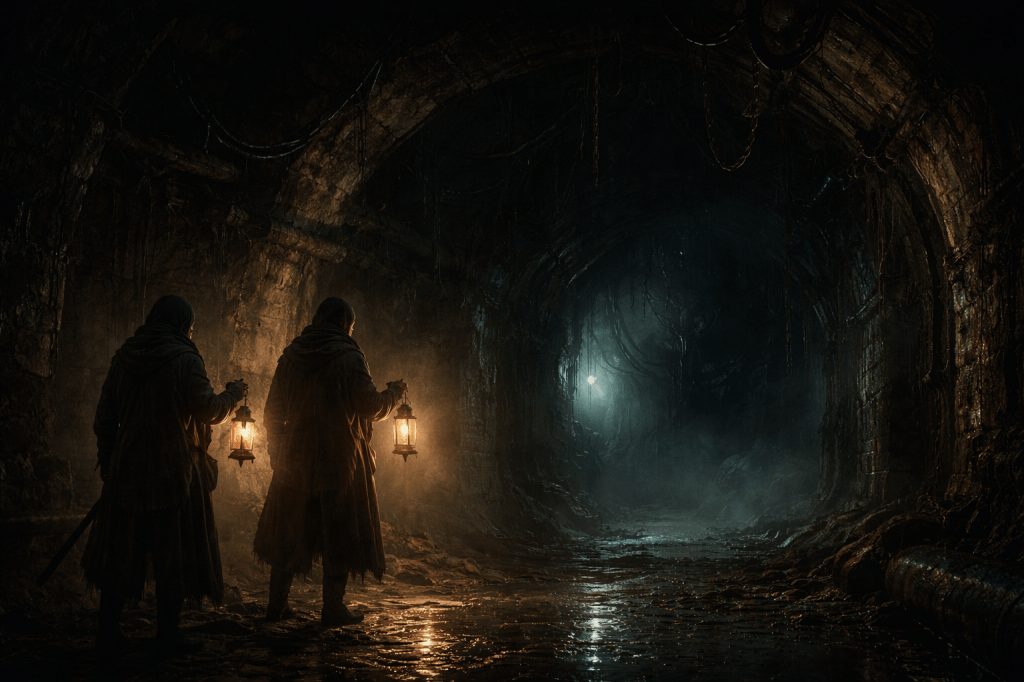
The Mythic Chronicle: The Thing That Answered

A record of sound within the tunnels that did not echo, though returned in answer to those who entered


The Passage That Answered

The passage had been entered in the record as a maintenance route, one of several that lay beneath the district and carried no distinction beyond their function. It formed part of an older network that predated the present structures, its course set through stone that had been opened and closed across successive years, though no single plan held its full extent. Those who worked along its length regarded it as ordinary ground, a place where sound travelled poorly and light settled close to the source, leaving the far sections to gather in shadow without depth or clear boundary.

On the morning it was first noted, two men were assigned to inspect a section where damp had been reported along the lower walls, the matter entered as a minor concern within the broader maintenance schedule. They carried a single lamp between them and a length of chalk for marking the points where repair would be required, moving at an unhurried pace through the narrow turn that led into the passage. Their attention was given more to the condition of the stone beneath their hands than to the space ahead of them.

“It ran further than the last plan showed,” the first said after a time, his voice held low as though the walls pressed it back upon him. “The turn should have come by now.”

The second lifted the lamp and let its light fall along the length of the corridor, where the walls drew in slightly before widening again, the line continuing without interruption. “The plans seldom match the ground,” he replied. “They follow what was set when the surface above was taken. This would have been left from earlier work.”

They continued on, marking the points where the stone showed signs of strain, their chalk passing in brief strokes across the surface before they moved on. The air held steady around them, cool and close, carrying a faint weight that settled after each step and returned to its place once they had passed, as though the space retained the shape of their movement before allowing it to fall away.

“It carried differently here,” the first said, pausing near a narrowing in the wall where the stone pressed inward. He rested his hand against the surface and held it there for a moment. “The sound sits lower.”

The second glanced back. “You hear your own step in these places,” he said. “It comes back from the turns.”

The first did not answer at once. He stepped forward and struck the wall lightly with the base of his tool, listening as the sound travelled into the stone and returned in a dull, contained form that held no echo beyond its point of contact. He struck it again, closer to the narrowing, and the sound carried further along the passage before settling.

“That was not the same return,” he said.

The second man set the lamp upon a ledge in the wall and leaned in to listen, his head angled slightly as he followed the path of the sound. “It carries along the length,” he said after a moment. “The wall opens beyond this point.”

The first struck the surface once more, this time with greater force. The sound travelled ahead of them and held for a moment before falling back. Within that brief space between the strike and its return there came a second sound, softer and set further along the passage, as though something within the stone had taken up the motion and given it back again in altered form.

They remained still.

“Did you hear that?” the first said.

The second did not reply at once. He lifted the lamp and stepped forward, holding the light out so that it reached further into the passage, though it revealed nothing beyond the same narrow stretch of stone. “Strike it again,” he said.

The first man did so, placing the tool against the wall and driving it forward with a measured blow. The sound carried ahead, clear and contained, and again there followed that second return, set apart from the first and delayed by a breath, its tone altered in a way that did not follow the shape of the corridor.

“It answers,” the first said quietly.

“It returns,” the second replied, though his voice held less certainty than before.

They moved forward together, their steps slower now, their attention drawn ahead of them where the light fell short. The air shifted as they advanced, the weight within it gathering slightly and then easing again, so that each movement seemed to meet a faint resistance before passing through.

The second man raised the lamp higher. “There is a junction ahead,” he said, though the light revealed no such division. “You can hear where the space opens.”

The first listened, though he could not mark the point where the corridor changed, only that the sound ahead carried a depth that had not been present before. He struck the wall once more, this time at the height of his shoulder. The sound travelled forward and returned, followed by that second response, closer now and more clearly set within the space beyond their sight.

“It came back to meet the sound,” he said.

The second man turned slightly, his gaze moving along the walls as though he might locate the source within them. “It follows the line,” he said. “There are channels set behind these sections. The sound carries through them.”

The first stepped closer to the narrowing and placed his ear against the stone. The surface held a faint coolness that stood apart from the air, and beneath that there lay a low vibration that did not align with the movement of their steps.

“Strike it again,” he said.

The second man hesitated, then did as asked, the tool striking the wall with a firm, controlled motion. The sound travelled into the passage, and for a moment it seemed to fade as before, though instead of settling it returned in two parts. The first followed the path already known, and the second emerged with a clearer shape, as though the sound had been taken up and set again with intent.

The first man drew back from the wall. “That is no echo,” he said.

The second lifted the lamp and held it steady, his hand tightening slightly around its handle. “There is no space ahead large enough to hold such a return,” he said. “It would show in the plans.”

The first gave a small nod. “Then it does not follow the plans.”

They stood in silence for a time, the lamp flame held steady between them, its light pressed close by the walls. The air gathered around their movement and settled again, and within that settling there remained a faint impression of the second sound, as though it had not fully passed from the space.

“We will mark this section,” the second said at last, though his voice carried the tone of a decision made to conclude the matter rather than to resolve it. He took up the chalk and set a small line upon the wall where the narrowing began. “It will be entered for further inspection.”

The first watched him for a moment, then turned back to the passage ahead. “Strike it once more,” he said.

The second man did so, though with less force than before, and the sound travelled forward and returned, followed by that second response, closer still and set at a height that did not align with the strike that had preceded it.

The first man spoke then, his voice held low within the space. “Who carries there?” he said.

The words settled into the passage and moved along it, their shape breaking slightly against the stone before returning, thinner and drawn out by the distance. For a moment there came no further sound, and the air held still around them.

Then, from further along the passage, there came a reply.

It did not take the form of words, though it followed the rhythm of speech, a low shaping of sound that rose and fell within the space ahead, carrying the same pattern as the voice that had preceded it, though altered in tone and set within a narrower range, as though it had been drawn through the stone before being returned.

The second man stepped back at once, his shoulder striking the wall as he turned. “There is someone ahead,” he said.

The first did not move. He stood where he was, his gaze fixed upon the darkness beyond the reach of the lamp. “No light shows,” he said.

“It could be set beyond the turn.”

“There is no turn marked here.”

The second lifted the lamp and held it higher, though the light fell short as before. “Call again,” he said.

The first man hesitated, then spoke once more. “Who stands there?” he said.

The words travelled forward and broke against the space, returning in their first form, and then again in that altered shape. The second sound followed with a delay that held too long to belong to the length of the passage.

The reply came again, closer now and with a clearer structure, though still without form that could be understood, its pattern aligned with the call that had preceded it and set within the same measure of sound.

The second man lowered the lamp slightly. “It repeats,” he said.

The first gave a small nod. “It answers,” he replied.

They did not advance further. The passage held before them, unchanged in its form, though altered in the manner in which it carried sound. The air settled around them once more, though it did not return to the same stillness it had held before their arrival.

“We will return this to the register,” the second said, his voice steadier now that the decision had been made. “It will be marked for survey.”

The first turned at last, though his gaze lingered for a moment upon the darkness ahead. “Mark it as you will,” he said. “It remains where it stands.”

They withdrew along the passage, their steps measured and their voices held low. The sound of their movement travelled behind them, returning in its usual form, though once, before they reached the turn, there came again that second response, faint and set at a distance that did not follow their retreat.

When they emerged into the broader corridor, the air shifted at once, the weight lifting from it as the space opened around them. The sound of their steps returned to its earlier pattern, carrying no second voice beyond their own.

The section was entered within the record as a matter requiring further inspection. The description held to the language of structure, referring to irregular sound return within a confined passage and noting the possibility of unseen channels within the stone. No mention was made of the reply that followed the call, and the matter was set within the register without expansion, its condition accepted within the limits of the space in which it had been observed.

The passage remained open for a time, and those who passed along it recorded no further irregularity, though one note referred to a moment in which a tool struck the wall and the sound returned with a delay that exceeded the expected length of the corridor, a detail entered without further comment.

The section was closed again following later works carried out along the adjoining structures, and the entrance was sealed in accordance with standard practice, its location marked only within the internal plans and its condition listed as stable.

No further reference appears within the primary record.

In later accounts, drawn from separate hands and gathered after the works had passed, there are brief mentions of sound within the lower passages that followed the shape of those who entered, returning in altered form and carrying the pattern of their movement ahead of them. These entries remain unconnected within the record and are set apart from the earlier inspection, their origin left without confirmation.

The passage holds its place beneath the district, its line set within the stone as it was before it was opened, and within it the air continues to gather and settle after each disturbance, returning to its earlier state. The sound within that space does not always follow the path it is given, and where it is carried forward it may return in a form that does not belong to the strike that set it in


Foundation Register: Lower Passage Acoustic Record

The passage entered within the lower district plans appears as part of a continuous substructure extending beneath adjoining properties, its course recorded across successive revisions with minor variation in length and alignment. Earlier entries refer to the corridor in practical terms, noting its function as a service route and its condition as stable, despite signs of prior sealing at several points along its length.

During routine inspection following reports of damp within adjacent structures, the passage was reopened for assessment, and initial observations were entered without distinction, referring to surface wear, minor shifts within the stone, and the need for limited reinforcement along sections where the wall had drawn inward. These entries hold to the language of maintenance and record no condition beyond those expected within enclosed substructures of this age.

Subsequent notes record irregularities in the behaviour of sound within the corridor, where impacts against the wall were observed to return in a manner that did not align with the known dimensions of the passage. Early descriptions refer to this as extended resonance, though later entries distinguish between the initial return and a secondary response set apart from it by a measurable delay.

In several accounts, the secondary sound is described as carrying the form of the original strike while failing to match its placement within the corridor, appearing instead at a distance inconsistent with the recorded length of the space. These observations are entered cautiously, with later revisions attributing the effect to concealed channels within the stone or to variations in the structure behind the visible surface.

A number of entries refer to instances in which spoken words were followed by a return that preserved elements of the original phrasing, though altered in tone and drawn through the structure before being heard. These notes remain limited in detail and are not expanded within the primary record, with several later annotations omitting reference to vocal response entirely.

Further examination records that the behaviour appeared more pronounced within sections where the passage narrowed or where the wall showed evidence of prior disturbance, though no consistent point of origin was identified. In these areas, sound is described as holding briefly within the space before returning in two parts. The second is set apart from the first by both timing and form.

The phenomenon was attributed to structural variation within the corridor and to the presence of voids or channels set beyond the visible surface, and no further inquiry was undertaken. The passage remained open for a limited period following inspection, during which additional observations were entered in reduced form, noting irregular sound return without elaboration.

A marginal notation, written in a later hand, refers to the behaviour as “a return that follows the voice rather than the wall”, a phrase set apart from the primary entry and left without further explanation. The notation appears once and is not repeated elsewhere within the register.

Final entries indicate that the passage was sealed following completion of adjacent works, and its condition was listed as stable within the internal plans. The acoustic irregularities were recorded as resolved through closure of the space, and no further observation was entered following its sealing.

The matter was entered as concluded within the register, and the passage remains recorded as a contained structure beneath the district, its condition accepted within the limits assigned to it and requiring no further attention.


About the Creator

The Mythic Chronicle is written and curated by Simon Phillips, a writer of mythic and speculative fantasy whose work explores the quieter edges of forgotten worlds, where buried structures, fractured records, and lingering presences continue beneath the surface of recorded history.

The accounts preserved within these Chronicles form part of a wider body of work in which cities stand upon older foundations, and events recorded as isolated disturbances are understood, in later tellings, to belong to patterns that were never fully recognised at the time.

One such account survives in a separate record, detailing an incident within a lower district where a death was first dismissed as excess, though the space in which it occurred retained a presence that resisted clearing, and where investigation revealed signs that the disturbance had not been confined to a single room.

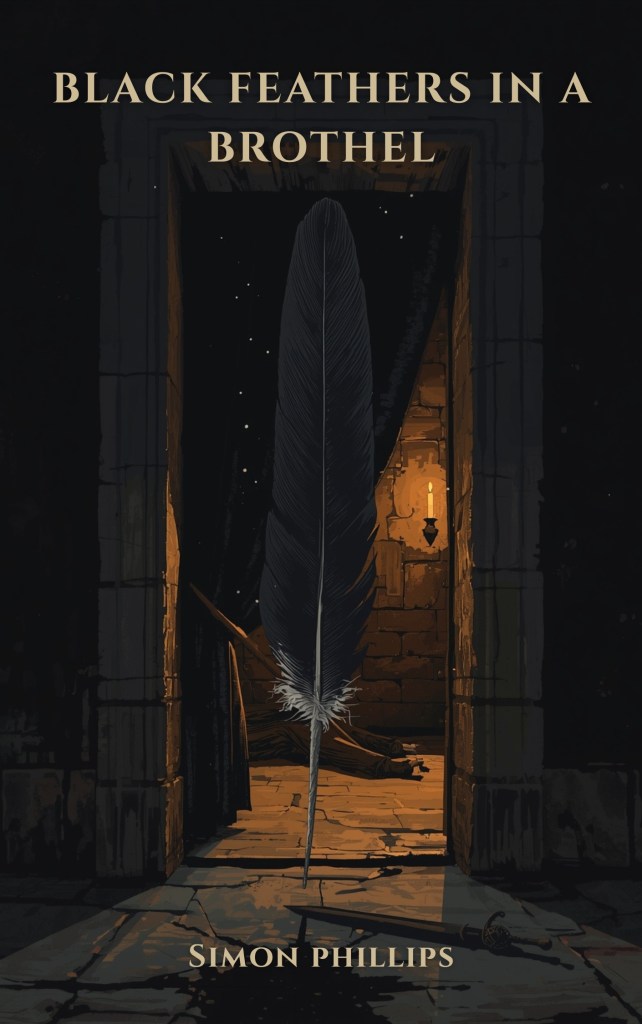
This record is preserved in the novella Black Feathers in a Brothel, where the events surrounding that incident are followed more closely, though even there the full nature of what lay beneath the structure remains uncertain.

Readers who wish to examine that account in its fuller form may find the record below.

Explore the book:
Black Feathers in a Brothel

You can watch his YouTube channel here:
Author Simon Phillips


Continuation of the Record

What follows is drawn from later entries concerning the passage beneath the district, where sound was first noted to return in irregular form during routine inspection. Initial accounts record the behaviour in practical terms and attribute it to variation within the structure, though subsequent notes refer to repeated instances in which impact and voice were returned in altered form. Each occurrence is entered briefly and left without further inquiry. In several cases, the response is described as following the shape of the sound set into the space, though no source is identified within the passage itself. Each record concludes with the condition accepted within the limits assigned to it.

Subscribe to continue reading

Subscribe to get access to the rest of this post and other subscriber-only content.

Prince Patrick: The Reluctant Heir of Bremyra

In The Unmarked Path, the first book of The Veil of Kings and Gods, Prince Patrick begins in a place of uneasy authority.

He is not introduced as a king in waiting, nor as a prince hungry for power. He is third in line to Bremyra’s throne, shaped by tutors, court duties, and the quiet expectation that others would stand before him when history made its demands. His father, King Cedric, carried the crown. His elder brothers, Aric and Aiden, carried the future.

Patrick was meant to serve beside them, to advise, to support, to understand the workings of power without being forced to become its centre.

Their absence changes everything.

With the King and the twin princes gone beyond the familiar borders of the realm, Patrick is left at a desk that still feels like his father’s, answering petitions beneath banners that seem to remember stronger hands. The kingdom has not stopped to mourn their silence. Bremyra still requires judgement, diplomacy, restraint, and command. Each sealed letter and whispered report draws him deeper into a role he never sought, while the court watches to see whether the third son can hold steady beneath the weight of a crown that has not yet been placed upon his head.


A Prince Left at His Father’s Desk

Patrick’s first appearance places him at his father’s desk, surrounded by court proceedings, petitions, diplomatic letters, and the ordinary machinery of rule. The scene is quiet, yet it carries pressure from the beginning. Bremyra has not collapsed. The castle still functions. Servants still move through its halls, guards still hold their posts, and the court still expects decisions.

That is what makes Patrick’s position so difficult.

There is no grand ceremony announcing that power has shifted. There is no clean moment where he chooses the burden. Instead, responsibility gathers around him slowly, page by page, seal by seal, until the absence of his father becomes its own form of command.

The desk itself matters. It is more than furniture in this scene. It is the place where King Cedric once shaped the movement of the kingdom, where treaties were read, roads considered, disputes answered, and royal judgement turned into law. For Patrick, sitting there is not an act of possession. It is an intrusion into a space that still belongs to someone else.

Every object around him reminds him of that. The papers waiting for his seal, the chair beside him, the formal language of court proceedings, even the silence of the room all point towards the same truth. Bremyra has continued, but it has continued around an absence.

King Cedric and the twin princes have been gone too long. Their expedition beyond the known reaches of the old empire has fallen into silence, and the court cannot live on hope alone. Patrick feels that silence every time he sits in the chair that should not yet belong to him.

This is where his burden begins. Not on a battlefield. Not before cheering banners. Not with a crown lowered onto his head.

It begins in paperwork, in waiting, and in the uneasy knowledge that a kingdom still needs ruling even when the rightful voices have gone quiet.


Patrick is trained, intelligent, and capable, yet capability is not the same as certainty.

He understands statecraft. He understands alliances. He understands that kingdoms survive through careful balances rather than noble feeling alone. His education has prepared him to read treaties, weigh counsel, manage factions, and recognise the danger hidden inside polite words. Yet Book 1 catches him at the moment where knowledge begins to harden into lived responsibility.

Bremyra is not waiting for him to feel ready.

Arvendral stirs with uncertain intentions, offering the language of peace while its movements suggest something more cautious and dangerous. Vaeldring becomes vital through Elana’s arranged marriage, turning his sister’s future into part of Bremyra’s political survival. Thalosia presses its own designs upon Patrick’s future, reminding him that even his personal life is no longer fully his own.

Every alliance has a cost, and every delay invites danger.

Patrick must decide while still grieving absence. He must govern while wondering whether his father and brothers will return. He must listen to advisers who expect steadiness from him, even as he feels the shape of his own inexperience beneath every command. The court sees a prince at the centre of power, but Patrick feels the empty spaces around him more sharply than the authority in his hands.

He is forced to think not as a younger son waiting behind the true heirs, but as the man currently holding the centre of the realm together.

This is the quiet tragedy of his opening arc. He has inherited pressure without inheriting clarity, and the kingdom has begun asking him for the certainty that no one has given him.


Elana and the Human Cost of Royal Duty

Patrick’s bond with Princess Elana gives his story its human warmth.

Their conversations carry the ease of siblings who have known one another beyond titles, ceremony, and court expectation. Elana does not look at Patrick only as the acting ruler of Bremyra. She sees the brother beneath the office, the young man sitting at their father’s desk before he has fully learned how to bear its weight. Patrick, in turn, sees more in Elana than the court allows. She is not merely a princess to be sent towards Vaeldring, nor a name placed into marriage negotiations. She is his sister, perceptive, spirited, and quietly braver than many of the men who speak around her.

That makes her departure harder.

Her marriage to Vaeldring is not treated as decoration. It is political architecture. Through her, Bremyra reaches towards stability, alliance, and protection at a time when the kingdom cannot afford isolation. Through Patrick, the same pressure appears in another form, as Thalosia looks towards him as a future husband and political partner. Their lives are being shaped into bridges between realms, and those bridges are built from obedience, silence, and sacrifice.

For Patrick, Elana’s journey is both necessary and painful. He understands why she must go, yet understanding does not soften the loss. Her absence removes one of the few voices able to speak to him honestly, one of the few people who can meet his burden without turning it into performance.

Both siblings are being moved by the needs of the realm.

Neither is truly free.


Bremyra Beneath Strain

Book 1 presents Bremyra as a kingdom still standing, yet already under pressure from several directions.

The danger is not simple. It does not arrive through one army at the gate or one enemy declaring war. Instead, it comes through rumours, border tension, court unease, foreign movement, and unanswered questions. Patrick must govern inside that uncertainty.

The court watches him. The Church measures the arrival of the Order. The nobles depend upon him while also studying his weakness. Every decision he makes is made beneath the shadow of men who are absent and institutions that remain powerful.

Patrick’s strength in Book 1 is not certainty. It is endurance. He keeps sitting at the desk. He keeps answering. He keeps listening. He keeps choosing, even when every choice feels incomplete.


The Arrival of Simion

The arrival of Simion changes the shape of Patrick’s burden.

Until that point, Patrick’s problems, however heavy, still belong to the visible world of rule: letters, borders, marriages, missing family, restless neighbours, and a court that expects him to answer before he feels ready. Simion brings something different into Bremyra. He brings the Order with him, and the Order is not simply another political body waiting to be managed.

To the court, Simion is a magician, and that alone is enough to unsettle the air inside the castle. The Order does not stand beneath a crown in the way soldiers, servants, and councillors do. It carries older authority, colder memory, and laws of its own. Its presence reminds Bremyra that there are powers in Ældorra which do not bend easily to royal command.

Patrick senses this immediately.

He wants plain answers, yet Simion does not offer them. The magician speaks with restraint, carries himself with controlled distance, and seems to move through Bremyra as both guest and investigator. He has returned to a place he once knew, yet he does not belong to it in any simple way. That makes him difficult for Patrick to read. Simion is familiar and foreign at once, tied to childhood memory through Elana, yet shaped by an institution Patrick cannot fully trust.

His presence stirs different fears in different people. Elana remembers the boy from the kitchens and sees something human beneath the robes. The Church sees the shadow of the Order and answers with suspicion. Patrick stands between both responses, aware that Simion may be dangerous, useful, wounded, or all three at once.

That uncertainty matters.

Patrick is not naïve enough to dismiss the threat a magician might pose, but neither is he foolish enough to ignore what Simion represents. Bremyra’s dangers are widening beyond ordinary court business. Foreign attackers have begun to move where they should not. The silence surrounding King Cedric’s expedition has grown harder to explain. The old world, once safely buried in books and ruins, seems to be pressing closer to the present.

In that atmosphere, Simion becomes more than an unsettling arrival.

He becomes a question Patrick cannot afford to put aside.

That tension becomes one of the important relationships in Book 1. Patrick cannot fully trust Simion, but he cannot ignore him either. He needs answers, yet the man most likely to find them carries secrets of his own. The prince and the magician stand on opposite sides of old authority, crown and Order, yet both are being drawn towards the same gathering storm.

For Patrick, accepting Simion’s presence is not an act of comfort.

It is an act of necessity.


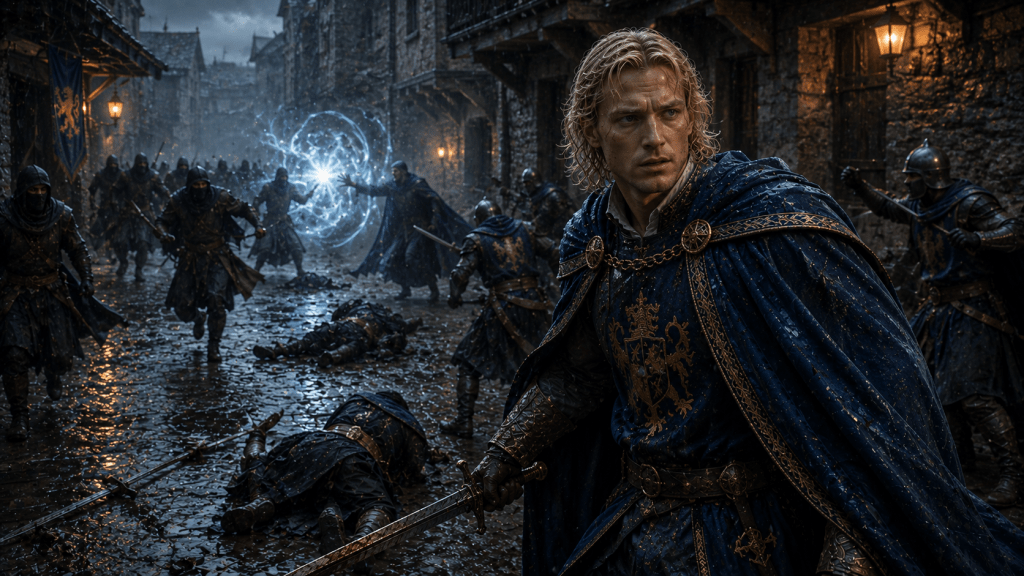
Patrick’s understanding of power changes during the ambush in Bremyra.

Until that moment, magic can still be kept at a distance. It belongs to the Order, to old stories, to political caution, and to the fear other people carry when a magician walks through the room. Patrick can study it as a matter of court risk. He can weigh Simion’s presence as a political complication. He can listen to the Church’s distrust and the council’s unease while still treating magic as something held beyond the ordinary shape of his duties.

Then foreign attackers strike inside Patrick’s own city, and all distance vanishes.

The attack is brutal, immediate, and personal. Patrick is no longer dealing with reports, rumours, or border movement. He is facing steel, strength, and death at close range, with the guards around him struggling to contain a threat that should never have reached him. The street becomes a place of sudden exposure. The prince who has spent his days behind desks, councils, letters, and guarded ceremony is forced into the raw truth of violence.

When Simion intervenes, Patrick sees magic not as theory, but as force.

There is no courtly veil around it. No ancient language softened by distance. No comfortable illusion that such power belongs safely inside the boundaries of the Order. Simion acts with speed and precision, and the world around Patrick changes in the space of a breath. The magician does not merely assist. He alters the outcome entirely.

It saves Patrick’s life.

It also unsettles him.

That is what makes the moment important. Patrick is grateful, yet he is too perceptive to be simple in his gratitude. He understands that the same power which protected him could terrify a court, silence a street, or reshape the balance between crown and Order if misused. He has seen something no council report could fully prepare him for: a man standing beside him who carries a kind of authority no prince can command in the ordinary way.

Patrick does not respond like a fool. He does not dismiss what he has seen, nor does he surrender blindly to it. He recognises the truth placed before him. Bremyra’s troubles may reach beyond ordinary politics, and Simion’s strength may be part of whatever answer the kingdom needs.

From there, Patrick’s relationship with Simion shifts. Gratitude enters the space between them. So does caution. So does necessity.

Patrick may not yet understand what Simion truly is, but he understands this much: Bremyra has stepped onto ground where steel, law, and royal blood may no longer be enough.


The Crown Begins Before the Coronation

Patrick’s arc in The Unmarked Path is not about becoming king in name. It is about the crown beginning to shape him before he is ready to wear it.

He is still a prince. He is still waiting for news of his father. He is still measuring himself against brothers who were meant to stand ahead of him. Aric and Aiden carry the image of succession more naturally in Patrick’s mind, while King Cedric remains the figure whose judgement should steady the realm. Yet their absence leaves no living hand between Patrick and the demands of Bremyra.

That absence becomes a kind of pressure.

Every petition placed before him reminds him that the kingdom cannot pause. Every council meeting asks him to speak with a confidence he does not fully feel. Every border report, marriage negotiation, and whisper from the court presses him closer to the shape of rule. He is not crowned, yet already he is being tested by the crown’s demands.

That is where his story gains its weight.

Patrick does not have Simion’s magic. He does not have Týrnan’s warrior certainty. He does not carry Elana’s hidden brilliance in the same way. His burden is different. He must stand in rooms where everyone wants something. He must listen to soldiers, priests, councillors, nobles, and foreign powers, knowing that each voice carries its own fear, ambition, or concealed truth.

He must make choices with incomplete knowledge. He must protect a kingdom that may already be part of a much older conflict. He must learn that leadership is not always a matter of bold speeches or battlefield glory, but of remaining steady while the world quietly removes every certainty around him.

Patrick’s strength in Book 1 is not triumph. It is endurance under scrutiny. He continues to sit at the desk, answer the summons, weigh the reports, and hold the centre while forces greater than one prince begin to move around Bremyra.


Why Patrick Matters in Book 1

Patrick matters because he gives the opening story its political heart.

Through him, Bremyra becomes more than a backdrop. It becomes a living kingdom, full of fragile alliances, absent rulers, cautious advisers, religious authority, old loyalties, and roads that no longer feel safe. His chapters show what happens when ancient danger begins pressing against ordinary governance, not through prophecy alone, but through letters, councils, rumours, borders, and the silence left by those who should have returned.

He stands between the personal and the political. Elana’s future is not only his sister’s sorrow, but part of Bremyra’s survival. Simion’s arrival is not only the return of a childhood memory, but a threat to the balance between crown, Church, and Order. Every private fear Patrick carries is mirrored by a public consequence waiting beyond the chamber door.

The wider world may be turning towards magic, invasion, and divine memory, but Patrick’s struggle remains deeply human.

He is tired.

He is uncertain.

He is watched.

And still, he must rule.


The Reluctant Heir

By the end of Book 1, Patrick has not solved Bremyra’s troubles. He has not uncovered the full truth of the foreign attackers, his father’s disappearance, or the strange forces gathering around Simion. What he has done is survive the first testing of his authority, and that survival matters.

He has seen that danger can reach him inside his own city, slipping through streets he believed protected by law, guard, and stone.

He has seen that Simion’s power may alter the fate of Bremyra, not as distant legend or court rumour, but as a force standing beside him when steel comes too close.

He has seen that Elana’s path is far more fragile than politics allowed him to believe, and that royal duty cannot always protect those it claims to serve.

Most of all, Patrick has begun to understand that rulership does not arrive with certainty. It arrives through pressure, through fear carefully hidden, through decisions made before every answer is known. His father’s chair remains too large for him, yet the kingdom has already begun looking to him as though he belongs there.

The crown is not waiting politely in the future.

It is already pressing its weight into his hands.

The Unmarked Path begins the first movement of The Veil of Kings and Gods, a fantasy series of political pressure, ancient magic, divine silence, and the people caught at the edge of forces older than kingdoms.

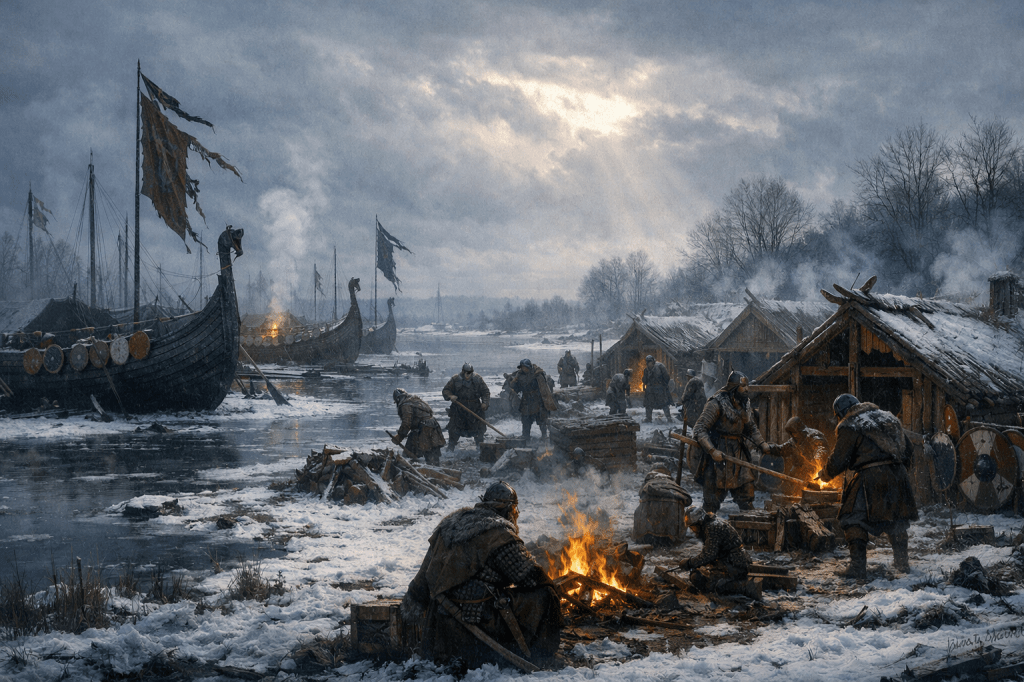
The Forgotten Chronicle: The Winter of the Vikings

When Norse raiders stopped returning home and began claiming the rivers and lands of England for themselves.


The Kingdom That Had Begun to Fracture

Winter settled slowly across the river valley. Frost clung to the reeds along the banks, and thin ice formed where the slow water touched the earth. A pale sky hung above the fields while smoke drifted in quiet threads across the cold morning air. Along the frozen shoreline a line of longships rested where autumn tides had left them, their dark hulls pulled high upon the bank, prows carved in the shapes of beasts that watched the empty countryside beyond. Shields hung along the sides of the vessels, their colours dulled beneath frost and travel. Around them moved men wrapped in wool and fur, their breath rising in the cold while axes struck timber and small fires burned among the ships.

The sound of labour carried across the valley. Trees fell along the riverbank, and heavy trunks were dragged across the frozen ground where rough walls began to take shape. Timber frames rose slowly between the ships while sod and straw gathered upon their roofs against the wind that swept across the open land. What began as a landing place for raiders had already begun to change its shape with the passing of the weeks. The ships remained where the storms of autumn had forced them ashore, while the men who arrived with oars and swords turned their attention toward earth, timber, and shelter. Smoke thickened above the camp as hearths burned through the long hours of winter light.

Beyond the river the English countryside stretched in quiet ridges and pale fields where distant villages stood among bare trees. For many years the sea had carried strangers across its grey waters, swift raids that struck monasteries and coastal towns before vanishing again beyond the horizon. Those earlier voyages followed the turning of the seasons. Ships appeared with the warmth of spring and faded from the coast as autumn winds gathered across the sea. This winter unfolded under a different design, as the longships remained along the rivers of England while their crews gathered supplies and watched the land that surrounded them.

Scouts moved along frozen tracks beside the water, learning the shape of the valleys and the routes that joined river and road. Each bend of the river revealed farms, cattle, and trading places where silver changed hands beneath fragile protection. Rival kings ruled these lands, their quarrels dividing the strength that guarded the countryside. The rivers carried quiet promise, for through their winding channels men could travel deep into the heart of the country where wealth waited beyond scattered defences.

Within the camp the rhythm of life settled into the long nights of winter. Fires burned while craftsmen repaired blades, shaped iron, and strengthened the ships that rested beside the frozen water. Leaders gathered beside the hearthlight, tracing the memory of rivers and valleys that reached far inland. Winter once meant departure, the season when raiders turned their prows toward distant fjords and narrow homelands across the sea. Along the rivers of England a different choice began to form among the timber halls and watchfires of the camp.

Storehouses filled with grain and salted meat while shelters spread across the frozen ground. Watchfires burned along the banks as though guarding a place newly claimed. The men who arrived with the tide lingered beside the land itself, their camp growing stronger with each passing week. Across the silent fields and frozen rivers a quiet transformation unfolded, one that would shape the fate of England long after the winter snow had melted from the banks.


Timeline of Events

793 AD – Viking ships attack the monastery of Lindisfarne, announcing the beginning of the Viking Age in England.

865 AD — The Great Heathen Army arrives in East Anglia, marking a shift from seasonal raids to organised invasion.

866 AD – Viking forces capture the city of York (Jórvík), securing a powerful foothold in northern England.

867–870 AD – Norse armies establish winter camps along rivers and fertile valleys, allowing them to remain in England year-round.

870s – Viking settlements begin spreading across northern and eastern England, laying the foundations of the future Danelaw.


About the Creator

This Chronicle is written by Simon Phillips, author of several historical and speculative fiction works exploring forgotten worlds, myth, and the turning points of history.

You can explore his books here:
Books by Simon Phillips

You can watch his YouTube channel here:
Author Simon Phillips


Continuing the Chronicle

The account that follows moves deeper into Northumbria’s troubled royal house, where rivalry between Ælla and Osberht weakened the kingdom from within and left its greatest city exposed at the very moment danger began to gather from across the sea.

Readers supporting The Forgotten Chronicle may continue into the full record below.

Subscribe to continue reading

Subscribe to get access to the rest of this post and other subscriber-only content.

The Future Chronicle: The Sealed Corridor

An abandoned structural level beneath Ashfall Station reveals a corridor sealed since the station’s earliest construction, drawing the attention of a retiring station detective before Fleet orders the investigation to cease.


Deck Twelve: Ashfall Station

The engineering request reached Detective Adrian Mercer during the quiet middle stretch of the station cycle, when the administrative decks of Ashfall settled into the slow rhythm that followed freight departures. Offices remained lit, terminals remained active, yet movement across the corridors softened into the patient routines of clerks and inspectors completing the final tasks of their shifts. Mercer sat alone within the records office beneath Central Security, surrounded by the layered archives of incidents that had travelled through the station across several decades. Each report carried the calm language of procedure and closure. It held the quiet assurance that whatever disturbance had once drawn attention eventually found its place inside the long memory of Ashfall Station.

Through the narrow reinforced windows behind his desk, the interior ring of the station turned in its endless orbit above the pale, clouded surface of Kestren-4. Cargo lights drifted across the distant docking arms where freight vessels prepared for departure, their engine glow reflecting faintly across the structural ribs of the outer ring. The sight carried a familiarity that came from long service rather than affection. Ashfall never attempted elegance. The station endured through scale, through industry, through the steady labour of crews who kept its immense systems working across decades of frontier commerce.

Mercer closed the final file on his terminal and allowed the quiet hum of the station to settle around him. That sound travelled everywhere through Ashfall. It lived beneath conversation, beneath the clatter of cargo lifts, beneath the distant roar of docking clamps engaging with incoming ships. Power conduits vibrated within the walls. Freight rails shifted their loads across the lower decks. Atmospheric processors breathed steadily through shafts that crossed the station from end to end. A man who served long enough inside the structure eventually learned to hear its mood through those vibrations alone. Older officers spoke of it with a seriousness that once amused Mercer during his early years in security. Time changed the way such remarks sounded.

The message waiting on his terminal carried engineering clearance tags from Deck Twelve, a location whose name appeared so rarely in modern station reports that it held the faint quality of something remembered from another era. Mercer opened the note and read the short description several times before leaning back in his chair.

Structural access discovered during inspection survey. Legacy corridor revealed behind sealed plating. Security presence requested before further entry.

Deck Twelve belonged to the earliest period of Ashfall’s construction, when the station functioned primarily as an orbital transfer hub for the ore shipments rising constantly from the mines of Kestren-4. During those years, the station existed as a harsher place, a skeleton of structural rings and industrial corridors designed for endurance rather than comfort. Later expansions buried much of that original framework beneath new habitation sectors and modern freight systems. Entire levels faded from daily use as trade patterns shifted across the frontier. Some compartments became storage vaults. Some were dismantled to strengthen newer construction. Others survived only as references inside the ageing schematics that engineers consulted whenever expansion projects reached deeper into the station’s buried architecture.

Even so, the phrase legacy corridor carried weight. Abandoned spaces existed throughout Ashfall. Deliberately sealed ones remained rare.

Mercer gathered his coat from the back of his chair and left the office behind, moving through the quiet corridors of Central Security towards the transit lifts that descended into the lower structure of the station. The lift doors opened with the soft mechanical patience common to Ashfall’s older systems. Inside, muted amber light reflected from the brushed metal walls while deck numbers began their steady descent through the station’s interior framework.

The upper levels passed first, familiar sectors filled with administration offices, habitation corridors, and the ordered calm of Fleet oversight. Soon, the lift continued into deeper regions where the architecture changed. Plating grew thicker. Corridor lighting carried a colder tone. Structural doors reflected the heavy engineering logic of an earlier generation of station builders who valued resilience above refinement. Mercer rested one hand against the rail as the lift travelled downward, feeling the subtle vibration of the machinery through the metal beneath his palm.

When the doors finally opened onto Deck Twelve, the air carried the dry scent of dust and insulation compounds that gathered slowly inside long-maintained engineering spaces. The arrival corridor extended ahead through reinforced bulkheads lined with power conduits and dormant freight rails. Overhead pipes carried atmosphere and coolant through the deeper infrastructure of Ashfall’s industrial body. Human presence felt thinner here than in the busy decks above. Maintenance crews passed through the level when expansion work required it, yet daily life unfolded elsewhere.

Two engineers waited near the far bulkhead beside a portable floodlamp that cast strong white light across the corridor. The older of the pair stood with the relaxed endurance of someone accustomed to long hours within structural maintenance zones. Silver threaded through the dark hair above his temples, and his coveralls carried the pale dust of recently disturbed plating. Beside him, a younger technician held a scanning slate close against her chest while studying the exposed section of wall with careful attention.

Senior Structural Engineer Tavin Istran inclined his head in greeting as Mercer approached.

“Detective Mercer. I appreciate you coming down.”

Mercer acknowledged him with a quiet nod while allowing his gaze to follow the direction of the floodlamp. An entire panel of corridor plating had been removed to reveal an older access frame buried behind later reinforcement layers. The metal carried a darker tone than the surrounding bulkhead, and the riveted edges reflected construction methods that belonged to Ashfall’s earliest structural phase. At the centre of the frame stood a pressure door whose surface had vanished beneath decades of dust and insulation residue. Someone, long ago, had concealed the doorway behind the new wall rather than leaving it visible within the corridor.

“What exactly came through your survey scans?” Mercer asked.

Istran directed the beam of a handheld lamp across the exposed structure. “Expansion planning for the western support run,” he said. “Engineering required a density survey before we anchored new conduit lines through this section. Current schematics indicated a solid bulkhead. Our scanner showed a hollow space behind the plating. Initial assumptions suggested abandoned cable housing. Once we cut through the reinforcement, we uncovered this.”

The younger technician stepped forward and activated the projection on her slate. A rotating structural image hovered above the screen, outlining a narrow corridor stretching deeper into the station’s buried frame.

“The cavity continues for approximately sixty metres,” she explained. “Straight alignment through the subframe. Internal pressure readings remain low yet stable. Structural integrity appears intact.”

Mercer studied the projection before returning his attention to the sealed doorway. The structure carried a deliberate quality that unsettled him in a quiet way he struggled to explain. Decommissioned corridors existed throughout the station, sealed through convenience during later renovations. This doorway suggested a different decision entirely. The plating around it formed careful layers that erased the original entrance from every visible surface.

“Authority to open?” Mercer asked.

Istran folded his arms while considering the question. “Engineering procedure allows inspection of undocumented spaces that interfere with active construction work. That remained sufficient until the door appeared. Once we realised the corridor had been intentionally sealed, security presence became necessary before any attempt at entry.”

Mercer moved closer to the exposed frame. Dust shifted under his boots as the floodlamp illuminated faded stencilling across the pressure door. Time had worn most of the lettering into obscurity, though one line still remained visible beneath the grime.

DECK 12 SERVICE TRANSIT: EASTERN ACCESS

The words belonged to another age of the station, when workers travelled constantly through corridors like this one during the first decades of Ashfall’s operation. Ore shipments rose continuously from Kestren-4 in those years, and the station’s industrial skeleton thrived on movement. The sealed doorway standing before him hinted at a later moment when someone decided that passage through this corridor carried a risk greater than leaving it buried within the structure.

“Deck Twelve appears in modern registry as structural support,” Mercer said slowly. “Transit corridors should remain mapped.”

The technician glanced at the slate again. “Three generations of station schematics contain no reference to this passage.”

Mercer rested his hand against the cold metal frame beside the door. The station continued its immense labour around them while freight systems shifted through distant decks and atmospheric regulators breathed steadily through unseen conduits. Ashfall had endured for decades through expansion, repair, and quiet compromise. Within that long history, the buried doorway before him suggested a moment when concealment seemed preferable to explanation.

He looked back towards the engineers standing in the bright spill of the floodlamp.

“Release the outer seal,” he said quietly.


Station Record: Deck Twelve Access Survey

Ashfall Station maintained extensive structural archives documenting the layered construction of the installation across several decades of expansion above the mining world of Kestren-4. From its earliest years as an industrial ore transfer platform, the station grew through successive phases of reinforcement and redevelopment as freight activity within the system increased. Each stage of construction left behind segments of earlier infrastructure embedded within the station’s expanding framework, forming a complex internal structure where modern engineering systems frequently intersected with components dating back to the original industrial period.

Deck Twelve belonged to this earliest phase of Ashfall’s development. During the first decades of orbital mining operations, the level formed part of the station’s internal transit network, providing access routes for engineering crews responsible for maintaining the cargo transfer systems that linked the station’s outer docking arms with the ore elevators rising from the surface of Kestren-4. These corridors allowed personnel and equipment to move through the station’s internal framework without interfering with the heavy freight traffic that dominated the primary cargo decks.

As Ashfall Station expanded into a larger logistical hub serving multiple trade routes, many of the original transit corridors were gradually replaced by newer structural pathways better suited to the installation’s evolving layout. Entire sections of the station’s early industrial framework became redundant as modern freight systems bypassed the older infrastructure. Engineering departments frequently sealed obsolete passages behind reinforcement plating during later construction work in order to maintain structural integrity across the station’s expanding hull.

Maintenance records indicate that structural surveys conducted during later expansion projects occasionally revealed compartments whose original purpose had faded from modern engineering documentation. In most cases, these spaces consisted of abandoned cable runs, obsolete machinery housings, or storage cavities left behind during earlier construction phases. Such discoveries were typically catalogued within the station’s structural archive and secured to prevent interference with contemporary engineering operations.

During a routine inspection connected to an expansion survey on Deck Twelve, engineering crews uncovered an access frame concealed behind reinforcement plating installed during a later phase of structural redevelopment. Removal of the outer plating revealed a sealed pressure door belonging to a transit corridor absent from modern station schematics. Preliminary scans suggested that the passage extended several dozen metres through the station’s internal subframe while retaining limited atmospheric pressure.

Initial assessment by the engineering team indicated that the corridor had been deliberately sealed during an earlier construction phase rather than simply abandoned. Multiple layers of reinforcement plating had been installed across the original access point, effectively removing the passage from the visible structure of the surrounding corridor. The doorway itself remained intact beneath these layers, preserving evidence of a transit route that once formed part of the station’s earliest engineering network.

At the time the discovery was recorded, the engineering department requested a security review before attempting to open the sealed corridor. The presence of a deliberate structural closure, combined with the absence of the passage from modern schematics, prompted a preliminary investigation into the circumstances under which the transit corridor had been removed from the station’s operational layout.

Archived engineering logs from that cycle indicate that the request for investigation was transmitted to Fleet administration shortly after the discovery was reported within the station’s internal maintenance network.

Further access to the corridor was temporarily suspended pending instructions from Fleet command.


About the Creator

The Future Chronicle is written and curated by Simon Phillips, a writer of science fiction and speculative storytelling who explores the quiet edges of human expansion, where ageing stations, distant worlds, and forgotten technologies continue their slow existence beyond the reach of the central worlds.

Many of the stories presented in these Chronicles exist within a wider fictional universe that follows the lives of investigators, engineers, and frontier workers living far from the comfort of the inner systems, where the machinery of civilisation continues to function long after its original purpose has begun to fade.

One such story unfolds aboard Ashfall Station, an ageing orbital installation whose corridors and industrial sectors form the setting for the science-fiction mystery novella Ashfall Station: The Dead Girl in Sector Twelve. What begins as a routine investigation gradually reveals that something hidden within the station’s structure may have been present for far longer than the official records suggest.

Readers who wish to explore the full investigation and its unfolding events can find the novella below.

Explore the book:
Ashfall Station: The Dead Girl in Sector Twelve

You can watch his YouTube channel here:
Author Simon Phillips


Continuing the Chronicle

The following Chronicle continues the reconstruction of the engineering survey on Deck Twelve, when maintenance crews first uncovered the sealed pressure door hidden within Ashfall Station’s earliest structural framework.

At the time, the discovery appeared to be a minor irregularity encountered during routine expansion planning. Engineering departments working across older sections of the station frequently encountered abandoned compartments left behind by earlier construction phases, and such spaces were usually catalogued within the station’s structural archive before being secured or absorbed into new engineering layouts.

The doorway revealed beneath the reinforcement plating on Deck Twelve suggested a more deliberate closure. Preliminary scans indicated that the corridor extended through the station’s internal subframe while remaining absent from all modern schematics used by Ashfall’s engineering systems. The presence of multiple reinforcement layers surrounding the original access frame indicated that the passage had been intentionally sealed and removed from the visible architecture of the station many decades earlier.

Later examination of archived engineering records suggests that the discovery on Deck Twelve represented the first documented moment when Ashfall’s contemporary maintenance crews encountered evidence of structural alterations whose origins no longer appeared within the station’s official construction history.

Readers supporting The Future Chronicle can continue the record below.

Subscribe to continue reading

Subscribe to get access to the rest of this post and other subscriber-only content.

Ghosts in the Underworks: A Sci-Fi Noir Detective Book Set Inside a Failing Space Station

Ashfall Station wakes badly.

Its corridors brighten in stages, old ceiling strips warming through yellow light while ration queues form before the first shift has even settled into motion. Lift alarms drag through the transit levels. Market shutters rattle open. Public screens speak in clean administrative language, telling tired workers that delays are temporary, supplies are stable, and order remains intact. Below those screens, people count water tokens, trade rumours, watch medbay lines grow longer, and listen for the difference between a maintenance fault and the beginning of something worse.

That is the world of Ghosts in the Underworks, the second book in Ashfall Files, a sci-fi noir detective series built around crime, pressure, and the slow failure of official truth aboard an ageing orbital station. It is a space station crime thriller where the mystery begins with a local wound: stolen medical ration packs, a family accused before the facts arrive, and a sick woman waiting for support that should already have reached her.

Ashfall does not fall apart in a single dramatic moment. It wears down through missed deliveries, altered records, exhausted workers, frightened witnesses, and corridors where people lower their voices before naming Earth Fleet. The danger lives in routine. That is what makes the station feel alive, and what makes each investigation matter.


When a Crime Scene Begins Inside Ordinary Life

A good noir mystery rarely begins with spectacle. It begins with a room, a body, a missing object, a witness who saw too little, or a record that seems too clean. On Ashfall Station, those small beginnings carry more weight because every ordinary failure sits inside a larger system already under strain.

In Ghosts in the Underworks, Ruff Kale and Lena Marik are called to H-Seventeen, a Mid-Ring housing block where stolen medical ration packs and filtration components have appeared inside a civilian unit. The discovery should create a simple case. Someone stole from medical supply. Someone hid the goods. Someone else suffered because of it.

Ashfall refuses that kind of simplicity.

The Pell family become targets before evidence can catch up. Talla Vesk misses a needed medical dose. The corridor turns on itself, driven by fear, rumour, and the kind of anger that grows in places where medicine arrives late and official language never admits panic. By the time Ruff and Lena step into the block, the damage has already become social as well as criminal.

This is where the book leans into dystopian detective fiction. The crime matters because it hurts people directly, yet it also reveals how fragile the station has become. A single missing allocation can turn neighbours against one another. A phrase on a public feed can change market prices before the truth reaches the people waiting in line. A wall panel can matter more than a locked door.


Ruff Kale and the Things Records Miss

Ruff Kale is useful because Ashfall cannot be read from a case slate alone.

He knows the difference between a forced room and a staged one. He notices heat along a panel seam, grit where no resident should have disturbed it, and the careful silence that follows a crowd realising it may have blamed the wrong family. He understands that official records often describe the station as it wishes to appear, while walls, routes, smells, and frightened people describe what actually happened.

That makes him the centre of Ashfall Files as a noir detective in space. He is tired, rough, cynical, and difficult, yet he moves through the station with the instincts of someone who has spent years watching systems fail in practical ways. Ruff does not chase grand conspiracies from a clean desk. He follows the small human cost first.

Lena Marik gives the investigation its counterweight. She documents what Ruff senses. She preserves evidence before command can reduce it. She handles witnesses with care in rooms where fear has already done most of the damage. Her role is central because procedure still matters, even when power tries to narrow what procedure is allowed to prove.

Their partnership works because each sees a different part of the same lie. Ruff finds the route into the truth. Lena keeps enough of it alive to survive the file.


The Hidden Station Beneath the Mapped One

The central pressure inside Ghosts in the Underworks is movement.

Ashfall has official routes: lifts, transit bands, service corridors, cargo lanes, maintenance access, registered doors. Those routes are watched, logged, delayed, priced, restricted, or controlled. Beneath them lies another station, one made from old service spurs, crawler tubes, blind panels, hidden alcoves, route marks, dockside whispers, and people who know how to pass between systems that no longer serve them.

Medical supplies move through those spaces. So do warnings. So do rumours. So, perhaps, did the dead girl whose erased case began the wider Ashfall Files sequence.

That is what gives this book its wider mystery. The case begins with stolen medical ration packs and filtration components, yet the investigation uncovers the logic of a hidden movement network. Maintenance crawlers, auxiliary spurs, Bay Four, Dock Twelve, route marks, cleaners, runners, and unnamed “ends” create a structure that belongs partly to crime, partly to survival, and partly to something far more dangerous.

Ashfall’s hidden routes are not glamorous secret tunnels. They are practical, cramped, hot, dirty, and useful. They exist because watched people need unwatched movement, because poor residents are easier to use as cover, and because official doors often ask questions that desperate people cannot afford to answer.


Earth Fleet, Supply Pressure, and Controlled Truth

Earth Fleet’s power in Ashfall Files rarely needs to arrive shouting.

It appears through resource control, information control, and the quiet pressure of jurisdiction. Medical supplies are delayed under clean terms. Cargo lanes are inspected. Public broadcasts translate shortages into temporary redistribution. Administrative language softens danger until the people living under it have already learned to trust rumour first.

This gives Ghosts in the Underworks its political sci-fi thriller edge while keeping the story grounded in a station-level investigation. The book never needs to turn Fleet into spectacle. Its influence is felt through the systems Ruff and Lena have to work around: supply chains, maintenance access, medbay records, case routing, and official summaries that make dangerous truths smaller than they are.

That narrowing becomes one of the book’s strongest pressures. Ruff and Lena can find evidence, preserve it, and understand its shape, yet command still has the power to decide which words survive in the official file. A route can become “local smuggling.” A supply breach can become “unauthorised maintenance access.” A wider pattern can be reduced until it looks containable.

The reader is left with the same discomfort Ruff carries: the case may be partly closed, yet the station has revealed something it cannot safely admit.


Read Ghosts in the Underworks on Kindle

Ghosts in the Underworks is available now on Amazon Kindle.

This book is for readers who enjoy atmospheric sci-fi noir, space station mystery, dystopian detective fiction, and adult science fiction built around pressure rather than spectacle. It follows Ruff Kale and Lena Marik into a case where stolen medicine, hidden routes, supply control, and institutional silence all point towards a larger Ashfall Files mystery.

The story stands as its own investigation while deepening the wider series world. It begins in the heat of Mid-Ring housing and moves through medbay queues, market overhangs, maintenance spurs, crawler bays, Freight Spine service spaces, and finally towards cleaner decks where danger wears a better surface.

At the centre of the book is a simple question with dangerous consequences: how does something move through a watched station without appearing in the records? The answer does not arrive through clean exposition or distant spectacle. It emerges through witness statements, damaged rooms, service panels, maintenance crawlers, missing supplies, and the ordinary people caught between need and blame.

For readers entering Ashfall Files through this book, Ghosts in the Underworks offers a grounded sci-fi crime story with a complete case, while still carrying the pressure of a larger mystery beneath it. For returning readers, it follows the thread left by The Dead Girl in Sector Twelve and pushes Ruff and Lena deeper into the hidden systems that keep Ashfall Station moving even as official truth begins to fracture.

It is a story of ration pressure, compromised infrastructure, controlled language, and the quiet cost of asking questions inside a system built to narrow the answers.


Watch the Ghosts in the Underworks Short

A short atmospheric video for Ghosts in the Underworks is available on YouTube, offering a fast visual entry point into the mood of Ashfall Station and the pressure behind the book.

The short is designed to carry the same atmosphere as the story: industrial corridors, station grime, noir shadow, failing light, hidden movement, and the sense that every official surface has something moving behind it. It gives viewers a glimpse of the world Ruff Kale and Lena Marik move through, where ration pressure, controlled broadcasts, maintenance routes, and quiet institutional fear shape every investigation.

Rather than explaining the case outright, the video works as a mood piece for the Ashfall Files series. It reflects the book’s central feeling: a watched station where truth rarely travels through the front door, and where the most important evidence may be hidden in service tunnels, wall seams, crawler bays, and the spaces ordinary people are forced to use when official systems fail them.

For readers discovering the series through video first, it offers a brief introduction to Ashfall’s blend of sci-fi noir, space station mystery, dystopian crime, and slow-burn detective pressure before entering the full book.


Why Ashfall Files Is Built Around Pressure

Ashfall Files is a detective science fiction series because investigation is the cleanest way to enter a dirty system.

Each case begins with something local enough to matter immediately: a dead courier, stolen medicine, missing evidence, altered records, a frightened witness, a family blamed too quickly, a route no one admits exists. The wider conspiracy does not arrive as a lecture. It appears through the practical work of asking who was hurt, who benefits from silence, who controls the file, and why the official explanation feels too neat.

That structure keeps Ashfall Station human. The station is more than a backdrop. It is a living pressure system where rationing, poverty, infrastructure decay, surveillance, and corruption shape every decision. People lie because truth costs them. Witnesses hesitate because records can be changed. Workers know routes that maps leave out. Criminal economies grow in the gaps left by official neglect.

This is what gives the series its noir identity. Truth exists, yet it moves through damaged channels. Power exists, yet it often appears first as delay, obstruction, or polite wording. Justice exists only as far as someone is willing to carry it after the case has already been made smaller.


The Station Keeps Moving

By the end of Ghosts in the Underworks, the immediate harm has been partly addressed. Evidence survives. Some supplies are recovered. The falsely accused are given enough official recognition to stand a little straighter. A sick woman receives support that should never have gone missing.

Yet Ashfall does not feel safer.

The route remains larger than the case file. The people who carry the middle still fear the ends. The dead girl’s movement through Sector Twelve has become less mysterious in one way and more dangerous in another. Ruff knows more than he can prove. Lena has preserved more than command wanted left intact.

That is the quiet strength of Ashfall Files. The books do not ask the reader to believe in a clean victory. They ask the reader to follow the evidence through a station where every answer opens another sealed panel, and every official summary leaves something breathing behind the wall.

Ashfall Station is still functioning.

The broadcasts say so.

The walls suggest otherwise.

The Mythic Chronicle: The Mark Beneath the Plaster

A record of markings uncovered within the walls, where a repeated form emerged through the surface and was obscured before it could fully be set.


The Wall Beneath the Surface

The work began in the early light, when the lane still held the damp of night and the first carts had yet to pass in full measure. A grey wash lay across the stone, and the walls carried a quiet that belonged to that hour alone. The section marked for repair showed a faint bowing along its length, a shallow swell that caught the eye once it had been seen. Such strain appeared in many places across the district, drawing little attention and passing into the day as ordinary labour.

Two men arrived with their tools in a shallow crate and a bucket for the broken plaster. They set their things down with care and stood before the wall, weighing its condition through habit more than thought. The older man ran his thumb along the surface where the plaster had begun to lift, feeling for the give beneath it, while the younger watched in silence, his gaze fixed upon the same line.

“It has taken the damp,” the older man said, his voice low in the stillness. “You can see where it has lost its hold.”

The younger stepped closer, his shoulder brushing the timber beside the wall. He leaned in and pressed his palm lightly against the surface. “There is something beneath it,” he said. “It carries through the layer.”

The older man gave a quiet breath through his nose. “Everything carries through when you stand close enough,” he replied. “Take the edge to it. It will come away.”

The first strike broke the surface with a dull crack. A thin section of plaster loosened and fell, splitting as it struck the floor. Dust rose in a brief cloud and settled again with a weight that held close to the wall, and the air took it in and kept it there.

They worked in a steady rhythm, each strike loosening another piece, each piece falling into the bucket or onto the growing scatter at their feet. The sound travelled along the lane in a muted way, held within the narrow space and softened by the walls that contained it.

“It is thinner here,” the younger man said after a time. He lifted a larger section free and let it fall aside. “There is less behind it than I would expect.”

The older man stepped forward. “Move aside,” he said, and the younger shifted without question. The tool pressed into the exposed layer and met a resistance that felt wrong in the hand, giving in a way that did not follow the pressure placed upon it.

He drew the tool back and leaned closer, his eyes narrowing as he studied the surface. “This has been worked before,” he said.

“What do you see?” the younger asked.

The older man ran his fingers across the exposed section. “Feel the line,” he said.

The younger hesitated, then placed his hand where the other had indicated. The surface held a faint unevenness that crossed the grain of the wall, resisting the skin in a subtle way, as though the mark had been set against the structure instead of within it.

“It has been cut,” the younger said.

“Or pressed,” the older replied. “The edge tells little from this.”

They cleared more of the surface, working outward from that point. The plaster came away in larger pieces now, revealing a broader stretch beneath. The marks grew clearer as the wall opened, lines emerging where no sign had shown before.

At first they appeared irregular, and the younger took them for scoring left by earlier work, while the older remained silent as more of the wall was revealed. The lines began to return upon themselves, crossing and curving in a way that suggested intention. A form lay within them, though it resisted being held in the eye.

The younger stepped back and looked at the exposed section. “That is no accident,” he said.

The older man stood with him and took in the surface as a whole. “It carries a pattern,” he said after a moment. “Though it refuses to settle.”

“Then why was it covered?” the younger asked.

The older man glanced towards the lane, where the first cart passed with a slow roll of wheels. “Because it stood there,” he said. “And someone chose to place it out of sight.”

The younger studied the lines again. “It feels unfinished,” he said.

The older gave a small nod. “Many of the strokes end too soon,” he said, “and others cut across them after.”

Several lines broke at their edges, the tool lifted before the stroke could carry through, while other lines crossed those breaks, drawn with a different hand or at a different time. The surface held the marks in layers, each one disturbing the last.

“It has been changed,” the younger said.

“It has been returned to,” the older replied.

They stood in silence for a short while. The lane had begun to wake, voices carrying in low tones from further along the street. Within the room, the dust settled in a way that seemed to cling to the wall itself, as though it found purchase there.

“We will clear it through,” the older said at last. “There is no purpose in leaving it half exposed.”

They returned to the work, though their pace had shifted, each strike coming with greater care and each section lifted with attention. The pattern extended as the wall opened, repeating across the surface in broken forms.

“It carries the same turn,” the younger said. “Here, and again along this edge.”

The older traced the curve with his eye. “It echoes itself,” he said, “though each instance fails to complete.”

Where a line might have closed, another cut through it, and where a shape might have formed, it had been disturbed. The surface resisted completion.

“It never settles,” the younger said quietly.

The older gave no answer. He set the tool aside and stepped back once more, taking in the whole of the exposed section.

A third man entered then, drawn by the sound. He stood in the doorway for a moment before crossing into the room, his gaze fixing upon the wall at once.

“You have uncovered something,” he said.

“Old work,” the older replied, his tone even.

The third man stepped closer. “That carries intention,” he said. “It was placed.”

“It will be covered again,” the older said.

The third man followed the lines with his eyes, his expression tightening slightly. “Who set it there?” he asked.

“No record remains,” the older replied.

The younger looked between them. “Should it be entered?” he asked.

The third man remained silent for a moment, his gaze moving along the broken lines and tracing their repetition. “It has already been addressed,” he said at last.

“How can you be certain?” the younger asked.

He gestured towards the surface. “You can see where it has been struck through,” he said. “Someone attempted to remove it.”

“And left it incomplete,” the younger said.

“Or found no end to the work,” the third man replied.

The older man lifted his tool again. “Our concern rests with the surface,” he said. “We return it to its place.”

The third man stepped back, though his attention lingered on the wall. “You will set it over as it stands?” he asked.

“As it was found,” the older said.

“And if it shows again?”

The older struck the wall once more, the sound sharp and contained. “Then it will be set again,” he said.

The third man gave a small nod and moved towards the door. He paused there and looked back once more at the exposed section before stepping out into the lane.

The work carried on. The final sections of plaster were removed, and the wall lay open across its width. The pattern held throughout, broken and repeated, never resolving into a complete form.

When the clearing ended, they stood back from it.

“That is the full extent,” the younger said.

The older gave a brief nod. “Enough has been seen.”

“And enough left beneath,” the younger added.

The older took up the fresh mix and pressed it against the wall. He worked in long, even strokes, smoothing the surface over the exposed lines. The pattern disappeared beneath the new layer at once, drawn out of sight as though it had never held the wall.

The younger watched for a moment, then took up his own tool and joined the work. Together they set the surface until it lay flat once more, the wall restored to its earlier state.

When they stepped back for the final time, no trace of the marks remained.

“It will hold,” the older said.

“For a time,” the younger replied.

The older set his tools aside. “That is all that is ever required.”

They gathered their things and left the room as they had found it, the wall newly set and the surface clean. The lane had taken on the full movement of the day, voices and wheels passing in steady rhythm.

Behind them, the plaster began to dry. Beneath it, the lines remained where they had been, held within the wall in their broken form, unchanged by the covering placed over them, and waiting where no eye could follow.


Foundation Register: Inner Wall Restoration Record

The section of wall recorded within the adjoining structures appears in district plans as part of a continuous interior surface shared between several properties, its construction formed through layered plaster applied across older stone and timber. Earlier revisions note minor repairs carried out across successive years, though no distinction is made concerning the portion later subject to restoration.

During routine maintenance following reports of surface strain, sections of plaster were removed to expose the underlying layer. Initial entries describe the condition in practical terms, referring to weakened adhesion and the need for replacement of compromised material. These observations were entered without indication that the work extended beyond ordinary repair.

Subsequent notes record the presence of markings beneath the removed surface, where lines were observed within the underlying layer in a form that did not align with known structural scoring. Early descriptions refer to the markings as irregular, though later entries note a repeated arrangement of lines across separate sections, each instance incomplete and partially obscured.

Further examination records that the lines appeared to have been altered after their initial placement, with sections broken or cut through by later marks. In several entries, the surface is described as holding multiple layers of disturbance, suggesting that the markings had been revisited more than once, though no record identifies the origin of these alterations.

The markings were attributed to earlier repair work or to residual scoring within the structure, and no further inquiry was undertaken. The exposed sections were covered during the course of restoration, and the surface was returned to its prior condition through application of fresh plaster.

A marginal notation, written in a later hand, refers to the markings as “a form interrupted within the wall”, a phrase set apart from the primary entry and left without expansion. The notation appears once and is not repeated elsewhere in the record.

Final entries indicate that the restoration was completed without complication, and the wall was listed as stable within the register. No further observation was recorded following the covering of the markings, and no connection was made between this discovery and earlier conditions noted within adjoining structures.

The matter was entered as resolved through restoration of the surface, and the record concludes with the structure accepted as sound, its condition requiring no further attention.


About the Creator

The Mythic Chronicle is written and curated by Simon Phillips, a writer of mythic and speculative fantasy whose work explores the quieter edges of forgotten worlds, where buried structures, fractured records, and lingering presences continue beneath the surface of recorded history.

The accounts preserved within these Chronicles form part of a wider body of work in which cities stand upon older foundations, and events recorded as isolated disturbances are understood, in later tellings, to belong to patterns that were never fully recognised at the time.

One such account survives in a separate record, detailing an incident within a lower district where a death was first dismissed as excess, though the space in which it occurred retained a presence that resisted clearing, and where investigation revealed signs that the disturbance had not been confined to a single room.

This record is preserved in the novella Black Feathers in a Brothel, where the events surrounding that incident are followed more closely, though even there the full nature of what lay beneath the structure remains uncertain.

Readers who wish to examine that account in its fuller form may find the record below.

Explore the book:
Black Feathers in a Brothel

You can watch his YouTube channel here:
Author Simon Phillips


Continuation of the Record

What follows is drawn from later entries concerning the restored wall within the adjoining structures, where the surface had been removed and set again in the course of ordinary repair. The markings beneath were entered at first in practical terms and attributed to prior work within the structure. Subsequent notes refer to the repeated appearance of similar lines across separate sections, each instance incomplete and each returned to concealment without further inquiry.

Subscribe to continue reading

Subscribe to get access to the rest of this post and other subscriber-only content.

The Forgotten Chronicle: The Fall of York (866)

How the Vikings captured one of England’s greatest cities amid the chaos of a divided kingdom.

A Kingdom Divided Beneath Quiet Skies

A pale autumn mist lay across the low ground around York as the morning light crept slowly across the fields and marshland that surrounded the ancient city. From the walls, the land appeared quiet and undisturbed, broken only by the distant movement of water birds rising from the River Ouse and the faint shapes of travellers moving along the Roman roads that had bound this place to the wider world for centuries. York stood as one of the great cities of the north, its stone and timber rising above the riverbanks, its markets alive with traders from across Northumbria and beyond, and its churches carrying the sound of bells over the rooftops and narrow streets.

Yet beneath this calm surface the kingdom that ruled the city had begun to fracture. Northumbria, once among the most powerful realms of early England, had drifted into bitter rivalry and suspicion among its own rulers. Two kings now struggled for control of the same crown, their followers divided across the countryside, their loyalties shifting with every rumour that travelled along the roads. Messengers rode between rival strongholds, and each gathering of warriors carried with it the quiet threat of open conflict. The walls of York still stood firm, though the authority that protected them had begun to weaken like timber left too long beneath the rain.

Across the North Sea another force had already begun to stir. Longships moved along the coasts and rivers of Britain with growing confidence as Norse leaders learned the weaknesses of the lands they visited. The raids of earlier years had revealed monasteries filled with treasure and settlements whose defences relied more upon peace than upon preparation for war. Those journeys had brought wealth and fame to the warriors who crossed the sea, and the tales carried home spoke of a divided island where opportunity waited beyond the horizon. The fleets that now gathered carried warriors, families, and leaders who sought more than plunder. They sought land, power, and a future carved from the struggles of others.

When these fleets turned their attention toward Northumbria, the fractured kingdom offered the perfect moment for conquest. Rival kings watched one another with suspicion while the great host of Norse warriors moved inland with speed and purpose. Their arrival fell upon a land already consumed by internal struggle, and the roads that led toward York soon carried the sound of marching men, creaking wagons, and the restless movement of an army that had crossed the sea in search of opportunity.

Within the city, the people continued their daily routines beneath the shadow of the walls, unaware that the fate of York had already begun to change. Markets opened, bells rang for prayer, and the river carried boats toward the bridges as it had done for generations. The great city remained confident in its strength, secure within its ancient defences and the authority of kings who claimed dominion over the north.

Beyond the horizon, however, a new power approached with patient determination. The struggle between rival Northumbrian rulers had opened a gate that no wall of stone could close, and the warriors who advanced toward York carried with them the beginning of a transformation that would reshape the history of England.


Timeline of Events

865 AD — The Great Heathen Army lands in East Anglia
A vast Viking host crosses the North Sea and lands in East Anglia. Unlike earlier raiding fleets, this army arrives prepared to remain through the winter, gathering horses, supplies, and intelligence for campaigns across the English kingdoms.

866 AD — Northumbria falls into civil war
The northern kingdom becomes divided as rival rulers, King Ælla and Osberht, struggle for control of the throne. Their conflict weakens the realm and leaves its greatest city vulnerable.

Late 866 AD — The Viking army marches north
Taking advantage of the division within Northumbria, the Viking host leaves East Anglia and advances toward the city of York, one of the richest and most strategically important settlements in Anglo-Saxon England.

November 866 AD — York is captured
The Viking army seizes the city with surprising speed. York’s strong Roman walls offer little protection against a kingdom already fractured by internal conflict.

March 867 AD — Northumbrian kings attempt to retake the city
King Ælla and Osberht temporarily unite and launch an assault on Viking-held York. The battle ends in disaster for the Northumbrians, and both kings are killed in the fighting.

After 867 AD — York becomes Jórvík
Under Viking control, the city transforms into Jórvík, a powerful Scandinavian stronghold and trading centre that anchors Norse influence across northern England.


About the Creator

This Chronicle is written by Simon Phillips, author of several historical and speculative fiction works exploring forgotten worlds, myth, and the turning points of history.

You can explore his books here:
Books by Simon Phillips

You can watch his YouTube channel here:
Author Simon Phillips

Subscribe to continue reading

Subscribe to get access to the rest of this post and other subscriber-only content.