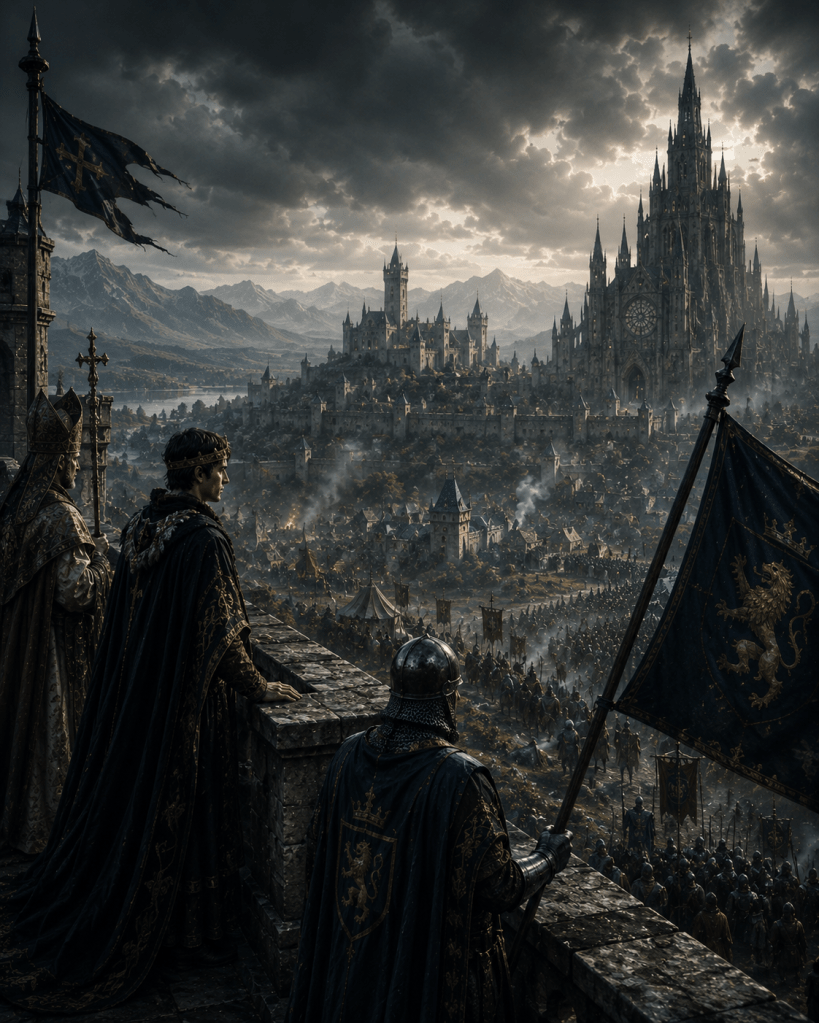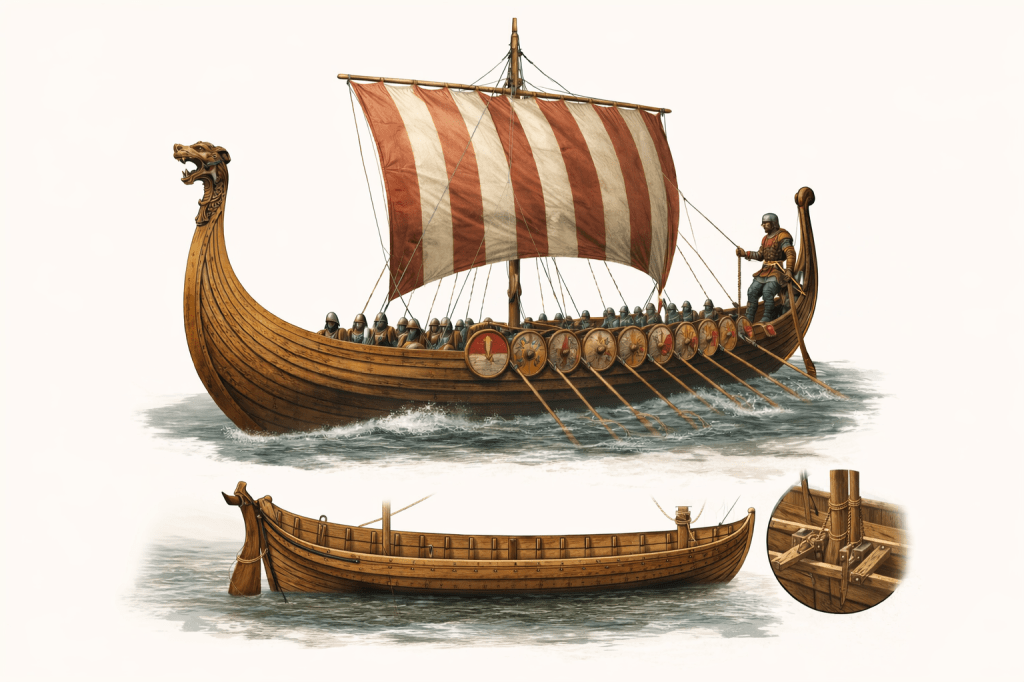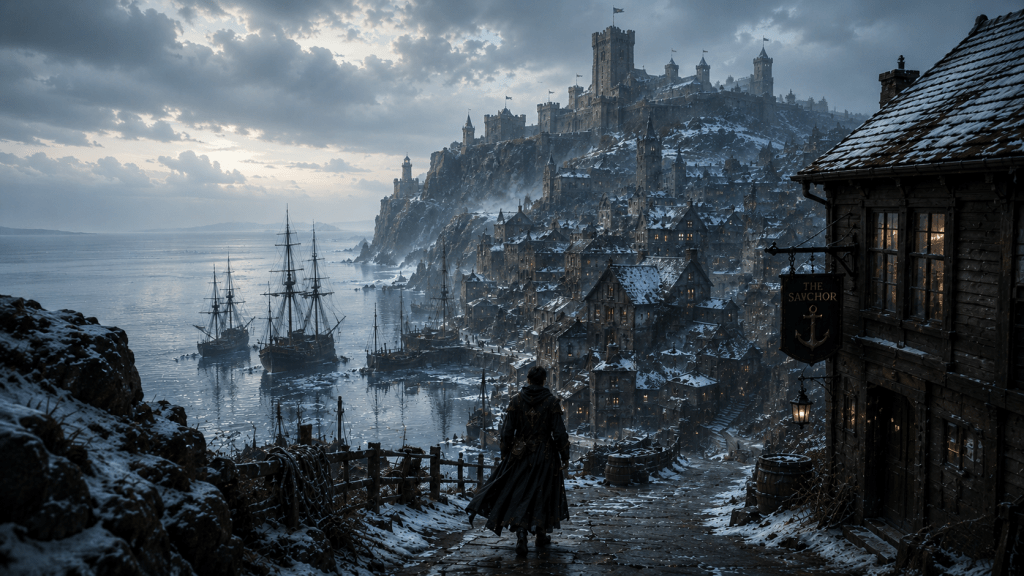
Who Is Simion? The Reluctant Magician at the Heart of The Unmarked Path

Every epic fantasy needs a doorway.

Sometimes that doorway is a battlefield. Sometimes it is a throne room, a prophecy, a blade drawn under stormlight, or a kingdom already burning beneath the weight of war.

In The Unmarked Path, the doorway is quieter.

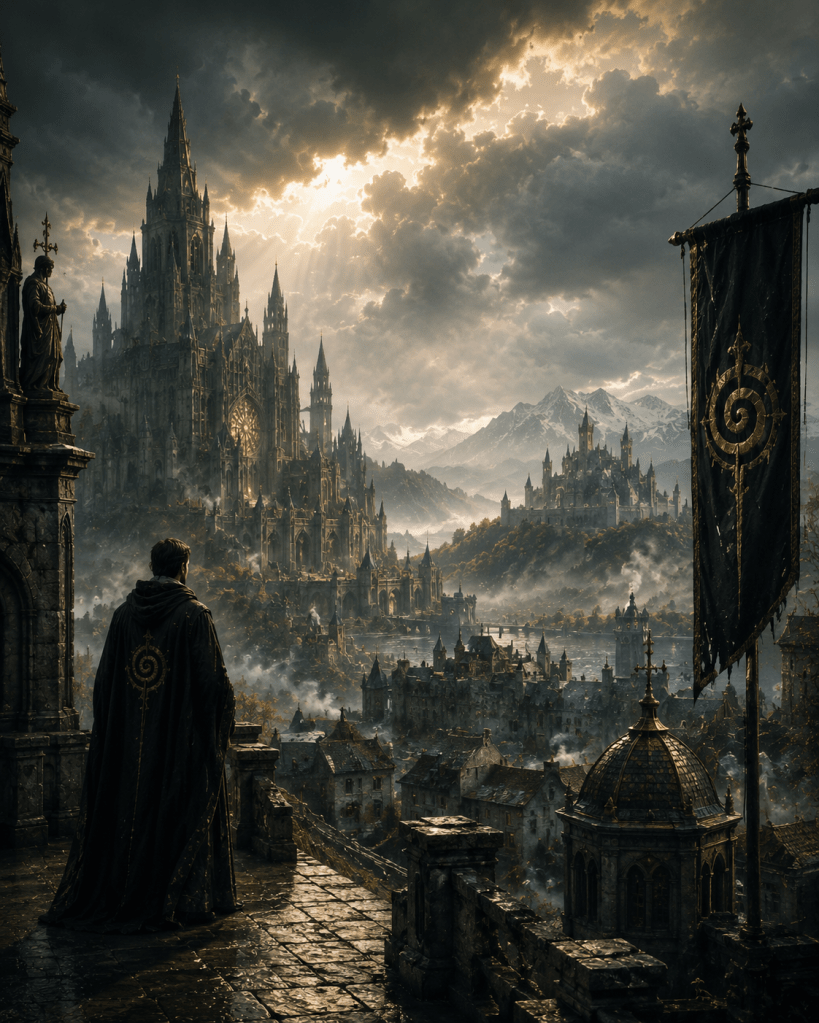
It opens with Simion, a magician of the Order, arriving in the cold coastal kingdom of Bremyra beneath a winter sky. He comes dressed in the black robes of an institution feared across the realm, carrying the authority of ancient magic and the uncertainty of a man who has never fully believed he belongs among those who wield it.

That tension is where his story begins.

Simion is no simple fantasy hero waiting for applause. He is no flawless master of the arcane, no proud champion striding into the world with certainty burning in his hands. He is weary, observant, guarded, and deeply human. He has been trained by the Order of Magicians, shaped by discipline and expectation, yet his place among them has always felt uneasy. Magic answers him in strange ways. Some simple things resist him, while darker and older powers seem to recognise him before he recognises himself.

That makes him dangerous.

It also makes him compelling.


A Magician Who Feels Out of Place
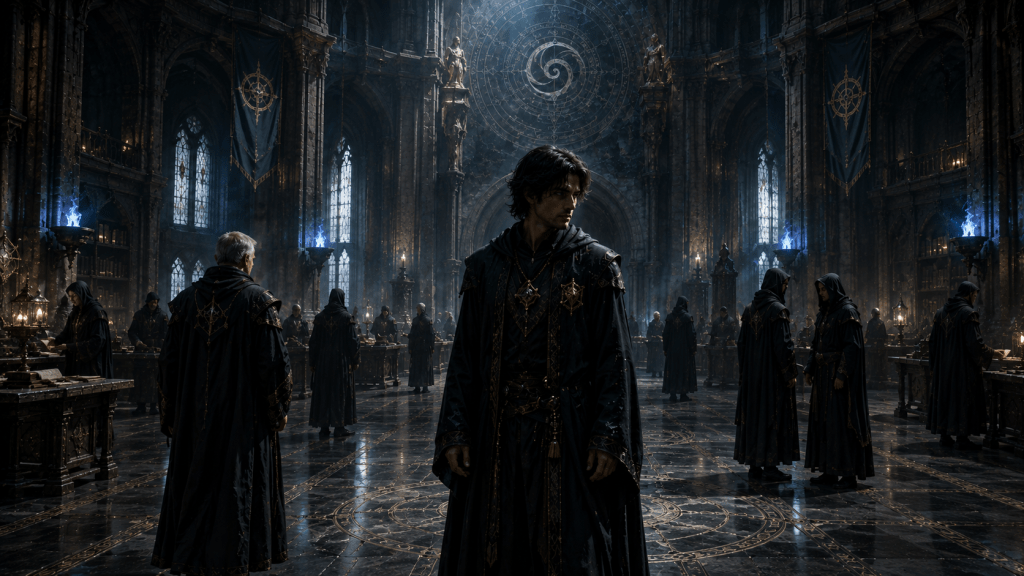
The Order of Magicians stands as one of the great institutions of Ældorra. It is old, powerful, and shaped by a history most of the living world only half-remembers. Its members are trained in discipline, ritual, incantation, and obedience. They carry an authority separate from kings, priests, and ordinary law.

Simion has passed through that world. He has learned its rules. He wears its robes.

Yet from the beginning, he feels like someone standing at the edge of his own life.

He has never been entirely comfortable among magicians who treat power as rank. At the Academy, he struggled where others advanced easily. He lacked the arrogance that often comes with mastery. His gifts seemed uneven, almost unreliable, as though the magic within him moved by some older rhythm than the lessons placed before him.

That uncertainty matters.

Simion begins the story believing himself ordinary by the standards of the Order. Skilled, perhaps. Capable enough to be useful. Still, he sees himself as a man chosen for duty, not destiny. He obeys because obedience is familiar. He studies because study is safer than instinct. He observes because action carries consequences he rarely feels ready to command.

The tragedy and beauty of Simion is that the world has already begun to move around him before he understands why.


Bremyra and the Weight of Return

When Simion arrives in Bremyra, he enters more than a kingdom under political strain. He returns to a place tied to his own buried past.

Before the robes, before the Order, before the careful distance he now keeps between himself and others, Simion once knew Bremyra through smaller rooms, warmer memories, and the overlooked spaces of castle life. He was once close enough to the royal children to carry echoes of childhood mischief, laughter, and belonging.

Years later, he returns as Lord Magician.

That title changes everything.

The servants fear him. The court watches him. The Church distrusts him. Patrick measures him with the caution of a prince carrying too many burdens. Elana remembers the boy beneath the robes, and that memory unsettles him more than suspicion ever could.

This is one of the strongest tensions in Simion’s character. He is treated as a figure of power, yet part of him still remembers being powerless. He is feared by people who once might have ignored him. He is addressed with reverence in halls where he once moved unseen.

Bremyra forces him to confront the distance between who he was and who the world now believes him to be.


The Mission Beneath the Surface
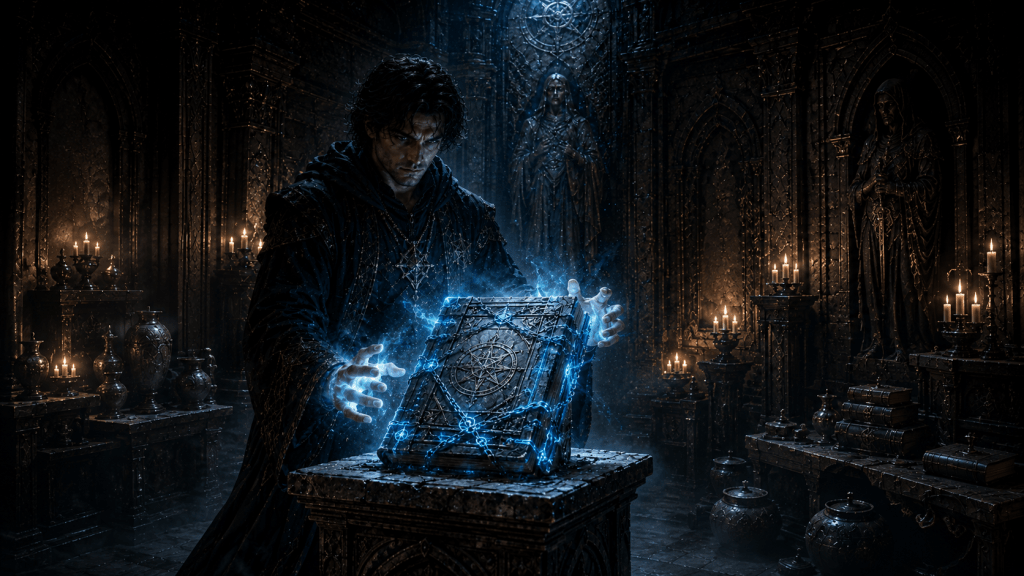
Simion’s official presence in Bremyra carries a polished explanation. He is there to observe, advise, and assist if needed. That is the surface truth presented to the court.

The deeper truth is more troubling.

Three magicians of the Order vanished in connection with King Cedric’s expedition and investigations into remnants of the ancient Imperium Arcana. Simion has been sent to uncover what happened. His task places him at the centre of a dangerous triangle: the Order, the royal household, and the Church.

Every question he asks risks offence. Every answer he finds may damage the fragile balance of the kingdom. If the missing magicians were betrayed, the consequences could reach far beyond Bremyra. If the Order is wrong, then Simion has arrived as a quiet threat inside a court already strained by absence, politics, and approaching war.

This gives his role a constant unease.

He is adviser and investigator. Guest and watcher. Servant of the Order and reluctant participant in royal life. He stands close enough to Patrick to earn trust, close enough to Elana to awaken old feeling, and close enough to hidden history to disturb forces that were meant to stay buried.


A Power Beyond the Lessons He Was Taught

The heart of Simion’s story lies in the gap between learned magic and something older.

In the world of The Veil of Kings and Gods, magic is structured. Magicians speak Flow. They shape power through words, training, and controlled forms. The Order teaches magic as discipline. It gives names to the currents of the world and expects its students to follow them.

Simion’s magic begins to move differently.

At first, these moments are subtle. A sealed book responds to him. Runes stir beneath his hands. Power gathers in silence, where silence should carry no spell. He feels forces he has no language for, forces that seem to reach past the laws of the Order and into the buried bones of the world.

This does not make him triumphant.

It frightens him.

That fear is important. Simion is powerful, yet he is also careful. He does not rush towards glory. He does not understand what has awakened around him. The old structures that shaped his life offer little comfort once his own magic begins to break their rules.

He begins to realise that the Order may have taught him how magic behaves, while something far older may be showing him what magic remembers.


The Hidden Book and the Call of the Seal

One of the defining images of The Unmarked Path is the hidden book beneath Bremyra.

Simion is drawn into the castle’s depths by whispers and old magic, where the familiar world of court duty, council suspicion, and royal politics gives way to something older. Beneath the halls where princes argue, priests watch, and servants move through their ordinary routines, another Bremyra waits in the dark. Its stones remember an age the kingdom has forgotten, and in that buried chamber, the past begins to reach for him.

At its centre waits an ancient book protected by a weave he does not understand.

The book is more than an object. It is a threshold.

It belongs to the part of Ældorra that survived in ruins, buried rooms, sealed warnings, and fragments of divine memory. It represents everything Simion cannot yet name: hidden history, forgotten magic, divine pressure, and the unsettling sense that his life has been touched by something older than the Order. The magicians who trained him taught rules, forms, and discipline. The book offers none of those comforts. It gives him no easy explanation, no clear command, no gentle revelation. It simply waits.

That waiting is what makes it powerful.

When the warning comes, it arrives in fragments. The seal weakens. The burden waits. The path will reveal itself only when its weight is accepted. There is no grand ceremony, no clean answer, and no voice kind enough to tell Simion exactly what he has become part of. The moment feels less like discovery and more like inheritance, as though something ancient has finally found the one person able to hear it.

For a man who has spent much of his life feeling uncertain of his place, this is devastating.

Simion wants understanding. What he receives is responsibility.

He wants answers. What he receives is a sealed path.

He wants control. What he receives is a mystery that responds to him in ways no ordinary magician should be able to explain.

That is why the hidden book matters so deeply to his story. It marks the point where Simion’s life begins to move beyond the limits of the Order. He can still pretend, for a time, that he is only an advisor, only an investigator, only a magician sent to Bremyra under orders. Yet the book has already changed the shape of the world around him. It has placed a quiet hand on his fate.

From that moment onward, Simion is no longer searching only for missing magicians.

He is searching for the truth of magic itself.

And the deeper he follows that truth, the more dangerous the path becomes.


Elana and the Human Thread

Simion’s story would lose much of its force if it only moved through magic, prophecy, and ancient danger.

Elana gives his arc its human warmth.

She remembers him before the title, before the robes, before the fear others attach to him. Her presence cuts through his formal distance, drawing forward traces of the boy he once was. She is bold, perceptive, and unafraid in a way few people around Simion are. Where others see the Order, she sees the man beneath it.

Their connection is layered with memory, restraint, duty, and danger. Elana is bound to royal obligation. Simion is bound to the Order. Neither of them moves freely, and that makes every exchange carry more weight than open confession could.

Through Elana, Simion is reminded that he is still human. He can still be seen. He can still be unsettled by kindness. He can still feel the pull of a life beyond duty, even as darker forces gather around him.

That matters because Simion’s greatest conflict is not simply whether he has power.

It is whether power will leave enough of him behind to love, fear, hesitate, and choose.


Why Simion Matters to the Saga
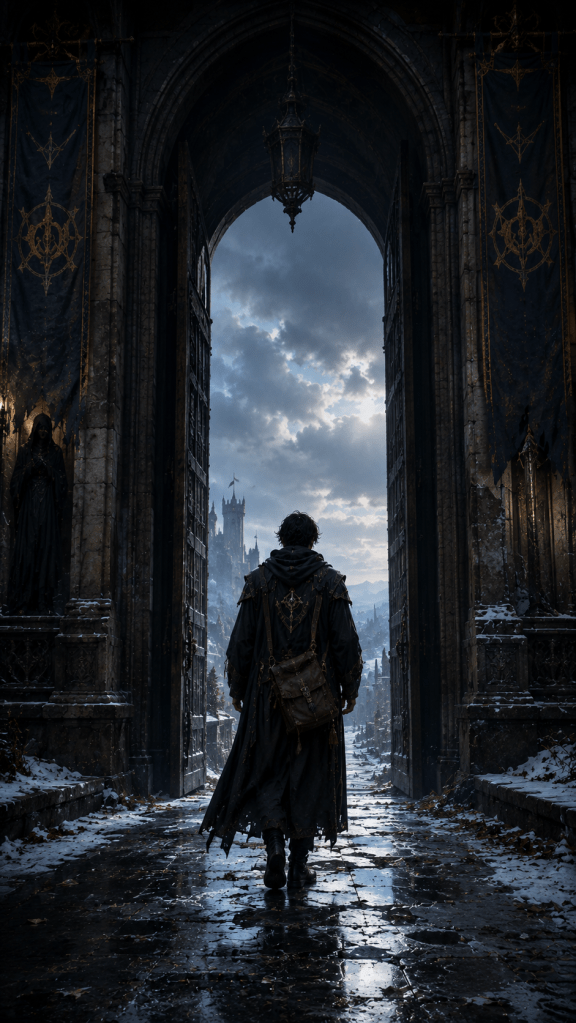
Simion matters because he stands at the meeting point of several forces that shape The Chronicles of the Spiral Realms.

He belongs to the Order, yet his power challenges its laws.

He enters Bremyra as an outsider, yet his past ties him to its royal family.

He seeks missing magicians, yet finds traces of something divine.

He believes he is following instructions, yet the world around him begins to move as though history has taken notice.

That is the kind of character who can carry a long fantasy saga. Not because he knows all the answers, and not because he rushes towards destiny with a raised blade. He matters because he is uncertain in the face of forces that demand certainty. He matters because he resists becoming the thing others expect him to be. He matters because the power awakening around him is vast, yet the emotional core of his story remains intimate.

He is a man caught between institutions, kingdoms, memory, and magic.

He is also the first sign that the forgotten history of Ældorra has begun to return.


The Story Begins With The Unmarked Path

The Unmarked Path is the opening book of The Veil of Kings and Gods, set within The Chronicles of the Spiral Realms. It begins a slow-burn epic fantasy saga of forbidden magic, ancient gods, royal duty, political tension, hidden histories, and divine silence.

For readers who enjoy mythic high fantasy with atmosphere, mystery, and character-driven tension, Simion’s story offers the first step into a much larger world.

He does not begin as a hero.

He begins as a magician sent to Bremyra under orders he barely understands.

Beneath the castle stones, something waits.

Above him, gods remain silent.

Around him, kingdoms begin to shift.

And somewhere within the sealed places of the world, the Spiral begins to turn.

The Unmarked Path is available now on Amazon Kindle.
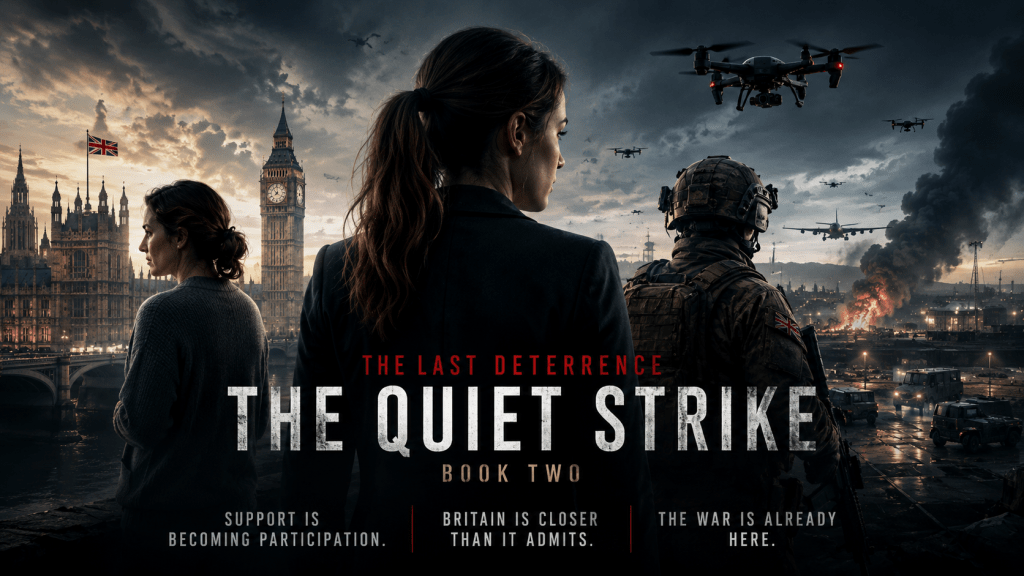
Grounded Modern War Fiction and the Moment Support Becomes Participation

There were some wars a country could watch from the edge of the room for a while. It could send equipment, issue statements, argue over proportionality, absorb the rise in fuel, and tell itself that distance still meant safety. It could speak of support, resilience, defensive aid, allied infrastructure, and managed escalation. It could choose careful words and hope the world accepted the distinction between helping a war and entering one.

That distinction was never as strong as the language around it.

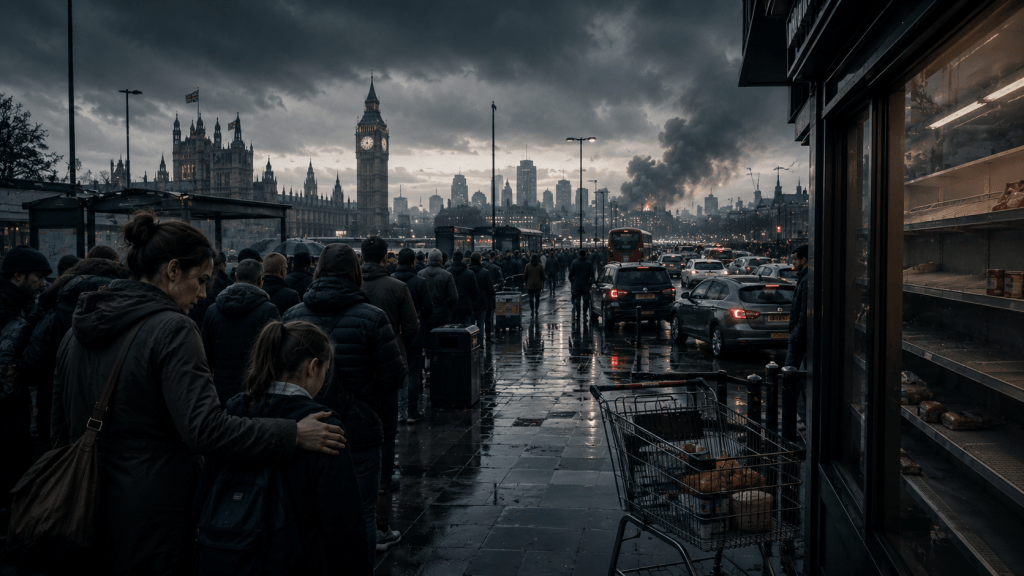
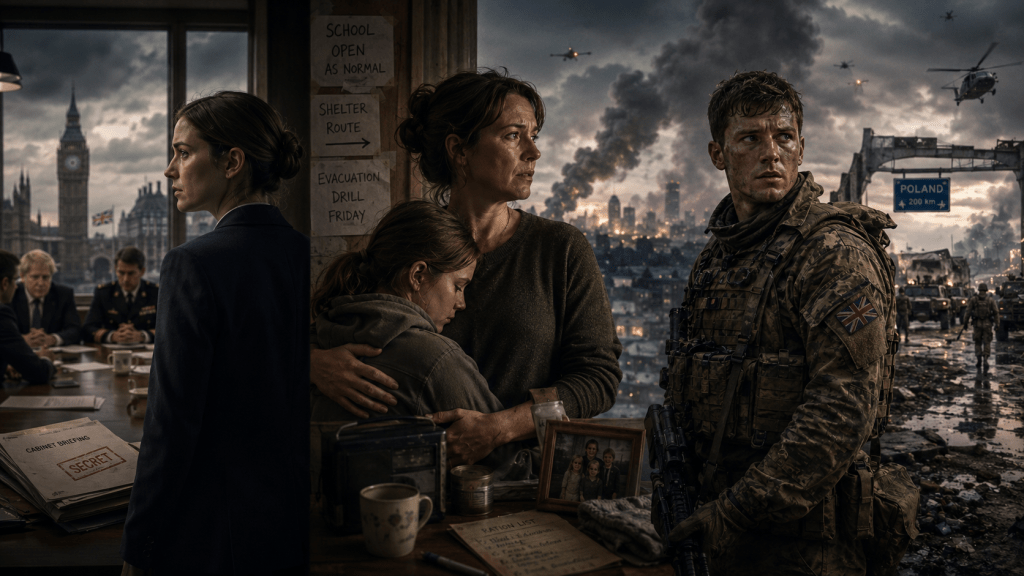
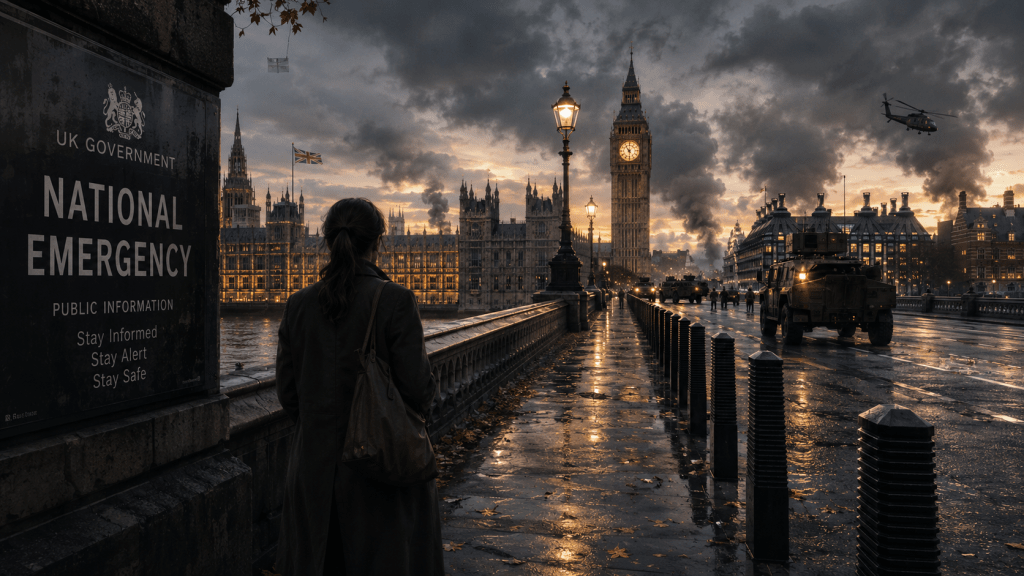
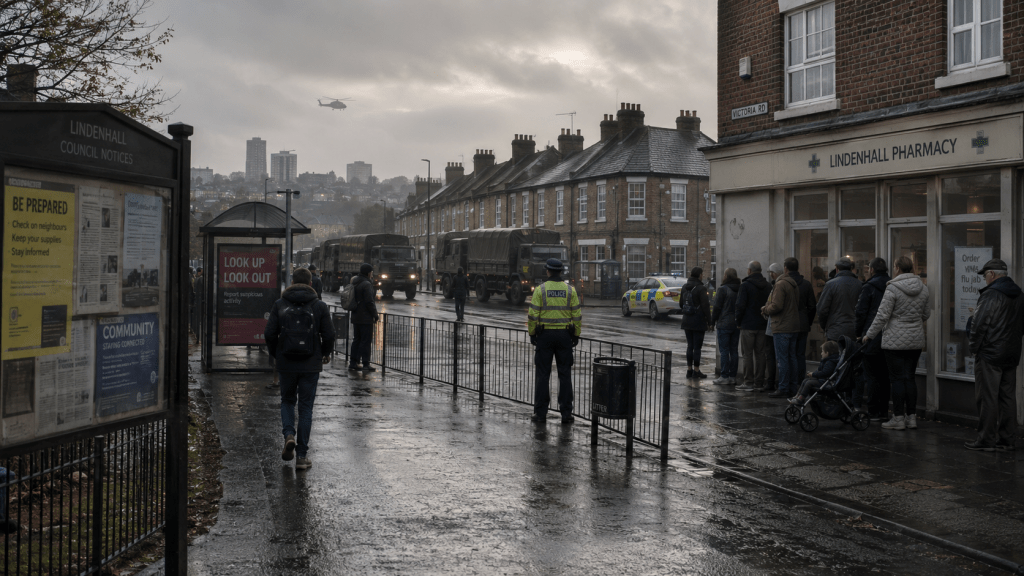
Grounded modern war fiction begins in that weakness. Not in the clean declaration, not in the heroic charge, not in the moment when every citizen wakes to find history has suddenly changed, but earlier, in the days when the signs are visible and still denied. It begins with the barrier moved outside a government building, the police route changed twice in the rain, the school trip trapped near a protest line, the supermarket notice asking people not to buy too much, the fuel queue stretching into traffic, the family message left unanswered because the person who could answer is not free to say what happened.

That is the pressure at the heart of The Last Deterrence. It is not a story about war arriving all at once. It is about the failure of distance, and the way a country can be changed by war before it admits that war has reached it.


The War Before the Declaration

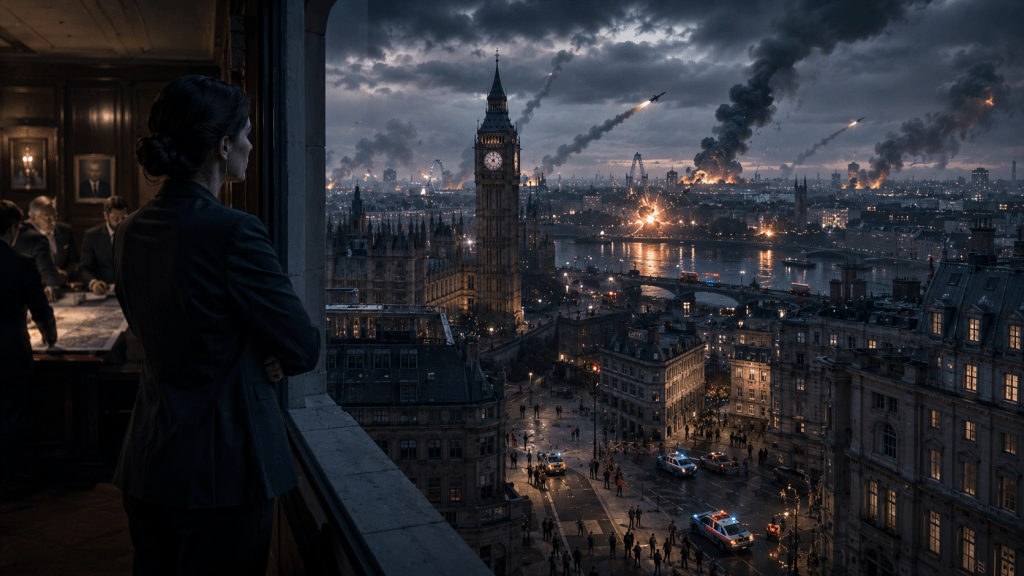
Modern war does not always announce itself in the old way. There may be no clean dividing line between peace and conflict, no single morning when every public statement finally matches the physical evidence. A government may still speak of restraint while bases move to elevated posture. Ministers may still use the language of support while fuel lanes, air movement sites, ports, depots, railheads, and logistics hubs become part of the battlefield.

That is why political military fiction has to pay attention to language as much as weapons. The public statement is not decoration. It is a tool, a shield, a delay mechanism, and sometimes a confession made carefully enough to pass as reassurance. In a NATO crisis, every phrase has several audiences. Allies hear one thing. Opponents hear another. The public hears something smaller and more domestic, something filtered through the price of petrol, the tone of a presenter, the closed road by the station, or the silence of someone serving overseas.

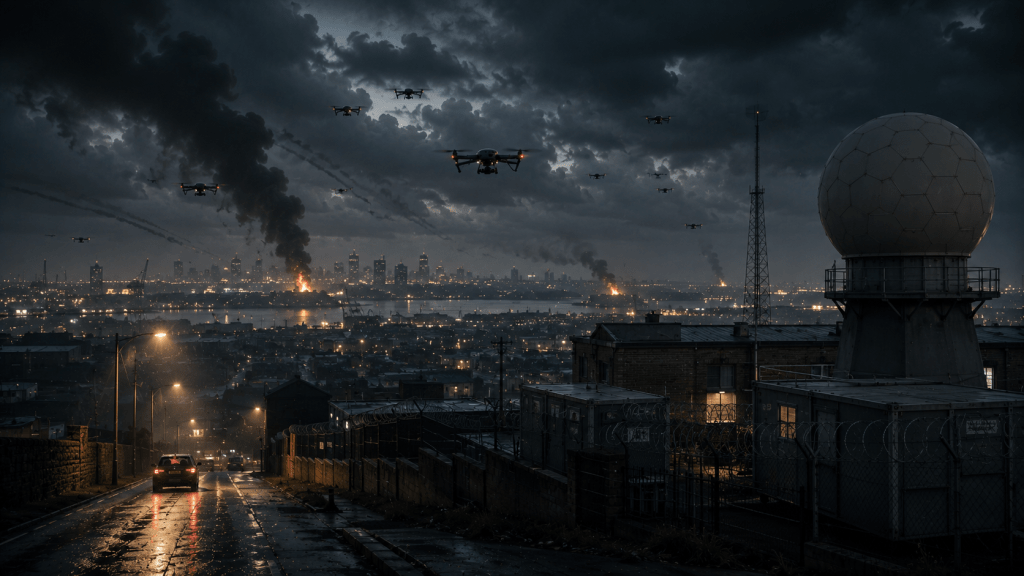
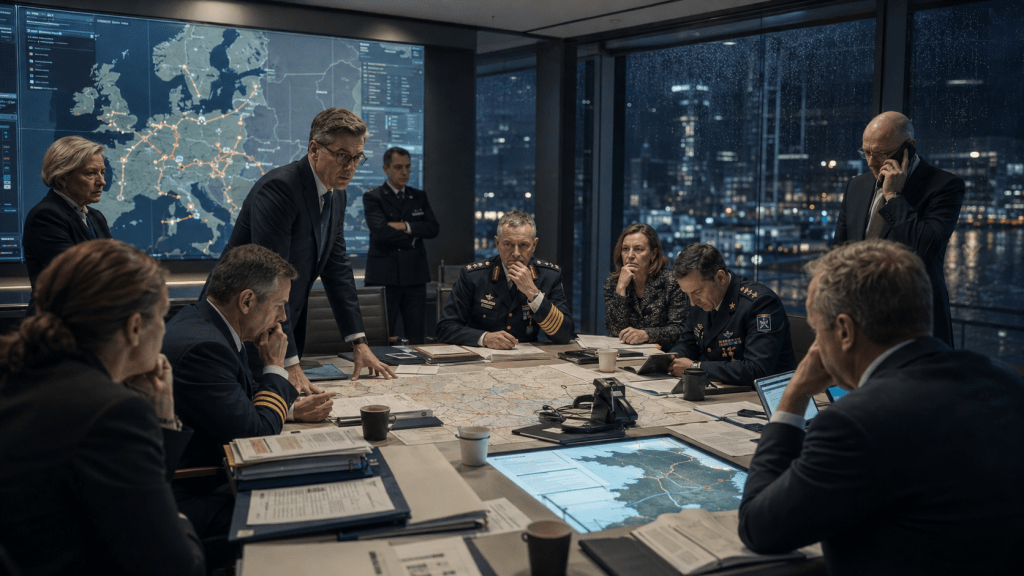
In The Quiet Strike, the second book of The Last Deterrence, Britain has not declared open war. That matters. It also matters that the country is already behaving as though the old distance has failed. The government still speaks of defensive reinforcement and allied logistics. Yet the physical world is moving faster than the public vocabulary. Military-linked sites are being watched. Small drones test perimeters. Fuel infrastructure becomes exposed. Support routes begin to look, to an adversary, like the early shape of intervention.

This is where grounded modern-war fiction finds its strongest tension: not in spectacle, but in contradiction.


Britain Under Pressure

A war story set around Britain cannot only be told through ministers and soldiers. If the country is under pressure, the pressure has to enter ordinary systems. It has to touch schools, shops, transport, pharmacies, family kitchens, shopping centres, petrol stations, police lines, local roads, and the tired staff who become the visible edge of decisions made elsewhere.

The home front is not passive in this kind of fiction. It is where the official story is tested against lived reality. A minister may say supplies are stable, but a parent sees the shelf gaps. A security correspondent may say an incident is under investigation, but a mother hears the phrase “military-linked site” and knows her son is somewhere inside that careful wording. A government may insist that measures are routine, but everyone can see more barriers, more police, more delays, more shortages, more signs asking people to stay calm.

That is one reason British war fiction has a different texture when it is handled seriously. Britain is small enough for the state, family, media, road network, military estate, and public mood to feel connected. A crisis in Whitehall can become a traffic jam, a cancelled bus, a school safeguarding concern, a family argument, or a queue outside a petrol station within hours. The distance between policy and kitchen table is never as wide as official language needs it to be.

In The Last Deterrence, Helen Mercer’s civilian line carries that weight. Her life is not separate from the strategic world. It is where that world becomes intimate. She sees the strain through prices, public anger, school routes, teenage fear, fuel anxiety, and the changing tone of ordinary conversations. Her family does not receive the war as doctrine. They receive it as disruption, silence, worry, and the slow shrinking of what used to be normal.


NATO Crisis Fiction Without Clean Certainty

A NATO crisis in fiction can easily become too neat. One side provokes, the other responds, alliances hold or fail according to simple dramatic need, and the story moves from escalation point to escalation point as if decision-makers are pushing buttons on a map.

The more frightening version is slower and less certain.

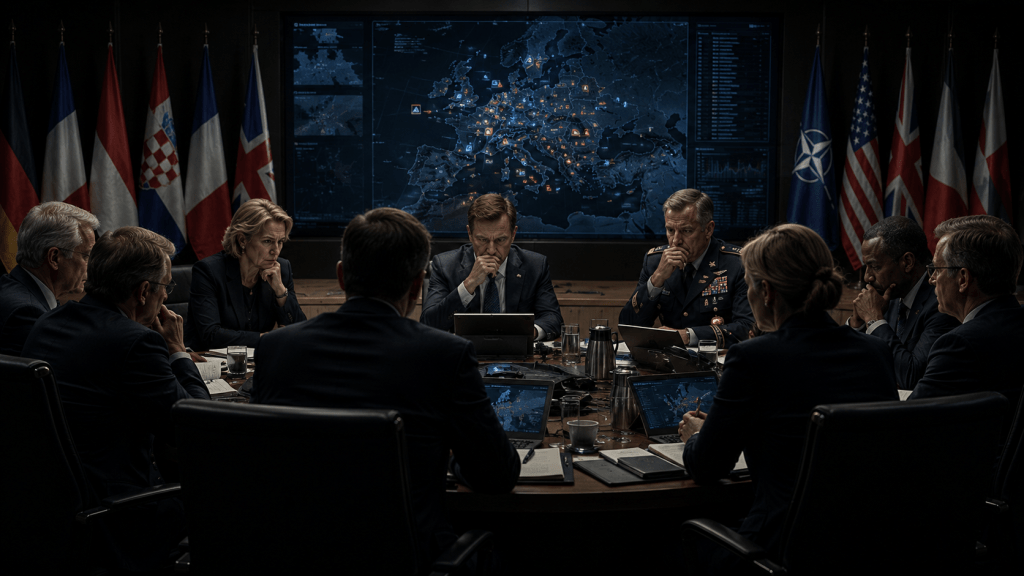
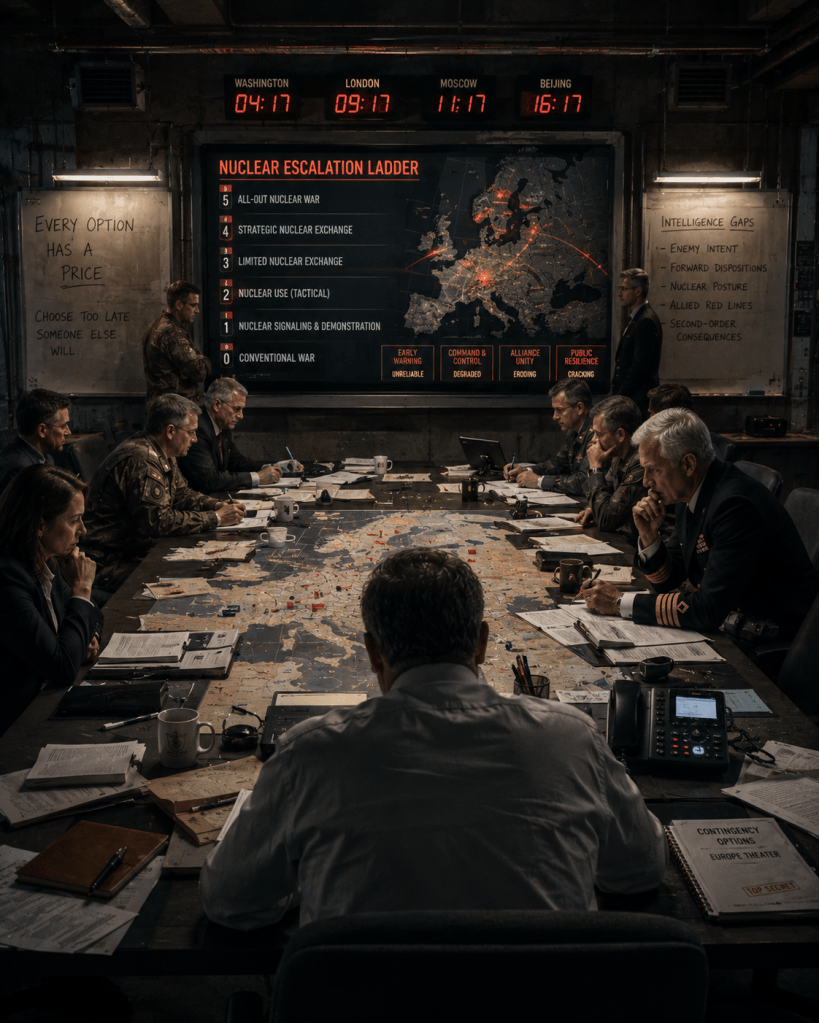
Alliances are made of governments, and governments are made of people working under pressure, with incomplete information, public fear, legal risk, military advice, domestic politics, media pressure, and allies who all need slightly different language. No capital hears the same phrase in exactly the same way. One country wants restraint named. Another wants deterrence visible. Another wants ambiguity. Another wants speed. Another wants proof that solidarity means more than statements.

That is where political military thrillers can become more than crisis machinery. They can show the strain of holding a coalition together when every word changes the room. The danger is not only that an enemy misreads a movement. It is that allies misread one another, governments speak past their publics, and military necessity begins to outrun political permission.

Leah Mercer’s state line exists inside that pressure. She works near the centre of government, where public language, private fear, and actual events pull apart. Her work is not simply to “know more” than the public. In many ways, her knowledge is another form of exposure. She sees how phrases are built to hold panic at bay. She sees which words are avoided, which ones are kept private, and which ones are released because no better shelter remains.

In this kind of story, the state is not omniscient. It is strained, reactive, skilled in language, and often behind the physical reality it is trying to manage.


Drone Warfare and the End of the Safe Rear

Modern war punishes movement. It punishes concentration, exposed logistics, predictable routes, fuel points, open tarmac, contractor sprawl, weak perimeters, and old assumptions about what counts as the rear. A site does not have to be on the front line to matter. It only has to be useful.

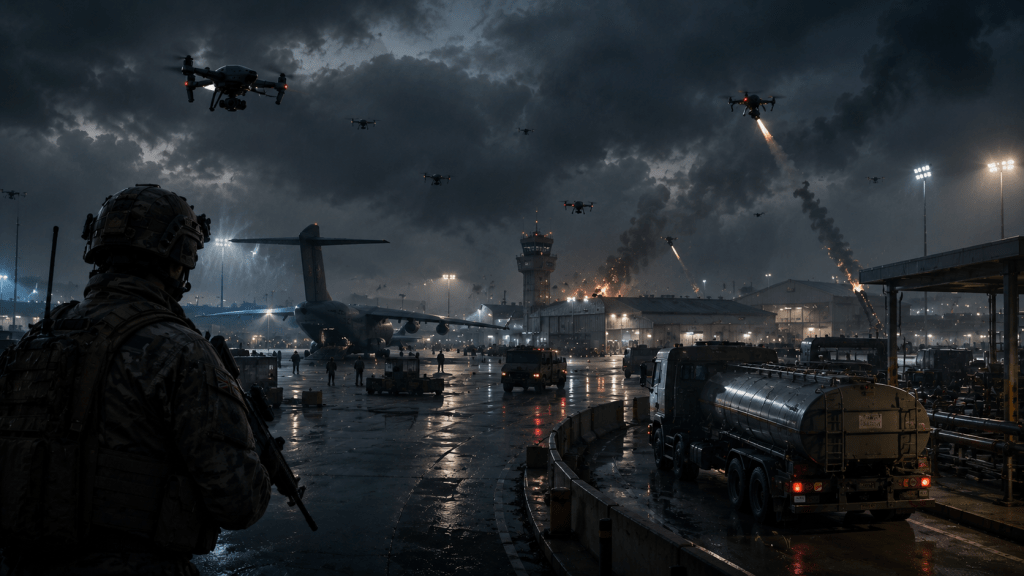
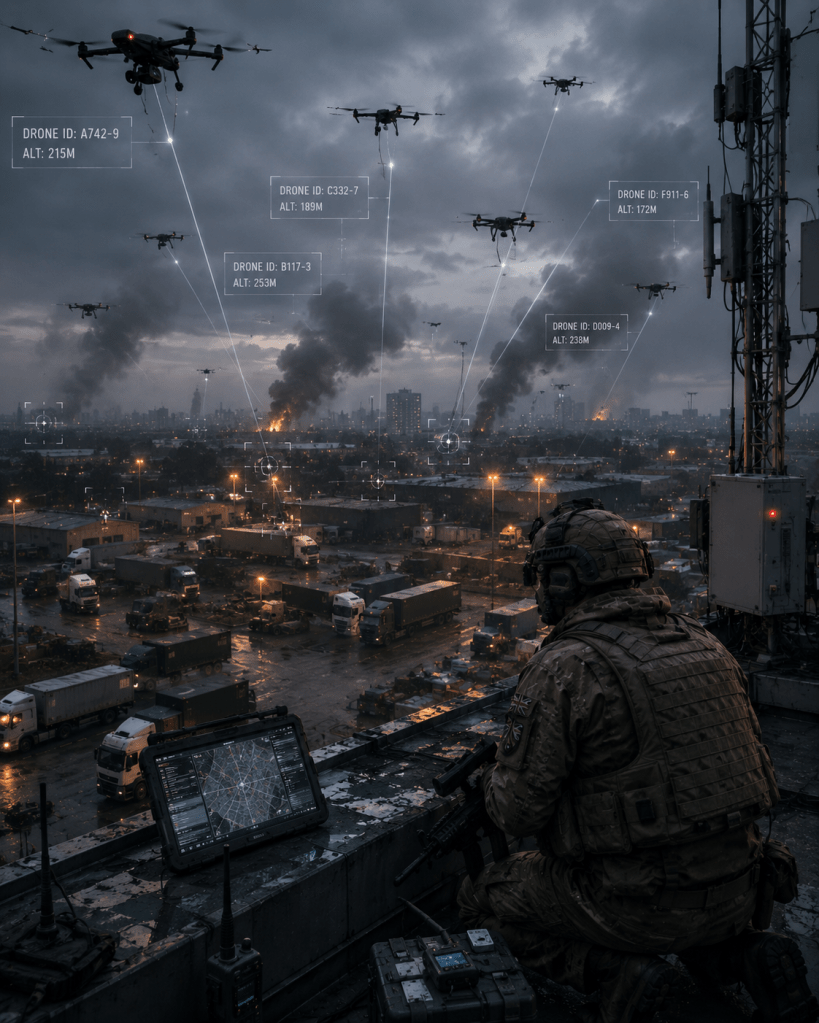
That is why drone warfare fiction has become central to any serious modern-war story. Drones change the emotional grammar of military space. A soldier can no longer assume that danger arrives with a visible enemy, a clear direction, or a traditional battlefield. A small unmanned platform can test a perimeter, record response patterns, reveal blind spots, disrupt fuel handling, damage confidence, or force a whole site to show its reflexes.

The danger is physical, but it is also psychological. Men look up before crossing open ground. Contractor vehicles are checked longer than before. A fuel lane becomes a target. A camera outage becomes a strategic problem. The air above a base stops being empty and becomes watched.

Daniel Mercer’s military line carries that truth from the ground. He does not experience the war as policy. He experiences it as rain on concrete, helmet straps, ruined food, shouted orders, smoke, blast pressure, exposed fuel systems, injured men, and the knowledge that support infrastructure is now part of the fight. His world is not abstract. It is made of gates, lanes, floodlights, barriers, radios, technical cases, medics, aircraft, and people trying to keep working after the site has been hit.

That is the crucial shift in The Quiet Strike. Rear space stops feeling rear. Support becomes dangerous not because someone has declared war, but because the machinery of support has become visible enough to strike.


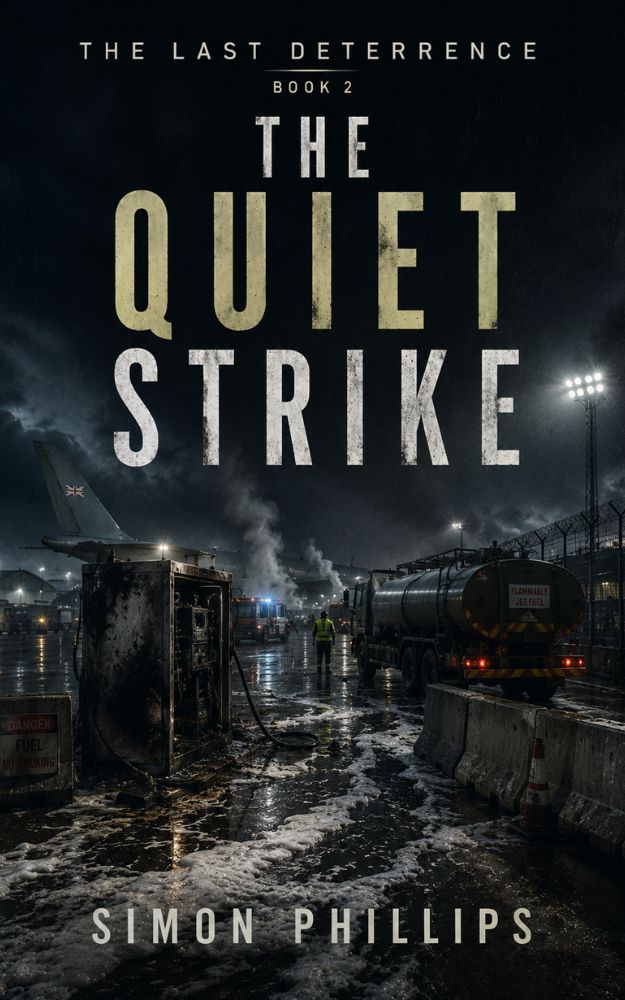
The Quiet Strike: Book Two of The Last Deterrence

The Quiet Strike is the second book in The Last Deterrence, and it sits at the point where Britain can no longer keep the war at a comfortable political distance.

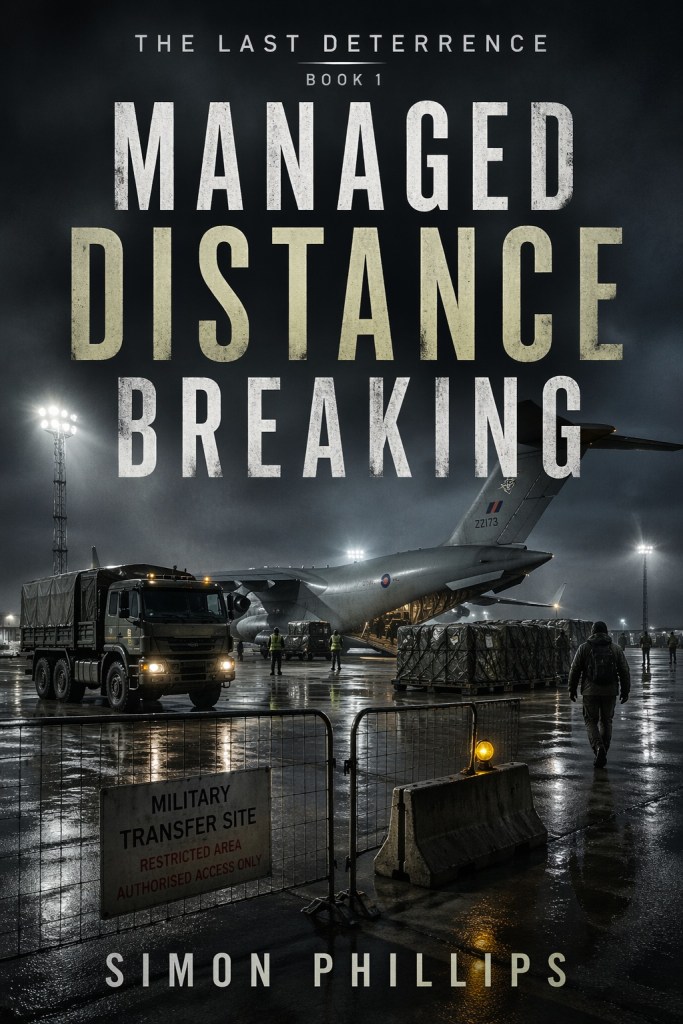
The first book, Managed Distance Breaking, showed the early failure of distance: public reassurance, government strain, family unease, and the first signs that a war described as external was already bending British life around it. The Quiet Strike moves the pressure closer. The language of support still remains in place, but the physical reality has changed. British-linked military space is being watched, tested, and struck. Drones reach towards air movement and fuel infrastructure. NATO allies argue over how much restraint can survive when the systems supporting the war are already under attack.

The book follows that pressure through three connected lines: Leah Mercer inside the machinery of government, Helen Mercer at home as public life narrows around shortages, transport disruption and family fear, and Daniel Mercer on the ground as the rear stops feeling safe. Together, those lines show the same crisis at different levels of knowledge. Leah sees the careful wording. Helen hears what the wording refuses to say. Daniel lives the danger that official statements reduce to incident language.

This is the published second entry in the series, and it marks the moment where support becomes participation in practice. Not through a formal declaration. Not through spectacle. Through movement, fuel lanes, exposed bases, public statements, family calls, and the slow recognition that Britain is already being pulled into the machinery of a wider war.


Family as the Place Where Strategy Lands

Large-scale war fiction often risks losing the human centre beneath the machinery of escalation. Maps grow larger. Threats multiply. The reader is told what governments fear, what armies require, what alliances decide. Yet the cost of those decisions becomes thinner if it does not land somewhere specific.

In The Last Deterrence, the Mercer family is that place.

The family connection is not decorative. It joins the three major forms of exposure: state, civilian, and military. Leah sees the language of government from inside the system. Helen feels the same language fail to comfort at home. Daniel lives the physical consequences of what is still publicly described as support. Around them, the wider family absorbs the crisis through finance, adolescence, transport, work, worry, and messages that are too short to carry the truth.

This matters because war does not give everyone the same knowledge. A soldier knows what happened at the fuel lane but not the full political calculation. A government staffer sees the restricted incident summary but not the smoke, fear, and ringing ears. A mother sees the public statement and knows only enough to be frightened. Each truth is partial. Each truth is real. The distance between them is where much of the story lives.

That separation gives the series its emotional force. Public truth, private knowledge, and actual events do not arrive together. They move at different speeds, and the family has to live inside the gaps.


The Quiet Strike and the Failure of Managed Distance

The Quiet Strike belongs to the stage before open European war, when the language of control still exists but has begun to carry too much weight. It is a book about British-linked military infrastructure under pressure, NATO allies trying to hold discipline, and a family discovering that the war can reach them through systems before it reaches them through declaration.

Its title points towards the way modern escalation often feels. Not quiet because nothing happens, but quiet because the public words remain controlled. Quiet because attribution is withheld. Quiet because the attack is processed through incident summaries, protective measures, revised lane plans, and cautious statements. Quiet because families hear only what can be safely said. Quiet because the real change is already moving beneath the surface.

The strike does not need to destroy a city to matter. It needs to change posture. It needs to make a base reveal its weaknesses. It needs to make fuel, air movement, technical support, and site security part of the war. It needs to turn defensive support into something that looks, to those watching, like participation.

That is the point where genre and story meet. This is grounded modern-war fiction because the war is not treated as spectacle. It is political military fiction because language, alliance pressure, and state decision matter. It is British war fiction because the crisis enters recognisable civic life. It is drone warfare fiction because small systems change large behaviour. It is NATO escalation fiction because every defensive movement can be read by someone else as the next rung.


The Wider Shape of The Last Deterrence

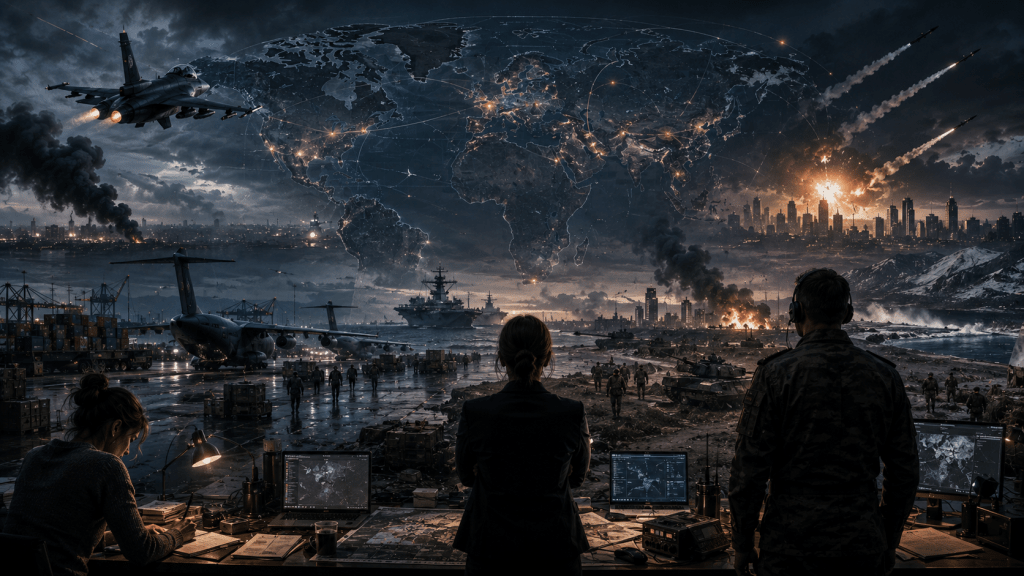
The wider series is built around the collapse of managed distance. It begins with a recognisable proxy-war frame and follows the way support, aid, training, movement, and infrastructure slowly become harder to separate from participation. The story widens through Europe, alliance overload, global pressure, nuclear threshold, and the long aftermath of partial survival.

But the purpose is not to hurry towards spectacle. The purpose is to let each stage change the people living inside it.

Ports matter because ships and fuel matter. Roads matter because movement is vulnerable. Schools matter because public reassurance reaches children through adults who are no longer sure what to say. Government rooms matter because the wrong phrase can harden an alliance, frighten a public, or give an adversary a signal it was already waiting to find. Bases matter because the rear is no longer safe simply because someone calls it rear.

The world of The Last Deterrence is built from these pressures. It is a war story about systems, but never systems alone. It is about the people who have to keep working inside them: the staffer drafting the line, the mother wiping water from a kitchen counter while the news scrolls beneath her, the soldier walking up an aircraft ramp with smoke still in his sleeve, the technician holding herself together because damaged equipment still needs to be made safe, the young private learning that fear can be carried but not dismissed.


When the World Changes Before the Words Do

The most dangerous moment is not always the loudest one. Sometimes it is the interval when everyone knows the situation has changed but the official language has not caught up. The country is still told that measures are defensive. The military is still told that movement is support. Families are still told that details cannot be shared. Allies are still told that consultation is holding. The public is still told that everything remains under urgent review.

And yet the roads are different. The gates are different. The queues are different. The silences are different.

That is where The Quiet Strike stands. It is the moment when support becomes participation in practice, when Britain’s distance from the war fails not through a declaration, but through movement, fuel, drones, family calls, public statements, and the visible strain of a state trying to remain calm while reality pushes past the words.

The world changes first.

Understanding follows later, unevenly, through official phrases, damaged places, short messages, and the people left to carry what those phrases cannot say.

The Future Chronicle: The Signal in the Debris Field

Frontier pilots approaching Ashfall Station begin reporting a repeating signal drifting through the outer debris field, even though station navigation confirms that no transmitter exists anywhere within the surrounding orbital space.


The Signal in the Debris Field

Approach to Ashfall Station rarely carried the drama imagined by those who had never travelled the outer routes of frontier space. For most pilots, the journey ended in a slow glide through the scattered remains of earlier industry, where fragments of forgotten machinery drifted in loose orbit around the silent mining world of Kestren-4. Cargo captains spoke of the region with a mixture of routine familiarity and quiet caution, since the debris field surrounding the station contained the accumulated remains of decades of industrial work. Broken survey satellites, abandoned ore containers, fragments of collapsed relay towers, and the rusting skeletons of transport frames all moved slowly through the dark, forming a shifting boundary that every incoming vessel learned to navigate with patient attention.

The pilot of the freighter Meridian Wake encountered the signal during the final stage of such an approach. Her vessel travelled along the outer navigation corridor that curved gradually toward Ashfall’s docking arms, engines reduced to manoeuvring thrust while the ship’s scanners tracked the larger fragments drifting ahead of the bow. Through the forward observation canopy, the distant ring of the station hung against the black horizon of space, its vast structure illuminated by the soft glow of maintenance lights tracing the circumference of the industrial habitat. Beneath the station, the surface of Kestren-4 rotated slowly through darkness, a barren world whose exhausted mines had once filled Ashfall’s cargo holds with ore during the early years of expansion across the system.

Traffic along the approach route remained quiet during that cycle. Two small salvage craft held position near the outer marker buoys while a long-range ore hauler departed the station’s southern docking spine and accelerated toward the deeper trade lanes beyond the system. Routine communications flowed across the Meridian Wake’s console as navigation systems exchanged positioning data with the station’s control tower. The pilot guided the freighter along the authorised corridor with the calm precision expected of anyone who had spent years crossing the frontier routes, where industrial stations served as the only islands of human presence within vast distances of unoccupied space.

It was during the final scan sweep of the debris field that the first trace of the signal appeared. The anomaly entered the ship’s communication display as a brief distortion across the receiver spectrum, a thin band of transmission energy repeating at regular intervals somewhere beyond the edge of the navigational corridor. At first, the pattern resembled the scattered noise sometimes produced by damaged communication beacons drifting within the debris field, remnants of earlier construction projects whose transmitters continued broadcasting fragments of long obsolete data into empty space. The Meridian Wake’s automated systems attempted to classify the signal within the standard catalogue of known transmissions across the Kestren system, yet the repeating pattern matched none of the frequencies registered within the station’s navigation archives.

The pilot adjusted the receiver gain and watched the signal repeat again across the console display. A narrow pulse travelled through the communication channel, fading into silence before returning several seconds later with the same precise rhythm. Each repetition carried identical amplitude and duration, suggesting a source operating with mechanical consistency somewhere within the drifting field of debris surrounding Ashfall Station. The ship’s long-range scanners turned slowly toward the region indicated by the signal’s directional trace while the navigation computer calculated the relative motion of nearby objects moving through the corridor.

Across the forward canopy, the darkness of the debris field appeared unchanged. Fragments of machinery drifted slowly through the weak gravity of Kestren-4 while Ashfall’s immense ring structure rotated in distant silence above the planet’s dim horizon. Yet the signal continued to repeat across the Meridian Wake’s receiver with quiet persistence, a steady pulse arriving from a point somewhere within the scattered wreckage ahead of the ship.

The pilot opened a routine communication channel with Ashfall Station’s navigation office while transmitting the signal data along with the vessel’s current position within the approach corridor.

“Ashfall Navigation, this is Meridian Wake approaching corridor three,” the pilot said into the bridge transmitter while the freighter continued its measured glide through the drifting debris. “Receiving a repeating transmission within the debris field ahead of the marker buoys. Forwarding signal trace to your console now.”

Several seconds passed before the reply arrived across the communication channel, the calm voice of a navigation officer emerging from the distant control rooms of the station.

“Meridian Wake, Ashfall Navigation receiving your transmission,” the officer answered with the quiet routine of someone accustomed to minor irregularities along the frontier routes. “Stand by while we check beacon registry and external sensor records.”

Reports of unidentified transmissions occasionally appeared within frontier systems where ageing infrastructure lingered long after its original function had faded from memory. In most cases, navigation technicians traced the source to damaged equipment or abandoned satellites still broadcasting faint automated signals through the surrounding vacuum. The pilot expected a similar explanation to emerge once the station’s monitoring systems examined the data arriving from the freighter.

Several minutes passed while the Meridian Wake continued its gradual approach toward the station. The signal repeated twice more during that interval, its narrow pulse crossing the receiver display with unwavering regularity. Ashfall’s navigation officer eventually returned the transmission with confirmation that no registered beacon operated anywhere within the debris field along the ship’s projected path. Automated sensor arrays surrounding the station scanned the indicated coordinates and detected no active transmitter within their range of observation.

For a brief moment, the bridge of the Meridian Wake fell quiet as the pilot studied the communication console where the signal continued to appear with patient rhythm. The freighter drifted between two large fragments of collapsed docking scaffolding while the navigation computer adjusted course to maintain safe distance from the surrounding debris. Beyond the canopy, the lights of Ashfall Station grew slowly brighter as the vessel closed the final kilometres of open space separating it from the docking ring.

The signal returned again, identical in form to each earlier transmission, emerging from the silent debris field where no transmitter had ever been recorded within the station’s operational charts. The navigation officer requested that the pilot maintain the recorded frequency within the receiver while the station’s monitoring systems continued searching the surrounding region for any object capable of generating the repeating pulse.

Across the dark expanse between the drifting fragments of machinery, the invisible source of that signal continued its steady broadcast toward the approaching freighter. It repeated with the same calm precision that would soon draw the attention of every pilot navigating the outer routes toward Ashfall Station.


Station Record: Frontier Navigation Monitoring

Ashfall Station maintained a permanent navigation monitoring system designed to regulate vessel movement through the debris field that surrounded the installation’s outer orbital corridor. The station’s position above the mining world of Kestren-4 placed it within a region crowded by the remains of earlier industrial expansion, where abandoned infrastructure and drifting machinery formed a loose halo of debris extending several thousand kilometres beyond the station’s docking rings. For vessels approaching from the outer trade routes, safe arrival required careful coordination with Ashfall’s navigation office, whose systems tracked both incoming traffic and the gradual movement of the debris field itself.

The debris surrounding the station consisted largely of industrial remnants dating from the early decades of the Kestren mining operations. When the system’s ore extraction projects expanded rapidly, construction crews deployed large numbers of relay platforms, cargo transfer frames, survey satellites, and automated mining equipment throughout the orbital zone above the planet. Many of these structures eventually fell into disuse as production declined across the system. Over time, the abandoned equipment fragmented into drifting clusters of metal framework that continued to orbit within the gravitational influence of Kestren-4.

To manage this environment, Ashfall Station established a network of navigational corridors marked by automated beacon buoys positioned along the safest approach routes toward the docking arms. Incoming vessels aligned their approach vectors with these corridors while the station’s control tower monitored traffic through a combination of radar systems, optical tracking arrays, and long-range communication receivers capable of detecting transmissions across the surrounding orbital space.

Although these monitoring systems provided extensive coverage across the region, Ashfall’s navigation personnel frequently encountered irregular signals produced by ageing infrastructure still drifting within the debris field. Damaged communication relays and obsolete survey satellites occasionally continued broadcasting fragments of automated transmissions long after their original control networks had ceased functioning. Most such signals were catalogued within the station’s archival records and rarely attracted attention beyond routine maintenance reports.

Archived navigation logs indicate that the freighter Meridian Wake reported a repeating transmission while travelling through the outer approach corridor during a routine arrival cycle. Initial analysis of the signal failed to match any registered beacon frequency operating within the station’s navigation registry. Sensor arrays surrounding Ashfall Station conducted a wide scan of the coordinates supplied by the vessel and confirmed that no active transmitter appeared within the detection range of the station’s monitoring equipment.

At the time the report was filed, the signal was classified as an unidentified transmission anomaly originating somewhere within the debris field beyond the approach corridor. Ashfall Station continued its standard docking operations throughout the cycle while navigation personnel opened a routine investigation into the source of the signal detected during the freighter’s approach.


About the Creator

The Future Chronicle is written and curated by Simon Phillips, a writer of science fiction and speculative storytelling who explores the quiet edges of human expansion, where ageing stations, distant worlds, and forgotten technologies continue their slow existence beyond the reach of the central worlds.

Many of the stories presented in these Chronicles exist within a wider fictional universe that follows the lives of investigators, engineers, and frontier workers living far from the comfort of the inner systems, where the machinery of civilisation continues to function long after its original purpose has begun to fade.

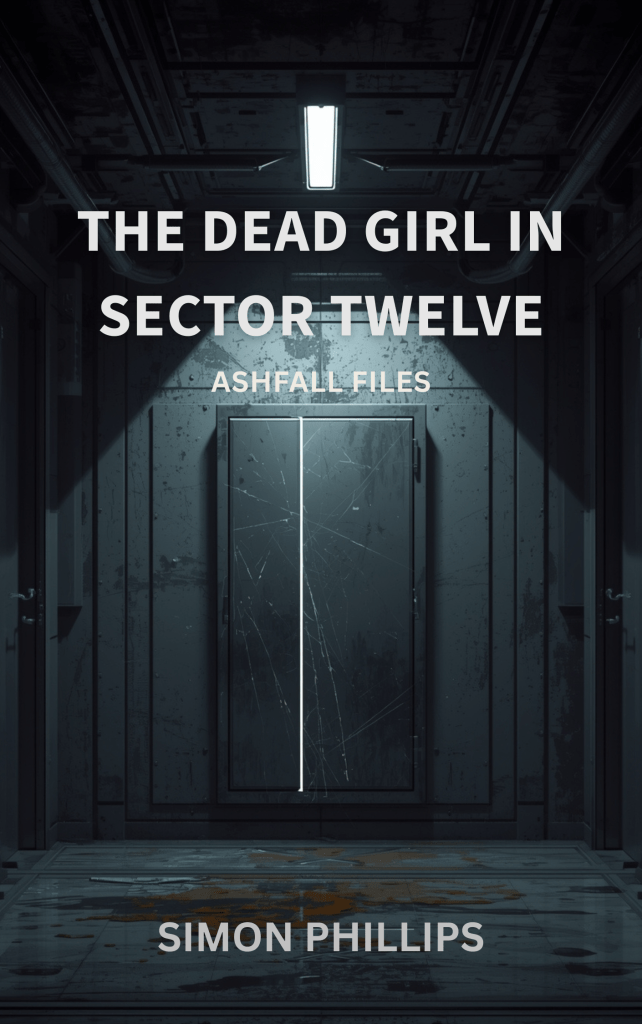
One such story unfolds aboard Ashfall Station, an ageing orbital installation whose corridors and industrial sectors form the setting for the science-fiction mystery novella Ashfall Station: The Dead Girl in Sector Twelve. What begins as a routine investigation gradually reveals that something hidden within the station’s structure may have been present for far longer than the official records suggest.

Readers who wish to explore the full investigation and its unfolding events can find the novella below.

Explore the book:
Ashfall Station: The Dead Girl in Sector Twelve

You can watch his YouTube channel here:
Author Simon Phillips


Continuing the Chronicle

The following Chronicle reconstructs the approach of the freighter Meridian Wake during the arrival cycle when pilots travelling through the outer debris field first reported a repeating signal drifting somewhere beyond Ashfall Station’s navigation corridors.

At the time the transmission appeared to be little more than an unidentified anomaly detected by a single vessel during routine approach procedures. Navigation officers reviewing the report recorded no registered transmitter within the surrounding debris field, and the station’s sensor arrays detected no active beacon operating within the region identified by the freighter’s communication logs.

Later examination of archived navigation records suggests that this brief encounter may represent one of the earliest documented observations of the signal that would gradually become known among pilots travelling the outer routes toward Ashfall Station.

Readers supporting The Future Chronicle can continue the record below.

Subscribe to continue reading

Subscribe to get access to the rest of this post and other subscriber-only content.

When Modern War Stops Being Distant: Britain, NATO, and the Pressure Beneath Political Calm

The first pressure is rarely announced as war

Modern war does not always arrive first as fire on the skyline. Sometimes it arrives as a changed route, a delayed convoy, a guarded gate, a school rumour, a longer queue at a port, or a government phrase that no longer has enough strength to hold the truth inside it.

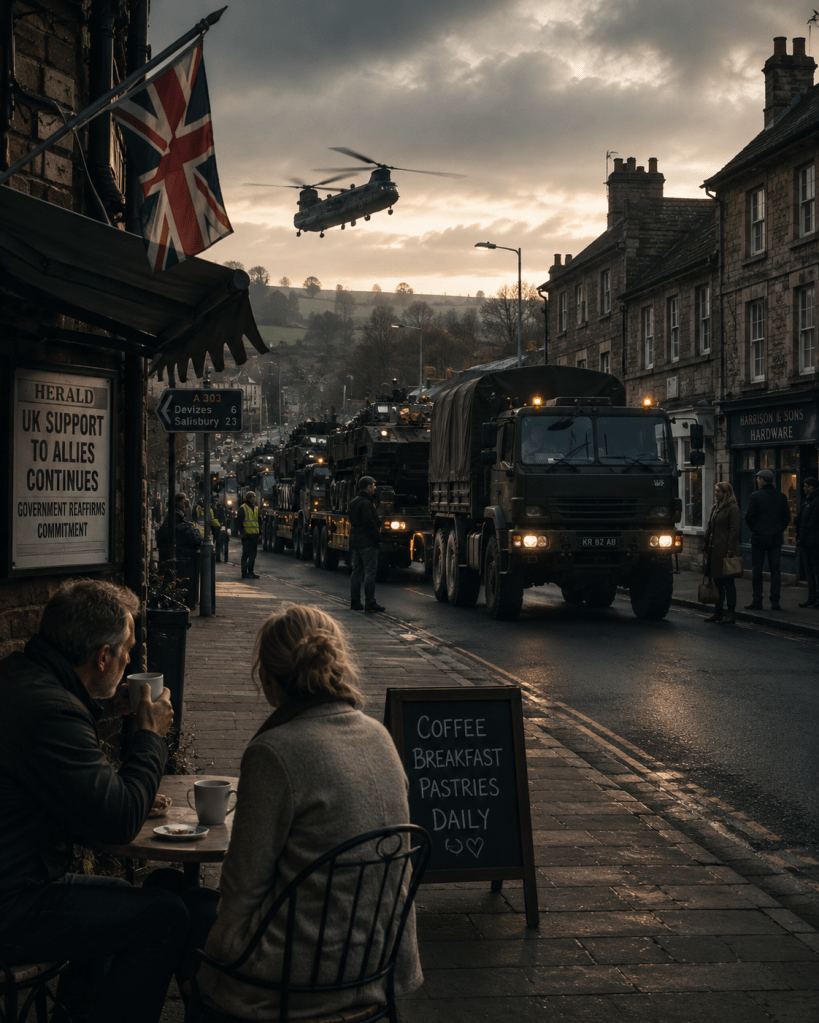
In grounded modern war fiction, Britain is rarely most interesting when it is already burning. The deeper tension begins earlier, when ordinary systems keep moving while the meaning beneath them changes. A freight yard still opens. A school still takes registration. A minister still speaks of restraint. A soldier still loads crates under rain. A family still eats at the kitchen table while the television softens danger into careful language. Nothing has fully broken yet, and that is what makes the atmosphere more frightening.

This is the world entered by Managed Distance Breaking, the opening novella of The Last Deterrence. It is a British war fiction novella about the stage before open war becomes undeniable, when NATO crisis fiction is still able to wear the clothes of policy, logistics, reassurance, and routine. The conflict remains officially elsewhere, yet every practical detail begins to suggest that distance has already failed.


Public calm and private movement

A country under pressure often speaks in layers. There is the public language, made for kitchens and news bulletins. There is the private language, spoken in offices, briefing rooms, depots, and command spaces. Then there is what is actually happening on the ground, where phrases such as support, preparedness, resilience, and restraint have to become fuel, medical crates, aircraft dispersal, armed guards, road priority, and exhausted people making bad systems work for one more night.

That gap matters. It is where political military fiction about Britain can become more than speeches and strategy. The real strain appears when government language tries to remain calm while the physical country beneath it is already changing shape.

In Managed Distance Breaking, the pressure does not come from spectacle. It comes from the slow recognition that support is no longer cleanly separate from participation. Aid to Ukraine and Europe is not abstract. It has to move through ports, road networks, military bases, freight yards, rail options, and civilian workers whose own lives are already stretched. Once those routes matter, they can be delayed, overloaded, watched, probed, and struck.

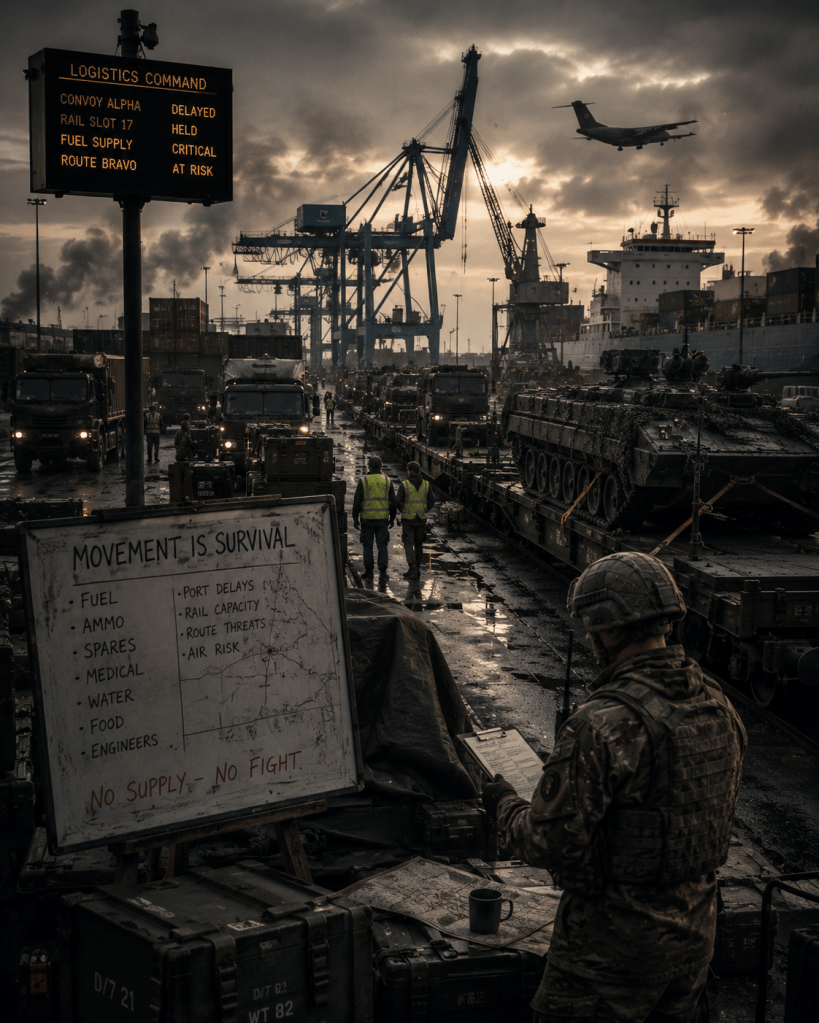
Modern war punishes movement. It punishes concentration. It punishes visible preparation. That is why infrastructure becomes as important as the battlefield. A port is not just a port. A rail spur is not just a rail spur. A fuel compound, a logistics site, a transfer yard, a guarded airfield, and a civilian freight lane all become part of the pressure map.

The public may still hear that Britain is steady. The people moving the weight know something has altered.


The family as a national pressure system

War fiction often widens too quickly. It reaches for maps, briefings, fronts, and declarations before the reader has felt what national danger does to a household. Yet the domestic line is where public truth is tested first. A family hears the softened words, sees the altered routines, and learns to read the spaces between them.

A school teacher notices the way pupils bring adult fear into the classroom as jokes, rumours, and half-understood politics. A daughter near government hears how phrases are shaped before they reach the public. A soldier sees how support becomes physical labour before anyone admits it has become military exposure. Another family member at a port sees the same pressure through containers, shift overruns, and freight chaos. A younger child feels it through cancelled buses, strange adult silences, and the slow loss of ordinary certainty.

That is what gives a modern war novella series its human spine. The war is not simply out there. It is distributed through family life. It reaches one person as a briefing, another as a queue, another as a route order, another as a classroom question, another as a message that arrives too late or says too little.

The Mercer family at the centre of The Last Deterrence carries that split. Leah, Helen, and Daniel do not experience the same truth at the same time. They cannot. One is close to government language. One is surrounded by civilian consequence. One is inside military movement. The emotional power comes from the fact that all three are right in partial ways, and all three are denied the whole shape of what is happening.

That separation is essential to grounded world war escalation fiction. When every character knows everything too early, tension collapses into explanation. When knowledge is uneven, the world feels larger, colder, and more believable.


Logistics as the hidden battlefield

The glamour version of war ignores logistics until it needs a dramatic convoy. A more serious war novel about modern technology has to understand that movement itself becomes a target. Drones, missiles, surveillance, digital systems, damaged roads, exposed depots, and stretched civilian infrastructure all make the act of moving material dangerous.

Before a soldier fires a shot, somebody has to load, route, fuel, guard, sign, scan, delay, unload, and reload. Somebody has to decide which civilian freight loses priority. Somebody has to explain why supermarkets, ports, buses, petrol stations, and schools are being touched by a war that the public has been told is still distant.

That is where the phrase “managed distance” begins to fail. Britain may still describe its role as support, yet support has weight. It takes up road space. It uses drivers, ships, rail slots, fuel, security, airfields, and political credibility. It creates patterns that adversaries can read. It makes domestic weakness visible.

In this kind of NATO crisis fiction, the first battlefield may be the route network. Not because roads and ports are more dramatic than soldiers, but because soldiers cannot exist apart from them. The state may speak from a lectern, yet the war moves through a gate in the rain.


NATO hesitation without caricature

A restrained political war thriller about Britain should not treat NATO hesitation as cowardice or simple incompetence. Alliance politics are slower and more strained than that. Every state has its own public, military limits, geography, stockpiles, industrial weaknesses, elections, memories, and fears. To move together, allies must translate danger into language each capital can survive.

That makes hesitation part of the drama. A government may know more than it says and still not know enough to speak plainly. It may fear panic at home as much as misreading abroad. It may need to reassure allies while avoiding a phrase that locks it into action before the military system is ready.

In Managed Distance Breaking, this strain is felt through the changing relation between Germany, Britain, NATO support, and the Russia-Ukraine war. The point is not to reduce escalation to one dramatic decision. It is to show how pressure accumulates until careful language becomes too thin for the events it is meant to contain.

The most dangerous moments are not always the loudest. Sometimes they are the moments when everyone still speaks calmly because no one can afford the alternative.


Drones, signals, and the loss of a safe rear

Drone warfare fiction often focuses on the machine itself: the object in the sky, the strike, the surveillance, the sudden violence. Yet the deeper unease lies in what drones do to the idea of distance. They make the rear feel watched. They turn fences, fuel points, cameras, and minor outages into signs that something hostile may already be inside the system.

A drone does not have to destroy a base to change how the base feels. A cut feed, a broken device near a fence, a temporary light failure, or a small intrusion at the wrong hour can force armed men to move differently on home soil. It changes posture. It changes sleep. It changes the meaning of a quiet night.

That is the beginning of the no-safe-rear logic. Not full collapse. Not spectacle. A subtler and more frightening transition: ordinary military space becomes alert space, then guarded space, then exposed space. The country has not yet admitted it is in the war, yet parts of it are already behaving as though the war has found them.


Why the first book begins before the explosion

There is a temptation in world war escalation fiction to hurry. To reach the declaration, the strike, the invasion, the nuclear threshold, the ruined city. Yet escalation only has force when the reader understands what has been lost before the obvious loss begins.

Managed Distance Breaking begins with the failure of ordinary reassurance. It lets the reader feel the country before open war has hardened it. Downing Street still speaks in careful phrases. Schools still operate. Freight still moves. Soldiers still joke while hauling loads. Families still argue about buses, food, work, and whether anyone is saying the whole truth.

That matters because later destruction needs memory. Places must feel inhabited before they are damaged. Systems must feel functional before they fail. Relationships must have humour, irritation, habit, and warmth before fear begins to alter them.

The novella’s pressure lies in recognising that the state, the family, and the military are all moving at different speeds towards the same conclusion. The public is told that things are manageable. The people closest to the machinery can feel that manageability thinning. The soldier sees the change first in orders, routes, load sheets, and posture rather than in speeches.

This is why the book does not need to shout. Its unease comes from delay, repetition, wet roads, freight lanes, official rooms, and the growing suspicion that every ordinary process has acquired a second meaning.


The road towards the nuclear threshold

The Last Deterrence is not only about the opening phase of war. Its wider world points towards darker territory: open European war, global overload, nuclear threshold fiction, and eventually post-nuclear survival fiction in Britain. Yet the early books matter because the final threshold must never feel like a shortcut.

Nuclear fear becomes hollow when it appears too early as spectacle. It becomes credible when it emerges from accumulated failure: conventional war that cannot decide anything cleanly, alliances under intolerable strain, infrastructure exposed, command confidence damaged, public truth corroded, and leaders forced to make decisions under shrinking time and worsening information.

That road begins with smaller failures. A phrase that no longer holds. A logistics system that cannot stretch further. A family that stops believing reassurance. A soldier recalled from one kind of work into another. A government discovering that calm has become expensive.

The aftermath, when it comes, must also grow from this same world. Not wasteland fantasy. Not instant lawlessness. A half-surviving Britain would still have queues, notices, local councils, ration points, military remnants, missing-person lists, exhausted teachers, damaged ports, guarded depots, and people arguing over who has the right to give orders. The horror would not be emptiness. It would be uneven survival.


Entering Britain before it understands itself

The strength of grounded modern war fiction lies in what it refuses to simplify. War is not only battle. Politics is not only speeches. Family life is not only worry. Military service is not only action. Each becomes part of the same strained system, and the pressure moves through all of it.

Managed Distance Breaking enters Britain at the point where the old distinction between elsewhere and here begins to fail. It does not ask the reader to admire war. It asks them to feel how a country starts changing before it has the courage, evidence, or permission to say plainly what is happening.

A road remains a road until it becomes a route.
A port remains a port until it becomes a pressure point.
A school remains a school until children start bringing the war in through rumour.
A family remains ordinary until every silence starts to mean more than it should.
A government remains calm until calm itself becomes part of the deception.

The world does not end in the opening movement. That is not the point. The more unsettling truth is that it continues. Lights stay on. Meals are made. Statements are issued. Vehicles move. People go to work. Children ask questions adults cannot answer cleanly.

The change comes first through roads, rooms, queues, gates, silences, and delays.

Understanding follows later.

The Mythic Chronicle: The Clerk Who Folded Inward

A record of a death where the body settled against itself, and the room retained a stillness that did not pass with breath or with time.


The Record of the Upper Chamber

The room stood above the lane where the evening light lingered longest, its windows set high above the street and its shutters drawn back just enough to admit the last of the day. What entered passed across the floor in a narrow band, touched the foot of the bed, and faded slowly into the dimness, while the chamber held to itself with a quiet reserve that seemed older than the house around it.

The man who had occupied it kept his surroundings in a way that spoke of habit more than comfort. Papers rested in measured piles upon the table, each set bound with cord drawn tight and turned once more through the knot for certainty. The chair stood close to the table’s edge, its legs worn in the same places by years of being pulled back and returned. The coverlet upon the bed had been smoothed in the morning, and a coat still hung from the peg beside the door as though the next hour had been expected to proceed as every other hour before it.

When the room was opened after his death, those who entered remarked first upon the stillness that lay inside it. It settled against the body and held there, deepening the breath and slowing the step, until even the smallest movement seemed to travel farther than it should.

“You felt it as you came in,” said the woman who stood just inside the threshold, her voice lowered by the space before she seemed aware of it. “It presses upon the chest.”

The constable remained with one hand upon the latch for a moment longer, as though the act of releasing it required more thought than usual. The air gathered around him with a quiet weight, and his first breath within the room drew shorter than the one he had taken in the passage.

“It is close in here,” he said at last. “The window should have eased it.”

“It stood open when they found him,” the woman replied. “They left it so for most of the night.”

He stepped fully inside and allowed the door to rest behind him, while the floorboards received his weight with a low creak that seemed to drift thinly through the chamber before settling into the walls. He gave his attention to the bed first, then to the window, then to the table, as though the proper order of ordinary things might restore the room to reason.

“Who found him?” he asked.

“A neighbour from the next house,” she said. “He came for a ledger that had been promised and never brought down.”

“And the state in which he was found?”

She paused then, her eyes returning to the bed with the same reluctance they must have carried the first time. “He had fallen,” she said, “though the form of it carried little of an ordinary fall.”

The constable moved nearer, each step measured and deliberate. The sheets had been drawn back after the body was taken away, though an impression remained in the fabric. It ran inward in a shape that troubled the eye, as though the weight that had made it had folded towards itself before it came to rest.

He stood over it for some moments in silence. The evening light had weakened by then, and the room seemed to hold more of its own dimness than the hour should have given it.

“There is no sign of struggle,” he said.

“None was spoken of,” the woman replied.

“No cry heard through the wall?”

“None that anyone would swear to.”

He bent slightly and held his hand above the sheet, close enough to feel the air gathered there. His expression altered in a way so slight another man might have missed it, though the woman at the door saw it clearly and lowered her gaze.

“It holds itself,” he said quietly.

“It returns,” she answered.

His eyes moved to the window again. The shutters remained open, and a faint current entered from the lane outside, carrying the last sounds of trade and passage below. That air entered the room and weakened within a few feet, as though the chamber accepted it only to set it gently aside.

“You kept the room open after he was found,” he said.

Yes.”

“And the air changed?”

“For a little while.”

He turned away from the bed and crossed to the table. The wood felt cool beneath his palm, and the papers upon it remained aligned with the care of a man who had expected to return to them. He lifted the edge of one packet and let it rest again, the slight sound of cord against paper carrying thinly through the room.

“He had been working,” he said.

“He always worked at that hour.”

“And then crossed to the bed.”

“That is how it appeared.”

The constable studied the chair, then the space between chair and bed, then the bed again. “He rose of his own will,” he said.

“That is what the room suggests.”

He looked towards her then. “The room suggests many things.”

She received that without change. “It does.”

He moved back towards the bed and placed his fingertips lightly upon the sheet. The fabric yielded at once, though the air above it seemed to gather around his hand and hold there, as though preserving the memory of weight after the weight itself had gone. He withdrew at once and straightened, his fingers curling briefly before he let them fall.

“It settles over the bed more strongly,” he said.

“Yes.”

“And nowhere else?”

The woman’s gaze shifted towards the chair by the table. “It held there as well, on the first evening. Less now.”

He followed her look. The chair stood with one leg turned slightly inward, the smallest disturbance in an otherwise ordered room.

“He became aware of something,” she said.

The constable remained silent for a moment. Then he asked, “You speak as though you had seen it.”

“I saw the room after,” she replied. “At times that is enough.”

He accepted that with the reserved expression of a man who had learned that certain answers closed more doors than they opened. His attention returned to the walls, which held plain plaster above old timber, sound enough to the eye and giving no sign of breach or entry.

“There is no mark of another presence,” he said.

“No mark that would satisfy a ledger.”

That drew his gaze back to her once more. She stood with her hands folded before her, composed in the way of those accustomed to difficult rooms and the stories that gathered inside them. Her age was hard to place in the dimness. Her voice had the steadiness of one who had long practised the art of speaking plainly when others wished for easier versions of events.

“It will be entered as failure of the body,” he said.

“Yes,” she replied.

“The position in which he was found will be noted.”

“Yes.”

He glanced again at the bed, then at the chair, and the stillness within the room seemed to draw closer, as though it heard and waited. “There will be no advantage in saying more than that.”

“There rarely is.”

The light had faded enough by then that the lamp in the passage cast a pale shape across the threshold. The constable went to the window and pushed one shutter wider, allowing more evening air to enter. For a brief moment the chamber eased, though the change remained slight and passed almost at once, the weight in the room settling back into its earlier form with a patience that carried something deeply unsettling in it.

He stood very still as that happened, and when he turned back his face had lost the last trace of practical certainty with which he had entered.

“How long has it remained this way?” he asked.

“Since the body was carried out.”

“And each time the room was entered?”

“It gathered again after every disturbance.”

The constable gave a slow nod and moved towards the door. He paused at the threshold, then looked back once more upon the bed, the table, and the ordered papers that would never be touched by the hand that had arranged them.

“Have the room closed,” he said. “There is little to be gained from leaving it open.”

“It will remain as it is.”

“I believe that.”

The woman stepped forward after he had passed into the corridor. She took one last look inside before drawing the door towards her. As it moved, the room seemed to gather itself more fully, the stillness deepening over bed and chair and table alike, while the dimness within held its place against the fading day.

When the latch settled, the chamber was shut again. Within it, the impression upon the bed remained, the papers waited in their ordered stacks, and the air drew inward once more into the same quiet state, patient and unchanged, as though it required no witness in order to hold what had occurred there.


Foundation Register: Lower Chamber Storage Record

The chamber recorded within the upper district plans appears as a private room set above the adjoining trade lane, its structure resting upon earlier timber and plaster whose alterations are noted across several revisions of the building. Surviving layouts refer to the space only in domestic terms, with no indication that it held any distinction beyond its use as a place of work and rest for its occupant.

During routine inquiry following a reported death within the room, entries began to note irregular conditions concerning the atmosphere of the chamber, where the air was described as holding its density beyond expected limits, and where the space failed to clear despite the opening of shutters and the introduction of air from the street below. These observations were recorded alongside the primary account and attributed to the enclosed nature of the room, as well as the materials of its construction and the arrangement of the surrounding structures.

Further entries describe the persistence of these conditions across repeated visits, noting that the atmosphere within the chamber appeared to settle into a consistent state after disturbance, returning to that state regardless of how long the room remained open. The effect was observed in each instance without variation, and no external source within the adjoining properties was identified that might account for the behaviour.

The death itself was entered in practical terms, with the position of the body recorded as having settled in a manner that did not align with an ordinary fall. This detail was included without expansion and was not pursued beyond its initial notation, the cause being assigned to failure of the body under strain.

A marginal notation, written in a later hand, refers to the chamber as holding “a retained stillness”, a phrase set apart from the primary entry and left without further clarification. The notation appears once and is not repeated within the register.

Subsequent entries indicate that the chamber remained in use following the incident, with no structural alteration or remedial work recorded. Recommendations were limited to continued ventilation and ordinary oversight, and the absence of further reports was taken as sufficient indication that the condition had stabilised.

No connection was made between this chamber and other irregularities noted within the district, and the record concludes with the structure listed as functional, its condition accepted without further inquiry.


About the Creator

The Mythic Chronicle is written and curated by Simon Phillips, a writer of mythic and speculative fantasy whose work explores the quieter edges of forgotten worlds, where buried structures, fractured records, and lingering presences continue beneath the surface of recorded history.

The accounts preserved within these Chronicles form part of a wider body of work in which cities stand upon older foundations, and events recorded as isolated disturbances are understood, in later tellings, to belong to patterns that were never fully recognised at the time.

One such account survives in a separate record, detailing an incident within a lower district where a death was first dismissed as excess, though the space in which it occurred retained a presence that resisted clearing, and where investigation revealed signs that the disturbance had not been confined to a single room.

This record is preserved in the novella Black Feathers in a Brothel, where the events surrounding that incident are followed more closely, though even there the full nature of what lay beneath the structure remains uncertain.

Readers who wish to examine that account in its fuller form may find the record below.

Explore the book:
Black Feathers in a Brothel

You can watch his YouTube channel here:
Author Simon Phillips


Continuation of the Record

What follows is taken from later accounts concerning the upper chamber, where the death was first entered as a failure of the body, and where the condition of the room was noted in passing within the same record. Subsequent entries describe the persistence of the atmosphere across repeated visits, where the space was observed to settle into a fixed state, and where the stillness remained after each disturbance, returning as though it held to a form of its own.

Subscribe to continue reading

Subscribe to get access to the rest of this post and other subscriber-only content.

The Forgotten Chronicle: The Great Heathen Army Arrives

When Viking raiders crossed the North Sea not for plunder, but for conquest, and the kingdoms of England faced an invasion unlike any they had known before.


East Anglia, AD 865

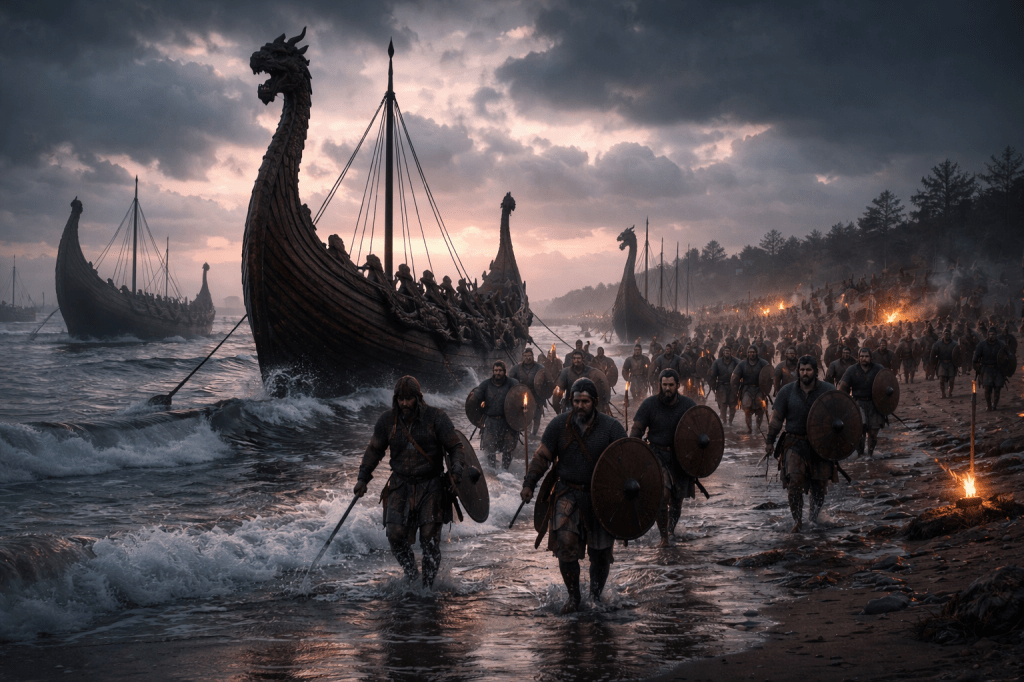
Late summer light lay across the waters of the North Sea as the longships came westward. Their prows rose and fell with the grey swell, carved beasts lifting above the spray as if ancient spirits guided the fleet across the restless tide. Sailcloth hung heavy with salt wind, striped patterns shifting beneath a sky where low cloud drifted in slow procession. Rowers moved in steady rhythm beneath the wooden ribs of the vessels, oars dipping and lifting as the shoreline of East Anglia began to gather form upon the horizon. From the sea the land appeared low and quiet, a line of marsh and sand broken by darker woods inland, fields stretching beyond toward villages where the harvest season had already begun.

Fishermen along the coast first glimpsed the shapes that morning, dark silhouettes rising from the mist beyond the shallows. At first glance the ships resembled many others that crossed these waters in trade, vessels from Frisia or the Danish coasts bringing amber, furs, iron tools, and news from distant shores. As the fleet pressed closer the number of hulls became clear, their ranks spreading across the sea in disciplined order. Shields lined the rails in painted rows of red, yellow, and black, a wall of colour against the pale surf. Warriors gathered along the decks in mail and leather, helms catching the muted light while spearheads glimmered above the gunwales. Word travelled inland through farm tracks and village paths as riders hurried across the fields, their warnings carried from settlement to settlement while the tide lifted the longships toward the beaches.

By afternoon the fleet reached the mouth of a quiet estuary where sandbars curved along the coast like pale ribs beneath the water. The first vessels grounded upon the shore with a grinding of timber and stone, keels sliding across wet sand as men leapt into the surf and hauled ropes forward. More ships followed in a widening arc, sails falling as crews dragged them higher along the strand. Smoke from village hearths drifted above the distant fields while the army gathered along the waterline in growing numbers, voices rising through the wind as banners lifted above the ranks. These arrivals carried a different purpose from the fleeting raids remembered along the coasts of Northumbria and Mercia. Camps began to take shape among the dunes as wagons were drawn ashore, horses led down the ramps of larger vessels, and scouts rode inland through the open country. The people of East Anglia watched from the edges of woodland and farmland as the strangers established their presence upon the shore, an encampment of warriors whose intentions stretched far beyond a swift strike against monastery or market town. Across the fading light of that evening the longships rested upon the beach in long dark lines, their carved prows facing the sea while the fires of the newly arrived host flickered against the gathering dusk.


Timeline of Events

793 AD — Viking raiders attack the monastery of Lindisfarne off the coast of Northumbria, marking the beginning of recorded Viking raids on England.

Late 8th to mid 9th century — Small Viking fleets strike monasteries, ports, and coastal settlements across Britain and Ireland, usually arriving in summer and departing with plunder before winter.

Early 860s — Scandinavian war leaders begin assembling larger forces across Denmark and Norway, bringing together warriors who had previously raided in smaller groups.

865 AD — A vast Viking host later known as the Great Heathen Army crosses the North Sea and lands in East Anglia, marking the shift from seasonal raids to organised invasion.

866–867 AD — The army marches north and captures York, overthrowing the Northumbrian kings and establishing Viking control over the city.

870–871 AD — Viking forces campaign across Mercia and Wessex, leading to major battles with the West Saxon kingdom.


About the Creator

This Chronicle is written by Simon Phillips, author of several historical and speculative fiction works exploring forgotten worlds, myth, and the turning points of history.

You can explore his books here:
Books by Simon Phillips

You can watch his YouTube channel here:
Author Simon Phillips

Subscribe to continue reading

Subscribe to get access to the rest of this post and other subscriber-only content.

The Mythic Chronicle: The Room That Would Not Clear

A chamber where the air returned to itself, and the presence remained after every closing.


The Record of the Lower Chamber

The chamber appeared on the older plans as storage, though nothing within it suggested a clear purpose beyond enclosure. It lay below the trade houses, reached by a narrow stair that bent once before settling into stone, where the air cooled too quickly and the light from above faded sooner than expected. Those who worked the lower district spoke of it in passing, naming it according to the street from which they entered. Some called it the back cellar, while others referred to it only as the lower chamber, as though withholding a name might lessen their share in it. Across all accounts, one detail held steady and settled into the telling with a quiet certainty. Each time the door opened, the air returned to the same state.

On the first night the record took hold, the room belonged to a merchant of cloth whose stores occupied three adjoining properties above the lane. Bolts of linen rested in the upper rooms, while cheaper dyed stock filled the lower spaces where damp rose through older stone and left a pale bloom along the walls each winter. The chamber itself stood apart from the regular stores, set behind a thick partition and entered through a door whose latch required lifting twice, a small resistance that had endured longer than memory cared to trace.

Edrin came down with the keys after dusk, once the ledgers had been closed and the younger boys sent home with thread still clinging to their sleeves. He carried caution as part of his trade, though he placed trust in what could be weighed and handled. Mould held its place as mould, rot remained rot, and stale air followed neglect. Even so, as he stepped onto the lower stair with the lamp in his hand, his tread softened without his intending it, and the motion settled into him as something he did not question until later.

The sound of the street lingered above him at first, reduced by distance and floorboards into a low, shifting presence. Then the stair bent, and the life of the district withdrew all at once, leaving only his own steps joined by the quiet movement of the lamp flame within its glass.

At the foot of the stair stood Jorren, one hand resting on the iron latch, the other drawn close against his coat as though the cold had reached him before the door had opened. He was a man of figures and measures, known for precision and a reluctance to overstate anything that could be written plainly. That evening, his composure carried a strain that sat uneasily upon him, and it showed in the way he held still when Edrin approached.

“You took your time,” Jorren said.

“The books would not close themselves,” Edrin replied, raising the lamp slightly as his gaze moved over the door. “You sent word as though the wall had given way.”

Jorren stepped aside at once, his movement restrained and deliberate. “Nothing has given way,” he said. “That is the trouble.”

Edrin regarded him briefly, then turned his attention to the door, allowing the moment to settle without pressing it further. “I had not thought sound walls worth a summons,” he said.

Jorren offered no reply, though the silence between them carried more than agreement. He lifted the latch.

The door opened inward with a dull drag, timber pressing close against stone before yielding. The chamber received the light without warmth, and the space within revealed itself slowly as the flame spread across it. It stretched wider than most cellar rooms in that part of the district, though the far end dipped low beneath a beam that carried the marks of long use. Shelves lined one wall, holding a scattering of wrapped bundles and jars left too long without purpose. A table stood near the centre, its surface bare save for a folded cloth and an empty bowl. Nothing lay overturned, and nothing bore the mark of intrusion, yet the absence of disturbance failed to bring any ease.

Edrin paused at the threshold, held there by a resistance that did not belong to the door or the stone. The air pressed gently against the face and chest, settling rather than moving, as though the room had been closed beyond simple enclosure. Something had gathered within it, and that gathering remained, quiet and insistent.

He stepped in, and the smell rose at once, damp plaster and old timber bound too closely together, carrying a sharper trace beneath them, dry and bitter, as though something had been scorched without flame. The lamp flame shortened where it stood, its light thinning at the edges as though the air had lost some willingness to hold it.

“When did you first notice it?” he asked.

“At closing,” Jorren said, entering behind him and closing the door with care. “Mira was below sorting stock. She came up saying the air would not clear.”

Edrin set the lamp upon the table and looked around, taking in the walls, the shelves, and the beam above. The haze lay faint within the chamber, almost absent, though the light struggled to carry fully across it, as though something held it back from reaching the far side.

“She opened the door?”

“She did. Left it wide.”

“For how long?”

“Long enough that it should have eased.”

“And it stayed?”

“It returned.”

Edrin moved to the nearest wall and placed his hand against the plaster, allowing the contact to settle before drawing any conclusion. It held cool and steady beneath his palm, and no fresh damp marked the surface. No seam or flaw offered explanation, and the stone carried its weight as it should.

“Mira thought the dye room carried through,” Jorren said, his voice lower now, as though the space required it.

“And you?”

“I said she should mind her count before naming causes.”

Edrin gave a faint nod, not in agreement, though in acknowledgement that the words had been spoken. “Fetch her,” he said.

Jorren hesitated for a moment, as though weighing whether the request would bring clarity or deepen what had already begun, then turned and left without further word. The door closed behind him, and the chamber settled more fully into itself as the second presence withdrew.

Edrin remained alone, and the silence deepened in a manner that drew his attention rather than eased it. It held between sounds instead of around them, filling the small spaces where quiet should have rested empty. He lifted the lamp and walked the perimeter, his shoulder brushing close to the wall at the narrower end, and there the pressure increased, faint though persistent, pressing inward as though the space drew itself towards a centre he could not see.

He slowed and listened, though no sound answered in any clear fashion. Even so, the room failed to feel empty, and it retained a suggestion of presence, quiet and patient, holding its place without movement or voice. The sensation lingered long enough that it settled into him before he chose to move again.

He turned from the wall and opened the door, leaving it wide and allowing cold air from the stair to drift into the chamber. For a brief moment the weight thinned, and the room seemed to release what it held, though the change failed to carry. The air gathered again, restoring itself as though the opening had been noted and allowed for.

When Jorren returned with Mira, Edrin stood near the table, watching the atmosphere settle back into its earlier form.

Mira paused at the threshold, her sleeves rolled, her hands marked with faint traces of dye. She studied the room before entering, measuring it against memory rather than expectation, and the hesitation in her stance carried a quiet certainty.

“You wished to hear it from me,” she said.

“I wished to hear what you found,” Edrin replied.

She stepped in, her gaze drawn to the chair near the table, as though that simple object held more weight than the walls themselves. “I found nothing,” she said.

“What brought you up the stair?”

“The sense that I had been joined.”

Jorren shifted behind her, though he held his tongue for a moment before speaking. “That is not how you said it.”

She kept her eyes on the chair, her voice steady though her posture held tension. “Before, I was told not to make a story of air.”

Edrin raised a hand, quieting them both before the exchange could take hold. “Begin again,” he said.

Mira nodded, drawing a breath that settled unevenly in her chest before she spoke.

“I came down after supper,” she said. “The room held as it always had. I set the lamp and began sorting the bundles. One had taken dust, so I shook it out, and the dust lingered longer than expected. I thought the air had turned close with the weather, though that thought did not hold for long. After a while, the room changed.”

“In what way?”

“It filled.”

Jorren made a small sound, though Mira continued before he could shape it into words.

“It felt as though someone stood behind me,” she said. “I turned, and no one was there. The door remained shut, though the air had taken on shape.”

Edrin watched her closely, allowing the words to settle before pressing further. “And then?”

“I opened the door. It eased. I closed it. It returned.”

The chamber seemed to receive that answer and hold it, the silence thickening in response.

Edrin drew the chair back across the floor, and the scrape carried further than the movement required. He placed it near the threshold and told Mira to stand where she had stood before. Jorren remained by the stair, his hand resting against the latch, while Edrin opened the door wide and stepped aside.

Cold air entered, and the flame steadied as the space shifted for a moment into something ordinary. The pressure eased just enough to suggest that it might not return.

“There,” Jorren said, the word coming too quickly to carry weight.

The air gathered again, and it did so without haste, returning first at the throat, then along the chest, drawing inward with quiet certainty. Mira lowered her gaze, and Jorren’s grip tightened on the latch as the chamber reclaimed itself beneath the open door.

“It is back,” Mira said, her voice low, as though speaking louder might draw it closer.

Edrin said nothing. He moved halfway towards the threshold and stopped, for from that point the change revealed itself most clearly. The outer air entered, though it failed to take hold, and the room restored its own condition beneath it, steady and untroubled by interruption.

He turned, taking in the walls, the beam, the worn floor beneath the table, and nothing within the space shifted or altered. Even so, the chamber carried a persistence that no simple confinement could account for, and that persistence settled into his understanding with a weight that would not move.

“Leave it open,” he said.

“All night?” Jorren asked.

“All night.”

“And if the damp reaches the stock?”

“Then we lose cloth.”

Mira watched him closely, her attention fixed upon him rather than the room. “And if it remains?” she asked.

Edrin met her gaze, and for a moment the answer held between them before he gave it voice.

“Then the room keeps something of its own,” he said.

The door stood open, and the stair beyond remained clear, while above them the district continued in its ordinary noise, unaware of what held beneath its floors. Within the chamber, the air settled once more, patient and unchanged, as though it required no concealment to remain where it had chosen to stay.


Foundation Register: Lower Chamber Storage Record

The chamber recorded within the lower district plans appears as an enclosed storage space set apart from the primary cellar structures, its construction resting upon earlier stone whose origin is absent from the surviving layouts. What remains within the register refers only to its use as an auxiliary holding room, with no indication that the space held any distinction beyond its position beneath the adjoining properties.

During routine inspection of storage areas, entries began to note irregular conditions within this chamber, where the air was observed to retain its density beyond expected limits, and where the atmosphere failed to clear despite repeated opening of the access door and the introduction of fresh air from the stair above. These observations were recorded without immediate concern and attributed to the enclosed nature of the space, along with the presence of damp within the surrounding stone.

Further entries describe the persistence of these conditions, noting that the atmosphere within the chamber appeared to restore itself after disturbance, returning to a consistent state regardless of the duration for which the room remained open. The effect was recorded across separate visits, with no variation observed between instances, and no external source identified within the adjoining structures that might account for the behaviour.

The condition was entered in practical terms, with recommendations issued for continued ventilation and periodic clearing of the space to prevent the accumulation of stagnant air. No unified cause was assigned within the register, and the matter was treated as a localised issue of storage conditions rather than a structural concern.

A marginal notation, written in a later hand, refers to the chamber as holding “a retained atmosphere”, a phrase left without further clarification and set apart from the primary entry without expansion or supporting detail. The note remains incomplete and is not referenced elsewhere within the record.

Subsequent entries indicate that the chamber continued to be used intermittently, with no formal record of alteration or repair entered into the register. The absence of further reports was taken as sufficient indication that the condition had stabilised, and the space was thereafter recorded as functional.

No connection was made between this chamber and other irregularities noted within the lower district, and the record concludes with the structure listed as stable, its condition accepted without further inquiry.


About the Creator

The Mythic Chronicle is written and curated by Simon Phillips, a writer of mythic and speculative fantasy whose work explores the quieter edges of forgotten worlds, where buried structures, fractured records, and lingering presences continue beneath the surface of recorded history.

The accounts preserved within these Chronicles form part of a wider body of work in which cities stand upon older foundations, and events recorded as isolated disturbances are understood, in later tellings, to belong to patterns that were never fully recognised at the time.

One such account survives in a separate record, detailing an incident within a lower district where a death was first dismissed as excess, though the space in which it occurred retained a presence that resisted clearing, and where investigation revealed signs that the disturbance had not been confined to a single room.

This record is preserved in the novella Black Feathers in a Brothel, where the events surrounding that incident are followed more closely, though even there the full nature of what lay beneath the structure remains uncertain.

Readers who wish to examine that account in its fuller form may find the record below.

Explore the book:
Black Feathers in a Brothel

You can watch his YouTube channel here:
Author Simon Phillips


Continuation of the Record

What follows is taken from later accounts concerning the lower chamber, where the condition of the air was first recorded as returning to a fixed state after each opening. Subsequent entries describe the persistence of this atmosphere across repeated use, where the space was observed to settle into itself regardless of ventilation or disturbance.

Subscribe to continue reading

Subscribe to get access to the rest of this post and other subscriber-only content.

Ancient Gods, Forbidden Magic, and the First Turning of an Epic Fantasy Saga


Where the Road Begins Beneath Winter Stone

A cold road leads into Bremyra, where the sea wind carries salt through narrow streets and old stone holds more memory than any living court dares to name. In The Unmarked Path, the opening novella of The Veil of Kings and Gods, magic is never treated as ornament. It belongs to law, fear, inheritance, and silence. It lingers beneath castle floors, inside sealed books, in the guarded breath of the Church, and in the hands of a magician who scarcely understands why the world has begun to turn around him.

This is the beginning of The Chronicles of the Spiral Realms, a serious adult high fantasy series shaped by ancient gods, forbidden magic, kingdom politics, fallen empires, and the slow return of truths buried beneath the present age. Ældorra is a world where mortal institutions believe they hold power, yet every crown, altar, and magical order stands upon older ground.


A World Built Over Forgotten Power

The world of Ældorra carries the remains of the Imperium Arcana, a fallen magical empire whose ruins still press through the age of kings. Its laws have decayed into custom. Its divine wounds have hardened into doctrine. Its power survives in fragments, watched over by institutions that remember enough to fear the past, yet never enough to understand it.

The Order of Magicians stands at the centre of that inheritance. Powerful, feared, and separate from crown or Church, the Order preserves magic through discipline and secrecy. Yet preservation is not the same as wisdom. Beneath its authority lies fracture, and beneath its history lies a truth far older than its masters are willing to face.

Opposite it stands the Church of Christiana, sacred and political in equal measure. Its cathedrals offer prayer, order, and memory, yet those memories are guarded by men who understand that truth can unmake authority as easily as war can unmake kingdoms. In this kind of mythic fantasy series, faith and magic are never safely divided. Each claims to serve the world. Each fears what the other might uncover.


Simion and the Burden of Reluctant Power

Simion enters the story as no triumphant chosen hero. He arrives tired, uncertain, and obedient, sent by the Order to Bremyra under instructions he only partly understands. His strength lies not in arrogance, but in restraint. He carries power, yet he also carries doubt, old loneliness, and the uneasy knowledge that magic has never fitted him in the way it fitted others.

That makes him central to the series’ tone. The Unmarked Path is an epic fantasy novella concerned with consequence before spectacle. Simion’s magic matters because it alters rooms, relationships, loyalties, and fear. When he walks through Bremyra, people remember the idea of magicians before they see the man. His black robe is enough to change the air around him.

Yet the deeper pressure comes from what he cannot explain. A hidden book. A seal. A divine whisper. A moment when magic moves through him in silence, beyond the methods the Order taught him. These are not answers. They are openings.


Kingdoms, Churches, and the Shape of War

While Simion is drawn toward buried magic, Prince Patrick struggles beneath the weight of mortal rule. Bremyra is a kingdom under strain, held together by court procedure, family duty, marriage alliances, and the absence of a king whose return grows less certain with every passing day.

Patrick’s world is political fantasy in its most human form. There are borders to guard, letters to answer, marriages to arrange, rumours to test, and enemies to watch. War does not arrive as grand spectacle at first. It arrives through uncertainty, through foreign blades in city streets, through reports from the north, through councils where no one has enough knowledge to feel safe.

Týrnan Valgrim’s northern arc gives that pressure another face. His people move south beneath the command of a High Chieftain whose ambition already carries a shadow. Týrnan is a war leader, yet not a simple raider or clean heroic figure. His path is marked by survival, honour, violence, and doubt. Through him, the series begins to show war as moral corrosion as much as military action.


Why Silent Gods Carry More Weight

The gods of The Chronicles of the Spiral Realms are powerful because they are distant. They do not stride through the mortal world giving simple answers. Their silence hangs over prayer, magic, fear, and memory. When divine presence touches the story, it arrives through pressure, vision, symbol, and burden.

This makes the series closer to ancient gods fantasy than conventional quest fantasy. The divine is not a ladder for characters to climb. It is a cost. Mortals pray into silence, institutions build doctrine around absence, and magicians inherit fragments of power whose origins have been softened by myth.

The Spiral itself belongs to that hidden language. It suggests recurrence, divine memory, forgotten truth, and a pattern returning through the lives of people who believe they are facing isolated crises. In The Unmarked Path, the Spiral is felt before it is understood. That restraint gives the saga much of its force.


Entering The Unmarked Path

Readers can begin the saga with The Unmarked Path, available on Amazon Kindle or paperback.

The novella opens the world without emptying it of mystery. It gives the reader Bremyra’s winter roads, the fear of magicians, the weight of royal duty, the unease of the Church, the first movement of northern war, and the sense that older powers have begun to stir beneath every visible conflict.

This is a fantasy novella series for readers who enjoy slow-burn epic fantasy, ancient gods, forbidden magic, magical orders, political tension, and worlds where history is never truly dead. Its power lies in the way the mortal and divine pressures touch one another. A prince’s council, a hidden chamber, a northern storm, a royal ambush, and a sealed book all belong to the same turning, even before the characters can see the shape of it.


The First Sign of a Larger Chronicle

The cover of The Unmarked Path captures that threshold well: a road leading through dark trees and ancient stones, spiral marks cut into a landscape where ruin and destiny seem to share the same breath. It is an image of entry rather than conclusion. The path waits. The title promises no certainty.

That is the heart of the opening novella. The world has not yet broken, yet the first strain is audible. The gods remain silent, yet something divine has already reached toward Simion. The kingdoms continue their ceremonies, yet war gathers beyond their borders. The Order still believes it controls magic, yet magic has begun to move beyond its rules.

The saga is entered through a road, a castle, a book, and a burden. What waits beyond them is older than any king’s claim, deeper than any archive, and far less willing to remain forgotten.

The Forgotten Chronicle: The Longship – Weapon of the Viking Age

The remarkable ship that turned the North Sea into a highway and allowed Viking sailors to strike the shores of Europe with speed and precision.

Northern Seas of Scandinavia: Early Viking Age

Along the windswept coasts of Britain, where narrow rivers met the restless waters of the North Sea and stone monasteries stood watching the long grey horizon, the monks who kept the written memory of the age had begun to record troubling reports carried slowly across the maritime world that connected the scattered shores of northern Europe.

Messages travelled gradually between the monasteries and trading settlements of the coasts, arriving with merchants who followed the sea lanes between England and the lands of the continent, with wandering pilgrims seeking distant houses of learning, and sometimes with fishermen who spoke of unfamiliar vessels sighted far beyond the shallows where the known trading ships usually sailed.

For generations the waters of the North Sea had served as a broad corridor linking distant communities, a place where commerce and travel moved with the rhythm of tide and weather as traders exchanged wool, timber, and crafted goods between the ports of Britain, Francia, and the Low Countries, while scholars and pilgrims crossed the same uncertain waters in search of devotion, learning, and sanctuary within the quiet walls of the monasteries that lined the northern coasts.

Yet beyond that familiar maritime world, along the broken coastlines and deep fjords of Scandinavia, a very different relationship with the sea had long shaped the lives of the people who lived among the mountains and narrow valleys of Norway and Denmark, where limited farmland and harsh winters had encouraged generations of seafarers to look outward across the northern waters in search of opportunity, trade, and sometimes plunder.

Within those northern communities, the craft of shipbuilding had developed steadily over many generations, as skilled builders shaped flexible oak planks along slender frames to produce vessels capable of moving with the motion of the sea itself while still remaining swift beneath both sail and oar, creating ships whose narrow hulls and shallow draught allowed them to travel across coastal waters, beaches, estuaries, and winding rivers that larger vessels could never approach.

The ship that emerged from this long tradition of experimentation and refinement would soon become known across the chronicles of Europe, for the vessel combined speed, balance, and adaptability in ways that made it uniquely suited to the restless northern seas, enabling its crews to cross the wide expanse of the North Sea with surprising speed before appearing suddenly along distant shores that had long believed themselves secure behind the uncertain barrier of the open water.

This vessel, which later generations would simply call the longship, represented far more than a tool of travel or trade, since its design embodied the accumulated knowledge of communities whose survival depended upon mastering the changing winds, tides, and currents of the northern seas, allowing its crews to approach almost any shoreline before withdrawing again into the wide waters from which they had emerged.

By the closing years of the eighth century, ships of this kind had begun to appear with increasing frequency along the coasts of Britain, sometimes arriving first as traders or explorers whose intentions remained uncertain, though the visits gradually became more troubling as small coastal settlements and isolated monasteries reported sudden attacks carried out by raiders who arrived swiftly from the sea before vanishing again beyond the horizon.

Word of these encounters moved slowly across the maritime world of the North Sea, recorded in fragments within monastic chronicles and carried through rumour and testimony between the scattered communities that depended upon the sea for travel and trade, while few at the time could yet recognise that these early attacks marked the beginning of a transformation that would soon reshape the balance of power along the northern coasts of Europe.

The quiet raids of the early Viking Age had begun.


Timeline of Events

793 AD — The attack upon the monastery of Lindisfarne sends shock across the Christian world, marking the beginning of what later generations would recognise as the Viking Age in Britain.

795 AD — Norse raiders strike the monasteries of Ireland, revealing that the northern seafarers have begun to range widely across the waters of the Irish Sea.

802 AD — Viking forces descend upon the sacred island monastery of Iona, destroying buildings that had stood for generations and demonstrating the growing reach of the northern fleets.

806 AD — A second attack upon Iona results in the killing of sixty-eight monks, an event recorded with deep sorrow in the surviving chronicles of the age.

820s AD — Raiding fleets begin appearing with greater regularity along the coasts of Francia and the Low Countries, extending the sphere of Norse activity beyond the shores of Britain.

830s AD — Viking expeditions increasingly follow the great river systems of Europe, travelling inland along waterways that lead deep into the heart of powerful kingdoms.


About the Creator

This Chronicle is written by Simon Phillips, author of several historical and speculative fiction works exploring forgotten worlds, myth, and the turning points of history.

You can explore his books here::
Books by Simon Phillips

You can watch his YouTube channel here:
Author Simon Phillips

Subscribe to continue reading

Subscribe to get access to the rest of this post and other subscriber-only content.

The Unmarked Path Is Available Now: Begin The Veil of Kings and Gods

The Unmarked Path Is Available Now

The Unmarked Path, Book 1 of The Veil of Kings and Gods, is now available.

This is the beginning of a new epic fantasy saga within The Chronicles of the Spiral Realms, a world of kingdoms, forbidden magic, ancient gods, buried histories, and mortal lives caught in the shadow of forces far older than they understand.

Every long fantasy series has a first doorway. For this one, that doorway opens in Bremyra, a coastal kingdom of stone, cold sea air, royal duty, old secrets, and the lingering fear of magicians. It begins with Simion, a magician of the Order who arrives under instruction, though even he has little idea why he has truly been sent.

He is not the kind of figure who strides into the story already certain of his destiny. He is uncertain, guarded, and burdened by the feeling that he stands in the wrong place at the wrong time. Yet around him, the world begins to shift. A hidden mission, a royal court under pressure, a princess bound by duty, northern raiders crossing the sea, and whispers of something sealed beneath the old stones all draw the story into motion.

The Unmarked Path is a slow-burn opening to a larger mythic fantasy world. It is built around atmosphere, character, mystery, and consequence. The story is not only about magic as power, but magic as inheritance, memory, fear, and responsibility.

At the heart of the novella is Simion, a reluctant magician shaped by the Order of Magicians, an ancient institution descended from a broken magical empire. He has been trained in power, discipline, and obedience, though he has never truly felt at home among those who taught him. When he arrives in Bremyra, he carries more than a letter from his superiors. He carries the first pressure of a destiny he cannot yet name.

Alongside him stands Prince Patrick, a royal son forced into responsibility while his father and brothers remain absent. Patrick’s world is one of council chambers, alliances, military pressure, marriage arrangements, and decisions made under uncertainty. His story brings the political heart of the novella into focus. Kingdoms are watching one another. Borders are tense. Peace feels formal rather than secure.

Then there is Týrnan Valgrim, a northern warleader whose people begin moving south across dangerous seas. His chapters carry the weight of iron, salt, storm, clan loyalty, and conquest. Through him, the wider world of Ældorra starts to open beyond Bremyra’s walls.

The novella also introduces Elana, Patrick’s sister, whose role reaches beyond royal duty. She brings warmth, intelligence, and emotional force into the story, while also revealing that the laws of magic in this world may be far more fragile than the institutions around her are willing to admit.

What begins as political unease slowly brushes against something older.

The history of Ældorra has been shaped by the Imperium Arcana, the Order of Magicians, the Church, the fallen god Azaroth, and the death of the God of Magic. Much of that history has faded into myth, yet myth has a way of returning when the world grows weak enough to hear it again.

That is where the Spiral begins to matter.

The Spiral is one of the central mysteries of The Chronicles of the Spiral Realms. In this first novella, it is not explained in full. It appears more as pressure, pattern, memory, and warning. It belongs to ruins, divine silence, forgotten truths, and the sense that history is not finished with the living.

For readers who enjoy fantasy that takes its time to build weight and atmosphere, The Unmarked Path offers the first step into a larger saga. It is not a light adventure or a simple quest story. It is a mythic fantasy opening about a world beginning to remember what it buried.

The story is for readers who enjoy:

ancient magical orders, reluctant magicians, royal courts under pressure, forbidden power, divine silence, old books, hidden chambers, political tension, northern warbands, and the feeling that a larger storm is gathering beyond the edge of the page.

This first novella is only the beginning. It opens the path, introduces the key players, and places the first cracks in the world. Simion does not yet understand what is reaching for him. Patrick does not yet understand how far duty will carry him. Elana does not yet understand the cost of the power within her. Týrnan does not yet understand what his people’s march will awaken.

The reader, like them, enters at the point where history begins to turn.

The Unmarked Path is available now on Amazon Kindle.
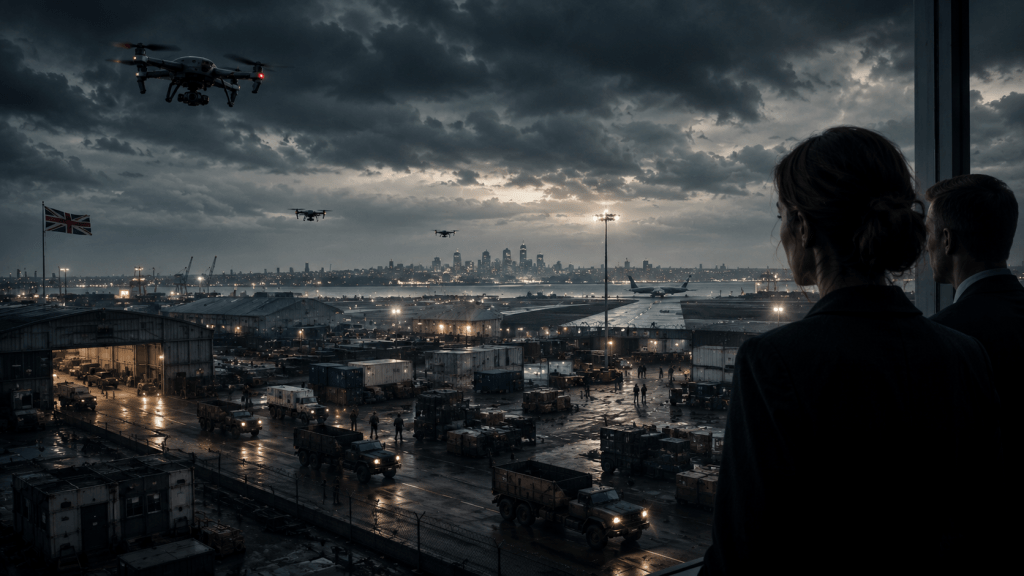
Begin the saga with The Veil of Kings and Gods.