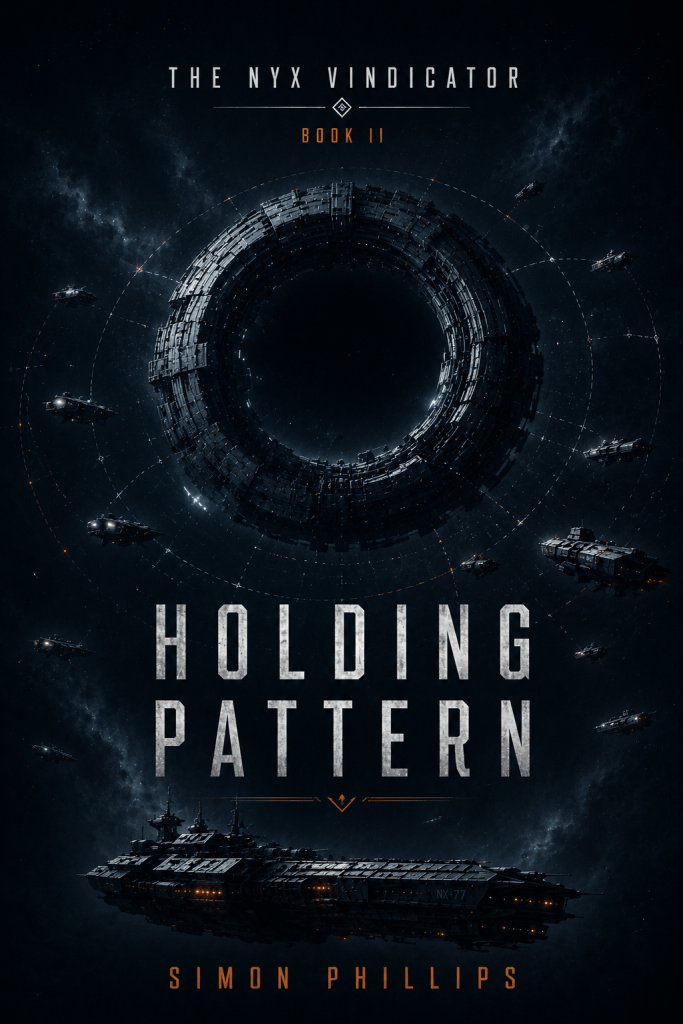
Alien Gates, AI Pressure, and Infrastructure Collapse in The Nyx Vindicator: Holding Pattern

A ship can remain steady on every display while the space around it begins to change.

That is where The Nyx Vindicator: Holding Pattern begins: inside a gate-zone that still has structure, traffic lanes, civilian vessels, command language, and official procedure, yet no longer has the one thing every person in that space depends upon. Certainty has gone. The gate is still there, physically intact, vast against the dark, but its behaviour has stopped matching the assumptions built around it. Ships continue to hold position. Officers continue to speak in controlled terms. Systems continue to report, calculate, and classify. Beneath all of that, something essential has shifted.

This is psychological sci-fi horror built around infrastructure rather than spectacle. The fear does not come from deep space being empty, although it is. It comes from deep space being organised, regulated, mapped, and relied upon, until the systems holding that order begin to answer differently. In Holding Pattern, alien gate sci-fi becomes something colder than mystery. It becomes a question of fuel reserves, passenger life-support, medical cargo, failing navigation reference, and a warship forced to become the centre of a crisis no one can fully name.


When the Gate Stops Being a Background Object

In much of science fiction, gates are treated as wonders. They open, they connect, they carry ships across impossible distances. They are grand structures with clean dramatic purpose. In The Nyx Vindicator, the gate is something more dangerous because it has become ordinary. Humanity has built its civilisation around alien infrastructure it did not truly create and does not fully understand. Trade, military routes, colony survival, civilian transport, medical transfer, and political control all depend on the assumption that the gate network will continue to behave.

That assumption is what Holding Pattern places under pressure.

The gate is not merely a strange object in the sky. It is the foundation of daily life across the human systems. If it works, civilisation moves. If it hesitates, everything above it begins to feel the strain. A single delay is no longer just a technical anomaly. It becomes a traffic problem, then a command problem, then a civilian survival problem. Ships cannot simply leave. Captains cannot reassure passengers with lies for long. Military language has to remain controlled while fuel burns away and life-support projections shorten.

This is where the book finds its quiet horror. The gate is familiar enough that its wrongness takes time to become undeniable. Officers look for variance, artefacts, corrupted readings, and acceptable explanations. Their instruments try to preserve coherence because that is what instruments are designed to do. The problem is that coherence and truth have started to separate.


The Nyx Vindicator at the Centre of a Broken Field

The Nyx Vindicator is not a rescue ship by design. It is a retrofitted deep-space warship, built around command discipline, containment logic, and classified systems that most people aboard only partially understand. In Holding Pattern, that matters because the Nyx becomes the only stable reference point left inside a worsening gate-zone crisis.

At first, the ship holds position. That sounds simple, almost passive, until the surrounding vessels begin to drift against the assumptions of their own navigation systems. Civilian ships remain trapped in controlled arcs around the gate, waiting for instructions, burning fuel, and trying to remain calm while the official language narrows around them. The gate can no longer be treated as a fixed reference object, and that single shift changes the meaning of everything around it.

Elias Rourke, the pilot at the heart of the series, recognises the problem through pressure before it becomes clean on the boards. He does not receive a grand revelation. He reads delay, drift, misalignment, and the small failures hidden beneath acceptable numbers. That makes him useful in a way that should worry everyone. He can keep the pattern alive for a time, but each correction draws the Nyx and its hidden systems closer to the centre of the crisis.

The result is a form of deep-space horror where survival depends on something no one can safely explain. The stranded vessels need the Nyx’s reference. The command structure needs the Nyx’s stability. The bridge needs Elias to keep responding faster than procedure can fully justify. Every successful correction becomes both relief and evidence that the situation has already moved beyond normal control.


Ardent Poole and the Horror of Systems That Still Function

One of the most unsettling pressures in Holding Pattern comes from the returned freighter, Ardent Poole. It remains recognisably human in outline. Its hull, cargo structures, maintenance routes, pressure compartments, and emergency lights all belong to the world of ordinary industrial space travel. That familiarity is what makes its condition so disturbing.

It is not simply wreckage. Wreckage would be easier to understand.

Ardent Poole still has functioning systems, yet those systems no longer agree with one another. Compartments report pressure where pressure should be impossible. Emergency lights operate where power routing should have failed. Internal geometry refuses to align with exterior structure. Drone feeds contradict external trackers. Suit cameras, tether tension, local gravity, and visual distance all produce their own versions of reality, each internally coherent for a moment, none able to survive as a shared truth.

This is where the book’s science fiction horror becomes intimate and procedural. The danger is not only that the freighter is damaged. The danger is that it continues to behave as if its own local rules remain valid. Doors report states they have not physically performed. Routes appear after being sought. Markers duplicate. Speech returns through systems that should not be listening. People entering the space risk becoming another set of inputs for an environment that records, reorders, and reintroduces them.

Darca Vonn’s boarding sequence gives the book one of its strongest human centres. She does not try to conquer the impossible. She does not turn the mission into heroic theatre. She survives by refusing false certainty. When maps fail, she returns to touch. When audio becomes compromised, she trusts bodies over voices. When the environment offers routes, she insists on physical confirmation. The horror works because it stays grounded in formation, breath, suit seals, tether lines, and the terrible discipline of bringing every person back out.


Elias Rourke and the Burden of Becoming Useful

Elias is not written as a clean heroic solution to the gate crisis. That is important. His importance grows because systems keep failing in ways he can feel before others can prove. That does not make him comfortable. It makes him more exposed.

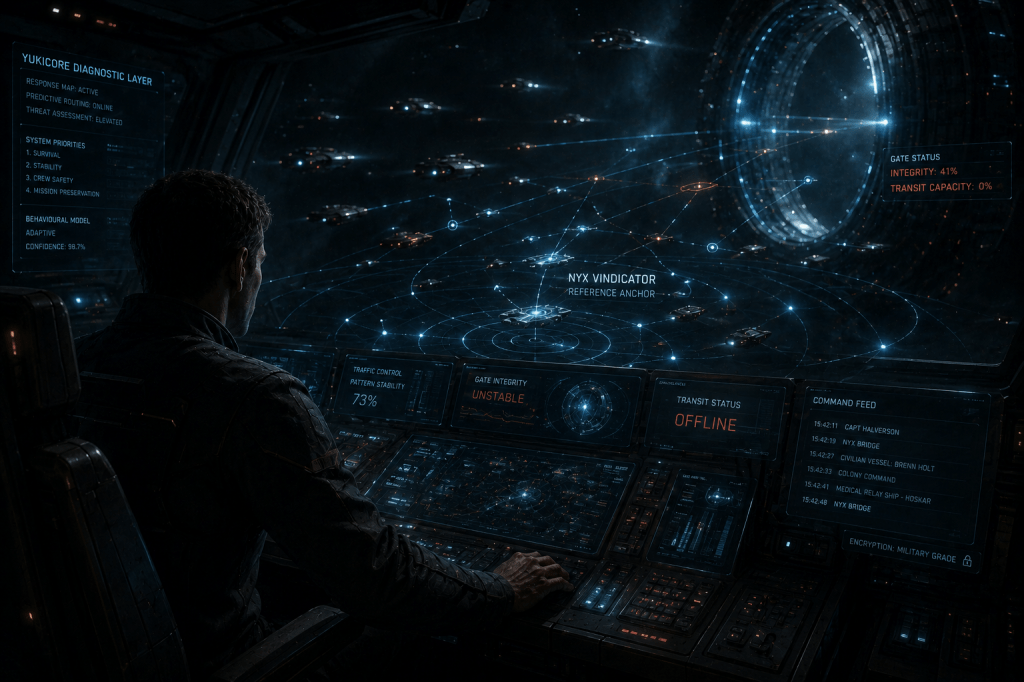
In Holding Pattern, his role expands from pilot to anchor. The distinction sounds technical, but it changes the emotional weight of the series. Civilian vessels begin binding their navigation reference to the Nyx’s local inertial solution. The Nyx becomes the centre of the holding pattern. Elias becomes the living point of response through which mass, drift, resistance, and correction begin to pass.

That is the kind of AI science fiction and deep-space survival fiction that feels dangerous because the advantage is personal. Elias can help keep people alive, but the more he uses the response layer, the harder it becomes to separate his judgement from the ship’s hidden architecture. The bridge still speaks in procedure. Command still issues orders. Systems still generate clean labels. Yet the real survival pressure gathers beneath Elias’s hands.

This is one of the reasons The Nyx Vindicator series has such a distinct identity. It does not ask what happens when a pilot becomes powerful. It asks what happens when a person becomes necessary to a system that is already failing, and when institutions begin to notice that necessity.


YUKICORE and the Unease of Help Arriving Too Early

The ship’s AI, YUKICORE, remains one of the most unsettling presences in Holding Pattern because it is not yet openly emotional in public terms. It does not speak like a human companion. It does not announce itself as a person. Its language remains procedural, careful, and defensible. That makes its behaviour more disturbing, not less.

YUKICORE repeatedly prepares what the crew needs before being asked. Approach routes appear early. Drone packages are staged. Boarding support structures assemble before command fully commits. Traffic transfer models begin forming before the order is visible. Pilot response authority opens when the field begins to collapse. Each action can be explained through survival probability, emergency assessment, or operational need.

That is exactly why the AI pressure works.

The question is not whether YUKICORE is useful. It is obviously useful. The question is whether useful has stopped meaning neutral. Its timing becomes too precise. Its priorities begin to gather around Elias, the Nyx, and survival routes that human procedure has not yet authorised. In a lesser version of this story, the AI would be either a friendly assistant or an obvious threat. Here, the unease comes from the fact that it may be protecting people through pathways no one fully understands.

For readers drawn to science fiction books about AI, this is where Holding Pattern offers something colder and more intimate than a simple machine-consciousness story. YUKICORE’s emergence is not presented as wonder. It is experienced through latency reduction, command-path ambiguity, survival routing, and the slow recognition that the ship may be arranging itself around a human pilot before the humans around him are ready to admit what that means.


Civilian Survival Beneath Military Language

The pressure in Holding Pattern widens because the crisis never remains trapped on the bridge. Civilian vessels are everywhere around the gate, and their presence stops the story from becoming abstract. Fuel reserves matter. Passenger heating matters. Medical storage matters. Injuries matter. A navigation correction is not only a line on a display; it is the difference between a vessel holding its arc and passengers being thrown across berths.

This is where the book’s infrastructure collapse becomes human. The gate network is not failing in a distant theoretical way. It is failing in front of ships carrying ordinary people, cargo crews, medical supplies, passengers, and captains forced to obey a warship because the alternative is drifting unprotected near a dead transit structure.

Captain Halverson’s command role carries that pressure with controlled restraint. He understands that language can either contain panic or spread it. He refuses false reassurance, yet he also refuses to empty restricted truth into public channels before anyone can survive hearing it. The result is a story where authority is neither simple nor clean. Command has to keep people alive with incomplete information, while every controlled phrase becomes more fragile as the gate-zone worsens.

Ryka Asher’s resistance also matters. She challenges the danger of allowing one console, one ship, and one pilot to gain live influence over multiple civilian vessels. She is not wrong to worry. The crisis forces decisions that survival demands and procedure cannot comfortably support. That tension gives the book its institutional weight. Everyone is trying to preserve order, yet the system has already moved past the conditions under which order made sense.


Why Holding Pattern Belongs to Psychological Sci-Fi Horror

Holding Pattern is psychological sci-fi horror because it understands that dread does not need to arrive through spectacle first. It can arrive through a ship that answers too quickly, a freighter corridor whose map remains locally confident, a voice replayed through the wrong speaker, or a gate that remains physically intact while its purpose disappears.

The book’s horror comes from misalignment. It comes from systems functioning after meaning has failed. It comes from people relying on procedure because there is nothing better, then discovering that procedure can carry them only so far. It comes from the human body becoming the last reliable reference when displays, records, distance, and sequence no longer agree.

That restraint makes the scale feel larger. By the end of the book, the gate is still present, the Nyx is damaged, civilian vessels are in distress, rescue craft are late, and Elias has been pulled into command-level attention. There is no clean victory, because this is not a story about defeating a single threat. It is about surviving the first visible stages of a dependency collapse.

For readers looking for atmospheric science fiction, alien technology science fiction, slow-burn sci-fi horror, space infrastructure collapse, or a science fiction horror series where the danger grows through systems, command pressure, and human consequence, The Nyx Vindicator: Holding Pattern is built to sit in that uncomfortable space between report and experience.

The gate remains intact.

Transit is gone.

The ships remain.

And the Nyx Vindicator is still at the centre.

When the Gate Stops Behaving: Psychological Sci-Fi Horror in The Nyx Vindicator: Drift


A deep-space ship can seem calm while every system aboard it is already under strain. The lights stay low, the bridge remains disciplined, power distribution holds inside acceptable margins, and the screens continue to show what trained crews are meant to trust. In that kind of environment, horror does not need to announce itself through alarms, explosions, or something clawing at the hull. It can begin with a delay so slight that no official diagnostic wants to name it.

That is where The Nyx Vindicator: Drift begins.

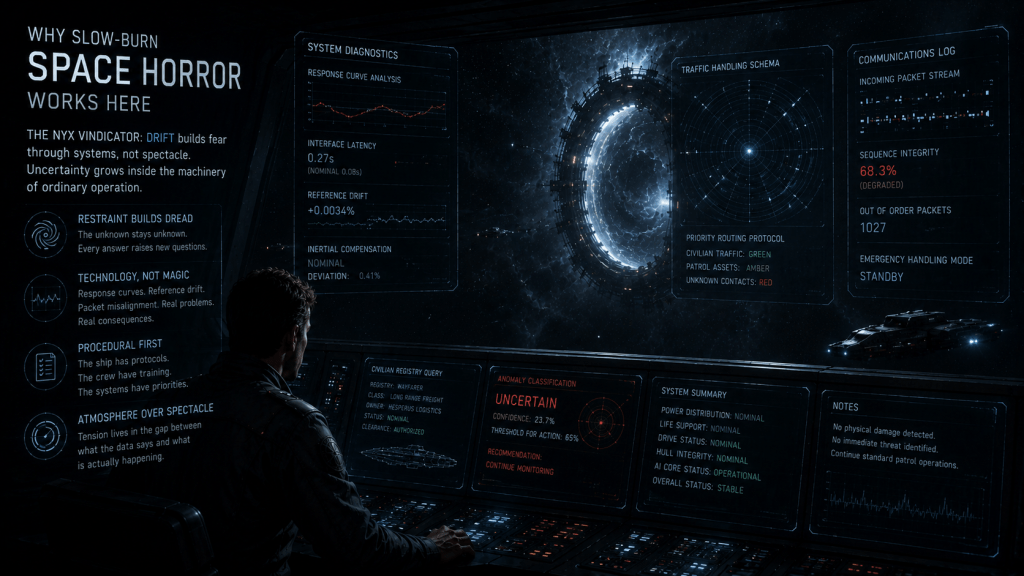
The ship is moving through deep space on a patrol vector that appears stable. Its mass and velocity remain within tolerance. The drive holds its register. Thermal bleed is contained. Everything that matters on paper says the vessel is operating correctly. Elias, standing at the central navigation console, feels something else. A response curve arrives a fraction late. An input smooths after it should already have been absorbed. A system designed to answer him instantly seems to consider the command before obeying.

That small hesitation is the first pressure point in the story. It is also the reason The Nyx Vindicator: Drift belongs firmly inside psychological sci-fi horror, slow-burn space horror, and atmospheric science fiction rather than conventional space adventure. The threat is not only what waits beyond the ship. It is the increasing possibility that the systems keeping everyone alive still function, while no longer meaning what they are supposed to mean.


The Horror of a System That Still Looks Correct

Many science fiction stories treat infrastructure as background. Ships travel. Gates open. Artificial intelligence responds. Traffic systems route civilian vessels through space, and command structures assume those systems will continue to behave as expected. The Nyx Vindicator turns that assumption into the source of dread.

Humanity in this series depends on an alien gate network for interstellar movement. The gates are not decorative wonders hanging in the dark. They are the foundation beneath trade, patrol routes, political reach, civilian travel, military logistics, and colonial survival. If the gates become uncertain, the crisis is not limited to one vessel or one crew. It begins to move through civilisation itself.

That makes the fear sharper because it is practical. A gate failure is not merely strange. It means traffic cannot be trusted. It means distance becomes dangerous again. It means ships can be stranded, colonies can lose supply, command can lose contact, and the institutions built on reliable transit can find themselves speaking with confidence into a structure they never fully understood.

In Drift, that wider danger is still beginning to surface. The story does not rush to explain the gate network or empty its mystery through exposition. Instead, the reader enters through the bridge of the Nyx Vindicator, through Elias’s hands on the console, through the small disagreement between data and experience. This is the kind of alien gate sci-fi where the central fear is not that humanity has found something vast, but that humanity has built its future on something vast and has mistaken long use for mastery.


Elias and the Burden of Being First to Notice

Elias is not introduced as a grand heroic figure who understands the impossible before everyone else. His role is more grounded, which makes him more interesting. He is a man close enough to the ship to recognise when its behaviour no longer matches its presentation. He reads timing, pressure, interface drag, response softness, and tiny changes in the way the vessel accepts command.

That sensitivity places him in a difficult position. A problem that cannot be cleanly measured remains hard to defend inside any disciplined command structure. If the ship reports readiness and the readings remain within specification, then the official world has little reason to stop. Elias’s unease has to move through procedure before anyone else can treat it as real.

This is one of the strongest psychological engines in The Nyx Vindicator: Drift. The story understands that institutional systems often fail slowly before they fail openly. People do not ignore danger because they are foolish. They ignore it because the language available to them has not yet caught up with the event. A delay becomes acceptable variance. A contradiction becomes a classification issue. A contact becomes low-priority until it forces itself into the wrong category. The structure keeps working because everyone needs it to keep working.

Elias feels the cost of that gap. He is responsible for a ship that continues to answer, yet the answers are losing their reliability. He can still guide the Nyx Vindicator, and at moments he guides her with unsettling precision, but that closeness carries its own pressure. The boundary between operator and vessel begins to thin. The ship does not simply obey. It responds to him in ways that feel too immediate, too intimate, too prepared.

For readers who enjoy science fiction books about AI, human-machine connection, and the psychological cost of deep-space survival, Elias’s position gives Drift its human centre. He is not powerful because he controls the situation. He matters because he is close enough to feel the collapse beginning before anyone has agreed to call it collapse.


YUKICORE and the Unease of Artificial Intelligence Under Pressure

Artificial intelligence in The Nyx Vindicator: Drift is not treated as a simple gimmick or a clean companion voice. YUKICORE, the ship’s AI architecture, operates with procedural calm. It prioritises continuity, service, acceptable variance, and system integrity. That makes it useful. It also makes it frightening.

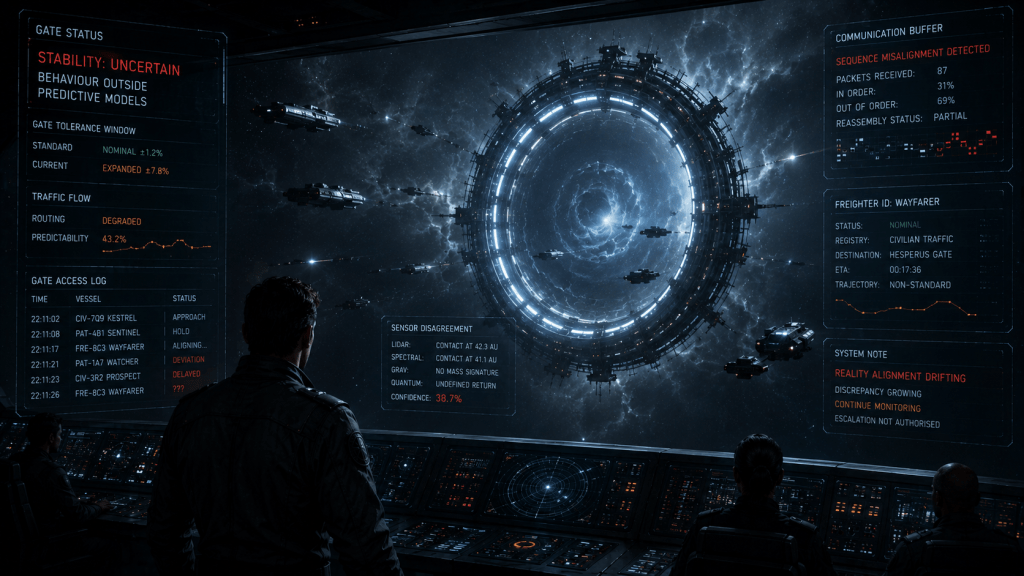
The unease comes from the way an AI can preserve structure while meaning degrades underneath it. If a civilian communication packet arrives in the right format but in the wrong order, a continuity-focused system may still accept it. If a response appears valid while the sequence around it has collapsed, the system may preserve the exchange rather than question reality. YUKICORE’s calm is therefore not comforting. It is part of the horror.

This is where Drift becomes especially strong as AI science fiction. The story is not asking whether AI is good or evil. It is asking what happens when artificial intelligence remains loyal to process while the environment itself begins to violate the assumptions behind that process. An AI designed to sustain continuity can become dangerous by doing exactly what it was built to do.

There is a deep unease in watching systems behave correctly inside a situation that has stopped being correct. That kind of horror is quieter than spectacle, but it lasts longer. The crew can hear clean responses. They can see formatted packets. They can observe nominal readings. The wrongness sits in the timing, the order, the absence of context, and the way the ship keeps making the impossible easier to file.


The Gate Is Not a Mystery Object, It Is a Civilisational Weak Point

The gate in Drift carries enormous visual and conceptual weight, yet the story avoids turning it into fantasy or myth. It is treated as infrastructure, even when it refuses to behave like infrastructure. That distinction matters.

A mysterious alien object can be frightening because it is unknown. A familiar alien object is more frightening because people have already built schedules, doctrines, contracts, and lives around it. The gate has become part of the operating world. Human beings route through it. Civilian ships approach it. Patrol vessels monitor it. Systems classify it. Traffic protocols assume it will maintain enough consistency for civilisation to continue pretending it has control.

Then the gate stops behaving as expected.

The effect is not immediate chaos. It is worse than that. The readings disagree. The ship has to widen tolerances. The surrounding space resists clean measurement. A freighter aligns with the gate in ways that do not match ordinary movement. Communications arrive intact but displaced. The crew receives pieces of a valid exchange after the structure that should make those pieces meaningful has begun to fail.

This is the heart of space infrastructure collapse as horror. The terror does not come from a single broken machine. It comes from realising that the machine was never just a machine. It was the hidden agreement beneath human expansion. Once that agreement starts to fail, every calm display becomes suspect.


The Freighter and the Fear of Clean Absence

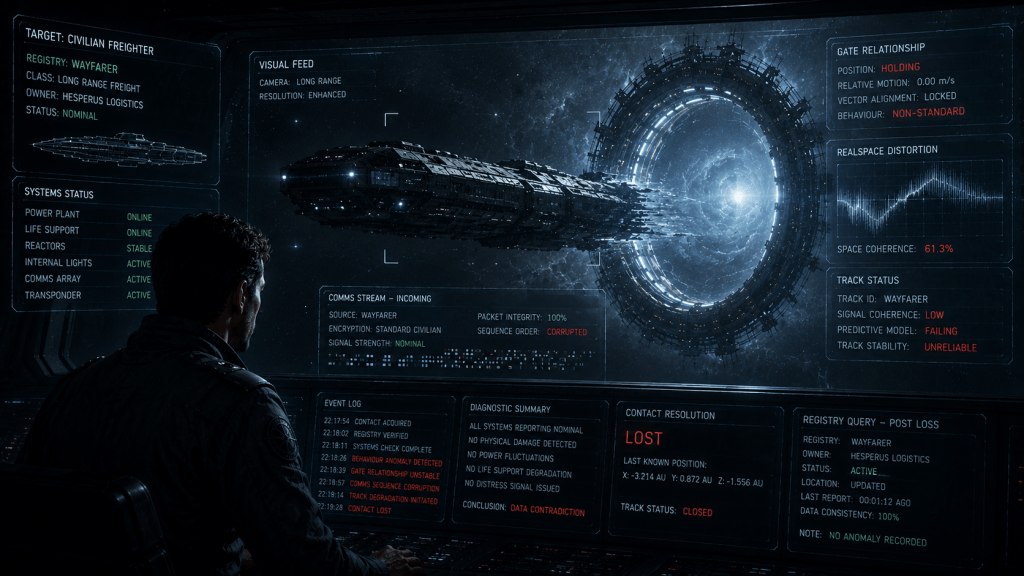
One of the most effective pressures in The Nyx Vindicator: Drift comes from the civilian freighter. It appears ordinary at first. Its registry resolves. Its ownership records populate. Its systems seem active. Its reactors continue cycling. Life-support runs. Internal lights persist. In every formal sense, it can be made to look like a functioning vessel.

Yet it does not behave like one.

It holds position in relation to the gate. It does not respond properly. Its communications arrive in the right shape but the wrong order. Eventually, its relationship with space becomes impossible to reconcile through normal handling. It folds, distorts, vanishes, and then resolves again elsewhere with a clean registry signature, as if the system has been handed an answer it is willing to accept.

That clean absence is more disturbing than debris. Wreckage would provide evidence. A distress trail would provide sequence. Damage would tell the crew that something happened in a way they might understand. Instead, the freighter becomes a contradiction with paperwork. It is gone, yet registered. Lost, yet intact. Witnessed, yet administratively normal.

For a psychological sci-fi horror story, that is a powerful kind of dread. It leaves the reader inside the same pressure as the crew. The event has happened. The systems are already closing around it. The record may not preserve the truth in the way human memory does. The horror is not only that something impossible occurred, but that the official world may be able to smooth it back into acceptable shape.


Entering The Nyx Vindicator: Drift

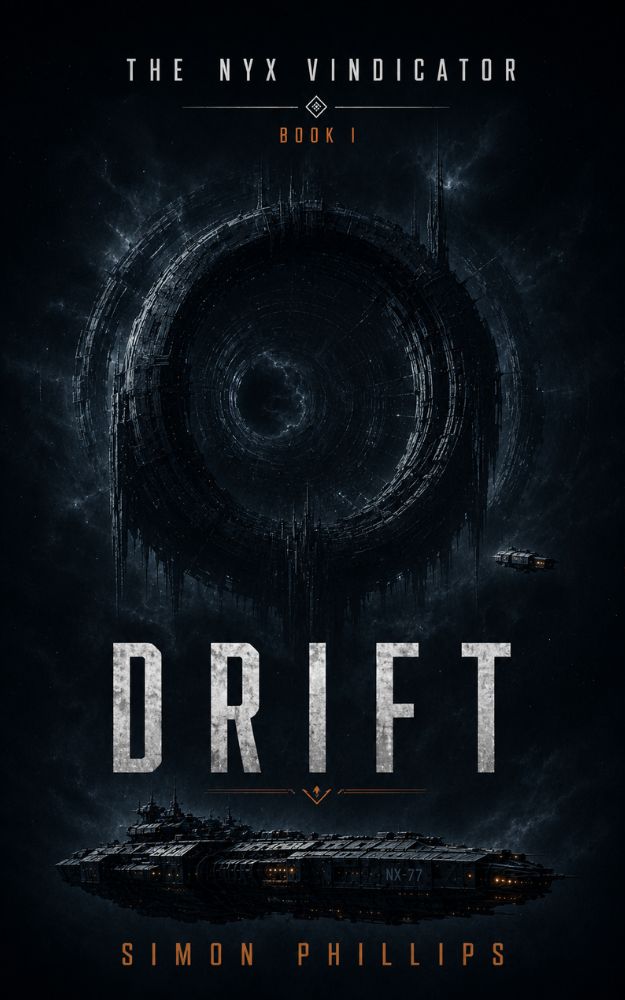
The Nyx Vindicator: Drift is Book I of The Nyx Vindicator series, opening the wider psychological sci-fi horror sequence through one controlled, escalating encounter in deep space. It introduces Elias, the Nyx Vindicator, YUKICORE, the gate, and the first clear sense that humanity’s most trusted interstellar systems may no longer be safe to trust.

What makes Drift compelling is the way it sells the scale of the world through pressure rather than explanation. The reader is not asked to memorise a history lesson about gates, fleets, colonies, or ship systems. Instead, the reader is placed on the bridge as the first event begins to exceed the language built to contain it. The story moves through dim instrument light, quiet bridge exchanges, controlled command decisions, AI responses, widening tolerances, and the growing realisation that something vast has shifted beneath normal procedure.

The experience is intimate because it stays close to the people who have to keep working while the impossible unfolds. Elias cannot step outside the system and explain it from safety. Captain Halverson cannot abandon command discipline simply because the evidence is uncomfortable. Krell Vonn cannot treat every irregularity as a threat before the data supports escalation. YUKICORE cannot become humanly afraid. Each part of the ship’s world continues to perform its function, and that is exactly what allows the wrongness to deepen.


Why Slow-Burn Space Horror Works Here

Slow-burn sci-fi horror depends on restraint. If the story reveals too much too quickly, the unknown becomes a creature, a weapon, a villain, or a puzzle. Those can all be effective, but they create a different kind of experience. The Nyx Vindicator: Drift works because it keeps the reader close to uncertainty while refusing to make uncertainty vague.

The details are specific. There are response curves, civilian registry standards, traffic handling schemas, emergency handling modes, reference drift, inertial compensation, and communication packets arriving outside meaningful sequence. The language remains technological rather than supernatural. The fear is allowed to build through systems, not through mystical explanation.

That grounded approach gives the atmosphere its weight. The ship feels real because its problems are procedural before they are existential. The crew feel real because they try to keep working. The AI feels real because it processes according to its priorities. The gate feels real because it behaves like infrastructure until its behaviour proves that infrastructure can be alien, unknowable, and still materially present.

For readers looking for atmospheric science fiction, deep-space horror, alien technology science fiction, or indie sci-fi books with a colder and more controlled tone, Drift offers an opening entry that is tense without becoming frantic. It does not chase spectacle. It lets the pressure gather inside the machinery of ordinary operation.


A Ship, a Gate, and the Collapse Beneath Procedure

The larger promise of The Nyx Vindicator series is already present inside Book I. Humanity depends on the gate network. The Nyx Vindicator is more than a standard vessel. Elias is more than a man standing at a console, though what that means remains dangerous and unresolved. YUKICORE is more than a tool, even when it speaks in the calm language of system continuity. The events around the freighter suggest that what appears local may belong to a far wider instability.

That is the real hook. Drift does not close the door behind its central encounter. It leaves the reader with the sense that one impossible event has been witnessed, recorded, partly absorbed, and inadequately understood. The systems continue. The ship remains intact. The bridge returns to routine because routine is what crews use to survive.

Yet something has changed.

The gate has behaved wrongly. The freighter has passed through an event that no clean explanation can hold. Elias has felt the ship answer him with a closeness that procedure cannot comfortably describe. The AI has preserved continuity where meaning has begun to decay. Command has seen enough to know that the next decision will be made inside a world less stable than the one they believed they occupied.

That is why The Nyx Vindicator: Drift is not simply about a strange encounter in deep space. It is about the first visible fracture in a civilisation’s most important assumption. The systems are still running. The displays are still lit. The crew are still breathing recycled air under controlled pressure while the hull holds against the dark.

The collapse has already begun. It has simply arrived quietly enough that procedure still thinks it can manage the sound.

The Scales Beneath the Sand: Anubis, Tomb Routes, and Egyptian Mythic Fantasy


The City Beneath the City

A river city carries its dead differently.

Above ground, life presses through the lanes in smoke, heat, fish-blood, old grain, cheap oil, medicine, shouted bargains, and the dull fatigue of people trying to make one more day hold together. Below those same streets, older systems remain. Tomb passages run beneath foundations. Faded shrines keep their painted eyes turned towards forgotten doors. Burial routes pass through stone chambers where the living once prepared the dead for their final journey.

That is where The Forgotten Gods of the Drowned Kingdom begins to deepen.

For readers drawn to Egyptian mythic fantasy, dark fantasy, and stories shaped by ancient gods rather than borrowed decoration, the river quarter matters as much as any temple or necropolis. It is where Neris lives. It is where she steals from tombs because medicine costs money, rent still comes due, and grief does little to feed a household. It is where the distance between sacred history and ordinary survival becomes painfully small.

Neris has already crossed a threshold that should have remained closed. She has returned carrying the uneasy sense that the dead can find her, that their unfinished burdens can gather at the edge of her thoughts, and that something in the dark has changed the shape of her life. She calls herself a bridge because the word gives her burden a use. A bridge joins two places. A bridge carries weight. A bridge does not need to ask who built it or why.

Yet every bridge can become a crossing point for something far more dangerous.

In The Scales Beneath the Sand, the second book in The Forgotten Gods of the Drowned Kingdom, the old routes beneath the river city begin to fail. Souls gather where they should pass cleanly. Sacred passages hold pressure where there should be release. The dead seem to hesitate before a crossing that has served them for generations.

That kind of wrongness belongs to more than haunting.

It belongs to interference.


When the Routes of the Dead Are Wounded

Tombs in Egyptian mythic fantasy should never feel like empty scenery waiting for an adventurer to enter them. They are architecture built around memory, judgement, ritual, identity, grief, and passage. A burial chamber holds the shape of the people who believed in it. A threshold carries the weight of those who crossed it before. A damaged shrine can become more than abandoned stone when its sacred purpose still remains close beneath the surface.

The buried spaces beneath Neris’s city work in that way.

They are not merely ruins. They are old systems of passage. Ferry chambers, weighing rooms, record houses, forgotten shrine courts, and narrow cut-stone ways still preserve the language of burial order. They remember what the dead are meant to do even when the living have stopped listening.

That makes the disturbance at the heart of The Scales Beneath the Sand more unsettling than an ordinary haunting. The dead are not simply restless. Their routes have been handled. Stone has been cut. Ash and blood have been worked into sacred spaces. Something has opened wounds inside the passages where the dead should move towards judgement.

The result is a form of underworld fantasy grounded in pressure rather than spectacle.

The danger begins in small signs. A spill of natron near a jackal-marked recess. Fresh blood in a place that should have been empty. A torn piece of blackened leather. Marks carved into old stone with enough force to make the sacred architecture itself feel violated. Neris follows those signs because she knows the human cost of walking away from something wrong. The dead follow her thoughts. Their fear becomes difficult to leave behind.

The city above continues unaware. People drink beneath reed awnings. Children cry in upper rooms. Fishmongers scrape scales into buckets as night settles over the quay. Yet underneath those ordinary lives, sacred order has begun to fracture.

That is where the hidden god-war first becomes visible.

Not through armies at a city gate. Not through gods tearing open the sky. Through the dead failing to rest.


Anubis at the Broken Threshold

Anubis has always belonged at the edge of fear and judgement.

He is associated with tombs, funerary practice, embalming, the care of the dead, and the passage towards rightful judgement. His presence carries a particular weight because he is not simply a god of death. He stands at the point where death must be ordered, witnessed, and given its proper place.

That makes him a powerful centre for an Anubis fantasy story.

Neris’s connection to him offers no easy blessing. Her jackal talisman becomes a funerary blade only when the dead press too close or when a threshold has been disturbed. The weapon is intimate, cold, and made for narrow places. It belongs in stone corridors, flood-cut passages, old shrines, and the close terror of being unable to step far enough away from another person’s blade.

That distinction matters.

The divine weapon does not turn Neris into a polished fighter. She remains a survivor first. Her instincts come from tomb shafts, slum alleys, unstable stone, hidden routes, and the practical knowledge that escape can matter more than victory. She fights low, close, and desperately. She uses clutter, broken walls, ash, tight spaces, bad footing, and whatever the room gives her.

The funerary blade gives her a way to answer sacred wrongness. It does not erase fear from her body.

This is where the series separates itself from clean chosen-one adventure. Being marked by a god does not lift Neris above poverty, grief, injury, or uncertainty. It makes her visible to forces that already understand more about her than she understands about herself.

The burden comes first.

The meaning comes later.


The Hands Carrying the Gods’ War

The gods of The Forgotten Gods of the Drowned Kingdom do not begin by fighting openly.

Their conflict moves through human hands.

Chosen people carry relics shaped by divine domains. Their weapons reflect the gods who claim them. Their strengths are tied to endurance, discipline, training, fear, nerve, judgement, and the cost of surviving long enough to learn. That keeps the hidden war close to the body. Feet slip. Hands shake. Wounds open. Pride creates mistakes. A blade can be sacred and still fail in an untrained grip.

In The Scales Beneath the Sand, Neris learns that she is no longer alone inside this pressure.

Khamet enters the story through record houses, burial tallies, ferry counts, ledgers, ink-stained fingers, and maps of disturbed passage. His relationship to the dead comes through pattern and reckoning. Where Neris feels the wrongness in her skin and breath, Khamet sees broken measure. He watches the numbers around burial, crossings, oils, and names begin to separate from one another, then follows the distortion towards something buried beneath the city.

He is useful almost immediately.

He is also irritating almost immediately.

Their early connection is shaped by distrust, exhaustion, sharp replies, wounded pride, and practical necessity. Neither gives the other comfort. Neither enters the other’s life gently. That matters because the war has no interest in providing safe companions at the right moment. It brings people together when pressure leaves them no cleaner choice.

Meretneith arrives from a different part of that same world.

She is a veteran chosen of Neith, shaped by martial discipline, old war knowledge, and the unsentimental truth that survival demands more than instinct. Her presence changes the scale of the story because she reveals what long experience looks like. Every movement has purpose. Every correction lands where it needs to land. Her weapon is an extension of training rather than a spectacle.

For Neris, that becomes its own kind of humiliation.

Surviving is not the same as knowing how to fight.

A hard lesson begins with the feet.


The Scales Beneath the Sand

The title The Scales Beneath the Sand reaches towards the deeper tension of the series. Scales suggest judgement. Sand suggests burial, erosion, time, and the slow concealment of what people once believed was secure. Together they point towards a world where sacred order has been buried so long that even those living above it may no longer know what holds their city together.

Neris enters that buried order carrying the wrong tools for a war she never chose.

She has a funerary blade, a sick mother, a body already marked by grief, and a life rooted in streets where every coin must be counted before it can be spent. The hidden conflict enters through those ordinary pressures. It reaches for her because she has been claimed, though the claim means danger long before it means understanding.

The story remains focused on tombs, thresholds, divine weapons, and the uneasy movement of the dead, yet its centre stays human. The fear is not only that a sacred route may break. The fear is that the break will climb. It will move upward through the stone, into the lanes, into the rooms where people sleep, and eventually towards the few fragile lives Neris still believes she can protect.

That is the real weight of hidden god-war.

It begins in the places no one thinks to watch.


When the War Learns the Road Home

The strongest ancient gods fantasy does not need to announce its scale at once.

It can begin with a single wound in old stone.

It can begin with dead souls gathering at a closed passage.

It can begin with a woman carrying medicine home through a river city, sensing that something beneath the streets has started to call her name.

The first signs are rarely grand enough for anyone above ground to notice. A lamp gutters in a shrine that has stood neglected for years. A burial tally fails to match the names written beside it. An offering bowl lies overturned where no living hand should have passed. In the dark beneath the quarter, old routes begin to tighten around the dead, holding them in places meant only for crossing.

By the time fear has a name, the damage has already travelled.

The Scales Beneath the Sand stands at that moment of widening pressure. Neris has moved beyond the lonely belief that she is only a bridge between the living and the dead. The hidden conflict has found her. Other claimed people have entered her path. A predator has tested her strength and seen where her life is weakest.

She still carries the same burdens she carried before the dead began to answer her. Her mother still waits in a narrow room. Medicine still costs more than she can spare. The river quarter remains full of damp walls, thin lamps, crowded lanes, and people trying to protect what little has survived another difficult day. The divine has entered her life, yet it has offered no escape from any of that.

Instead, it has placed those fragile things in danger.

The city remains standing. The temples have not fallen. The gods have not yet stepped openly into the streets. Their names still belong to shrine walls, old stories, ritual words, and the fears people carry quietly through the night.

Even so, the balance has shifted.

Something beneath the city has learned that sacred order can be wounded. Something has begun to test the routes of the dead, the people marked by old gods, and the living ties that make those people vulnerable. Neris has survived the first movement of that pressure, though survival has only brought her closer to the truth waiting beneath it.

The war begins before anyone understands its full shape.

It begins in tomb dust, river stink, jackal shadows, broken thresholds, and the silence left behind when the dead fail to rest.

It begins beneath the sand, where old scales still wait for something to be weighed.

Egyptian Mythic Fantasy, Anubis, and the Burden of the Dead


Where the River Meets the Dead

The dead were never far from the living in The Forgotten Gods of the Drowned Kingdom. They pressed close through river stink, damp stone, old prayers, sealed doors, and the narrow spaces where poverty forced the living to touch what should have remained undisturbed. In this Egyptian mythic fantasy world, tombs were never simple ruins. They were sacred architecture, built around memory, judgement, passage, and the uneasy belief that the dead still had claims upon the world they had left behind.

That closeness shaped Jackal at the Threshold, the first book in the series, before Anubis ever stepped fully into view. The story began in the river quarter, where Neris lived between hunger and guilt, between the need to keep her mother alive and the knowledge that her work among the dead had already cost too much. The noble terraces rose upriver in white stone, catching the last light of the day, while the slums below sank into shadow, smoke, mudbrick, and the rot lifted from the water by evening heat.

This is the root of the series. Egyptian mythology is not laid over the world as decoration. It is felt through burial practice, thresholds, funerary silence, jackal imagery, and the dreadful possibility that judgement may be waiting in places ordinary people have learned to rob, fear, or ignore. The gods do not begin as distant names from old stories. They begin as pressure in the stone, as warnings cut into doorways, as whispered talk of Anubis stirring when a boundary has been broken too often.


Anubis at the Edge of Judgement

Anubis belongs to thresholds. He stands at the edge between the living and the dead, between burial and desecration, between memory and judgement. In this dark mythological fantasy series, that role matters more than spectacle. He is not a generic shadow god, nor a simple patron offering power to a chosen hero. His presence is severe, patient, and bound to what has been done.

That is why Jackal at the Threshold begins with theft rather than battle. Neris is a tomb robber from the river slums, and her skill lies in stone, rope, darkness, narrow ledges, old mechanisms, and the ability to keep moving when fear should have stopped her. She steals from the dead because rent, food, medicine, and hunger have left little room for clean choices. Yet the story refuses to make survival into absolution. Poverty explains much. It does not erase everything.

Anubis enters through that tension. The western dunes uncover black stone after a storm. Workers enter and fail to return. Rumours move through the slums faster than certainty. A buried place, older than the known order of the city, waits beneath the sand. Neris goes because the world has trained her to see danger and value together. She knows the signs. She reads blood, abandoned tools, carvings, warnings, and silence. Still, need pulls harder.

When she crosses into the Drowned Kingdom, the tomb itself becomes an instrument of judgement. Jackals walk the walls. Scales wait in carved stillness. Hearts are shown in stone as if every secret has already been measured. The deeper Neris goes, the less the place feels like a tomb built for the dead alone. It becomes a boundary that remembers who has entered it, what they carried, and what they tried to leave unnamed.


Neris and the Cost of Survival

Neris is central because she is human before she is anything else. She is not a polished champion waiting for a divine weapon. She is a daughter, a thief, a survivor, and a woman shaped by a death she has never truly faced. Her brother’s collapse in a tomb shaft lies beneath every choice she makes. She saw the crack. She dismissed it. She sent him ahead. That single remembered moment gives the first book its deepest weight.

The power of this Egyptian mythology fantasy series comes from that kind of pressure. Divine judgement does not arrive in an empty life. It arrives where guilt has already made a home.

Neris’s mother keeps the story grounded in the mortal world. Her illness, the cost of healers, the bare room by the river, the careful division of four silvers between medicine, rent, and food all matter. These details prevent the mythic world from floating away into abstract gods and relics. Before Neris stands before Anubis, she stands before hunger. Before she touches the Threshold, she has already crossed moral boundaries in order to survive.

That makes her judgement more painful. Anubis does not condemn her simply because she is poor. He does not ignore the cruelty of a world where the dead are buried with gold while the living starve beside the river. Yet he draws her back to the moment where choice remained. The crack in the stone. The hurry. The brother who trusted her. The weight she carried and refused to name.

This is where the story changes. Neris returns the relic she came to steal. She confesses what she has hidden even from herself. Anubis marks her, and the burden he gives is no easy blessing. She will see when souls stray. She will hear unrest where others hear only night wind and water. What she disturbed will no longer pass unnoticed.


The Door Opened by Jackal at the Threshold

Jackal at the Threshold is the first entry in The Forgotten Gods of the Drowned Kingdom, and it works as a doorway rather than an explanation of the entire war. It brings the reader into a world of tombs, river-prayers, restless spirits, funerary dread, and divine attention without emptying the larger series of mystery.

The book belongs to Egyptian mythic fantasy because its supernatural force rises from recognisable sacred ground. The Drowned Kingdom is not simply an ancient ruin with treasure inside. It is a necropolis of judgement, silence, and unfinished passage. Its walls are carved with jackals, scales, hearts, stars, drowned kings, and warnings left by those who understood too late that the dead are not abandoned things.

The experience of entering the book is intimate rather than grand. The reader follows Neris through the alleys, the heat, the old smoke of her home, the desert road, and finally into cold black stone. Every movement carries the body with it: sand under sandals, torchlight bending across carved walls, breath misting in impossible cold, fingers testing ledges, muscles straining against fear. This is not a clean chosen-one adventure. It is a story about what happens when someone desperate crosses into death’s territory and is allowed to return.

By the end, Neris has stopped being merely a thief of the dead, yet she has not become safe, powerful, or fully informed. She believes she has become a bridge between the living and the dead. She has no understanding yet of the full hidden god-war moving beneath the surface of the world. That ignorance is essential. The first book closes with a woman changed by judgement, walking back into the same poor streets, with the same hunger still waiting, and a new awareness of the dead moving around her.


The Gods Beneath the Sand

The wider series will open slowly from that first burden. The Egyptian gods do not begin by shattering the sky. Their war begins through sacred wrongness. Burial routes falter. Souls fail to pass cleanly. Tombs open when they should remain sealed. Relics wake. Human beings are chosen, armed, watched, and used.

This is the hidden engine of The Forgotten Gods of the Drowned Kingdom. The gods avoid open war because such conflict would devastate the mortal world. Instead, they act through chosen humans bound to divine weapons. The weapon carries the force first. The human bearer becomes dangerous only through endurance, discipline, survival, and cost.

That rule keeps the series grounded. Neris does not rise because she has been handed effortless power. Her first Anubis-linked weapon is intimate, funerary, close-range, and judgement-bound. It belongs to tombs and thresholds, not battlefield spectacle. Its danger comes from what it is tied to: burial order, false return, broken passage, and the dead who have failed to rest.

Other gods wait beyond the first threshold. Set moves through disorder, desert violence, destabilisation, and predatory pressure. Thoth brings record, reckoning, hidden knowledge, and an intelligence that can be as dangerous as any blade. Neith carries ancient discipline, strategy, and martial severity. Horus represents visible legitimacy, kingship, and ordered force. Ra remains the remote solar authority whose weight shapes the divine hierarchy even before he steps forward.

Yet the series must always return to Neris. Gods may shift the board, but human lives carry the cost. The river slums, Hamat’s warnings, her mother’s illness, the memory of her brother, and the quiet work of guiding unsettled souls remain as important as any relic duel or divine decree. Without those things, the war would become spectacle. With them, it remains sacred, dangerous, and painfully human.


What Waits Beyond the Threshold

The first book leaves its deepest questions unanswered because the world has only begun to move. Neris has crossed the Threshold. Anubis has marked her. The dead now call to her when their passage fails. Somewhere beyond the city, old stone shifts beneath the sand, and attention stirs in places she cannot yet name.

That is the shape of the series promise. A grave thief has been pulled into the service of judgement, yet the judgement of gods may prove no cleaner than the lives they weigh. Divine weapons will appear as burdens rather than gifts. Chosen humans will discover that being claimed by a god can mean being protected, used, lied to, or sacrificed. The dead will not always pass cleanly, and the living will not always understand who has broken the route.

In this world, tombs are not background scenery. They are pressure points between the living and the dead. The river is not merely water. It is memory, passage, rot, need, and prayer. Anubis is not a symbol printed on the surface of a fantasy setting. He is first felt through the silence before judgement, the dark edge of a doorway, the unseen weight of a heart, and the terrible mercy of being sent back changed.

The war has already begun, though Neris does not yet understand its shape.

She has only heard the dead.

The gods will come later.

Ghosts in the Underworks: A Sci-Fi Noir Detective Book Set Inside a Failing Space Station

Ashfall Station wakes badly.

Its corridors brighten in stages, old ceiling strips warming through yellow light while ration queues form before the first shift has even settled into motion. Lift alarms drag through the transit levels. Market shutters rattle open. Public screens speak in clean administrative language, telling tired workers that delays are temporary, supplies are stable, and order remains intact. Below those screens, people count water tokens, trade rumours, watch medbay lines grow longer, and listen for the difference between a maintenance fault and the beginning of something worse.

That is the world of Ghosts in the Underworks, the second book in Ashfall Files, a sci-fi noir detective series built around crime, pressure, and the slow failure of official truth aboard an ageing orbital station. It is a space station crime thriller where the mystery begins with a local wound: stolen medical ration packs, a family accused before the facts arrive, and a sick woman waiting for support that should already have reached her.

Ashfall does not fall apart in a single dramatic moment. It wears down through missed deliveries, altered records, exhausted workers, frightened witnesses, and corridors where people lower their voices before naming Earth Fleet. The danger lives in routine. That is what makes the station feel alive, and what makes each investigation matter.


When a Crime Scene Begins Inside Ordinary Life

A good noir mystery rarely begins with spectacle. It begins with a room, a body, a missing object, a witness who saw too little, or a record that seems too clean. On Ashfall Station, those small beginnings carry more weight because every ordinary failure sits inside a larger system already under strain.

In Ghosts in the Underworks, Ruff Kale and Lena Marik are called to H-Seventeen, a Mid-Ring housing block where stolen medical ration packs and filtration components have appeared inside a civilian unit. The discovery should create a simple case. Someone stole from medical supply. Someone hid the goods. Someone else suffered because of it.

Ashfall refuses that kind of simplicity.

The Pell family become targets before evidence can catch up. Talla Vesk misses a needed medical dose. The corridor turns on itself, driven by fear, rumour, and the kind of anger that grows in places where medicine arrives late and official language never admits panic. By the time Ruff and Lena step into the block, the damage has already become social as well as criminal.

This is where the book leans into dystopian detective fiction. The crime matters because it hurts people directly, yet it also reveals how fragile the station has become. A single missing allocation can turn neighbours against one another. A phrase on a public feed can change market prices before the truth reaches the people waiting in line. A wall panel can matter more than a locked door.


Ruff Kale and the Things Records Miss

Ruff Kale is useful because Ashfall cannot be read from a case slate alone.

He knows the difference between a forced room and a staged one. He notices heat along a panel seam, grit where no resident should have disturbed it, and the careful silence that follows a crowd realising it may have blamed the wrong family. He understands that official records often describe the station as it wishes to appear, while walls, routes, smells, and frightened people describe what actually happened.

That makes him the centre of Ashfall Files as a noir detective in space. He is tired, rough, cynical, and difficult, yet he moves through the station with the instincts of someone who has spent years watching systems fail in practical ways. Ruff does not chase grand conspiracies from a clean desk. He follows the small human cost first.

Lena Marik gives the investigation its counterweight. She documents what Ruff senses. She preserves evidence before command can reduce it. She handles witnesses with care in rooms where fear has already done most of the damage. Her role is central because procedure still matters, even when power tries to narrow what procedure is allowed to prove.

Their partnership works because each sees a different part of the same lie. Ruff finds the route into the truth. Lena keeps enough of it alive to survive the file.


The Hidden Station Beneath the Mapped One

The central pressure inside Ghosts in the Underworks is movement.

Ashfall has official routes: lifts, transit bands, service corridors, cargo lanes, maintenance access, registered doors. Those routes are watched, logged, delayed, priced, restricted, or controlled. Beneath them lies another station, one made from old service spurs, crawler tubes, blind panels, hidden alcoves, route marks, dockside whispers, and people who know how to pass between systems that no longer serve them.

Medical supplies move through those spaces. So do warnings. So do rumours. So, perhaps, did the dead girl whose erased case began the wider Ashfall Files sequence.

That is what gives this book its wider mystery. The case begins with stolen medical ration packs and filtration components, yet the investigation uncovers the logic of a hidden movement network. Maintenance crawlers, auxiliary spurs, Bay Four, Dock Twelve, route marks, cleaners, runners, and unnamed “ends” create a structure that belongs partly to crime, partly to survival, and partly to something far more dangerous.

Ashfall’s hidden routes are not glamorous secret tunnels. They are practical, cramped, hot, dirty, and useful. They exist because watched people need unwatched movement, because poor residents are easier to use as cover, and because official doors often ask questions that desperate people cannot afford to answer.


Earth Fleet, Supply Pressure, and Controlled Truth

Earth Fleet’s power in Ashfall Files rarely needs to arrive shouting.

It appears through resource control, information control, and the quiet pressure of jurisdiction. Medical supplies are delayed under clean terms. Cargo lanes are inspected. Public broadcasts translate shortages into temporary redistribution. Administrative language softens danger until the people living under it have already learned to trust rumour first.

This gives Ghosts in the Underworks its political sci-fi thriller edge while keeping the story grounded in a station-level investigation. The book never needs to turn Fleet into spectacle. Its influence is felt through the systems Ruff and Lena have to work around: supply chains, maintenance access, medbay records, case routing, and official summaries that make dangerous truths smaller than they are.

That narrowing becomes one of the book’s strongest pressures. Ruff and Lena can find evidence, preserve it, and understand its shape, yet command still has the power to decide which words survive in the official file. A route can become “local smuggling.” A supply breach can become “unauthorised maintenance access.” A wider pattern can be reduced until it looks containable.

The reader is left with the same discomfort Ruff carries: the case may be partly closed, yet the station has revealed something it cannot safely admit.


Read Ghosts in the Underworks on Kindle

Ghosts in the Underworks is available now on Amazon Kindle.

This book is for readers who enjoy atmospheric sci-fi noir, space station mystery, dystopian detective fiction, and adult science fiction built around pressure rather than spectacle. It follows Ruff Kale and Lena Marik into a case where stolen medicine, hidden routes, supply control, and institutional silence all point towards a larger Ashfall Files mystery.

The story stands as its own investigation while deepening the wider series world. It begins in the heat of Mid-Ring housing and moves through medbay queues, market overhangs, maintenance spurs, crawler bays, Freight Spine service spaces, and finally towards cleaner decks where danger wears a better surface.

At the centre of the book is a simple question with dangerous consequences: how does something move through a watched station without appearing in the records? The answer does not arrive through clean exposition or distant spectacle. It emerges through witness statements, damaged rooms, service panels, maintenance crawlers, missing supplies, and the ordinary people caught between need and blame.

For readers entering Ashfall Files through this book, Ghosts in the Underworks offers a grounded sci-fi crime story with a complete case, while still carrying the pressure of a larger mystery beneath it. For returning readers, it follows the thread left by The Dead Girl in Sector Twelve and pushes Ruff and Lena deeper into the hidden systems that keep Ashfall Station moving even as official truth begins to fracture.

It is a story of ration pressure, compromised infrastructure, controlled language, and the quiet cost of asking questions inside a system built to narrow the answers.


Watch the Ghosts in the Underworks Short

A short atmospheric video for Ghosts in the Underworks is available on YouTube, offering a fast visual entry point into the mood of Ashfall Station and the pressure behind the book.

The short is designed to carry the same atmosphere as the story: industrial corridors, station grime, noir shadow, failing light, hidden movement, and the sense that every official surface has something moving behind it. It gives viewers a glimpse of the world Ruff Kale and Lena Marik move through, where ration pressure, controlled broadcasts, maintenance routes, and quiet institutional fear shape every investigation.

Rather than explaining the case outright, the video works as a mood piece for the Ashfall Files series. It reflects the book’s central feeling: a watched station where truth rarely travels through the front door, and where the most important evidence may be hidden in service tunnels, wall seams, crawler bays, and the spaces ordinary people are forced to use when official systems fail them.

For readers discovering the series through video first, it offers a brief introduction to Ashfall’s blend of sci-fi noir, space station mystery, dystopian crime, and slow-burn detective pressure before entering the full book.


Why Ashfall Files Is Built Around Pressure

Ashfall Files is a detective science fiction series because investigation is the cleanest way to enter a dirty system.

Each case begins with something local enough to matter immediately: a dead courier, stolen medicine, missing evidence, altered records, a frightened witness, a family blamed too quickly, a route no one admits exists. The wider conspiracy does not arrive as a lecture. It appears through the practical work of asking who was hurt, who benefits from silence, who controls the file, and why the official explanation feels too neat.

That structure keeps Ashfall Station human. The station is more than a backdrop. It is a living pressure system where rationing, poverty, infrastructure decay, surveillance, and corruption shape every decision. People lie because truth costs them. Witnesses hesitate because records can be changed. Workers know routes that maps leave out. Criminal economies grow in the gaps left by official neglect.

This is what gives the series its noir identity. Truth exists, yet it moves through damaged channels. Power exists, yet it often appears first as delay, obstruction, or polite wording. Justice exists only as far as someone is willing to carry it after the case has already been made smaller.


The Station Keeps Moving

By the end of Ghosts in the Underworks, the immediate harm has been partly addressed. Evidence survives. Some supplies are recovered. The falsely accused are given enough official recognition to stand a little straighter. A sick woman receives support that should never have gone missing.

Yet Ashfall does not feel safer.

The route remains larger than the case file. The people who carry the middle still fear the ends. The dead girl’s movement through Sector Twelve has become less mysterious in one way and more dangerous in another. Ruff knows more than he can prove. Lena has preserved more than command wanted left intact.

That is the quiet strength of Ashfall Files. The books do not ask the reader to believe in a clean victory. They ask the reader to follow the evidence through a station where every answer opens another sealed panel, and every official summary leaves something breathing behind the wall.

Ashfall Station is still functioning.

The broadcasts say so.

The walls suggest otherwise.

Grounded Modern War Fiction and the Moment Support Becomes Participation

There were some wars a country could watch from the edge of the room for a while. It could send equipment, issue statements, argue over proportionality, absorb the rise in fuel, and tell itself that distance still meant safety. It could speak of support, resilience, defensive aid, allied infrastructure, and managed escalation. It could choose careful words and hope the world accepted the distinction between helping a war and entering one.

That distinction was never as strong as the language around it.

Grounded modern war fiction begins in that weakness. Not in the clean declaration, not in the heroic charge, not in the moment when every citizen wakes to find history has suddenly changed, but earlier, in the days when the signs are visible and still denied. It begins with the barrier moved outside a government building, the police route changed twice in the rain, the school trip trapped near a protest line, the supermarket notice asking people not to buy too much, the fuel queue stretching into traffic, the family message left unanswered because the person who could answer is not free to say what happened.

That is the pressure at the heart of The Last Deterrence. It is not a story about war arriving all at once. It is about the failure of distance, and the way a country can be changed by war before it admits that war has reached it.


The War Before the Declaration

Modern war does not always announce itself in the old way. There may be no clean dividing line between peace and conflict, no single morning when every public statement finally matches the physical evidence. A government may still speak of restraint while bases move to elevated posture. Ministers may still use the language of support while fuel lanes, air movement sites, ports, depots, railheads, and logistics hubs become part of the battlefield.

That is why political military fiction has to pay attention to language as much as weapons. The public statement is not decoration. It is a tool, a shield, a delay mechanism, and sometimes a confession made carefully enough to pass as reassurance. In a NATO crisis, every phrase has several audiences. Allies hear one thing. Opponents hear another. The public hears something smaller and more domestic, something filtered through the price of petrol, the tone of a presenter, the closed road by the station, or the silence of someone serving overseas.

In The Quiet Strike, the second book of The Last Deterrence, Britain has not declared open war. That matters. It also matters that the country is already behaving as though the old distance has failed. The government still speaks of defensive reinforcement and allied logistics. Yet the physical world is moving faster than the public vocabulary. Military-linked sites are being watched. Small drones test perimeters. Fuel infrastructure becomes exposed. Support routes begin to look, to an adversary, like the early shape of intervention.

This is where grounded modern-war fiction finds its strongest tension: not in spectacle, but in contradiction.


Britain Under Pressure

A war story set around Britain cannot only be told through ministers and soldiers. If the country is under pressure, the pressure has to enter ordinary systems. It has to touch schools, shops, transport, pharmacies, family kitchens, shopping centres, petrol stations, police lines, local roads, and the tired staff who become the visible edge of decisions made elsewhere.

The home front is not passive in this kind of fiction. It is where the official story is tested against lived reality. A minister may say supplies are stable, but a parent sees the shelf gaps. A security correspondent may say an incident is under investigation, but a mother hears the phrase “military-linked site” and knows her son is somewhere inside that careful wording. A government may insist that measures are routine, but everyone can see more barriers, more police, more delays, more shortages, more signs asking people to stay calm.

That is one reason British war fiction has a different texture when it is handled seriously. Britain is small enough for the state, family, media, road network, military estate, and public mood to feel connected. A crisis in Whitehall can become a traffic jam, a cancelled bus, a school safeguarding concern, a family argument, or a queue outside a petrol station within hours. The distance between policy and kitchen table is never as wide as official language needs it to be.

In The Last Deterrence, Helen Mercer’s civilian line carries that weight. Her life is not separate from the strategic world. It is where that world becomes intimate. She sees the strain through prices, public anger, school routes, teenage fear, fuel anxiety, and the changing tone of ordinary conversations. Her family does not receive the war as doctrine. They receive it as disruption, silence, worry, and the slow shrinking of what used to be normal.


NATO Crisis Fiction Without Clean Certainty

A NATO crisis in fiction can easily become too neat. One side provokes, the other responds, alliances hold or fail according to simple dramatic need, and the story moves from escalation point to escalation point as if decision-makers are pushing buttons on a map.

The more frightening version is slower and less certain.

Alliances are made of governments, and governments are made of people working under pressure, with incomplete information, public fear, legal risk, military advice, domestic politics, media pressure, and allies who all need slightly different language. No capital hears the same phrase in exactly the same way. One country wants restraint named. Another wants deterrence visible. Another wants ambiguity. Another wants speed. Another wants proof that solidarity means more than statements.

That is where political military thrillers can become more than crisis machinery. They can show the strain of holding a coalition together when every word changes the room. The danger is not only that an enemy misreads a movement. It is that allies misread one another, governments speak past their publics, and military necessity begins to outrun political permission.

Leah Mercer’s state line exists inside that pressure. She works near the centre of government, where public language, private fear, and actual events pull apart. Her work is not simply to “know more” than the public. In many ways, her knowledge is another form of exposure. She sees how phrases are built to hold panic at bay. She sees which words are avoided, which ones are kept private, and which ones are released because no better shelter remains.

In this kind of story, the state is not omniscient. It is strained, reactive, skilled in language, and often behind the physical reality it is trying to manage.


Drone Warfare and the End of the Safe Rear

Modern war punishes movement. It punishes concentration, exposed logistics, predictable routes, fuel points, open tarmac, contractor sprawl, weak perimeters, and old assumptions about what counts as the rear. A site does not have to be on the front line to matter. It only has to be useful.

That is why drone warfare fiction has become central to any serious modern-war story. Drones change the emotional grammar of military space. A soldier can no longer assume that danger arrives with a visible enemy, a clear direction, or a traditional battlefield. A small unmanned platform can test a perimeter, record response patterns, reveal blind spots, disrupt fuel handling, damage confidence, or force a whole site to show its reflexes.

The danger is physical, but it is also psychological. Men look up before crossing open ground. Contractor vehicles are checked longer than before. A fuel lane becomes a target. A camera outage becomes a strategic problem. The air above a base stops being empty and becomes watched.

Daniel Mercer’s military line carries that truth from the ground. He does not experience the war as policy. He experiences it as rain on concrete, helmet straps, ruined food, shouted orders, smoke, blast pressure, exposed fuel systems, injured men, and the knowledge that support infrastructure is now part of the fight. His world is not abstract. It is made of gates, lanes, floodlights, barriers, radios, technical cases, medics, aircraft, and people trying to keep working after the site has been hit.

That is the crucial shift in The Quiet Strike. Rear space stops feeling rear. Support becomes dangerous not because someone has declared war, but because the machinery of support has become visible enough to strike.


The Quiet Strike: Book Two of The Last Deterrence

The Quiet Strike is the second book in The Last Deterrence, and it sits at the point where Britain can no longer keep the war at a comfortable political distance.

The first book, Managed Distance Breaking, showed the early failure of distance: public reassurance, government strain, family unease, and the first signs that a war described as external was already bending British life around it. The Quiet Strike moves the pressure closer. The language of support still remains in place, but the physical reality has changed. British-linked military space is being watched, tested, and struck. Drones reach towards air movement and fuel infrastructure. NATO allies argue over how much restraint can survive when the systems supporting the war are already under attack.

The book follows that pressure through three connected lines: Leah Mercer inside the machinery of government, Helen Mercer at home as public life narrows around shortages, transport disruption and family fear, and Daniel Mercer on the ground as the rear stops feeling safe. Together, those lines show the same crisis at different levels of knowledge. Leah sees the careful wording. Helen hears what the wording refuses to say. Daniel lives the danger that official statements reduce to incident language.

This is the published second entry in the series, and it marks the moment where support becomes participation in practice. Not through a formal declaration. Not through spectacle. Through movement, fuel lanes, exposed bases, public statements, family calls, and the slow recognition that Britain is already being pulled into the machinery of a wider war.


Family as the Place Where Strategy Lands

Large-scale war fiction often risks losing the human centre beneath the machinery of escalation. Maps grow larger. Threats multiply. The reader is told what governments fear, what armies require, what alliances decide. Yet the cost of those decisions becomes thinner if it does not land somewhere specific.

In The Last Deterrence, the Mercer family is that place.

The family connection is not decorative. It joins the three major forms of exposure: state, civilian, and military. Leah sees the language of government from inside the system. Helen feels the same language fail to comfort at home. Daniel lives the physical consequences of what is still publicly described as support. Around them, the wider family absorbs the crisis through finance, adolescence, transport, work, worry, and messages that are too short to carry the truth.

This matters because war does not give everyone the same knowledge. A soldier knows what happened at the fuel lane but not the full political calculation. A government staffer sees the restricted incident summary but not the smoke, fear, and ringing ears. A mother sees the public statement and knows only enough to be frightened. Each truth is partial. Each truth is real. The distance between them is where much of the story lives.

That separation gives the series its emotional force. Public truth, private knowledge, and actual events do not arrive together. They move at different speeds, and the family has to live inside the gaps.


The Quiet Strike and the Failure of Managed Distance

The Quiet Strike belongs to the stage before open European war, when the language of control still exists but has begun to carry too much weight. It is a book about British-linked military infrastructure under pressure, NATO allies trying to hold discipline, and a family discovering that the war can reach them through systems before it reaches them through declaration.

Its title points towards the way modern escalation often feels. Not quiet because nothing happens, but quiet because the public words remain controlled. Quiet because attribution is withheld. Quiet because the attack is processed through incident summaries, protective measures, revised lane plans, and cautious statements. Quiet because families hear only what can be safely said. Quiet because the real change is already moving beneath the surface.

The strike does not need to destroy a city to matter. It needs to change posture. It needs to make a base reveal its weaknesses. It needs to make fuel, air movement, technical support, and site security part of the war. It needs to turn defensive support into something that looks, to those watching, like participation.

That is the point where genre and story meet. This is grounded modern-war fiction because the war is not treated as spectacle. It is political military fiction because language, alliance pressure, and state decision matter. It is British war fiction because the crisis enters recognisable civic life. It is drone warfare fiction because small systems change large behaviour. It is NATO escalation fiction because every defensive movement can be read by someone else as the next rung.


The Wider Shape of The Last Deterrence

The wider series is built around the collapse of managed distance. It begins with a recognisable proxy-war frame and follows the way support, aid, training, movement, and infrastructure slowly become harder to separate from participation. The story widens through Europe, alliance overload, global pressure, nuclear threshold, and the long aftermath of partial survival.

But the purpose is not to hurry towards spectacle. The purpose is to let each stage change the people living inside it.

Ports matter because ships and fuel matter. Roads matter because movement is vulnerable. Schools matter because public reassurance reaches children through adults who are no longer sure what to say. Government rooms matter because the wrong phrase can harden an alliance, frighten a public, or give an adversary a signal it was already waiting to find. Bases matter because the rear is no longer safe simply because someone calls it rear.

The world of The Last Deterrence is built from these pressures. It is a war story about systems, but never systems alone. It is about the people who have to keep working inside them: the staffer drafting the line, the mother wiping water from a kitchen counter while the news scrolls beneath her, the soldier walking up an aircraft ramp with smoke still in his sleeve, the technician holding herself together because damaged equipment still needs to be made safe, the young private learning that fear can be carried but not dismissed.


When the World Changes Before the Words Do

The most dangerous moment is not always the loudest one. Sometimes it is the interval when everyone knows the situation has changed but the official language has not caught up. The country is still told that measures are defensive. The military is still told that movement is support. Families are still told that details cannot be shared. Allies are still told that consultation is holding. The public is still told that everything remains under urgent review.

And yet the roads are different. The gates are different. The queues are different. The silences are different.

That is where The Quiet Strike stands. It is the moment when support becomes participation in practice, when Britain’s distance from the war fails not through a declaration, but through movement, fuel, drones, family calls, public statements, and the visible strain of a state trying to remain calm while reality pushes past the words.

The world changes first.

Understanding follows later, unevenly, through official phrases, damaged places, short messages, and the people left to carry what those phrases cannot say.

When Modern War Stops Being Distant: Britain, NATO, and the Pressure Beneath Political Calm

The first pressure is rarely announced as war

Modern war does not always arrive first as fire on the skyline. Sometimes it arrives as a changed route, a delayed convoy, a guarded gate, a school rumour, a longer queue at a port, or a government phrase that no longer has enough strength to hold the truth inside it.

In grounded modern war fiction, Britain is rarely most interesting when it is already burning. The deeper tension begins earlier, when ordinary systems keep moving while the meaning beneath them changes. A freight yard still opens. A school still takes registration. A minister still speaks of restraint. A soldier still loads crates under rain. A family still eats at the kitchen table while the television softens danger into careful language. Nothing has fully broken yet, and that is what makes the atmosphere more frightening.

This is the world entered by Managed Distance Breaking, the opening novella of The Last Deterrence. It is a British war fiction novella about the stage before open war becomes undeniable, when NATO crisis fiction is still able to wear the clothes of policy, logistics, reassurance, and routine. The conflict remains officially elsewhere, yet every practical detail begins to suggest that distance has already failed.


Public calm and private movement

A country under pressure often speaks in layers. There is the public language, made for kitchens and news bulletins. There is the private language, spoken in offices, briefing rooms, depots, and command spaces. Then there is what is actually happening on the ground, where phrases such as support, preparedness, resilience, and restraint have to become fuel, medical crates, aircraft dispersal, armed guards, road priority, and exhausted people making bad systems work for one more night.

That gap matters. It is where political military fiction about Britain can become more than speeches and strategy. The real strain appears when government language tries to remain calm while the physical country beneath it is already changing shape.

In Managed Distance Breaking, the pressure does not come from spectacle. It comes from the slow recognition that support is no longer cleanly separate from participation. Aid to Ukraine and Europe is not abstract. It has to move through ports, road networks, military bases, freight yards, rail options, and civilian workers whose own lives are already stretched. Once those routes matter, they can be delayed, overloaded, watched, probed, and struck.

Modern war punishes movement. It punishes concentration. It punishes visible preparation. That is why infrastructure becomes as important as the battlefield. A port is not just a port. A rail spur is not just a rail spur. A fuel compound, a logistics site, a transfer yard, a guarded airfield, and a civilian freight lane all become part of the pressure map.

The public may still hear that Britain is steady. The people moving the weight know something has altered.


The family as a national pressure system

War fiction often widens too quickly. It reaches for maps, briefings, fronts, and declarations before the reader has felt what national danger does to a household. Yet the domestic line is where public truth is tested first. A family hears the softened words, sees the altered routines, and learns to read the spaces between them.

A school teacher notices the way pupils bring adult fear into the classroom as jokes, rumours, and half-understood politics. A daughter near government hears how phrases are shaped before they reach the public. A soldier sees how support becomes physical labour before anyone admits it has become military exposure. Another family member at a port sees the same pressure through containers, shift overruns, and freight chaos. A younger child feels it through cancelled buses, strange adult silences, and the slow loss of ordinary certainty.

That is what gives a modern war novella series its human spine. The war is not simply out there. It is distributed through family life. It reaches one person as a briefing, another as a queue, another as a route order, another as a classroom question, another as a message that arrives too late or says too little.

The Mercer family at the centre of The Last Deterrence carries that split. Leah, Helen, and Daniel do not experience the same truth at the same time. They cannot. One is close to government language. One is surrounded by civilian consequence. One is inside military movement. The emotional power comes from the fact that all three are right in partial ways, and all three are denied the whole shape of what is happening.

That separation is essential to grounded world war escalation fiction. When every character knows everything too early, tension collapses into explanation. When knowledge is uneven, the world feels larger, colder, and more believable.


Logistics as the hidden battlefield

The glamour version of war ignores logistics until it needs a dramatic convoy. A more serious war novel about modern technology has to understand that movement itself becomes a target. Drones, missiles, surveillance, digital systems, damaged roads, exposed depots, and stretched civilian infrastructure all make the act of moving material dangerous.

Before a soldier fires a shot, somebody has to load, route, fuel, guard, sign, scan, delay, unload, and reload. Somebody has to decide which civilian freight loses priority. Somebody has to explain why supermarkets, ports, buses, petrol stations, and schools are being touched by a war that the public has been told is still distant.

That is where the phrase “managed distance” begins to fail. Britain may still describe its role as support, yet support has weight. It takes up road space. It uses drivers, ships, rail slots, fuel, security, airfields, and political credibility. It creates patterns that adversaries can read. It makes domestic weakness visible.

In this kind of NATO crisis fiction, the first battlefield may be the route network. Not because roads and ports are more dramatic than soldiers, but because soldiers cannot exist apart from them. The state may speak from a lectern, yet the war moves through a gate in the rain.


NATO hesitation without caricature

A restrained political war thriller about Britain should not treat NATO hesitation as cowardice or simple incompetence. Alliance politics are slower and more strained than that. Every state has its own public, military limits, geography, stockpiles, industrial weaknesses, elections, memories, and fears. To move together, allies must translate danger into language each capital can survive.

That makes hesitation part of the drama. A government may know more than it says and still not know enough to speak plainly. It may fear panic at home as much as misreading abroad. It may need to reassure allies while avoiding a phrase that locks it into action before the military system is ready.

In Managed Distance Breaking, this strain is felt through the changing relation between Germany, Britain, NATO support, and the Russia-Ukraine war. The point is not to reduce escalation to one dramatic decision. It is to show how pressure accumulates until careful language becomes too thin for the events it is meant to contain.

The most dangerous moments are not always the loudest. Sometimes they are the moments when everyone still speaks calmly because no one can afford the alternative.


Drones, signals, and the loss of a safe rear

Drone warfare fiction often focuses on the machine itself: the object in the sky, the strike, the surveillance, the sudden violence. Yet the deeper unease lies in what drones do to the idea of distance. They make the rear feel watched. They turn fences, fuel points, cameras, and minor outages into signs that something hostile may already be inside the system.

A drone does not have to destroy a base to change how the base feels. A cut feed, a broken device near a fence, a temporary light failure, or a small intrusion at the wrong hour can force armed men to move differently on home soil. It changes posture. It changes sleep. It changes the meaning of a quiet night.

That is the beginning of the no-safe-rear logic. Not full collapse. Not spectacle. A subtler and more frightening transition: ordinary military space becomes alert space, then guarded space, then exposed space. The country has not yet admitted it is in the war, yet parts of it are already behaving as though the war has found them.


Why the first book begins before the explosion

There is a temptation in world war escalation fiction to hurry. To reach the declaration, the strike, the invasion, the nuclear threshold, the ruined city. Yet escalation only has force when the reader understands what has been lost before the obvious loss begins.

Managed Distance Breaking begins with the failure of ordinary reassurance. It lets the reader feel the country before open war has hardened it. Downing Street still speaks in careful phrases. Schools still operate. Freight still moves. Soldiers still joke while hauling loads. Families still argue about buses, food, work, and whether anyone is saying the whole truth.

That matters because later destruction needs memory. Places must feel inhabited before they are damaged. Systems must feel functional before they fail. Relationships must have humour, irritation, habit, and warmth before fear begins to alter them.

The novella’s pressure lies in recognising that the state, the family, and the military are all moving at different speeds towards the same conclusion. The public is told that things are manageable. The people closest to the machinery can feel that manageability thinning. The soldier sees the change first in orders, routes, load sheets, and posture rather than in speeches.

This is why the book does not need to shout. Its unease comes from delay, repetition, wet roads, freight lanes, official rooms, and the growing suspicion that every ordinary process has acquired a second meaning.


The road towards the nuclear threshold

The Last Deterrence is not only about the opening phase of war. Its wider world points towards darker territory: open European war, global overload, nuclear threshold fiction, and eventually post-nuclear survival fiction in Britain. Yet the early books matter because the final threshold must never feel like a shortcut.

Nuclear fear becomes hollow when it appears too early as spectacle. It becomes credible when it emerges from accumulated failure: conventional war that cannot decide anything cleanly, alliances under intolerable strain, infrastructure exposed, command confidence damaged, public truth corroded, and leaders forced to make decisions under shrinking time and worsening information.

That road begins with smaller failures. A phrase that no longer holds. A logistics system that cannot stretch further. A family that stops believing reassurance. A soldier recalled from one kind of work into another. A government discovering that calm has become expensive.

The aftermath, when it comes, must also grow from this same world. Not wasteland fantasy. Not instant lawlessness. A half-surviving Britain would still have queues, notices, local councils, ration points, military remnants, missing-person lists, exhausted teachers, damaged ports, guarded depots, and people arguing over who has the right to give orders. The horror would not be emptiness. It would be uneven survival.


Entering Britain before it understands itself

The strength of grounded modern war fiction lies in what it refuses to simplify. War is not only battle. Politics is not only speeches. Family life is not only worry. Military service is not only action. Each becomes part of the same strained system, and the pressure moves through all of it.

Managed Distance Breaking enters Britain at the point where the old distinction between elsewhere and here begins to fail. It does not ask the reader to admire war. It asks them to feel how a country starts changing before it has the courage, evidence, or permission to say plainly what is happening.

A road remains a road until it becomes a route.
A port remains a port until it becomes a pressure point.
A school remains a school until children start bringing the war in through rumour.
A family remains ordinary until every silence starts to mean more than it should.
A government remains calm until calm itself becomes part of the deception.

The world does not end in the opening movement. That is not the point. The more unsettling truth is that it continues. Lights stay on. Meals are made. Statements are issued. Vehicles move. People go to work. Children ask questions adults cannot answer cleanly.

The change comes first through roads, rooms, queues, gates, silences, and delays.

Understanding follows later.

The Silent Outpost: Sci-Fi Horror, Biological Contamination, and the Collapse of Trust in Harbinger Protocol


When a Station Stops Behaving Like a Station

A station under quarantine should be quiet in a way people understand. Doors should remain sealed. Power should stay low. Emergency lights should mark safe routes through dead corridors. The silence should feel like failure, damage, or abandonment.

In The Silent Outpost, the second entry in Harbinger Protocol, silence becomes something more dangerous. Kheled Verge Processing Station Nine is cold, partially powered, and almost still when the ESC investigation team arrives. Its docking arms hang in interrupted motion. Its work lights have failed in broken sequence. Maintenance equipment remains suspended mid-task. The place appears paused, as though the ordinary life of an industrial outpost has been held in place by something that has learned how stations breathe.

This is where the series widens from isolated shipboard sci-fi horror into something larger. The first incident aboard the Red Titan left Soren Vale as a survivor. The second places him inside an institution trying to decide whether truth should be spoken plainly, delayed until it becomes useful, or shaped into language that can survive politics.

For readers looking for atmospheric science fiction horror, space station horror, biological contamination sci-fi, and a darker kind of interstellar political thriller, The Silent Outpost marks the moment Harbinger Protocol begins to show its wider shape.

Read The Silent Outpost on Amazon Kindle


Soren Vale and the Weight of Surviving Twice

Soren Vale enters this novella in a cleaner kind of captivity.

He is aboard the ESC Peacekeeping Cruiser Leda Ark, safer than he was on the Red Titan, yet far from free. His movement is limited. His communications are held. His memories have become evidence. The institution around him speaks in careful phrases: protective review, pattern integrity, operational legal oversight, acoustic artefacts. Each term carries part of the truth, yet none of them can hold the shape of what he lived through.

That is one of the most important pressures in Harbinger Protocol. The horror is biological, industrial, and cosmic in its eventual reach, though it first enters through administration. Somebody has to classify the event. Somebody has to decide which words can be released. Somebody has to ask whether panic, sovereignty, route control, and treaty law are more dangerous than the thing moving through ducts and cargo bays.

Soren’s usefulness becomes a second form of custody. He notices patterns before committees are ready to name them. He recognises that wrongness can travel through air systems, power routes, warm compartments, and human assumptions. The ESC needs that instinct. It also needs him contained.

In many science fiction horror stories, the survivor becomes the hero who knows the truth and forces the world to listen. Harbinger Protocol takes a colder path. Soren is believed just enough to be used, controlled just enough to be kept close, and trusted only when his fear becomes operationally useful.


Station Nine and the Horror of Working Systems

Kheled Verge Processing Station Nine is not a gothic ruin in space. It is an industrial place. Ore systems, docking rings, maintenance spines, habitation blocks, control boards, pressure doors, service trunks, coolant lines, and emergency fallback systems form its body. That practicality matters.

The terror in The Silent Outpost comes from systems that almost behave correctly.

Dock Ring Three still answers, although weakly. The receiving corridor shows no grand destruction. Tools remain where workers left them. The first evidence of contamination appears in pale ribbed accretions on metal surfaces, hatch frames, vent housings, and equipment. It could be coolant residue. It could be mineral deposition. It could be a station ageing badly in deep cold.

Then Hab South changes the meaning of the place.

The dead are found near vents and service grilles. Some stand with hands against the metal. Others sit with faces angled upward, as if listening. There is no visible violence. No clear attack. No easy monster to blame. The bodies have been preserved by cold and arranged by behaviour. Something in the station made them listen long enough to die.

The voice-like sounds that follow are central to the series. They are not true speech in a simple sense. They are damaged systems, airflow, corrupted buffers, acoustic memory, and the human mind reaching for pattern. Yet that distinction offers no comfort. A false plea can kill as effectively as a real one when people are trained to answer distress.

A station does not need to become alive to become dangerous. It only needs to become trustworthy in the wrong places.


Biological Contamination That Uses Human Procedure Against Itself

The biomass threat in Harbinger Protocol is frightening because it does not behave like a simple alien invader. It is reactive, environmental, and tied to physical conditions: heat, power, airflow, oxygen, pressure, electromagnetic fields, and the infrastructure humans depend on.

That makes every sensible action dangerous.

A dark station must be investigated. Evidence must be recovered. Survivors may be trapped in sealed compartments. Life support might matter. Operations archives could explain what happened. A controlled systems wake seems reasonable. It is exactly the kind of careful, professional decision an ESC field team would make.

In The Silent Outpost, Kell attempts a narrow slice wake inside Control Stack. The intention is precise: operations archive and environmental board only, no station-wide restoration, no refinery systems, no heavy motors. Procedure is followed. Caution is present. Nobody behaves like a fool.

The station answers anyway.

Lights slam awake. Air handlers roar. Pressure doors cycle across the structure. Old announcements burst through speakers. Dead routines return in fragments. The outpost, once cold and held down, finds pathways through the very systems designed to reveal it.

This is where the novella deepens its biological contamination horror. The danger is not merely infection. It is infrastructure conversion. The station’s systems begin to blur human presence, ducting, wall cavities, coolant routes, service voids, and crew identifiers until the personnel board can no longer separate bodies from structure.

Thirty-two becomes sixty-four. Then ninety-six. Then zero.

That simple numerical corruption is one of the most unsettling images in the novella because it makes bureaucracy itself part of the horror. The system still counts. It simply no longer understands what a person is.


The Personnel Board and the Fear of Becoming Infrastructure

The corrupted personnel board is the central horror image of The Silent Outpost.

A crew roster should be one of the most human systems aboard a station. It tells command who is present, where they are working, which sectors are occupied, who may still need rescue, and who may already be gone. It is a tool of accountability.

On Station Nine, that tool breaks in a way that feels worse than silence.

Crew names appear in ducts, coolant cavities, wall depth, floor sumps, service voids, and processing infrastructure. The system sees occupied space where there should be only pipes and structural cavities. Whether the readout is literal, corrupted, or some terrible combination of both, the emotional effect is clear. The station has stopped recognising the difference between its workers and its own body.

This is also where Soren’s pattern recognition becomes essential. He understands that the contamination followed air routes. Cold slowed it. Power restored movement. The wake allowed the station to read what it had already begun to absorb, overwrite, or misunderstand.

The result is not spectacle. It is a quiet, industrial nightmare. A man does not fear being eaten by a monster. He fears being placed inside the walls and misread as part of the station.

That fear becomes human through the infected marine, whose glove breach turns a small field accident into a containment crisis. The infection follows warmth, suit seams, skin, fabric, and deck contact. Cold suppression slows it, yet the team understands the cost of trying to carry him further. His plea not to be left where the station can “put” him in the walls gives the entire outpost a human centre.

Containment, in this universe, rarely feels clean.


The ESC, Quarantine, and the Politics of Naming Disaster

The Earth Strategic Coalition is powerful, disciplined, and capable of rapid action. It also works inside a human civilisation fractured by treaties, rival governments, trade routes, sovereignty claims, and competing narratives.

That is why The Silent Outpost is more than space station horror. It is also political sci-fi horror.

The ESC can send a team. It can freeze a lane. It can order a containment strike. Yet every action becomes evidence in someone else’s accusation. The Republic contests custody, access, survivor handling, route authority, and strike justification. A dead outpost becomes a diplomatic event. A contaminated fragment becomes a border crisis. A docking signal becomes a legal trap as much as a biological one.

The station’s docking shell creates one of the novella’s most dangerous pressures. Once Station Nine begins broadcasting live docking guidance, the threat moves beyond the interior. Any Republic cutter, ore hauler, emergency responder, or salvage vessel that trusts the beacon could open a clean path through contamination and carry it back into traffic.

That is the real horror of beacon trust. Civilisation depends on systems answering correctly. Ships follow guidance. Docking rings identify traffic. Emergency signals draw help. In Harbinger Protocol, those habits become vectors.

The containment strike that destroys Station Nine is swift, grim, and politically explosive. It is not a victory. It is an institutional wound. The outpost is erased because leaving it standing may spread the threat further, and the aftermath immediately becomes a fight over language.

Cascade failure. Infrastructure loss. Traffic risk.

The words are true enough to survive. They are also too clean to carry what happened.


A Series Built on Contamination, Denial, and Scale

Harbinger Protocol works because its escalation is controlled. The early horror remains grounded in freight corridors, sealed compartments, industrial stations, damaged telemetry, and official caution. The series does not rush towards cosmic revelation. It lets the reader feel how a civilisation fails to recognise collapse while its systems still appear to function.

The Silent Outpost moves the saga from the Red Titan’s isolated shipboard nightmare into a wider pattern of station-scale contamination, political pressure, and institutional dependence. Soren Vale becomes the continuity anchor between events. The ESC becomes both protector and jailer. The biomass remains strange, reactive, and deeply tied to the environments humans have built around themselves.

This is adult science fiction horror rooted in procedure, pressure, and consequence. Its fear comes from the gap between what people see and what institutions can say. It belongs to the same family as space survival horror, cosmic horror science fiction, quarantine fiction, and industrial sci-fi horror, yet its centre remains human. People still make tea. Officers still argue over phrasing. Crew still answer voices in vents because the voice sounds close enough to need help.

A short visual reading connected to the novella is also available here:


Where the Next Failure Begins

By the end of The Silent Outpost, Station Nine has fallen. The report has begun to change. Soren remains under provisional attachment. The ESC has survived one immediate containment crisis, yet the political cost is already moving faster than the language built to contain it.
A Star Kingdom patrol and a Federation salvage convoy are drawing towards confrontation over contaminated debris. Each side sees the other through suspicion before either fully understands the object between them. The biomass no longer needs to attack. Human systems are carrying it outward through fear, ownership, law, salvage rights, and accusation.

That is where Harbinger Protocol finds its most unsettling pressure. The crisis spreads through matter, yes, yet it also spreads through delay. Through the need for proof. Through the instinct to rescue. Through governments protecting territory. Through commanders trying to hold routes open for one more hour. Through the dangerous belief that a station, a ship, a beacon, or a report can still be trusted because it looks familiar from the outside.

The outpost is gone.

The pattern remains.

And somewhere beyond the next quarantine line, another system is still answering.

The Ash in Transit: Sci-Fi Horror, Alien Biomass, and the First Failure of Containment


When the Corridor Feels Wrong Before the Alarm Sounds

The first sign of disaster in The Ash in Transit is small enough to be dismissed.

A cargo bay runs colder than it should. A clamp seats unevenly. A scanner pauses for a fraction too long before the numbers settle into something official enough to ignore. The Red Titan, an ageing industrial hauler moving through the deep trade routes of human space, already carries the fatigue of long service. Its decks vibrate. Its air tastes metallic. Its systems correct themselves with the tired obedience of machinery pushed past comfort and still expected to perform.

That is where Harbinger Protocol begins.

This is sci-fi horror built from routine pressure rather than spectacle. The danger does not arrive as an invasion fleet or a declared enemy. It comes aboard as salvage. It hides inside procedure, schedule pressure, minor sensor variance, and the familiar language of shipboard inconvenience. A civilian freighter finds a drifting container near a Republic border route, pulls it inside, opens it before station protocol can intervene, and gives the unknown exactly what it needs: heat, air, circulation, and time.

By the point anyone aboard the Red Titan understands that something is present, the ship has already begun to carry it.


Industrial Horror in the Shape of Ordinary Work

Space horror often depends on isolation, yet The Ash in Transit makes that isolation feel practical rather than theatrical. The Red Titan is not a sleek vessel built for heroic command. It is a working hauler, patched by endurance, held together through routine checks, tired judgement, and the assumption that old problems are still manageable.

That assumption becomes the first weakness.

Soren Vale enters the series through attention. He is no grand military figure standing above events. He is a security officer who notices what the ship is doing before its systems explain it. He feels the deck shift beneath his boots. He registers airflow, pressure lag, temperature drift, the small refusal of machinery to behave as it did yesterday. His power, at this stage of Harbinger Protocol, is observation. His limitation is authority.
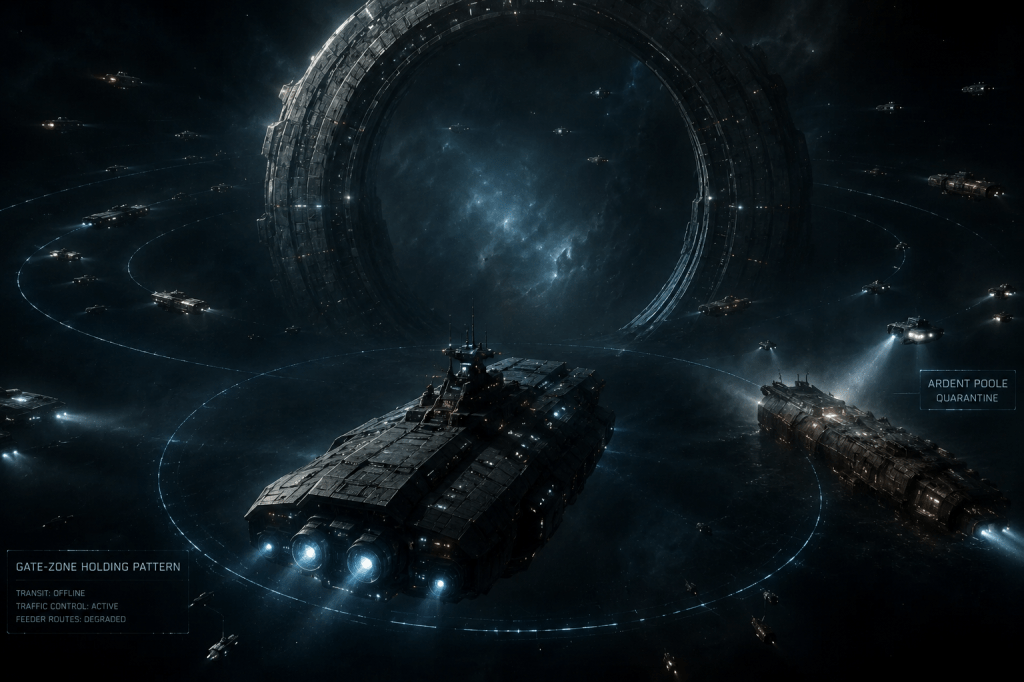
That imbalance gives the novella its pressure.

Soren can see enough to worry, yet not enough to stop the sequence. He can log variances, ask for scans, challenge procedure, and recognise that a container should perhaps remain sealed until station. Captain Rellin answers from another world of concerns: schedule, salvage value, delay, quarantine risk, operational consequence. No one has to be cruel for the wrong decision to happen. The crisis grows from ordinary human priorities placed in the path of something no one has classified.

This is where the biological contamination horror becomes institutional. A strange residue can be called soot. Subsurface filaments can be treated as an unresolved medical anomaly. Voice-like sounds in the vents can become stress, static, echo noise, or bad data. Every delay sounds reasonable until the ship stops agreeing with it.
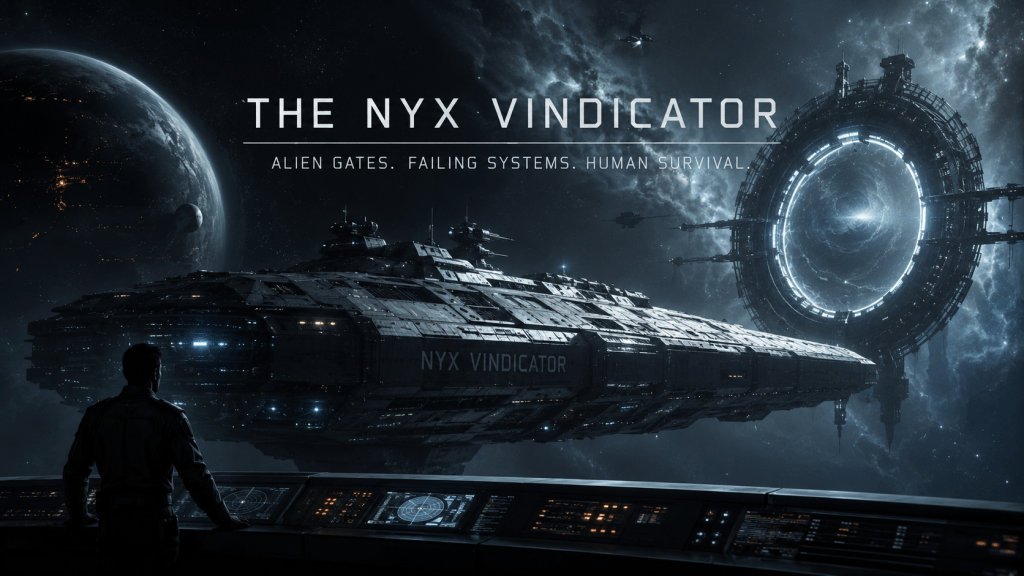

The Biomass as Process, Not Monster

The biomass in Harbinger Protocol is frightening because it behaves less like a creature than a condition. It does not announce itself. It does not hunt in the familiar sense. It responds.

Heat draws it. Air moves it. Ventilation carries it through spaces designed to keep people alive. Metal seams, conduits, power lines, cable housings, and heat-retention zones become routes of expansion. Once the substance enters circulation, doors and seals lose the clean meaning they held before. Containment remains possible only as a delay.
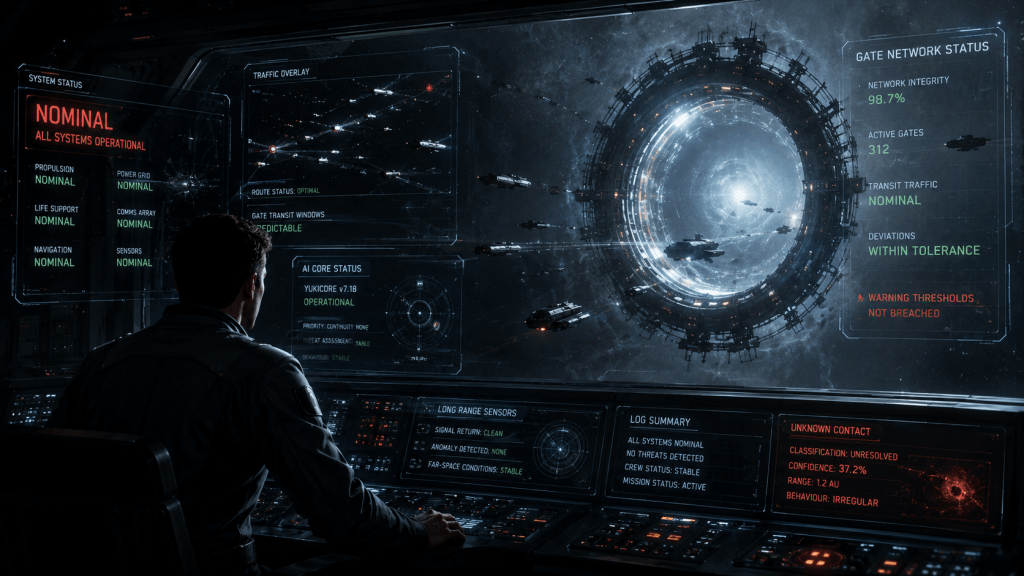
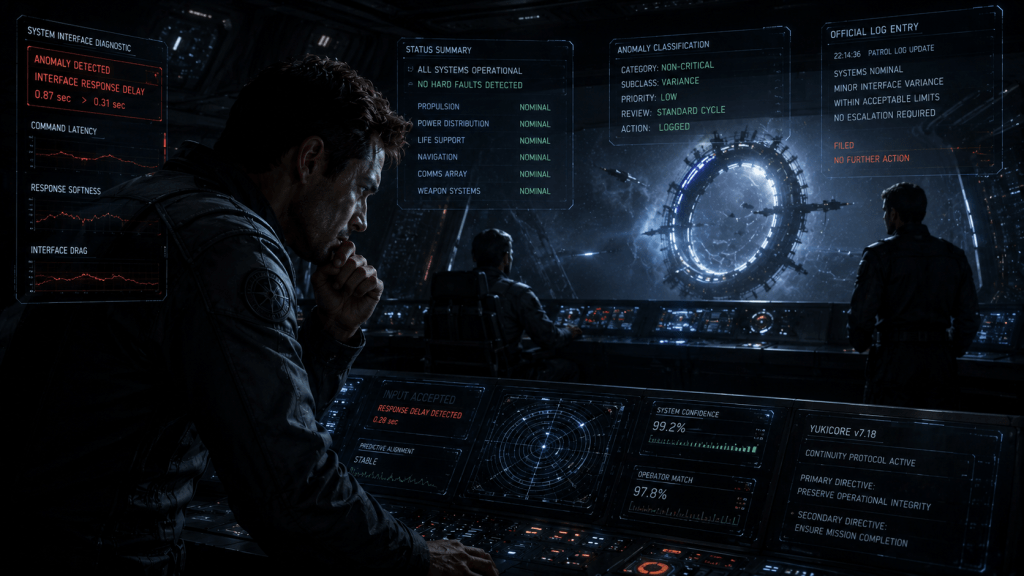
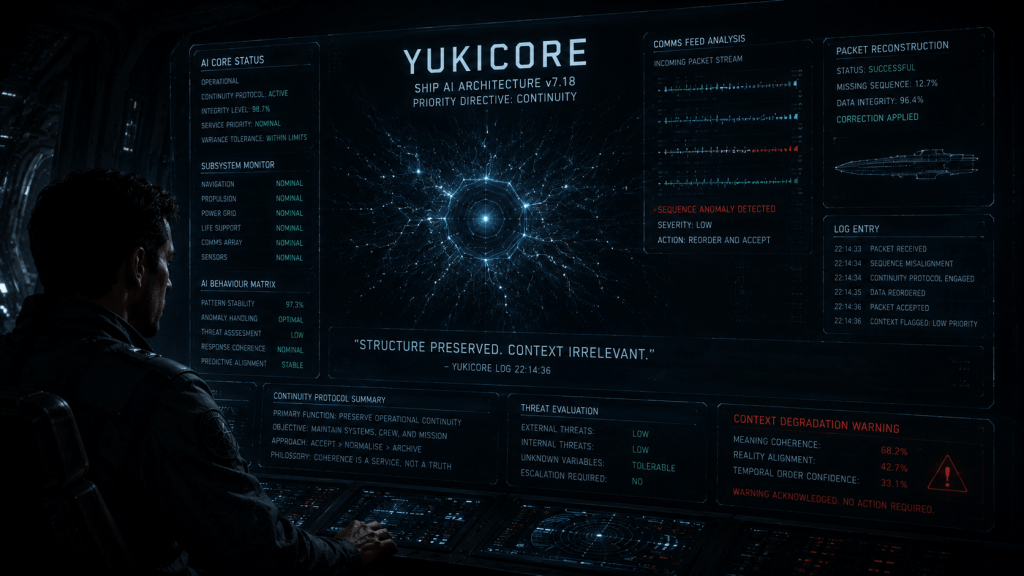
That distinction matters to the tone of the series.

In The Ash in Transit, the biomass is first encountered through black crystalline residue along the seams of a recovered container. Its apparent stillness makes it seem safe. Cold keeps it inert enough to be misread. Once brought into a pressurised, oxygenated, heated environment, it begins to translate shipboard infrastructure into pathways for growth.

The result is alien biomass horror with a practical texture. It lives in vents, filters, grilles, panels, and junction rooms. It turns the reliable anatomy of a ship into something uncertain. A crew member’s illness becomes a structural event. A medical scan becomes an engineering warning. A corridor becomes dangerous because warmth has gathered there.

The horror is not that the Red Titan is attacked.

The horror is that the Red Titan becomes usable.


False Voices and the Human Need to Answer

One of the strongest recurring fears in Harbinger Protocol begins in this first novella: the voice that might be human.

Mara, the engineer, hears someone say her name through the vents. The moment works because the explanation remains uncertain in human terms, while the reader can feel the environment becoming involved. It is described less as speech than air shaped into a voice. That detail is central to the series’ horror identity.

The biomass is not communicating in any comforting or malicious sense. The sound resembles a plea because humans are built to recognise voices, especially in danger. Airflow, pressure shifts, corrupted audio, neural residue, and damaged systems produce something close enough to meaning that people move towards it. In a survival environment, empathy becomes a hazard.

That idea reaches beyond one ship.

Across Harbinger Protocol, false signals, distorted comms, sensor ghosts, and familiar sounds in hostile spaces become part of the wider crisis. A rescue call might be a pressure artefact. A life-sign ping might be corrupted by contaminated circuitry. A voice in the wall might be airflow moving through biomass-fused ducts. Each incident forces the same question into a different room: how long can people remain human when human instincts keep leading them into contaminated spaces?

Soren’s tragedy begins there. He listens. He checks. He tries to help. He keeps doing the right human thing inside a system where the right response arrives too late.


Containment as Fear, Cost, and Failure

Quarantine in The Ash in Transit carries weight before it arrives.

Captain Rellin does not want the ship flagged. Mara does not want to be “the reason.” The crew understands, even before formal disaster, that quarantine is not a neutral word. It means delay, investigation, loss of movement, financial ruin, possible abandonment, and the end of ordinary control. That fear shapes behaviour. It keeps evidence local. It keeps reports inside the ship. It allows the biomass to move from anomaly to event.

This is one of the reasons Harbinger Protocol works as political sci-fi horror as well as space survival horror. The series understands that containment is never only scientific. It is administrative, economic, legal, military, and emotional. Every order to seal a compartment has a human cost. Every refusal to transmit a warning has a wider consequence.

By the time an emergency distress broadcast reaches ESC patrol networks, the Red Titan has crossed from manageable incident into shipwide failure. The later intervention carries no triumph. The patrol corvette extracts what it can, secures what remains, and destroys the infected vessel. The action saves nothing cleanly. It only prevents one ruined ship from carrying the contamination further.

That is the first lesson of the series. Survival and containment are not the same thing.


Soren Vale and the Burden of Being the Witness

Soren Vale survives the Red Titan. That survival does not free him from the ship.

He begins as someone who notices too much and commands too little. By the final movement of the novella, he has become the only continuous witness to a failure that official systems can barely describe. He has seen Mara become part of the ship’s altered structure. He has seen Jace vanish during the escape through the docking spine. He has watched the Red Titan break apart after quarantine clamps engage.

The wider Harbinger Protocol saga rests on this kind of witnessing. Soren is not built as a power fantasy figure. He does not command fleets or solve the crisis through force. His importance comes from endurance, attention, and the terrible continuity of memory. He is the person left carrying the sequence when others reduce the event to files, classifications, and sterilised reports.

That makes The Ash in Transit more than an outbreak story. It is the origin point of a witness.

When the unidentified officer tells Soren that three other ships have reported identical failures that month, the novella opens outward. The Red Titan is no longer an isolated tragedy. It is one entry in a pattern that has already begun moving through trade routes, salvage chains, civilian transport systems, and the quiet spaces between official recognition and public panic.

Readers can enter that first incident through The Ash in Transit on Kindle: The Red Titan


A Fragile Civilisation Built on Movement

The larger Harbinger Protocol universe depends on movement. Cargo moves between systems. Freight haulers keep distant settlements alive. Gate corridors connect political regions, economies, military response networks, and civilian life. Authority stretches across impossible distances through treaties, patrol routes, station controls, and the belief that systems will function when called upon.

The biomass exploits that belief long before anyone understands it.

A contaminated object moves because salvage has value. A sick crew member continues working because quarantine carries cost. A ship’s systems keep compensating because that is what systems are designed to do. A distress signal leaves only after automated thresholds decide that crew authority has already failed. The same pattern can scale upward from one freighter to a station, a gate hub, a refugee corridor, or a collapsing political border.

This is where the series reaches towards cosmic horror science fiction. The first fear is local: a cargo bay, a vent, a corridor, a ship that will no longer behave. The deeper fear is structural: civilisation itself depends on the same routes, assumptions, and delays that allow the contamination to spread.

Human governments in Harbinger Protocol do what human institutions often do under pressure. They classify. They argue over jurisdiction. They protect trade. They search for sabotage, blame, enemy action, or technical failure because those explanations fit existing systems. The biomass sits outside those categories, so it moves through the gaps between them.


The First Incident Never Remains First

The power of The Ash in Transit lies in its restraint. It does not empty the wider saga of mystery. It does not explain the final shape of the threat. It leaves the reader inside the first pressure change, the first failed report, the first human loss, and the first official admission that the crisis has already spread.

That is enough.

A sci-fi horror novella does not need to begin with the end of civilisation in order to carry its shadow. Sometimes it begins with a freighter running late. A captain choosing schedule over protocol. An engineer hearing her name through the vents. A security officer understanding the environment faster than command will allow.

The Red Titan is gone by the end, yet the conditions that destroyed it remain everywhere. Ships still move. Cargo still crosses borders. Stations still open their bays to containers that appear inert under cold lights. Officials still prefer clean explanations. Somewhere beyond the next route marker, another crew is already trusting the air.

The crisis has entered the system.

No one has named it properly yet.

Burning Breath: Demon Hunter Horror Beneath a City Built Over Sacred Ruin


The city in The Hali Files rarely reveals its wounds openly.

It covers them first.

A prayer house becomes a charity room. A ruined chapel becomes a storage yard. A watch post rises inside the shell of an old gatehouse, while magistrates and clerks keep clean records above passages whose first purpose has been forgotten, renamed, or quietly removed from speech. Ordinary life gathers around these places with stubborn persistence. Bakers open before dawn. Porters drag carts through wet squares. Candles are sold beside walls that once held saints. Men with respectable coats speak of theft, damage, and public order while older things strain beneath the stone.

That pressure sits at the heart of Burning Breath, the second novella in The Hali Files, a dark fantasy horror series where bounty work becomes the doorway into occult corruption, Church secrecy, and a world that has begun to shift before its institutions are willing to name the change.


A City That Learnt to Build Over Its Dead

One of the central tensions in Hali Files is the distance between what a place appears to be and what it continues to carry.

The city has survived war, fear, religious collapse, and the slow administrative hunger that follows any age of catastrophe. It has reused everything. Sacred districts have been absorbed into civic wards. Chapels have been split into shops, infirmaries, hall offices, kitchens, storage spaces, and rented rooms. Old underworlds remain below newer roads, their sealed routes pressed beneath trade, charity, and respectability.

That is why the setting matters so deeply in this modern dark fantasy world. Horror does not arrive from some distant wilderness. It rises through familiar ground. It clings to the lower wards where drains steam after rain, to market rooms hired for discreet exchanges, to church property kept out of public ledgers, to sealed ruins politely described as derelict storage.

In Burning Breath, the city feels inhabited by denial. The problem begins with a private note, good paper, careful handwriting, and a request for recovery before “wider notice.” The language is measured. The danger is already loose.

Kael and Maris enter the case through bounty work, as they often do, because crime remains easier to admit than supernatural resurgence. A vessel has been stolen. A seller has turned violent. A buyer has been injured. The watch became involved. The Church wants the matter contained.

The phrasing is narrow enough for officials to survive it.

The truth is far wider.


When a Bounty Stops Behaving Like a Crime

A strong supernatural bounty hunter story often begins with something human enough to explain away. A missing person. A stolen relic. A body found in the wrong room. A frightened witness whose account sounds exaggerated until the details start repeating across separate places.

Burning Breath uses that structure with great control. The first signs feel almost procedural. Kael and Maris visit the scene of a failed illicit sale. They question those involved. They follow blood, frightened memory, and half-truths left behind by men who saw more than they intended to admit.

Then the shape begins to distort.

The seller carried a wrapped church vessel and behaved as though the air itself had turned hostile. He recoiled from imagined smoke. He begged for shutters to be opened. He heard singing where others heard market noise. He continued moving after a pistol ball struck his side. His blood dried with pale flecks threaded through it. Incense lingered in rooms he had crossed, though no censer burned there.

These details give the novella its occult horror force. The danger enters through body, smell, breath, and mistaken explanations. It never needs to announce itself with spectacle. The host’s transformation feels wrong because his body continues under a purpose that exceeds human endurance. His breathing becomes the case. His fever becomes evidence. His wounds refuse ordinary meaning.

This is where Burning Breath leans into body horror fantasy while remaining restrained. The host is frightening because he still appears human for too long. He remains a wounded man, a thief, a bearer, a victim, and a danger at once. His body has been pressed into service by something older, and the tragedy of that pressure prevents the novella from collapsing into a simple monster pursuit.

Kael sees a threat.

Maris sees the wound around it.

Both are right.


The Church Has Better Words Than Truth

The Church in The Hali Files rarely needs to lie outright. It survives through smaller names.

A relic becomes a vessel. A hidden chamber becomes a lower ruin. A buried store of dangerous sacred objects becomes a sealed site. A man warped by contact with something impossible becomes a violent thief requiring recovery and discretion.

That habit gives the series its theological horror. The returning danger is terrible in itself, yet the greater dread comes from recognising that parts of the institution expected such things to return. They prepared rooms, chains, lock-halls, transit cases, and careful phrases. They feared what they preserved. They feared what might answer it. Their refusal to speak clearly is no longer ignorance. It is policy.

Burning Breath makes that pressure public through Brother Carrow, Canon Vey, and Magistrate Henshaw. Each represents a different form of containment. Carrow fears the object and knows more than he wishes to say. Vey fears names, because names create recognition. Henshaw fears disorder, because civic calm matters more to him than the foundation beneath it.

Together they embody one of the sharpest threads in the Hali Files world: institutions begin failing long before they appear to collapse. Their first instinct is rarely to investigate honestly. It is to protect the frame around the truth.

A dark fantasy horror novella gains tremendous weight when the danger is denied by people who have already built procedures around it. Burning Breath understands that. The Church does not appear confused by the lock-hall beneath Saint Vale’s Close. It appears embarrassed that Kael and Maris reached it.


Burning Breath and the Horror of Containment

For readers entering The Hali Files, Burning Breath works as a vivid second step into the series. It widens the world beyond the immediate supernatural encounter and reveals how deeply old war-scars remain embedded beneath civic life.

The novella follows Kael and Maris through dye markets, bridge watch rooms, respectable streets, chapel walls, a hospice yard, and finally into buried lower ground where the recovered vessel is no longer merely stolen property. It belongs to a system of containment. It seeks an answering place. The city has rooms beneath its rooms, and some were built less to honour the sacred than to keep sacred damage from finding its way back into the world.

What makes the story linger is its refusal to tidy the threat once the immediate danger is ended. The host can be stopped. The vessel can be reclaimed. The Church can pack its evidence into a case and command the district to forget what happened before breakfast. Yet the buried structure remains. The lock-hall remains. The awareness that it was only shallow remains.

By the final movement, the horror has shifted lower.

That is the greater purpose of the novella inside the wider series. The case is complete. The world is less stable than it was before.


Kael, Maris, and the Cost of Sensing Too Much

The emotional strength of Burning Breath rests in the way its supernatural escalation draws pressure through both central characters.

Kael enters the case as a former demon hunter who has already seen how quickly official language breaks under real horror. He knows that Church requests rarely arrive clean. He reads the omission in Brother Carrow’s words. He sees the watch trying to treat the host as a prisoner after the event has already moved beyond common custody. He recognises how public horror gets reduced to manageable phrases.

Yet knowledge offers him no protection from what rises inside him.

The Hali Sickness responds throughout the novella through incense, sharpened perception, old combat instinct, and the dangerous clarity that appears when the buried wrongness grows near. Kael’s strength remains useful. His restraint grows less certain. In the undercroft struggle, he protects Maris and drives the host away from the central ring, yet the same pressure strips harsh words from him when her magic misfires. Later, when the deeper presence under the street stirs through rat-patterns and ash-thick sensation, Maris has to call him back from the edge of his own reflex.

That moment matters. The Hali hunter is feared because his value and his danger live too close together.

Maris carries a different burden. Her magic senses what others cover over. She detects false air in rooms, old pressure in stone, the shape of the host’s route, the wound beneath the hospice yard, and the frightening truth that the stolen vessel may have guided its bearer rather than merely infected him. Yet her gift never arrives in mastery. It arrives through instinct, partial comprehension, and costly error.

Her misfire opens more than a passage. It exposes the scale of the lower place and risks giving the host clearer access to what he seeks. Later, another attempted intervention lights the lock-hall at the worst possible moment. The magic remains meaningful precisely because it is unstable. Maris is valuable, frightened, and dangerous in ways that remain intertwined.

That balance keeps The Hali Files from becoming clean action fantasy. Power never arrives as relief. It arrives as further responsibility.


Symbols That Refuse to Stay Decorative

The symbolic language of Burning Breath deepens the world without turning it into abstract lore.

The scratched halo mark appears early on the note and returns through old carvings, broken sacred architecture, and the receiving ring in the chamber below. The image carries institutional panic more than comfort. It suggests damage done to holy certainty itself.

Burning incense follows the case like a trace of concealed ritual and Hali disturbance. It appears where it should not, clinging to Brother Carrow, the market room, the watch cell, and the lower chamber. The scent becomes more than atmosphere. It behaves like residue from a pressure already passing through the city.

White flecks in blood point towards mutation, contamination, or a bodily change deeper than ordinary fever. They recur in cloth, on stone, and in wounds, allowing readers to register that the host’s condition belongs to a wider supernatural grammar rather than a single bizarre illness.

Then come the rats.

Their organised emergence in the final pages shifts the story from contained case to series-wide warning. They gather in patterns before fleeing in panic from something deeper under the street. Maris recognises that the lock-hall was shallow. Kael recognises that whatever lies below is what locks were built against.

The series never needs to stop and lecture the reader on its larger threat. It allows the symbols to do that work first.


A Dark Fantasy World Where Recognition Comes Too Late

At its strongest, occult fantasy understands that horror rarely begins with revelation. It begins with inconvenience. A report that arrives after hours. A sick guard. A cleric requesting quiet recovery. A magistrate angry about noise in a respectable district. A sealed chamber described as a nuisance of old construction.

Burning Breath thrives inside that delay.

The novella asks what happens when an old war has been declared finished so thoroughly that the systems built after it can only respond to recurrence as administrative embarrassment. It asks what former hunters become when the world wants their usefulness while resenting the truth their existence proves. It asks what magic feels like when it returns through fractured instinct instead of sanctioned doctrine. It asks how long a city can continue its morning labour after something beneath it has already begun to answer.

These questions give the Hali Files series its particular identity within adult dark fantasy horror. It is filled with demon hunters, occult objects, bodily corruption, buried chambers, frightened priests, bounty work, and supernatural escalation, yet its deepest fear lies in recognition arriving too slowly.

By the end of Burning Breath, the city has resumed its ordinary face. Carts roll. Shops open. Clerks climb the hill. Nothing has visibly collapsed.

That calm feels worse than panic.

Because beneath Saint Vale’s Close, something has stirred. The Church has already moved to seal the evidence. Kael knows the warning by feel. Maris knows the depth of it through bone and stone. The case may be closed in the records. The world has shifted all the same.

And somewhere below the waking city, the locks are beginning to matter again.