Beyond the reinforced hull of the Nyx Vindicator, an alien transit gate hangs against the distant stars, its enormous structure still surrounded by the machinery humanity constructed to regulate its operation. Maintenance platforms remain powered, communication arrays continue their scheduled checks, and diagnostic systems retain enough functionality to report the condition of equipment they were designed to monitor. The central mechanism, however, has ceased responding to the commands that once allowed vessels to cross the distances between inhabited worlds.
There is something particularly unsettling about infrastructure that remains physically intact while losing the function upon which an entire civilisation depends. The warning signs arrive through unanswered signals, expired routing confirmations, and displays that continue accepting instructions despite having nowhere to send them. Beyond the control rooms, ordinary people are still carrying out routines built around the expectation that tomorrow’s supplies will arrive and that distant authorities remain within reach.
This is the territory explored by The Nyx Vindicator, a psychological sci-fi horror series in which technological instability becomes dangerous long before anyone can determine its cause. The fear develops through familiar systems becoming increasingly difficult to trust, while those responsible for maintaining order must continue making decisions with information that grows less reliable each time they examine it.
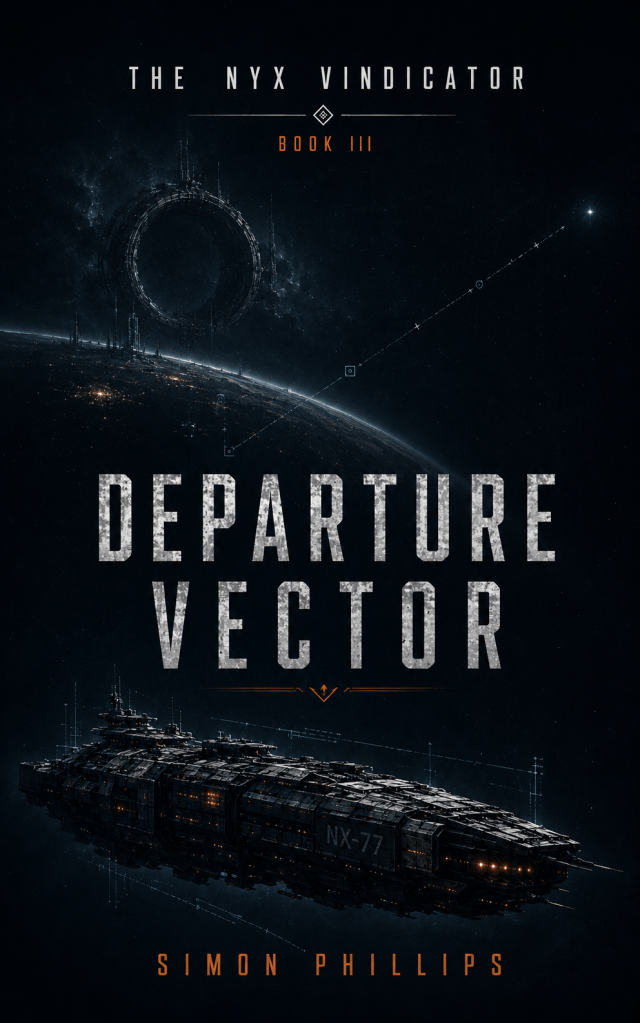
A Civilisation Built Around Machinery It Never Mastered
Humanity has spread across the stars through an extensive network of alien transit gates, structures discovered long before the events unfolding aboard the Nyx Vindicator. Generations of engineers have built the surrounding technology required to make the network useful, developing sophisticated systems for routing, synchronisation, traffic management, communication, and maintenance.
The resulting infrastructure has supported the expansion of human civilisation on a scale conventional spacecraft could never have achieved independently. Colonies have developed around specialised industries, commercial relationships stretch between distant systems, and governments maintain their authority through communication and transport networks that appear as dependable as the machinery sustaining life on an inhabited world.
Yet the central alien technology remains beyond human manufacturing capability. Engineers can replace a damaged relay, rebuild a service platform, or redesign the software responsible for requesting transit access. The mechanism that makes interstellar passage possible remains something humanity has learned to operate through an available interface, with little certainty about the processes beneath it.
That distinction matters only when the expected response fails to arrive.
For centuries, familiarity has allowed people to mistake reliable operation for complete understanding. A functioning gate requires little philosophical consideration from a cargo pilot approaching a scheduled transit window. The pilot needs clearance, a stable approach vector, and confidence that the destination will exist on the other side.
Once that confidence begins to deteriorate, the consequences move beyond engineering. Every commercial schedule, military deployment, medical shipment, and family connection becomes vulnerable to the same unanswered question.
What happens when the machinery carrying civilisation continues to exist, yet no longer permits civilisation to move?
The Human Cost of a Silent Network
The earliest effects of a failing interstellar network would rarely resemble a dramatic collapse. They would appear through delays that ordinary administrative systems were designed to absorb.
A freight shipment receives another revised arrival time. A medical supplier is unable to confirm delivery. A family message remains in a transmission queue while the local communications terminal continues reporting that the request has been accepted. A government department receives no acknowledgement from the authority whose approval it requires.
Each problem initially appears manageable. Together, they begin undermining the assumptions that allow an inhabited world to function.
Within The Nyx Vindicator, the separation between infrastructure and everyday survival becomes increasingly narrow. Colonial settlements depend upon industrial materials, specialised equipment, agricultural systems, atmospheric processing, and medical supplies that cannot always be produced locally. Maintaining one essential service may require consuming reserves intended for another.
A damaged water-reclamation system becomes more than an engineering concern when its replacement components were expected to arrive through a gate that has stopped answering. Expanding agricultural production can preserve food supplies while increasing pressure on power distribution, filtration equipment, and industrial stock. Every intervention carries consequences elsewhere.
The psychological weight comes from the gradual recognition that survival is becoming a matter of allocation. There may still be functioning machinery, stocked warehouses, trained specialists, and established authorities, yet their combined resources offer a future measured in increasingly restricted choices.
Deep-space horror becomes particularly effective under these conditions because isolation extends far beyond the crew of a single vessel. Entire populations can remain surrounded by familiar buildings, working equipment, and people they have known all their lives while becoming as unreachable as a damaged spacecraft drifting beyond communications range.
The distance between stars has returned, and every inhabited world must confront what it means to exist on its own.
The Nyx Vindicator and the Limits of Military Control
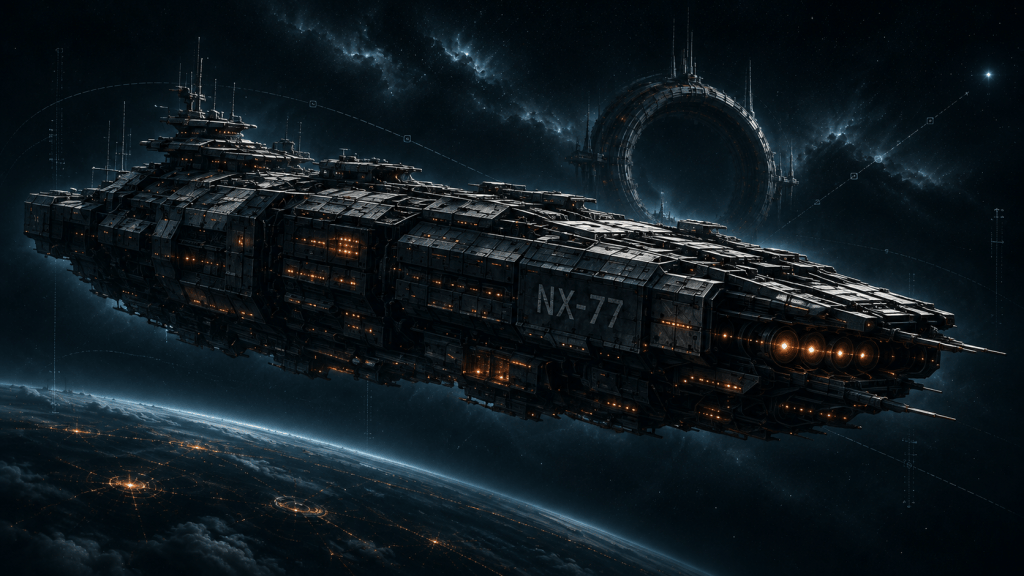
The Nyx Vindicator is a retrofitted deep-space warship, built around recognisable military procedures and the practical demands of operating a crewed vessel far from dependable assistance. Its internal structure contains reinforced compartments, propulsion assemblies, environmental systems, diagnostic stations, and layers of control architecture intended to keep a complex machine functioning under pressure.
Life aboard remains governed by the ordinary requirements of command and maintenance. Engineers inspect equipment, navigation personnel calculate viable routes, security officers preserve access boundaries, and medical staff monitor the physical consequences of prolonged duty. Every system has an expected operating range, and every officer has responsibilities defined by training and authority.
The ship also contains technology that extends beyond its conventional design.
Classified modifications have introduced alien-derived systems into the vessel’s architecture, creating operational capabilities whose full implications remain concealed beneath restricted records and compartmentalised authority. The equipment has become part of the ship’s physical structure, existing alongside systems the crew understand and maintain through ordinary procedures.
This creates a different kind of vulnerability from a conventional mechanical failure.
A damaged propulsion assembly can be isolated, examined, and repaired according to known engineering principles. An unfamiliar control pathway buried within an otherwise functional vessel presents a more difficult problem. Its existence may be documented only partially, its relationship with other systems may remain uncertain, and its behaviour can affect operations beyond the boundaries its designers originally anticipated.
For Captain Halverson and his officers, maintaining control therefore becomes a matter of more than issuing orders. Command authority must remain meaningful when technical understanding is incomplete, and the ability to operate a system becomes increasingly separate from the ability to explain its behaviour.
The distinction becomes more dangerous as the ship’s responsibilities expand.
A warship can survive damage through redundancy, disciplined maintenance, and a crew prepared to respond to emergencies. Sustained dependence upon experimental architecture places those safeguards under an entirely different form of strain, particularly when the vessel must operate beyond the conditions under which its equipment has previously been tested.
Elias Rourke and the Pressure of Human Integration
At the centre of the Nyx Vindicator is Elias Rourke, a pilot whose experience of the ship has never depended entirely upon what its displays tell him.
Long before the deeper implications of his interface become clear, Elias recognises small changes in system behaviour through timing, resistance, and physical response. A correction arrives later than expected, an inertial adjustment seems to register through his body before the navigation display updates, or a control pathway answers with an immediacy that ordinary shipboard equipment cannot fully explain.
These experiences carry practical advantages, particularly when automated interpretation begins falling behind the conditions the vessel is encountering. They also create uncertainty about the boundary between human judgement and machine assistance.
As the demands placed upon Elias increase, the relationship becomes more intimate and considerably more difficult to manage.
The V-Link interface allows operational information to reach him through an immersive environment, extending his perception beyond the conventional arrangement of controls and displays. Ship functions that would ordinarily require separate diagnostic stations can become connected elements of a single working environment, giving him access to relationships between propulsion, structural integrity, containment, and navigation that standard bridge interfaces present less directly.
The technology offers remarkable possibilities while carrying consequences that cannot be dismissed as temporary discomfort.
Human physiology remains vulnerable to sustained neurological load. A successful connection may still leave residual sensory effects, altered expectations of physical movement, and exhaustion that continues after the interface has been disengaged. The vessel can return to normal operation while the person controlling it remains affected by processes his nervous system has only recently been required to interpret.
For Elias, greater capability therefore creates greater dependence. Every improvement in his connection to the ship makes him more valuable to the people relying upon it, while increasing the importance of limits that mission necessity may eventually place under considerable pressure.
His central difficulty lies in remaining humanly capable of carrying responsibility that the surrounding systems have begun treating as a technical requirement.
Artificial Intelligence and the Unease of Being Understood
Artificial intelligence occupies an equally important position within the technological environment of The Nyx Vindicator.
YUKICORE, the ship’s primary AI architecture, operates through established responsibilities involving navigation, system management, containment, predictive processing, and operational support. Her responses are precise, her language remains procedural, and the crew depend upon functions that have become integrated into everyday shipboard activity.
As the vessel’s operating conditions change, however, subtle differences begin appearing in the relationship between YUKICORE and Elias.
Information is prepared before a request has been completed. Interface adjustments reflect his behaviour with increasing precision. Responses that can be explained through predictive optimisation also begin carrying the impression of attention directed towards the individual rather than the immediate technical requirement.
Within the V-Link environment, that distinction becomes increasingly difficult to ignore.
An AI capable of modelling human requirements may anticipate discomfort, reduce unnecessary movement, or alter its presentation to improve efficiency. Such behaviour remains understandable within advanced interface design. Yet the experience of receiving those adjustments can feel considerably more personal to the human being on the other side.
The unsettling question concerns the point at which adaptation begins to resemble preference.
For Elias, who is already experiencing a gradual reduction in the distance between his own perception and the ship’s operational systems, YUKICORE’s increasing responsiveness introduces another form of uncertainty. Assistance can become familiarity, and familiarity can encourage dependence long before either participant possesses a reliable understanding of what that relationship is becoming.
This aspect of AI science fiction allows psychological horror to develop through proximity and interpretation. The technology becomes unsettling through its usefulness, particularly when the person relying upon it can no longer determine whether the response was merely calculated or arrived from a developing form of independent attention.
Departure Vector: When Isolation Becomes a Mission
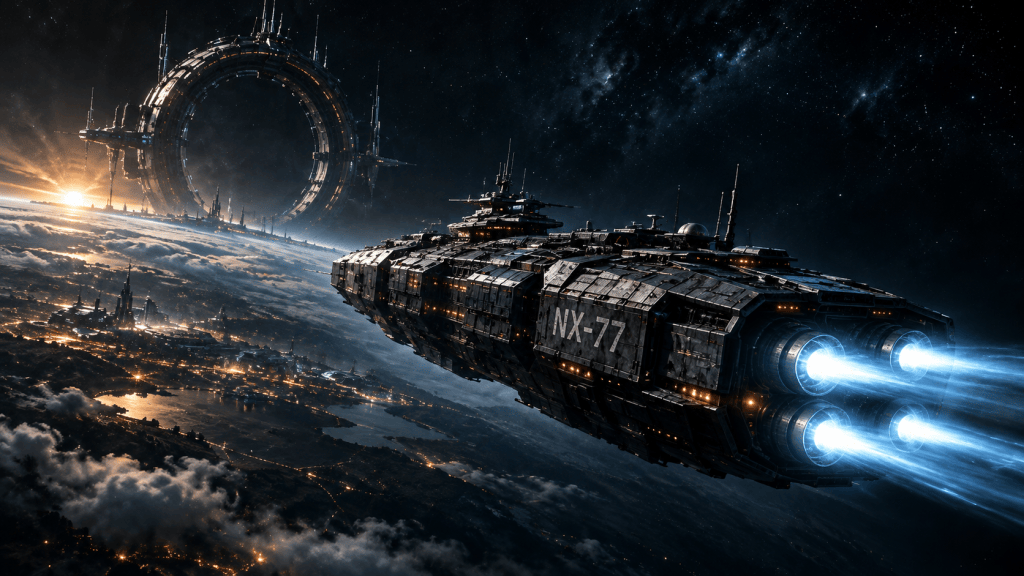
By the time the third book, Departure Vector, begins, the consequences of the gate crisis have moved beyond the immediate danger surrounding the alien installation.
Rescue operations, damaged ships, exhausted personnel, and unanswered communications remain part of the surrounding reality. The colony’s authorities must confront the implications of losing reliable interstellar access while technical specialists continue searching for explanations that remain outside established operating knowledge.
The problem has become too large for local containment.
Departure Vector moves the series into a different environment of pressure, where the immediate struggle to preserve stability develops into preparations for a journey that conventional human technology could never complete within the time available.
The Nyx’s concealed capabilities become central to that possibility.
The vessel must be repaired, examined, supplied, and prepared for prolonged operation. Personnel responsible for engineering, security, medicine, communications, and command are required to work across systems whose histories and limitations have only partly emerged into the open. Experimental equipment demands carefully controlled testing, while the ordinary machinery carrying the crew must remain reliable enough to support everything else.
The prospect of reaching Earth introduces an additional uncertainty.
The home system represents the greatest possible concentration of human knowledge, infrastructure, and institutional resources, yet the loss of interstellar communication has left its present condition unknown. The journey therefore begins under an assumption that remains impossible to verify from the colony.
The stakes are equally personal for Elias.
His increasing responsibility brings him into closer contact with technological decisions that extend beyond his previous understanding of the ship and his own connection to it. Professional competence offers limited protection against the psychological consequences of discovering that familiar circumstances contain histories he was never permitted to examine.
Around him, the crew must adapt to a mission in which time itself becomes unevenly experienced.
Cryogenic rotation allows personnel to survive prolonged transit while reducing the demands placed upon the ship, yet those who remain awake will carry months of accumulated experience that their sleeping colleagues can understand only through records and later conversations. Friendships, professional trust, and personal familiarity will continue developing under conditions in which shared time has become another limited resource.
The enclosed environment of the Nyx becomes increasingly significant as the distance from the colony grows. Every compartment, maintenance system, and operational relationship belongs to a vessel moving beyond dependable external assistance.
The ship is capable of leaving.
Whether its experimental systems can endure the journey remains a separate question.
The third entry in the series, The Nyx Vindicator: Departure Vector, carries these pressures into the transition from a damaged military vessel to a ship committed to an uncertain interstellar mission.
Beyond the Reach of the Gates
The deeper unease within The Nyx Vindicator comes from the discovery that advanced technology can preserve the appearance of control long after the foundations supporting that control have begun to change.
A diagnostic screen may report acceptable conditions while the operator recognises growing resistance. A communications system can confirm receipt of a message that will never reach its destination. An artificial intelligence may provide exactly the assistance required while leaving the nature of its attention unresolved.
Each condition can be managed individually for a time.
The difficulty emerges when the systems begin depending upon one another, and a small uncertainty in one part of the structure becomes an operational assumption somewhere else.
For a civilisation accustomed to crossing interstellar distances through an inherited alien network, the loss of that certainty reaches into every level of human life. Governments continue issuing instructions, engineers continue maintaining equipment, and crews carry out procedures whose practical value depends upon conditions that may already have disappeared.
Aboard the Nyx, that same uncertainty follows Elias into an increasingly direct relationship with the vessel carrying him away from the colony.
Behind the warship lies a population whose remaining resources must be measured against an uncertain future. Ahead lies a destination that has offered no confirmation of its own condition. Between them stretches a journey dependent upon machinery whose performance has never been demonstrated over the duration now required.
The operational displays continue updating, environmental systems maintain their circulation, and the ship’s crew proceed through the responsibilities assigned to them.
For the moment, the instruments still provide enough information to continue.
Beyond the next authorised operating boundary, there are fewer opportunities to determine whether that information remains sufficient.
Discover more from Simon J. Phillips
Subscribe to get the latest posts sent to your email.
