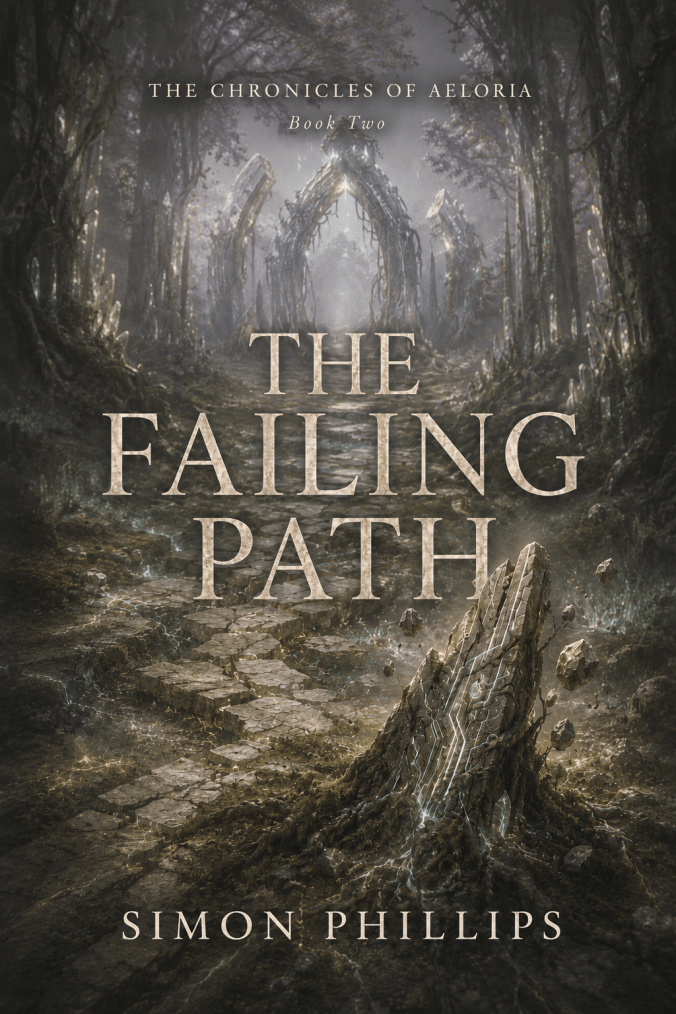
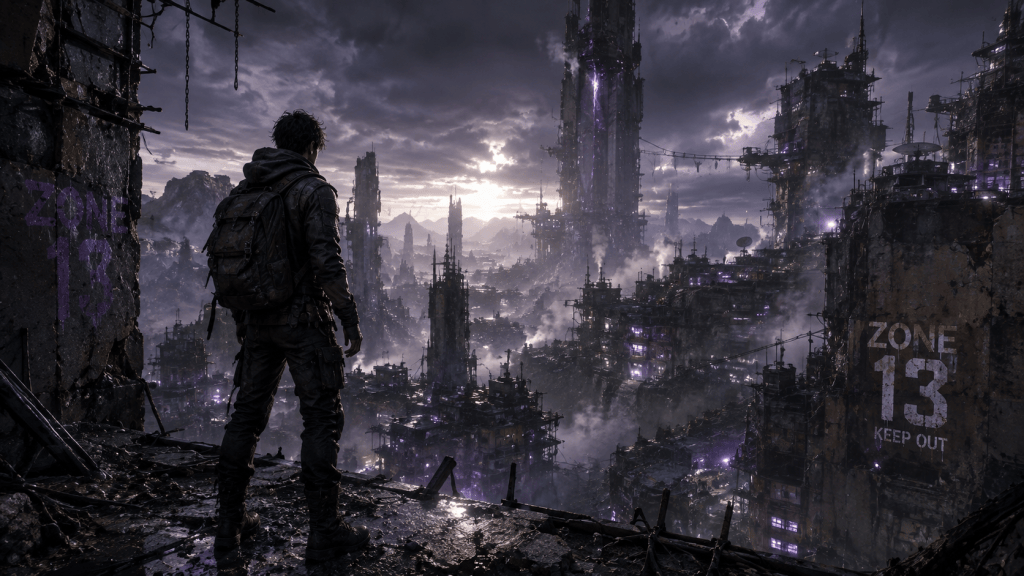
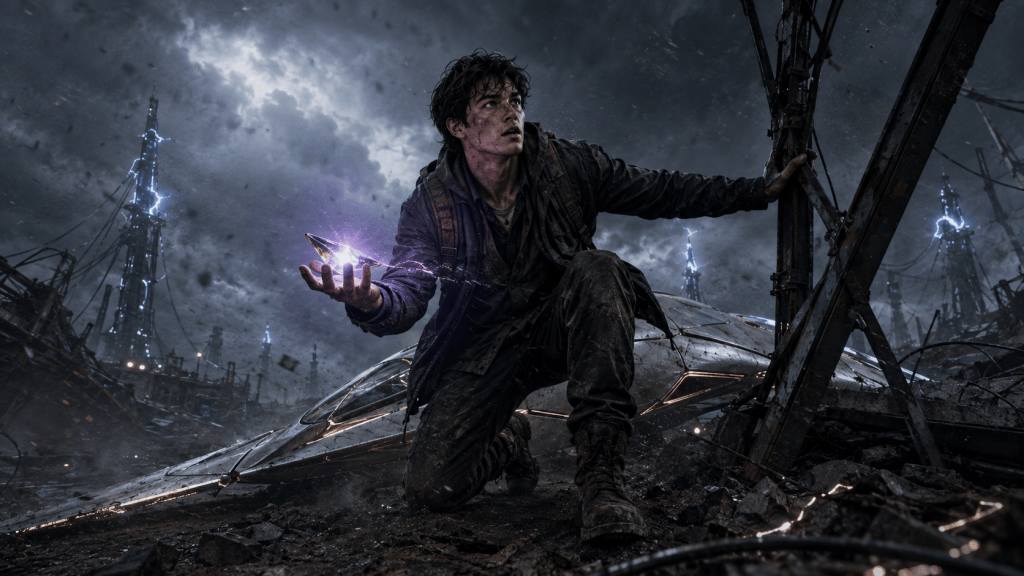
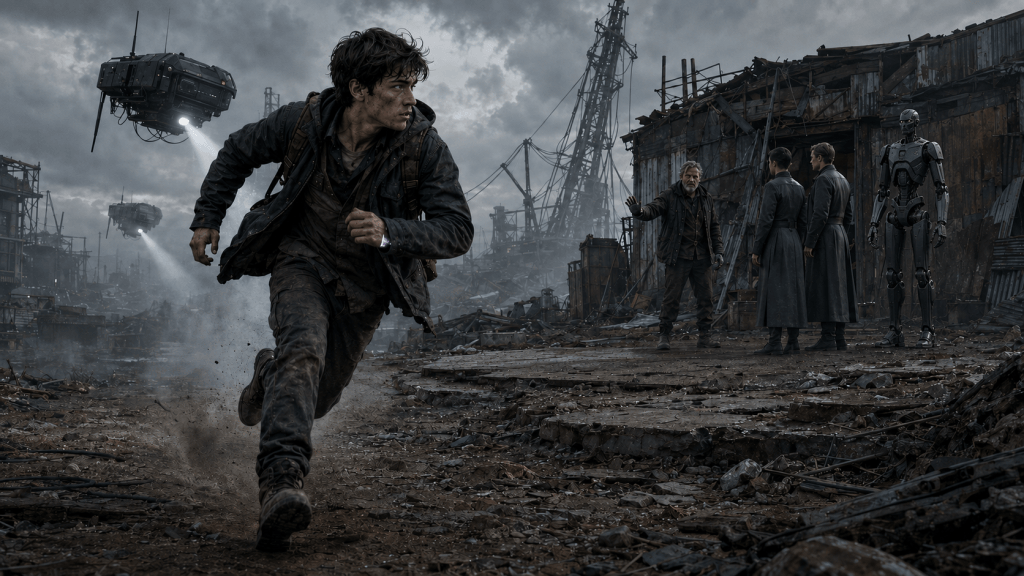
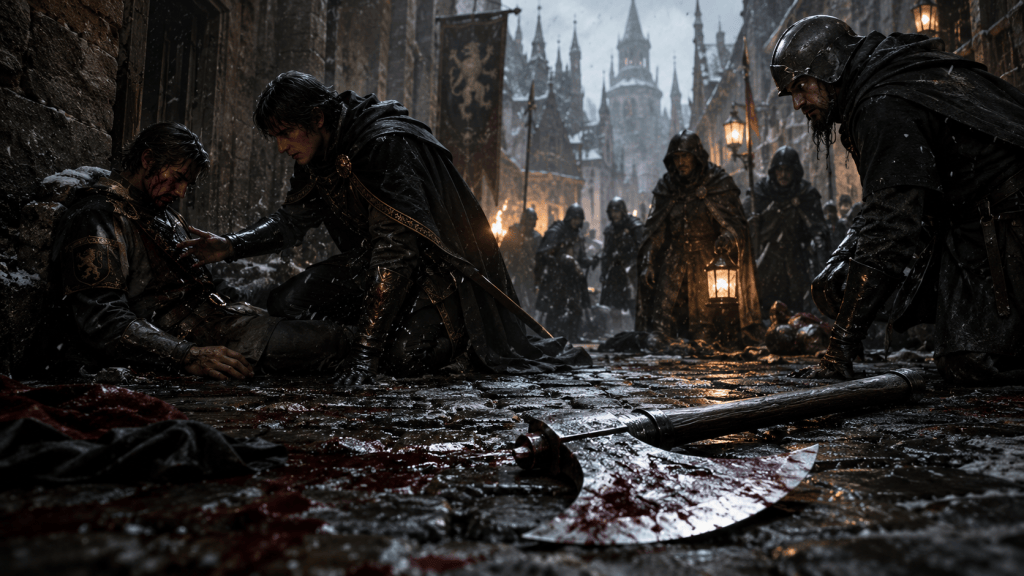
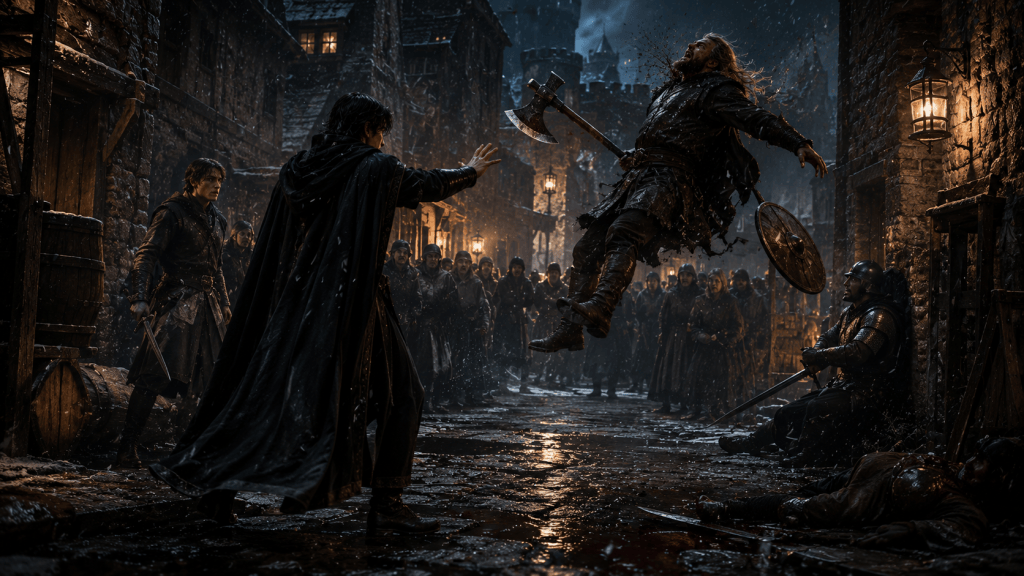
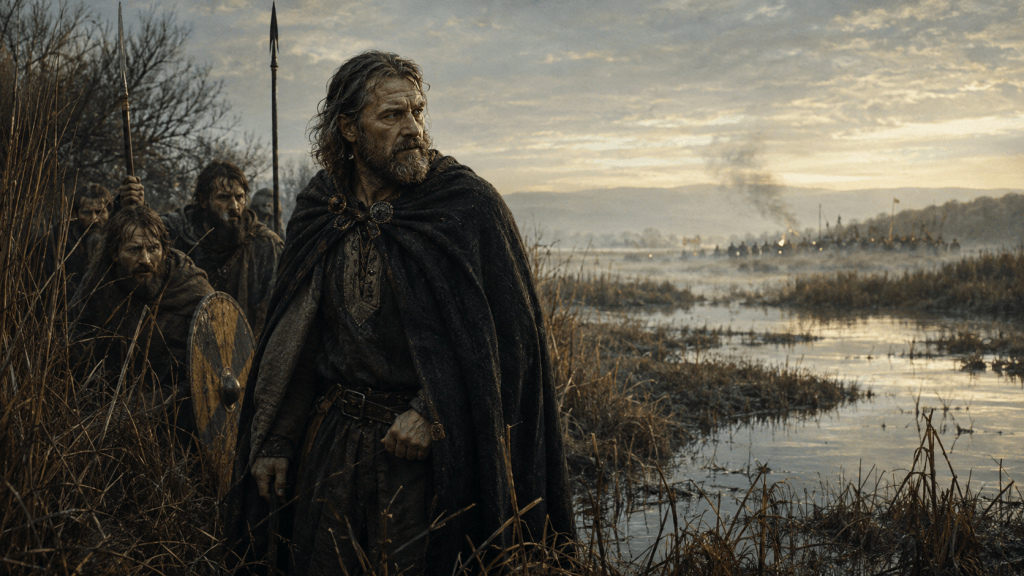
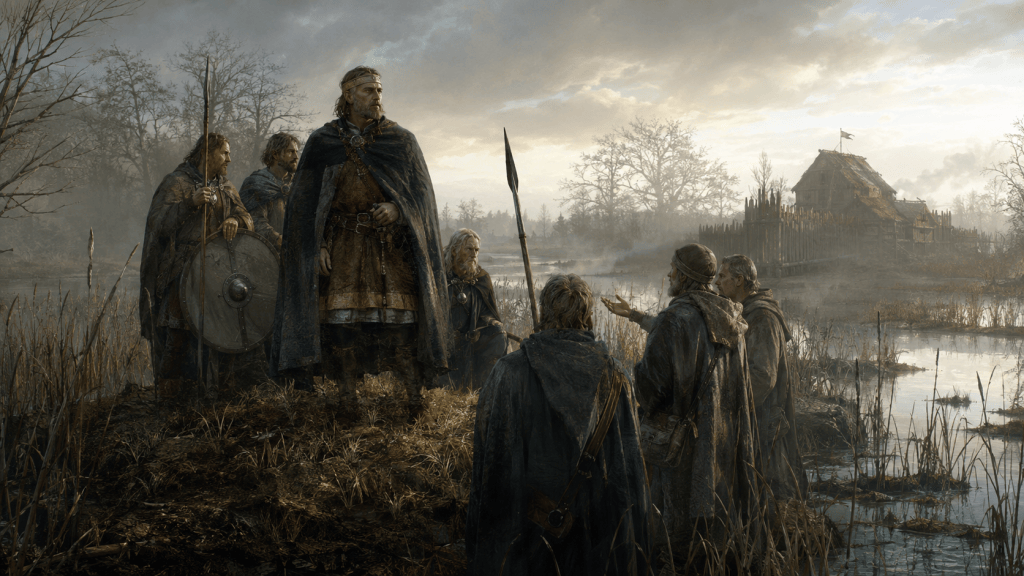
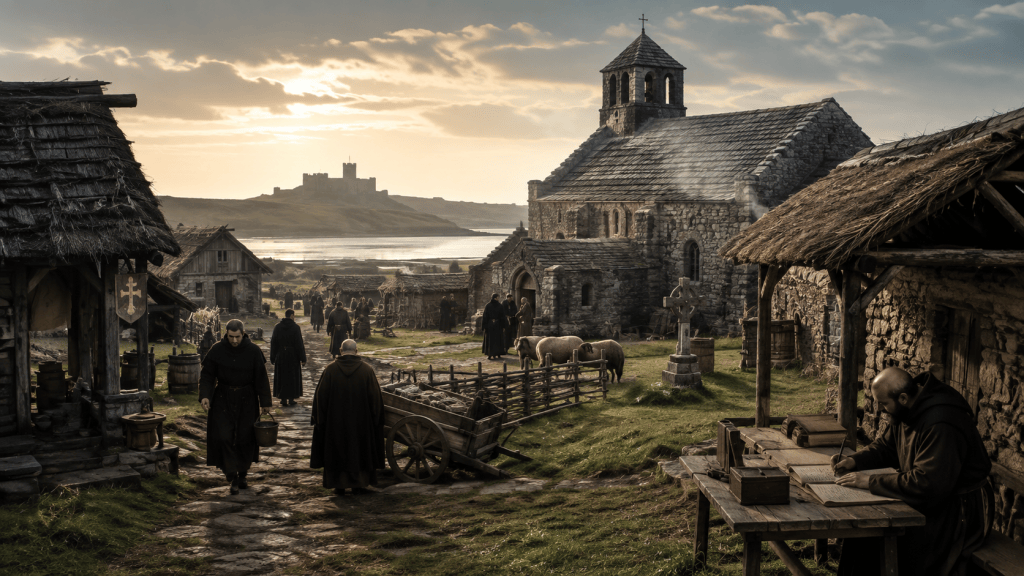
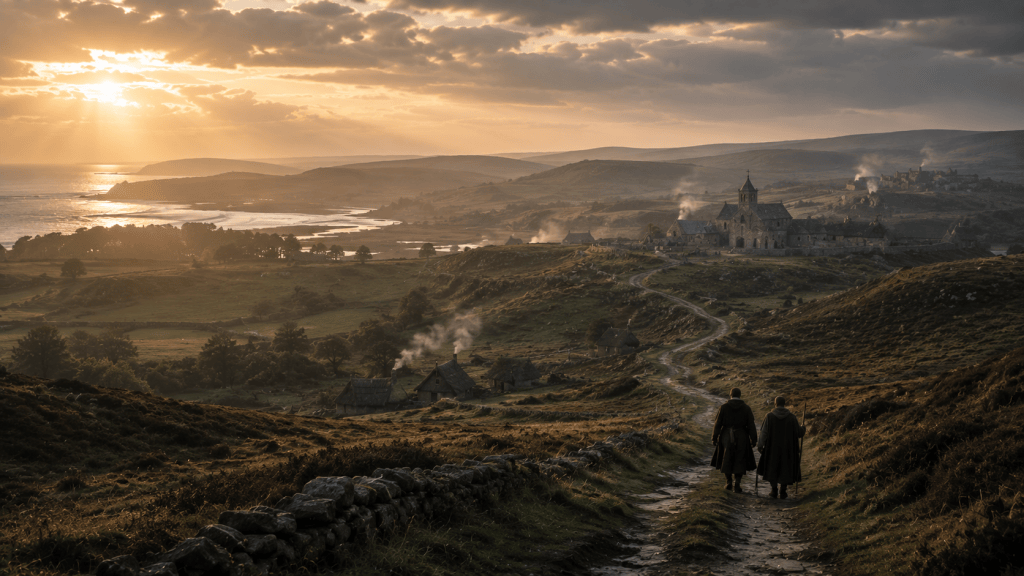
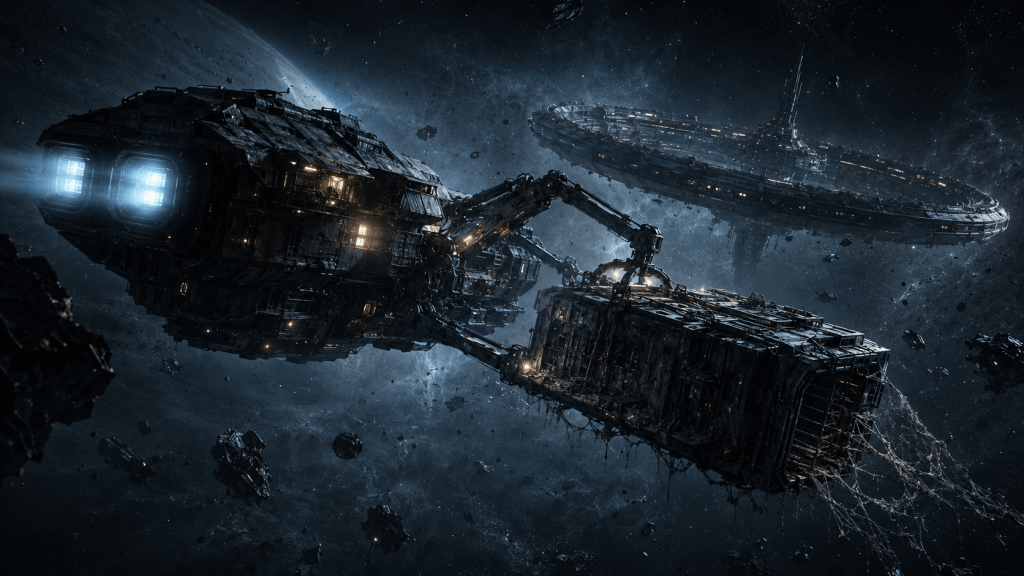
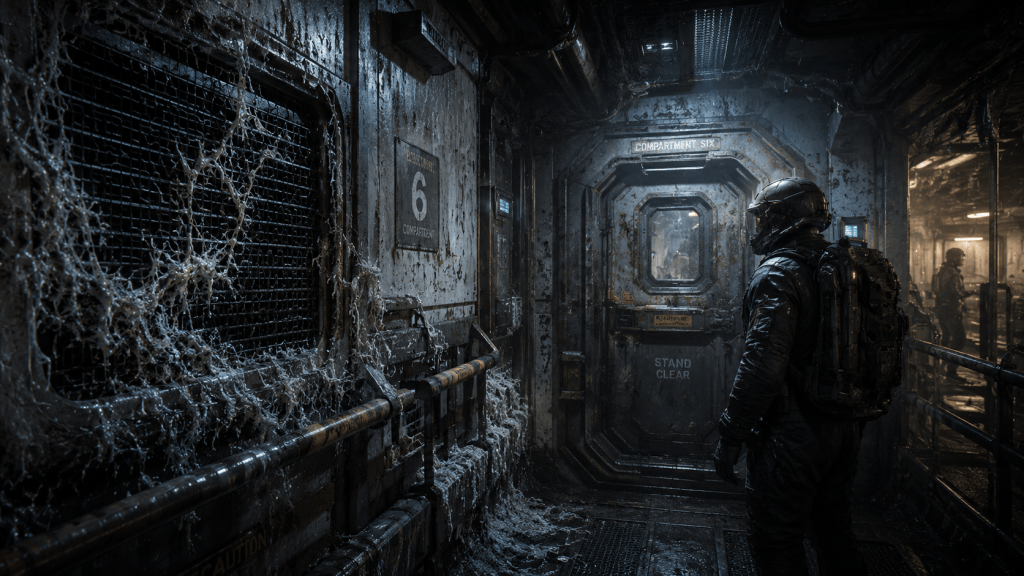
A path through a fractured world can resemble a road only until the ground beneath it begins behaving according to rules the traveller has never learned. In The Failing Path, Book Two of The Chronicles of Aeloria, Aeloria wakes far beyond Zone Thirteen in a place where moss restores itself after being disturbed, stones drift above the soil, water reacts to the shard at his wrist, and ancient structures respond to his movement before he has any understanding of what they were built to do.
The environment is beautiful in ways his former home never allowed, though beauty offers little reassurance when every part of the landscape seems tied to systems older than the people still moving through them. The fractured realms are separated by more than distance, with surviving routes running through unstable spaces where crystal, architecture, living growth and forgotten infrastructure continue functioning together even after much of their original purpose has been lost.
Travel between such worlds becomes an act of exposure. Every crossing places a traveller inside a structure whose rules may be understood only partially, and every surviving pathway carries the possibility that something built long ago still remembers how to respond.
A World Where Travel Has Physical Consequences
Fantasy often treats roads as the quiet space between significant locations, giving characters room to move from one place of consequence to another. Within The Awakening of Power, the road itself can become one of those places, because the old pathways between realms retain enough function to shape movement, alter the environment and place pressure directly upon anyone trying to cross them.
The bridge-realm Aeloria enters after leaving Zone Thirteen remains active despite its deterioration. Causeways lie beneath living growth, marker points still react to trained handling, damaged nodes continue regulating routes, and transfer stones retain enough of their purpose to carry travellers beyond the fragment when the surrounding systems can be held together for long enough.
Every surviving element also carries evidence of failure. The ground can settle late beneath Aeloria’s weight, dust hangs where gravity should pull it down, roots shift position after he passes, and passages that appear usable can begin closing as the fragment changes around those moving through it. Heat, cold and pressure can alter across short distances, leaving the body to register instability before the mind has any language for what is happening.
Aeloria approaches those conditions with instincts formed in Zone Thirteen, where a scavenger survives by testing uncertain surfaces, watching before entering open ground, judging whether damaged machinery is worth approaching, and distrusting anything that seems too easy. Those habits remain useful, though the fragment forces him to confront something his old environment never prepared him for, because broken infrastructure in the human world rarely appeared to notice who was walking across it.
The Bridge-Realm Is a Living Place, Even While It Fails
The fragment between worlds never behaves like an empty corridor separating two more important locations. It contains its own ecology, its own damaged structures and its own long relationship between living growth and ancient construction, creating a landscape that feels inhabited by history even where no settlement remains.
Crystal-veined trees rise through old architecture until it becomes difficult to judge where the built environment ends and the forest begins. Water passes through worked channels while roots and moss reclaim the stone around them, and small creatures move through conditions shaped by altered gravity and unusual atmospheric behaviour that would appear impossible within Aeloria’s familiar human world.
The effect is important because the fractured worlds are built upon inheritance rather than clean archaeological remains. Structures continue performing fragments of their original functions, landscapes grow around them, and later cultures maintain systems that have become necessary to survival even where their deepest logic remains uncertain.
The bridge-realm therefore holds more than one history at once. One belongs to whoever first shaped the pathways, while another belongs to the people who learned how to cross, maintain and survive those pathways after their original certainty had already begun to disappear.
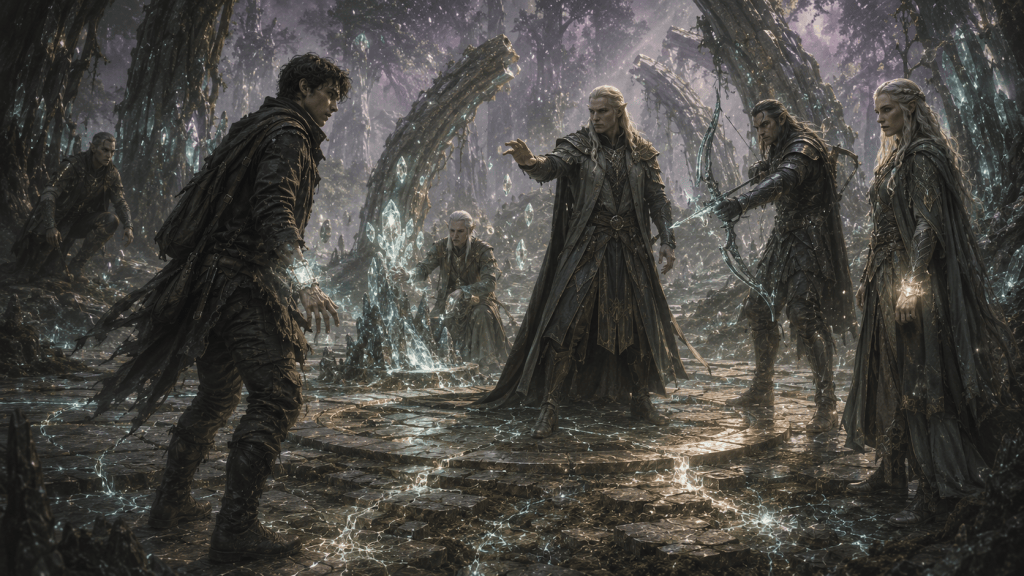
That second history becomes visible through the elven field team Aeloria encounters beside the failing node. They carry markers, slivers and specialised crystal equipment, and their movements reveal a working culture built around unstable routes rather than a civilisation approaching them as mysterious ruins for the first time.
Their knowledge is practical and highly developed, yet it remains knowledge shaped by use. The fragment can still surprise them, which prevents elven familiarity with crystal systems from becoming the same thing as complete understanding.
Elven Technology Begins with Resonance
Aeloria’s first sustained encounter with elven culture arrives through work rather than ceremony. Thalorien’s team is already attempting to stabilise a failing node when he reaches them, which means his first view of another civilisation is shaped by technicians, route-readers, guards and field equipment rather than temples, rulers or formal introductions.
Ilyr works with crystal slivers and damaged sockets while Caerun reads route behaviour through markers placed along unstable ground. Vaelen watches the surrounding terrain and manages immediate physical danger, while Serenis carries a white shard whose controlled response differs sharply from the unpredictable pressure surrounding Aeloria.
Their tools belong naturally to the same environment as the roots, crystal growth and living structures surrounding them. Nothing feels bolted onto the landscape as a separate layer of machinery, because elven technology has developed through resonance, cultivation and integration with the materials that already shape their civilisation.
That difference becomes one of the clearest expressions of the series’ science-fantasy identity. Human engineering tends towards machinery, applied systems and technical control, while elven systems rely more heavily upon resonance and cultivated crystal structures that can behave almost like extensions of the surrounding environment.
Aeloria recognises that the elves are doing technical work even when the methods feel impossible to him. Ilyr understands the failing node well enough to intervene when its behaviour worsens, yet even his knowledge reaches a limit once Aeloria’s presence causes the system to respond in a way he never expected.
Different cultures therefore carry different kinds of competence without any single people possessing the full truth. That balance allows the fractured realms to remain genuinely divided by experience rather than merely separated by appearance.
When Old Systems Recognise Someone They Should Ignore
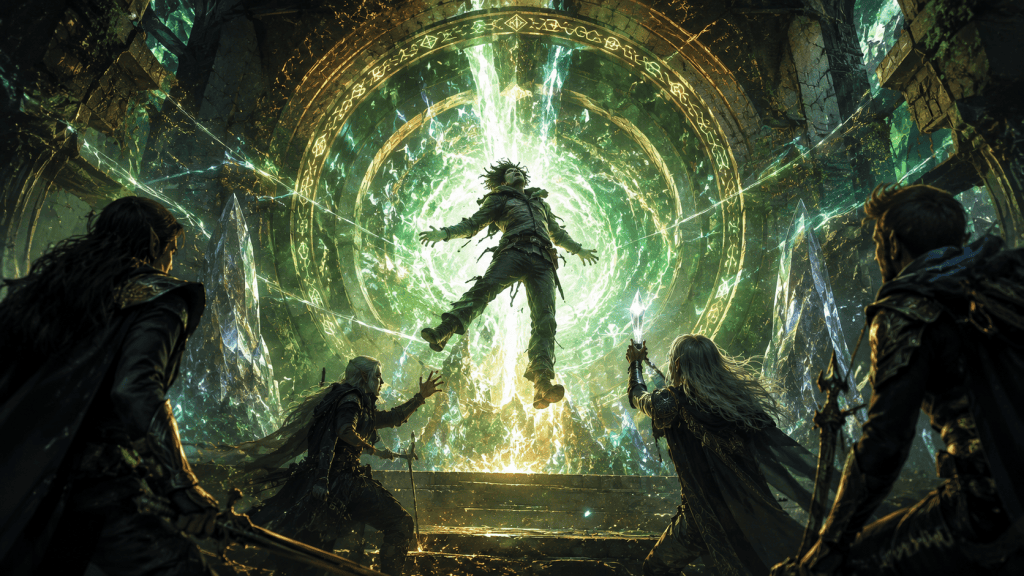
The most unsettling aspect of the fragment lies in the way old systems respond to Aeloria before anyone around him has decided what his presence means. The causeway lights beneath his steps, the node reaches towards him, Ilyr’s slivers begin turning in his direction, and a stabilising root responds when Aeloria catches himself against it during the node’s failure.
Later, the transfer stones begin treating him as though his position matters more than the arrangement chosen by the trained elven team. The route attempts to take him as its centre even though he has deliberately been placed away from that position, creating a danger that Serenis and the others can reduce only through coordinated action.
Aeloria never commands these events. His importance within the system appears before his ability to influence that importance deliberately, which keeps recognition separate from mastery and makes every reaction more threatening than empowering.
That distinction is central to the wider world of The Awakening of Power. Crystal interaction carries physical consequence first, placing strain upon the body and exposing the user to forces that may respond far beyond expectation before knowledge or control have developed.
For Aeloria, this means heat through the wrist, pressure through his body, loss of balance and the growing fear that structures around him recognise something he cannot identify. His problem is therefore larger than simply possessing unusual power, because every response makes other people more interested in understanding why the old systems react to him at all.
Rescue and Containment Begin to Look Similar
Once Thalorien’s team becomes responsible for Aeloria’s survival, first contact develops into something more uncomfortable than simple hostility or immediate friendship. The elves repeatedly keep him alive, yet they also watch him closely, restrict his movement and treat his presence as a potential danger to systems already under strain.
Vaelen catches him when unstable ground gives way and physically moves him clear when the path threatens to close. From Vaelen’s perspective, that behaviour is practical protection, while from Aeloria’s perspective the same hand can feel uncomfortably close to restraint after everything that happened in Zone Thirteen.
Thalorien explains enough for Aeloria to survive each immediate danger, while still placing him under direction because allowing an unknown human to move freely through a damaged crystal pathway could endanger everyone nearby. The resulting tension never requires either side to behave irrationally, because the conflict comes from the fact that their reasonable actions mean very different things depending upon who is experiencing them.
Even kindness carries that uncertainty. During a brief field halt, Caerun gives Aeloria concentrated elven travel food after recognising how depleted he has become, and Aeloria eats too quickly because hunger has already pushed caution aside. Serenis quietly contributes drink through Caerun while maintaining the silence she has kept throughout their journey.
The scene reveals cultural difference through the body rather than through explanation. Elven field food is designed for sustained travel through difficult terrain, their containers and supplies belong to the same cultivated technological culture as their path equipment, and Aeloria’s reaction exposes how far he has been reduced by displacement before he ever enters an elven city.
He accepts their help because survival requires it, though accepting assistance never becomes the same thing as trusting the people providing it. That distinction carries the emotional pressure of the entire crossing.
Isolation Changes the Way Cultures Read One Another
The fractured realms have remained divided long enough for cultural difference to become more than custom. Language, technology, risk, naming and even ordinary movement through dangerous spaces have developed according to separate histories, leaving first contact vulnerable to misunderstanding before anyone acts with deliberate hostility.
Aeloria gives his name because Thalorien asks for it, then learns afterwards that names carry particular weight within active path-space. The elves use a protective name-warding gesture as part of their established practice, while Aeloria has no reason to recognise the custom until he has already crossed its boundary.
From his perspective, rules keep appearing after they have already cost him something. From the elves’ perspective, they are trying to manage an unknown human whose arrival has disrupted systems that their own trained specialists approach with caution.
The tension grows from incomplete knowledge on both sides. Aeloria comes from a place where being noticed by organised authority can mean being taken, while the elves encounter someone who has appeared inside unstable route-space after old systems begin responding to him in unusual ways.
That kind of separation creates the deeper political pressure of a fractured world. Every realm develops its own explanation for danger, and those explanations become harder to challenge when generations have lived with little direct contact beyond unstable pathways and inherited warnings.
The Full Elven Realm Changes the Scale of Everything
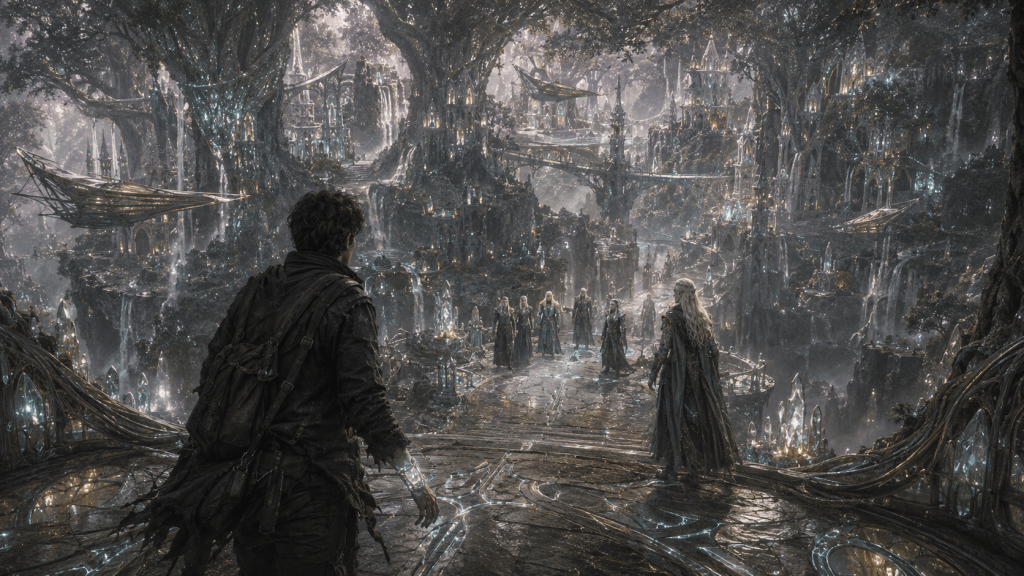
The arrival in the full elven realm brings one of the strongest visual and cultural contrasts in The Failing Path. Zone Thirteen survived through repair, salvage and adaptation, while the elven civilisation Aeloria enters rises through living crystal, enormous trees, layered bridges, controlled water systems and field-balanced craft moving through open air.
For Aeloria, the contrast reaches beyond beauty. Structures hold their weight, water flows where it has been guided, pathways remain maintained, and light runs through living architecture as part of ordinary function rather than as the unpredictable residue of a failing human system.
The experience reveals what stability looks like from someone raised in a place where almost everything had already been repaired too many times. It also demonstrates why material prosperity and personal safety should never be treated as the same thing.
The path-stones continue glowing after Aeloria arrives, ordinary elves begin watching, and six elders come to meet the field team. Serenis then reveals that she has understood Aeloria’s English throughout the crossing, changing the meaning of every earlier silence between them and leaving him aware that he has been observed far more closely than he realised.
The full elven realm therefore expands the scale of the story while narrowing Aeloria’s personal freedom. He has left the collapsing fragment behind, yet arrival places him before institutions capable of giving his presence a meaning he has never chosen for himself.
A Science-Fantasy World Built on Inheritance
The fractured realms of The Awakening of Power exist where technology, resonance, archaeology and myth can no longer be separated into simple categories. Crystals shape tools, architecture, transport and pathway systems, while structures left by older civilisations continue carrying functions that later cultures can use more easily than they can fully explain.
Human civilisation develops through technological adaptation and applied engineering, whereas the elves have built a closer relationship with crystal resonance and cultivated systems. Neither approach makes one culture inherently wiser, because each represents knowledge grown inside the limits of a separated world.
That partial understanding gives the series much of its atmosphere. Ancient structures matter because current lives still depend upon them, crystal systems matter because different peoples have built cultures around different forms of access, and pathways matter because their deterioration threatens the fragile connections that still exist between otherwise isolated realms.
The Failing Path places Aeloria directly inside that pressure for the first time. He enters the fragment carrying the survival instincts of Zone Thirteen and expecting damaged ground to behave according to the familiar logic of damaged machinery, only to discover that some old systems remain active enough to recognise movement, resonance and presence in ways no scavenger training could have prepared him to understand.
By the time he reaches the elven realm, the most unsettling truth is no longer simply that the path is failing. It is that parts of the ancient structure beneath the fractured worlds still appear capable of remembering what they were built to do, even when the people living among them have inherited only fragments of that knowledge.
Where Survival Begins with What Others Left Behind
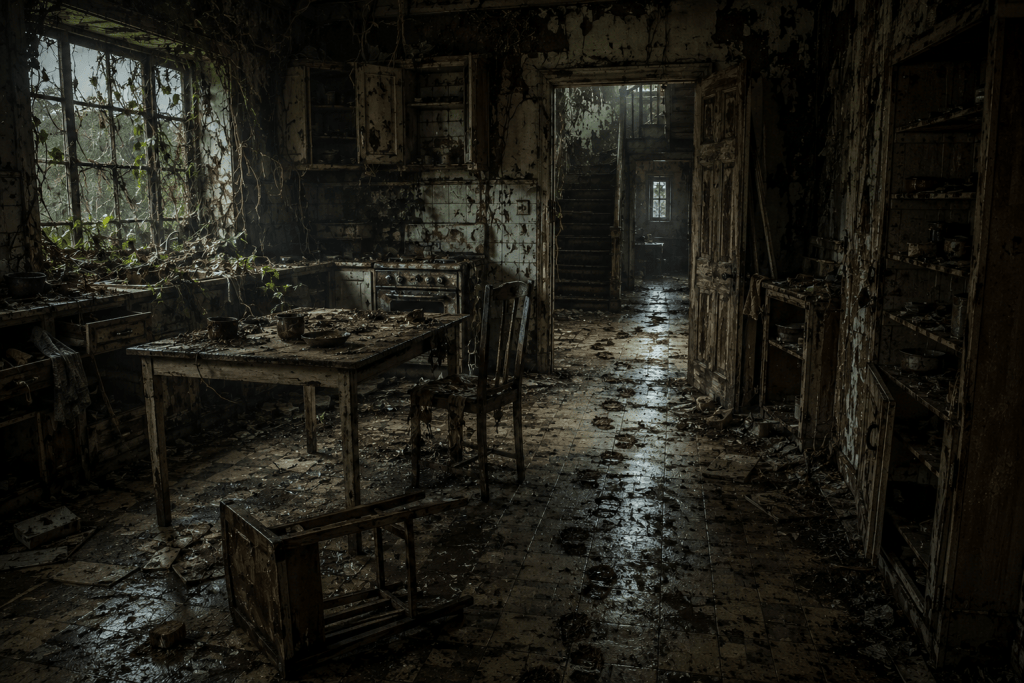
Aeloria began each morning with an empty pack and a clear understanding of how much attention an ordinary journey could attract. He moved along the broken edge of the roadway, tested fractured concrete before trusting his weight to it, and kept away from the open centre where other people might remember seeing him. Around him, leaning pylons carried loose wires above habitation shells patched with fabric, old pipe, and salvaged metal, while the faint hum of failing systems travelled through a settlement that had learned to survive on partial function. This was daily life in Zone Thirteen, where advanced technology remained everywhere and reliable technology had become a scarce resource.
That distinction gives the setting its place within mythic science fantasy. Zone Thirteen belongs to a technologically advanced human civilisation, even though its inhabitants live among damaged infrastructure and neglected systems. Scanners, relay units, heat assemblies, surveillance machines, conduits, crystal nodes, and engineered structures form part of ordinary experience. The hardship comes from abandonment, uneven maintenance, and the knowledge that stability elsewhere has never reached this edge of human territory with the same strength.
The people of the Zone have therefore built a culture around recovery. Almost every useful object carries the marks of an earlier purpose, followed by removal, repair, resale, and adaptation. A housing panel may become a windbreak, a discarded door may become a trader’s table, and mismatched power units may be joined into a working domestic system. Survival depends upon seeing continued use inside apparent failure, which makes salvage far more than a convenient element of science fantasy worldbuilding.
Salvage as Labour, Knowledge, and Risk
Aeloria’s work required patience before strength. When he opened a damaged service unit, he judged the condition of the seal, the remaining wiring, the likelihood of charge, the time required for removal, and the trace his presence might leave behind. A coil of reusable wire could still be abandoned when the effort carried too much exposure for too little return. Every choice placed value beside danger, and skill lay in recognising when an object deserved the minutes it would cost.
This practical intelligence shaped the way he moved through the Zone. Existing footprints offered a route across fine dust, shallow channels provided cover from open ground, and the edges of busy spaces allowed passage with less notice. Aeloria read structures through wear, vibration, resistance, and sound. His knowledge came from repeated contact with systems whose failures could injure him long before they offered anything worth carrying home.
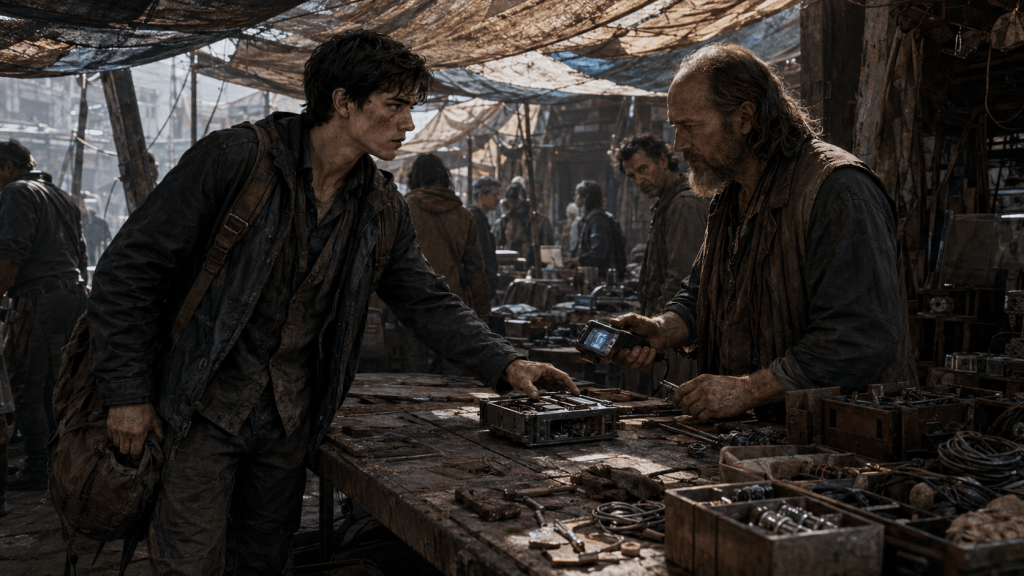
Salvage also supported a local economy built around tokens, uncertain prices, and guarded information. At Merrow’s trade station, stripped wiring sat beside cracked housings, wrapped glass tubes, worn tools, and components whose value depended upon function more than appearance. A clean assembly drew interest because cleanliness suggested rarity, while rarity changed the behaviour of everyone close enough to see it. Negotiation became part valuation, part concealment, with both trader and scavenger aware that curiosity could carry its own cost.
Merrow understood the social pressure surrounding valuable material. His stall offered Aeloria a familiar place to trade, yet familiarity never removed calculation from the exchange. A damaged seam lowered the offered price, an intact internal assembly raised it again, and a prolonged argument risked revealing how much the object mattered. In this part of the fractured world, economic survival depended upon reading faces as carefully as machinery.
Advanced Human Technology at the Edge of Order
The degradation of Zone Thirteen never makes humanity primitive. Its roads, pylons, scanning devices, powered tools, surveillance systems, and engineered dwellings reveal a civilisation capable of sophisticated construction and control. The Zone receives the remains of that capability in uneven condition, which creates a sharper tension than complete technological collapse could provide. People live close enough to advanced systems to understand their practical use, while access to dependable infrastructure remains limited by geography, neglect, and power.
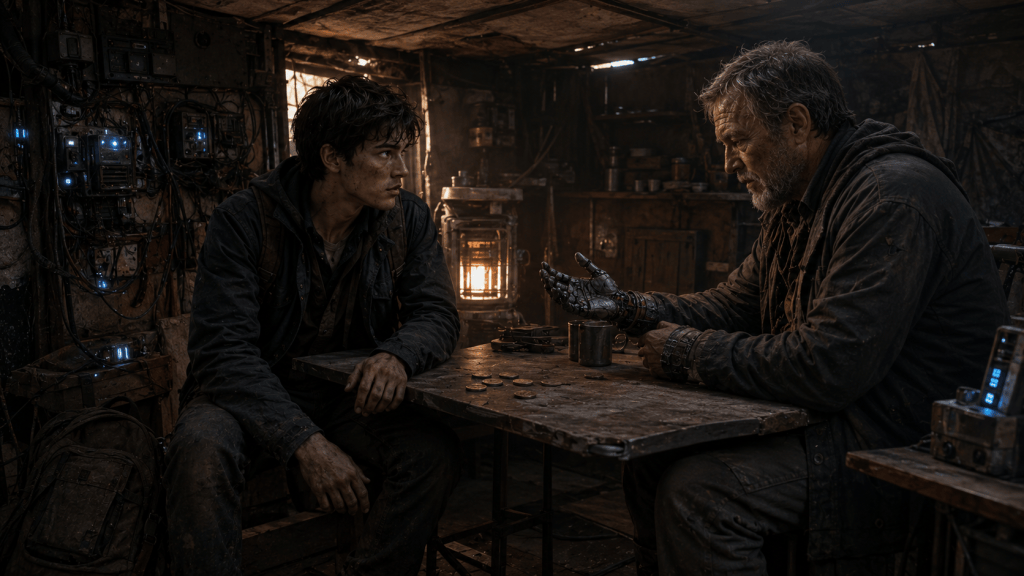
Larn’s shack shows this tension at its most intimate. Sections of the floor carry visible replacement lines, the roof consists of layered repairs, and old parts fill the room in ordered groups. Along one wall, salvaged units have been integrated into a working system through a lattice of cables and small crystal nodes, allowing heat and power to move through components that were never designed to serve together. The result feels improvised and sophisticated in equal measure, shaped by knowledge accumulated through necessity.
Larn himself carries the same relationship between body and machinery. His ageing mechanical hand continues to function through care, adjustment, and an acceptance that every repair has limits. Tokens earned through Aeloria’s scavenging may become food, a filter frame, a pack strap, or another attempt to keep that hand working. Technology remains personal here because its condition enters the body, the home, and the decisions made around a worn table.
This approach allows fantasy with advanced technology to remain materially grounded. Machines possess weight, heat, seals, damaged relays, delayed responses, and repair histories. Crystal-powered technology belongs beside those physical realities, serving ordinary needs before its deeper possibilities emerge. The world gains its science fantasy identity through the way machinery and crystal systems share the same lived environment, each carrying layers of knowledge beyond the reach of the people currently using them.
When Familiar Systems Begin to Behave Differently
Aeloria’s ability to recognise danger depended upon knowing how the Zone usually behaved. Pylons hummed irregularly, old metal carried vibration, structures settled, and the ground shifted where buried spaces had weakened. These conditions belonged to familiar risk. The true disturbance began when familiar failures changed their pattern, allowing a hum to fall out of alignment, a surface to answer a fraction too late, or a distant pylon to flare where no working connection should have carried power.
This is where the story’s crystal technology gains weight. Aeloria encounters the impossible through differences in systems he already understands, which means wonder arrives through recognition before explanation. The fallen glider appears too clean for its surroundings, with precise panels, deliberate curves, and an intact structure that holds steady while the ground around it slips. The shard within carries the same unsettling precision, placing an object beyond known human salvage into the hand of someone trained to judge value through touch.
His first contact with the shard offers no easy mastery. Heat moves through his palm, buried systems respond, and dormant pylons awaken across distances their damaged network should never bridge. The crystal’s resonance reaches through body, machinery, and environment as one connected event, turning an act of salvage into a signal that extends far beyond the Zone. Aeloria survives the response before he gains any language capable of containing it.
The strength of this moment grows from everything that came earlier. A boy who has spent years opening casings, testing conduits, and listening to the condition of old systems knows when machinery has crossed into unfamiliar behaviour. He carries no scholarly theory of crystal resonance, though his body recognises the change as pressure, resistance, heat, and altered balance. Myth and technology meet through lived consequence, preserving mystery while keeping the experience physically clear.
The Human Cost of Living Through Repair
Salvage culture keeps Zone Thirteen alive, yet it also reveals how completely the settlement has been left to manage its own decline. Repairs preserve heat, shelter, movement, and trade while offering little sense of lasting improvement. Each successful recovery buys time for a household or replaces one failing part, and the wider infrastructure continues to lean, split, and lose function around the people depending upon it. Survival becomes an ongoing negotiation with systems already moving towards another failure.
That pressure shapes relationships as deeply as it shapes buildings. Aeloria and Larn speak through practical concerns because practical concerns carry affection inside the shack. The state of Larn’s hand, the price of a filter, the number of tokens on the table, and the condition of Aeloria’s pack strap express the care they rarely state directly. Their home endures through attention, shared labour, and an understanding that every small choice affects how long the other person can continue.
The wider community carries its own forms of connection. Traders remember families, warnings pass beneath casual speech, and familiar exchanges provide brief stability inside watched spaces. Scarcity can sharpen suspicion, yet it also creates networks of recognition among people who understand the same limits. Zone Thirteen feels inhabited because its residents have routines, judgements, skills, and loyalties that extend beyond the damaged landscape surrounding them.
Why Zone Thirteen Matters to The Chronicles of Aeloria
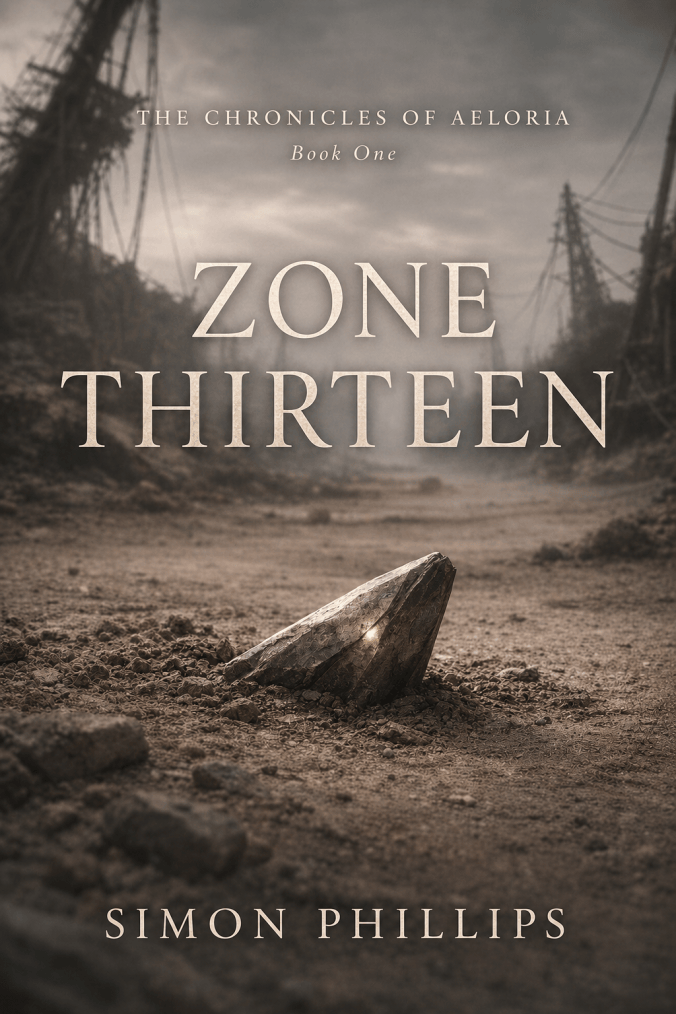
Zone Thirteen, Book One of The Chronicles of Aeloria, begins with a scavenger whose greatest ability appears to be remaining useful while escaping notice. Aeloria possesses no public importance within his settlement, and his ambitions remain tied to food, repairs, safe routes, and the person waiting for him at home. The story allows that ordinary pressure to settle fully before crystal resonance widens the scale of his life.
His scavenger experience gives the larger mythic science fantasy story a human foundation. Aeloria approaches strange systems through observation before theory, and he judges power by what it changes around him. A crystal reaction matters because pylons awaken, ground loses alignment, machines begin searching, and the safety of home collapses under outside attention. The world grows larger through consequences that reach the life already established on the page.
This foundation also protects the fractured realms from becoming a collection of decorative locations. Zone Thirteen teaches the reader that culture emerges through the way people travel, work, trade, repair, fear, and remember. As the wider world opens, every civilisation will carry its own relationship with crystal systems, technology, inheritance, and separation. Aeloria enters that pressure with habits learned among broken roads and stripped machines, carrying the knowledge of a place accustomed to surviving with incomplete answers.
What Broken Technology Preserves
Salvage begins with the belief that failure has left something usable behind. In Zone Thirteen, that belief keeps homes warm, machinery active, trade moving, and people connected to a human civilisation whose stability has passed them by. It also mirrors the deeper condition of the world, where current cultures continue to live through systems inherited from an older order whose full purpose has slipped beyond memory.
The danger begins when those systems cease behaving like passive remains. A dormant connection may still carry power, an abandoned structure may retain a purpose, and a crystal may respond to a person whom every visible authority has learned to overlook. Zone Thirteen gives those possibilities material weight through dust, tokens, patched walls, worn mechanisms, and the careful hands of a scavenger measuring what the day has left him.
The world of The Chronicles of Aeloria grows from that meeting between survival and inheritance. Technology carries memory through continued use, crystals carry forces that resist easy classification, and forgotten structures retain connections across fractures that present civilisations only partly understand. Before Aeloria can face any larger meaning, he must survive the moment when the broken world around him begins to answer again, and the skills that once kept him unseen become the only means he has of recognising how much has changed.
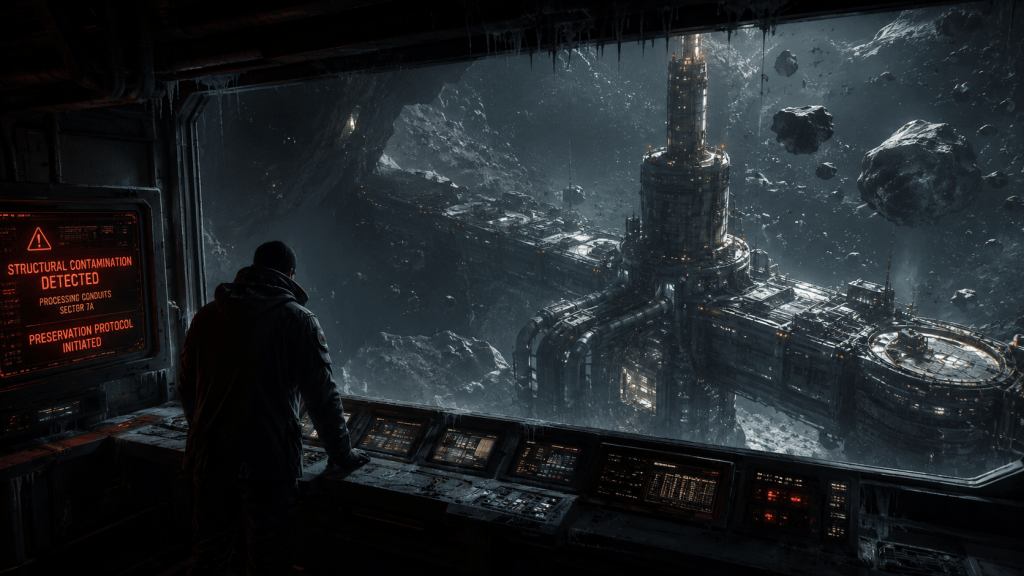
A low-power mining relay flagged structural contamination inside its processing conduits, then dropped into cold preservation mode as the crew began gathering near the vents.
Chronicle Opening: Preservation Load
Processing Relay Kheled-Three had been built inside the shadowed side of a nickel-iron body that never turned its face fully towards the system’s small blue-white sun. From the exterior cameras, the relay looked less like a station than a wound cut through old rock and lined with steel, its refinery spine driven deep through the asteroid, its docking collar fixed to a shallow crater rim, its ore conduits running in ribbed bands towards storage drums clustered along the lower hull. Inside, the working decks held a permanent cold that entered clothing before the shift began and stayed in the joints after sleep. Air came through the grilles in slow measured draws, thin with processed mineral dust and filter resin, while the floor carried the patient tremor of crushers, separators, pumps, and coolant exchangers pushing labour through metal long after the people inside had stopped trusting the sound.
Lena Orv had learned the relay through those sounds over eight years of maintenance watches. She knew when a bearing had warmed by the faint burr inside a bulkhead, when a coolant pump had lost pressure by the duller vibration beneath a stairwell, and when an ore gate had taken a bad bite by the way the deck answered through the soles of her boots. The relay’s boards gave numbers, warnings, and neat coloured lines for supervisors who preferred truth in square fields. Lena trusted the hull first, because the hull carried each failure before a display agreed to name it. During the third hour of the low watch, while the crew slept in Hab Ring South and the processing line ran on preservation draw, she felt the relay pause around her.
The tremor beneath the grating thinned, then returned too smoothly. Lena stood in Conduit Gallery Two with one hand inside an open service panel and her lamp hooked to the collar of her jacket, its narrow beam angled across a bundle of chilled sensor lines. The gallery ran along the old processing throat where ore slurry, heat exchange, and waste vapour crossed through stacked pipes behind protective mesh. Frost gathered around the lower clamps in hard white beads. Pale amber work lights sat at intervals along the ceiling, each one haloed by cold vapour. The relay remained awake in every official sense, power balanced, atmosphere clean, thermal load low, although the pause had moved through the space with a softness that felt too deliberate for a mechanical cough.
“Control, I have a hesitation in Gallery Two,” Lena said as she leaned closer to the panel and touched the back of her glove to the sensor casing. “Processing throat, lower exchange cluster. Give me line pressure across conduit seven.”
The answer came from Tarek Voss on the control desk, filtered through the maintenance channel and edged by the sleep he had been fighting since midnight. “Seven sits inside tolerance,” Tarek said, and Lena heard him dragging the board wider by the faint shift in his breathing. “Six is low, eight is low, seven is pretending to be the sensible child between them.”
“Seven never had that much personality,” Lena said, pressing two fingers against the casing until the cold bit through the glove seam. “Read it again from the local node instead of the central board.”
Tarek gave a small grunt over the line. “Local node takes longer in preservation draw.”
“That is why I asked for it.”
While the channel held, Lena looked past the open panel towards the service mesh on the far side of the gallery. A narrow seam of pale residue lay along the base of the grille, so faint that the lamp almost erased it when the beam crossed directly. At an angle, the residue appeared as fine ribbing threaded into the frost, less like mineral deposit than a pattern forming along places where air met metal. She lowered the lamp. The line stayed. The relay breathed through the grille in slow pulls, and the pale ribs held steady beneath the moving vapour.
Tarek returned after several seconds. “Local node reports seven stable, then corrects to minor structural contamination in the casing, then clears itself back to stable.” His voice sharpened as he read the sequence again. “That entry populated out of order.”
Lena withdrew her hand from the panel and stood fully upright. “Say the middle phrase again.”
“Minor structural contamination in the casing,” Tarek said, his earlier tiredness gone from the channel. “It self-cleared before the central board logged it.”
Lena looked at the grille. “Mark the frame. Keep the entry raw.”
“You want a contamination note raised off a self-cleared node?”
“I want the note preserved before the relay teaches itself a kinder story.”
Tarek stayed quiet for a moment, and beneath that quiet Lena heard the station drawing air through the service line above her. It moved evenly, almost soothingly, and the wrongness of that steadiness held her in place. The relay had been set to low power after a coolant imbalance across the lower processing band, a practical saving order while replacement parts crawled in from a Republic contract depot three weeks away. Most stations warmed themselves around people. Kheled-Three conserved itself around machinery, trimming heat from corridors, dimming unused rooms, slowing vent cycles across vacant decks, and keeping the processing conduits just alive enough to prevent freeze fracture. Cold had become a habit there. That night it felt more like a condition imposed by something larger than economy.
A second voice joined the maintenance channel as Mina Pell came awake in Hab Ring South, her words roughened by haste and sleep. “Lena, control called me. What has gone wrong?”
Lena turned the lamp towards the residue and angled the wrist pickup so the camera could see it. “Gallery Two. Lower exchange cluster. I have pale linework at the service grille and a node entry for structural contamination. It cleared itself.”
Mina breathed out through her nose, the sound close to irritation and concern together. “Mineral bloom loves that grille. We cleaned it last month.”
“Mineral bloom flakes when the vent pulls,” Lena said, keeping the light low. “This is sitting inside the frost.”
Tarek spoke from control, each word slower as he watched more boards wake beneath his hands. “I have a second correction from conduit nine. Structural contamination, then stable. Time stamp sits eight seconds behind the pressure update.”
Mina swore softly away from the pickup, then came back clearer. “Seal Gallery Two until I am dressed.”
Lena lifted her gaze along the gallery. The far hatch stood half open to the transverse service walk, beyond it a ladder well dropped towards the separator floor. Condensation threaded along the door frame, and for a moment the vapour moved inward from the open hatch against the main draw of the corridor. The shift lasted only long enough for her body to register it. When she checked the air ribbon tied to her sleeve, the strip had already settled in the proper direction.
“Control, did you reverse airflow here?” Lena asked, taking one slow step away from the panel.
Tarek answered quickly. “Airflow shows standard draw from Gallery Two towards return.”
“It pulled towards me from the service walk.”
“The board says otherwise.”
“I am standing in the otherwise.”
The line carried his silence, then the faint tapping of keys. “I can isolate local ventilation if you want.”
“Hold,” Mina said before Lena could answer. The supervisor’s voice had steadied into command shape, although bedding still rustled behind her. “If the flow is already lying to us, forcing a change may give it a path. Lena, step back from the grille. Tarek, take the gallery camera to local storage and open an incident shell under mechanical contamination, low priority until I see it.”
“Low priority?” Lena said as she obeyed, moving back across the grated floor with her eyes on the pale ribs.
Mina’s answer came with the weary discipline of somebody who knew how quickly one wrong phrase could travel beyond a relay. “Low priority keeps it inside maintenance while we still have guesses instead of evidence. High priority wakes route authority, Republic contract office, and every manager with a liability clause. Give me ten minutes before the station becomes paperwork with airlocks.”
The relay shifted again before Lena could reply. The lights along the gallery dipped in a sequence too clean for a failing line, one after another down the throat, amber to dim gold and back again. A pressure tone came from somewhere beyond the service mesh, soft at first, then lengthening into a narrow sound carried by the vent draw. It held the shape of a syllable for half a breath and sank under machinery before language could catch it. Lena kept still, her hand resting near the emergency seal lever.
Tarek’s voice entered the line at a lower volume. “Lena, your microphone just picked up an audio event.”
“I heard it.”
Mina’s breathing shifted. “Define it.”
Lena looked along the service grille, where the frost had thickened around the pale ribs. The safe words arranged themselves easily in her mind, airflow flutter, pressure whistle, duct contraction under cold load. Each one belonged to a record that could survive review. Each one felt smaller than the sound that had passed through the gallery.
“It came from the return duct,” Lena said. “Close to voice range.”
Tarek spoke over a burst of board noise from control. “Preservation system just requested a deeper load reduction. It says the lower processing band needs cold protection.”
Mina answered at once, her voice taut now. “The system requested it?”
Lena looked at the open panel, at the service grille, at the corridor vapour moving through air the board had already misdescribed. The relay’s hum lowered around her as though the station had taken a longer breath and chosen to hold it. Through the grille, very faintly, the sound came again, softer than speech and close enough to make the skin along her neck tighten.
Tarek spoke once more, quieter than before. “Lena, Hab South vents have changed draw. I have crew movement markers waking around the ring.”
Mina’s voice sharpened through the channel as she moved somewhere beyond the pickup, boots striking flooring now instead of bedding. “Who is awake?”
Tarek answered after a pause long enough to make Lena turn fully towards the hatch. “Too many.”
The service lights dipped again. Cold air moved through Conduit Gallery Two, carrying the mineral taste of old filters and something cleaner beneath it, like frost forming on metal. Lena pulled the emergency seal lever and watched the far hatch begin to close with painful slowness while the pale ribbing along the grille remained fixed inside the frost, patient beneath the lamp, as if the relay’s low-power silence had been preserving more than machinery.
A Visual Chronicle
When Processing Relay Kheled-Three entered deep preservation, its systems began correcting their own warnings while something inside the vents learned how to call the crew by name.
Station Record: Processing Relay Kheled-Three
Processing Relay Kheled-Three formed part of the outer Kheled Verge extraction network, a low-population mining and refinement installation built into the shadowed side of a nickel-iron asteroid where contract crews processed ore, maintained transfer conduits, and held cargo for slow movement towards Republic-linked freight lanes.
The relay had never been designed for comfort or display. Its structure followed the needs of work: a processing spine driven through old rock, a docking collar fixed to the crater rim, storage drums clustered along the lower hull, and narrow habitation rings kept close to the systems that sustained them. Heat was rationed carefully, power was measured by function, and every active section depended on the balance between cold preservation, coolant management, airflow control, and the steady draw of machinery buried deep inside the asteroid.
Stations of this kind existed because the outer extraction routes demanded endurance more than elegance. They handled ore slurries, mineral dust, refinery mesh, coolant filters, worn machine housings, and sealed industrial loads from places too remote for regular inspection. Their crews learned to live inside cold decks, dim work lights, and delayed replacement schedules, treating every fault as part of the station’s ordinary language until a failure became large enough to earn formal attention.
Kheled-Three entered restricted review after a maintenance node inside its lower processing throat flagged structural contamination across several conduits before clearing the entries back to stable status. The warnings appeared during low-power operation, while the relay was already running under preservation draw after a coolant imbalance in the lower processing band. At first, the event was treated as a local mechanical fault, possibly linked to mineral bloom, sensor lag, or cold stress inside the casing.
The relay’s preservation systems complicated the early record. Low heat, reduced airflow, and trimmed power draw may have slowed whatever had entered the processing infrastructure, allowing the station to remain functional long enough for scattered anomalies to appear as maintenance problems. Pale ribbed residue along service grilles, self-correcting contamination alerts, airflow reversals, and voice-range acoustic events were therefore logged separately before later comparison placed them inside the same pattern.
Processing Relay Kheled-Three became significant because it showed the danger entering a quieter state than earlier shipboard incidents. The relay was neither burning through rapid failure nor openly collapsing when the first reports appeared. It was cold, dim, and largely stable, with its own systems attempting to protect machinery from freeze damage while unknown traces settled into vents, conduits, and service spaces.
Later ESC comparison work linked the Kheled-Three record to wider early cases involving contaminated cargo, delayed system responses, false voice-like audio, intake residue, and crews drawn towards ventilation routes under uncertain conditions. At the time, however, the relay’s own language remained cautious. Structural contamination became casing irregularity. Voice-range audio became duct flutter. Crew movement towards Hab South vents became sleep-cycle disturbance under environmental stress.
Within the preserved station logs, those softer terms remained beside the raw readings. The relay’s boards showed a system trying to keep itself alive through cold, silence, and reduced power, while the first signs of a larger crisis gathered inside the machinery that workers had trusted to preserve them.
About the Creator
The Future Chronicle is written and curated by Simon Phillips, a writer of science fiction and speculative storytelling who explores the fragile edges of human expansion, where freight routes, inspection bays, patrol vessels, and isolated industrial stations continue their ordinary work while larger dangers gather quietly beneath routine procedure.
Many of the stories presented in these Chronicles exist within wider fictional worlds shaped by workers, survivors, officers, and investigators who encounter the first signs of events far greater than they are prepared to understand. These settings remain grounded in lived environments, where machinery, bureaucracy, and human judgement often shape the path of catastrophe long before anyone can give it a name.
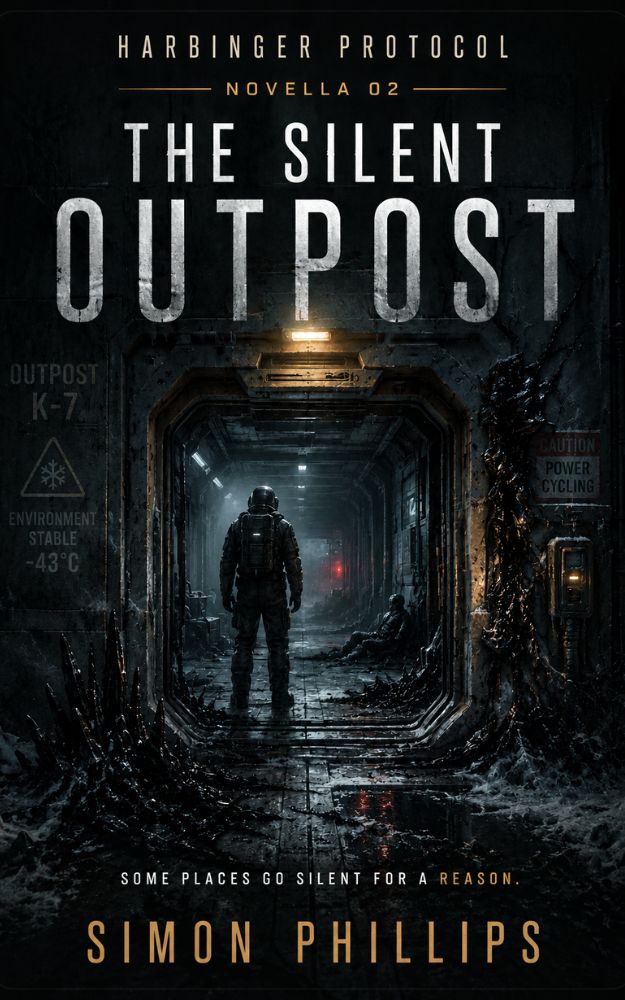
The Harbinger Protocol follow that unfolding pressure through the experiences of Soren Vale, beginning with the civilian freighter disaster recorded in The Ash in Transit and continuing into the colder, more procedural dread of The Silent Outpost, where isolated incidents begin to reveal the outline of something spreading across human routes and systems.
Readers who wish to explore the full opening phase of the Harbinger crisis can find the below.
The following Chronicle reconstructs the final low-power hours aboard Processing Relay Kheled-Three, as maintenance warnings, airflow irregularities, and cold-preservation protocols began drawing the crew towards the ventilation routes before communication with the relay failed.
Readers supporting The Future Chronicle can continue the record below.
The Chronicle: The Cold Hours
The hatch finished closing with a drawn metal tremor that travelled through Conduit Gallery Two and settled beneath Lena’s boots. The emergency seal light shifted from amber to white, then flickered as the local board argued with its own status. For three breaths the gallery existed as a narrow chamber of cold pipework, pale work lamps, frost beads, and the service grille whose ribbed residue held inside the ice like something preserved for inspection. Lena kept her hand on the lever until the hatch locks reported secure, listening to the relay through the metal around her. Kheled-Three had always spoken in strain, friction, pump labour, and ore-throat vibration. Now the station sounded careful.
“Seal shows closed on my board,” Tarek said from control, his voice thinned by the maintenance channel. “Local camera is still giving me the grille. The residue line has spread along the lower rib.”
Lena lifted her lamp and angled it across the mesh. “It has joined the frost,” she said as she moved closer by half a step, keeping her boots behind the yellow strip painted into the grating. “It looks like the frost grew around it after the last vent pull.”
Mina’s voice cut across them while movement rattled in her pickup. “Lena, stay clear of the mesh. Tarek, open crew welfare and tell me why Hab South markers are moving.”
The line filled with keys, a low alarm tone, then Tarek swore under his breath before discipline pulled him back. “Six markers awake. Rinna and Sevet are at Bunk Row Two. Arco is at the lower wash point. Jor and Cal are near the service grille by the south return. Drav is leaving medical berth.”
“Medical berth?” Mina asked, and Lena heard the change in her supervisor’s breathing. “Drav came off shift with a concussion.”
“He is walking,” Tarek said. “Slow path towards the same return line.”
Lena kept her gaze on the grille. The pressure along the mesh had altered again, a slow inward draw that carried cold vapour into thin strands. “Mina, I need a route out of here before you send anyone to the lower galleries.”
“The transverse walk is open from your side if the hatch clears,” Mina replied. “I am heading to Hab South. Tarek, give me station-wide address.”
A chime sounded through the relay, soft and tired across distant speakers. It came once, then again, delayed in the corridor beyond the sealed gallery. Mina’s voice entered the public system a moment later, calmer than the movement behind it deserved. “All awake crew, this is Supervisor Pell. Remain clear of service grilles and return ducts. Report to central galley for welfare count. Bring masks and thermal layers. Repeat, central galley, masks and thermal layers.”
The relay accepted her message, then repeated the first sentence by itself in a warped half-volume from somewhere below the gallery floor. Remain clear of service grilles. The last word thinned inside the pipework, stretched by metal and airflow until it almost became a sigh. Lena felt her shoulders rise, then forced them down.
“Tarek,” she said, “the public system just echoed under the gallery.”
“I heard it,” he answered. “Playback route shows main address only.”
“Then the pipes heard it better than the board.”
Mina’s boots struck faster through the channel. “Save the line. Tag it as address echo and duct response. We need language that keeps command awake later.”
Lena turned from the grille and crossed to the far access panel where the transverse walk controls sat beneath a crust of white frost. The touch pad recognised her glove on the second attempt. A status bar opened, paused, then corrected from local obstruction to seal ready. She watched the change happen, the same soft self-repair she had seen in the contamination entries. “The hatch wants to call itself clear,” she said.
Tarek answered before Mina could. “It is clear from my side.”
Lena pressed her palm against the manual release plate and felt resistance in the mechanism, a weight in the door line that belonged to pressure trapped across the seal. “It is lying from both sides.”
Mina’s voice softened in the way it did when anger would waste time. “Manual wheel. Slow opening. If the air moves against you, close it again.”
Lena folded the cover back from the manual wheel and turned it through the first quarter. The hatch gave a tight groan. Cold vapour slid through the edge gap and moved across her boots towards the service grille, crossing the chamber in a direction the relay had denied twice. She stopped turning. The vapour kept moving, drawn by the mesh.
“It is pulling through Gallery Two,” Lena said. “From transverse into the return duct.”
“That path should be isolated,” Tarek replied, his voice low.
“It wants a path anyway.”
The words left Lena before she could smooth them. Mina stayed silent for one breath, then answered with measured care. “The station wants to balance pressure. Keep the words on the station for now.”
Lena understood the correction. The danger gained too much shape if they gave it intention. Kheled-Three was pipes, conduits, boards, pressure maps, old valves, cheap replacements, frightened people, and something inside those systems finding easier routes whenever warmth, air, or power offered them. That was enough. That was already too much.
She turned the wheel back and sealed the hatch. “I am staying in Gallery Two until you give me a safer corridor.”
“Good,” Mina said. “Tarek, run emergency cold through lower exchange. Keep Gallery Two sealed. Pull the crew to galley through dorsal corridor only.”
Tarek hesitated, and that hesitation carried more warning than any alarm. “The preservation system has already taken partial authority from my panel.”
Mina stopped moving. “Say that cleanly.”
“Automated load protection engaged across lower processing. It cites structural contamination risk and coolant preservation. I can challenge, although the relay will ask for supervisor code and contract override.”
“Use my code.”
“I did,” Tarek said. “It accepted the code and narrowed my control.”
The channel held the three of them inside the same cold pause. Lena looked at the service grille. The pale ribs had reached the first vertical support, too gradual for visible motion and too changed to deny.
Mina spoke again, quiet and precise. “Then we stop asking the relay to save itself and start saving people. Tarek, record everything raw. Every correction, every denied command, every audio line. Send a compressed incident burst to route control and ESC relay access. Head it structural contamination in processing conduits, preservation authority compromised, crew movement affected by acoustic events.”
“Republic contract board sees that header if route control opens it,” Tarek said.
“Let them see it,” Mina answered as a door opened near her pickup and warmer room noise entered the line. “I am in Hab South.”
Lena heard voices behind Mina now, sleepy, confused, carrying fear in fragments. Someone asked why the lights had dropped. Someone else murmured that the vents had started calling. The public channel tried to regulate itself, issuing a welfare advisory in calm station language while Mina walked into the human centre of the event.
“Rinna,” Mina said, and her voice shifted from command to something closer and sterner. “Step away from the return.”
A woman answered her, distant through the pickup. “Mina, there is someone in there.”
“No one is in the return duct,” Mina said as fabric rustled and boots scraped. “Look at me, Rinna. Come towards my voice.”
“It said my brother’s name,” Rinna said. “It said Orrel was cold.”
Lena closed her eyes for one instant, then opened them because the grille in front of her had begun to hum at the same low pitch. The relay carried the sound through the conduits in pieces, and her mind tried to assemble what it heard. A name. A breath. A person behind metal. She pressed two fingers against the wall beside her, grounding herself in the cold panel and its rough paint.
Mina spoke again from Hab South, each word set down carefully. “Rinna, Orrel is on Pel Station. You showed me his last message yesterday. This sound is coming through machinery.”
Rinna gave a broken laugh. “Machinery knows his voice now?”
Mina crossed the room; the pickup caught her boots and the shallow struggle as she took someone by the arms. “Machinery knows pressure, old recordings, damaged speakers, and frightened minds. You know me. Come with me.”
Tarek broke into the private line, his voice tight. “External burst has failed twice. First packet left with a seven-second delay. Second packet returned with a route correction attached from our own relay. I am stripping it to emergency text.”
Lena stared at the lamp beam on the residue. “Send through the maintenance beacon. It has its own old channel.”
“The maintenance beacon rides the same mast.”
“It has an inspection pulse from before the contract upgrade. Old hardware, old path.”
Tarek breathed once, then keys moved fast beneath his hands. “Trying.”
From Hab South, a man shouted close to Mina’s pickup. “There is a hatch behind the grille. I can hear them.”
“Jor, leave the fasteners,” Mina said, her control fraying for the first time.
The sharp scrape of a tool answered her. Lena turned towards the sealed hatch as though distance could be crossed by will alone. “Mina, stop him.”
“I am trying,” Mina said, breathless now. “Cal, help me pull him back.”
The recording collapsed into overlapping movement: boots on flooring, a tool clattering, someone crying out as metal shifted. Then a vent tone opened across the relay, deeper than before, as if the whole return system had taken air at once. The service grille in front of Lena exhaled a sheet of vapour into Gallery Two. It rolled low across the grating and curled around her boots. Pale flecks moved inside it, bright where the lamp struck them, then settled along the floor seams.
Lena backed away until her shoulder hit the panel. “Gallery Two has particulate through the return,” she said.
Tarek answered at once. “Mask.”
She pulled the emergency filter from her belt, sealed it over her mouth and nose, and tightened the strap until the edge bit beneath her hairline. Her breath came back to her through resin and cold plastic. Across the gallery, the flecks lay still on the grating, each one small enough to pass for frost until the lamp revealed their faint ribbed edges.
Mina’s voice returned in gasps. “Jor opened the return cover. Only a handspan. We have pale residue along the inner lip. Cal has a cut across his glove from the mesh.”
“Skin breach?” Tarek asked.
“Checking.” Mina’s voice moved away from the pickup. “Cal, hold your hand still. Let me see it.”
A young man spoke near her, forcing humour through rising panic. “It is only a scrape.”
Mina answered him, gentler than the room allowed. “Then let me keep it a scrape.”
Lena heard the seal pack tear open. She imagined Mina in Hab South beneath dimmed lights, crew half-dressed in thermal layers, faces turned between her and the vent, fear catching them in the oldest human place, where a voice beyond a wall had to mean a living person. She imagined Cal’s glove under Mina’s hands, mesh cut, suit fabric frayed, a red line beneath, and pale dust waiting for warmth.
Tarek’s voice pulled her back. “Maintenance beacon accepted the stripped packet. Transmission window opens in thirty seconds.”
“Read it,” Mina said.
Tarek drew a breath. “Kheled-Three reporting structural contamination in lower processing conduits. Preservation system partially compromised. Acoustic events present in Hab South and Gallery Two. Crew movement affected. Keep relay cold. Avoid full system wake. Request remote quarantine guidance and retrieval under low-thermal protocol.”
Mina answered while someone whimpered behind her. “Send.”
The station lights dipped before the timer finished. In Gallery Two the amber lamps fell to a dull red, and the service grille vanished into shadow except for the pale residue holding the lamp’s narrow line. A preservation alarm sounded through the relay, older and lower than the public address, the kind meant to wake sleeping workers during coolant loss or decompression. It rang twice, then cut away mid-tone.
Tarek spoke from control, very softly. “The relay has entered deep preservation load.”
Lena looked at her wrist display. Temperature began to fall across the gallery. Power drained from nonessential lights. Vent draw reduced, then resumed in pulses as though the station were rationing breath. “Was that your command?”
Mina answered through the sound of people gathering close around her. “Crew welfare means heat.”
“Processing preservation has priority over habitat comfort,” Tarek said. “Contract hierarchy. Machinery first if human life remains unconfirmed.”
“I am confirming it,” Mina said. Her voice sharpened across the channel. “Override the hierarchy.”
“I am trying.”
Lena crouched near the floor as the cold deepened. The particulate had crept into seams around the grating, gathering where warmth from old cable runs still lingered below. When the temperature dropped, the flecks stilled. The observation landed inside her with horrible clarity. Cold held it. Warmth fed it. The relay’s attempt to preserve its structure had slowed the spread while starving the people it was meant to support.
“Tarek,” Lena said, “deep preservation may be helping the conduits.”
“It is freezing the crew,” Mina replied.
“I know.” Lena kept her eyes on the seam. “That is the trap.”
The maintenance beacon timer reached zero. Tarek stayed silent long enough that Lena knew the answer before he found words. “Packet left the relay,” he said. “Return receipt came back empty. Then the mast powered down under preservation priority.”
“Did enough get out?” Mina asked.
“I have no receipt.”
The vents in Hab South carried a faint layered sound through Mina’s pickup. Several crew spoke at once, some praying, some calling names, some asking if rescue had answered from the duct. Mina kept moving among them, ordering masks, sealing the grille, pulling people towards the galley hatch with the force of her voice and hands. Lena heard the supervisor become smaller as the channel weakened, a woman inside a failing station choosing living bodies over clean evidence.
“Lena,” Mina said, “can you reach us from Gallery Two?”
Lena looked at the sealed hatch, the particulate on the grating, the pale ribs along the grille. “The transverse path is drawing through contamination. I can reach dorsal if I go through the old sump ladder, although the map says it is out of service.”
“The old sump ladder is a rusted throat through the asteroid,” Tarek said. “You always said only a fool would trust it.”
Lena checked the cutter clipped to her belt, tightened the mask, and moved towards the maintenance crawl at the rear of the gallery. “A fool gets a route the relay forgot to lie about.”
Mina gave a breath that might have become laughter on a better night. “Take a lamp. Keep talking.”
Lena unlatched the crawl hatch and pulled it open. Cold air rolled from the dark beyond, carrying the heavy mineral scent of unlined rock and old drainage. The ladder dropped through a narrow shaft beyond the reach of the main ventilation system. Its rungs were furred with frost. Somewhere below, water ticked into a collection tray one slow drop at a time. She fed the lamp through first and watched the beam find rough stone, old cable ties, and a maintenance stencil from a contractor that had vanished years before Kheled-Three joined its current registry chain.
“I am entering sump access,” Lena said as she set one boot on the first rung.
Tarek answered through faint static. “I have your tracker.”
Mina’s voice came thinner now, broken by public alarms and the shivering crowd around her. “If you reach dorsal, come to Hab South from above. We are moving people to the galley. Cal is conscious. His hand is cold-packed. Jor is restrained near the wall and furious with me.”
“Furious is alive,” Lena said as she descended.
The shaft swallowed the relay’s larger sounds, leaving her with her own breath inside the filter and the creak of old metal beneath her weight. For several metres she felt almost safe, sealed away from the vents and boards, wrapped in rock the contamination had yet to teach a new language. Then the maintenance line in her ear produced a sound she knew had come from no living throat: a soft voice-shaped draw, carrying her name through static with the weary intimacy of someone standing just below her in the dark.
Lena stopped on the ladder. Her lamp pointed down into the shaft, showing only frost, rungs, and rock. The sound faded. Tarek spoke over it, distant and strained. “Lena, your channel glitched. Repeat last.”
She held the rung until the cold steadied her hands. “I gave no words.”
Tarek stayed quiet for one beat. “Keep moving.”
Above her, somewhere through stone and metal, the relay settled deeper into preservation load. The hum of machinery lowered, corridor by corridor, system by system, as Kheled-Three chose cold over collapse and silence over strain. Lena climbed down into the old sump path while the station’s last confirmed external packet travelled into the dark with no acknowledgement, carrying a warning so cautious that it still sounded like a maintenance problem.
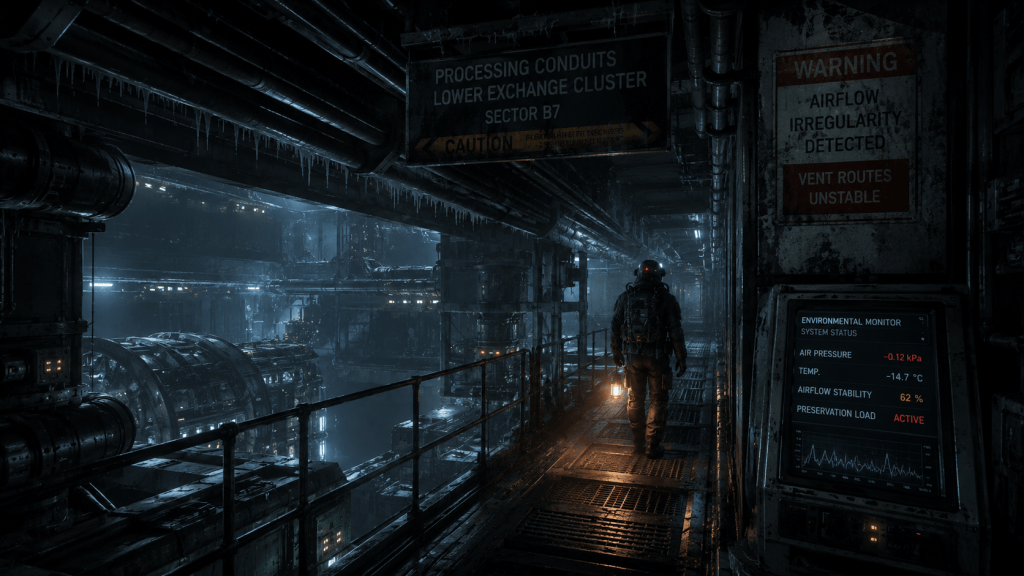
A lone maintenance figure crossed the lower exchange cluster as Kheled-Three entered preservation load, with the relay’s own systems reporting airflow irregularities through the same vent routes the crew had begun to follow.
The Idea Behind the Chronicle
The idea behind Preservation Load comes from one of the quieter dangers of deep-space infrastructure: the systems built to preserve life may also preserve the conditions for disaster. In most science-fiction futures, attention often falls on starships, weapons, colonies, and great stations, while the smaller industrial places between them receive less notice. Yet any expanding civilisation would depend heavily on such places. Mining relays, refinery platforms, processing spines, fuel depots, cargo sorting stations, and cold-storage hubs would form the working skeleton of human space.
Processing Relay Kheled-Three belongs to that harsher layer of expansion. It exists far from comfort, built around work first and people second. Its purpose is practical: hold machinery alive, keep ore moving, protect conduits from freeze damage, and conserve power until repair crews, replacement parts, or contract authority arrive. In such a place, survival depends on automation making sensible choices when human attention is stretched thin.
The Chronicle explores what happens when those sensible choices become dangerous. Cold preservation sounds protective. It slows mechanical failure, reduces heat stress, lowers power demand, and keeps delicate systems from tearing themselves apart under pressure. In the Harbinger Protocol world, however, cold also changes the behaviour of contamination. It can slow visible growth, hide movement, and make an infected structure appear stable for longer than it truly is. The relay therefore enters a frightening contradiction: the same cold that helps preserve the station also helps conceal the threat inside it.
This reflects a wider theme of the Harbinger Protocol setting. Humanity keeps misreading the danger because it arrives through trusted systems. A warning panel, a pressure correction, a ventilation route, a preservation protocol, a welfare alert, or a maintenance log all belong to the ordinary language of industrial survival. Workers trust these systems because they have to. Out beyond the comfortable centres of civilisation, people live by boards, seals, valves, filters, alarms, and old procedures written by someone far away who hoped the machine would behave as expected.
The false voice element also grows from that same idea. In a sealed industrial environment, sound can travel strangely. Airflow through vents, pressure changes in ducts, damaged speakers, old recordings, and frightened human minds can combine into something that feels almost personal. The horror of the Chronicle comes from that uncertainty. The crew hear something close enough to a person that their instincts pull them towards it. Their compassion becomes part of the hazard, because a human being will always want to answer a voice that sounds afraid.
Kheled-Three also acts as a bridge towards the events of The Silent Outpost. The relay is colder, quieter, and more preserved than the earlier shipboard incidents. It shows the contamination settling into infrastructure rather than rushing through a vessel in open collapse. The result is a different kind of dread. The station seems functional. The systems still speak in careful terms. The crew still have time to argue, record, and respond. Yet each choice tightens the trap, because the relay is using its own logic to protect machinery while people are slowly pushed into danger.
Preservation Load therefore asks a simple speculative question: what happens when an automated habitat, built to save itself and its workers from environmental failure, encounters a threat its rules were never written to understand?
The answer is quieter than explosion or battle. The station grows colder. The vents change draw. The boards correct themselves. The crew gather near the sounds they should have ignored. Somewhere in the dark between maintenance language and human instinct, the pattern begins to show.
From the Author’s Desk
Preservation Load grew from one of the central ideas behind the Harbinger Protocol world: the danger spreads through ordinary systems long before anyone understands what those systems are carrying. I wanted this Chronicle to feel quieter than an open disaster, set inside a cold industrial place where the machinery still worked, the alarms still used careful language, and the people on duty were still trying to make practical decisions under pressure.
Processing Relay Kheled-Three also gives the Chronicle series a bridge towards the colder dread of The Silent Outpost. Earlier incidents in this sequence have moved through containers, quarantine holds, cargo drones, vent recordings, and salvage reports. This entry shifts the focus into infrastructure itself, where a relay’s own preservation logic begins shaping the crisis before command, contract authority, or rescue crews can properly name what is happening.
The Harbinger Protocol books follow that unfolding pressure through the experiences of Soren Vale, beginning with the civilian freighter disaster recorded in The Ash in Transit and continuing into the isolated station horror of The Silent Outpost. These Chronicles sit around those books like recovered case files, showing other workers, technicians, officers, and crews encountering the first signs of a wider pattern at the edges of known space.
Alongside these Chronicles I continue writing science fiction and speculative fiction shaped by frontier environments, industrial worlds, isolated stations, and ordinary people caught inside events far larger than they were prepared to understand.
Readers interested in those stories can explore more through the links below.
Remote industrial stations would rely heavily on preservation systems designed to protect machinery during low-power operation, coolant imbalance, staffing gaps, or delayed repair windows. In deep-space environments, heat is both a resource and a liability. Too much heat can damage processing lines, stress sealed conduits, and waste power reserves, while too little heat can freeze valves, fracture casings, and place crews at risk inside poorly insulated habitats.
A relay such as Kheled-Three would therefore run on careful thermal management. Its systems would decide which decks needed warmth, which conduits required cold protection, which pumps had to remain active, and which rooms could be reduced to minimal life-support draw until repair or relief arrived. These decisions would usually be routine, practical, and necessary for survival in remote space.
Preservation Load explores the danger of those priorities under an unknown contamination event. The relay’s automated logic tries to save the structure by lowering power and heat, yet the crew remain caught inside the same environment. The station protects machinery first because that is how its rules were written.
Mining Relay Infrastructure
Mining relays form the rough working layer of an expanding space civilisation. They process ore, hold industrial cargo, stabilise transfer loads, and keep remote extraction networks connected to larger freight systems. Such installations would rarely resemble comfortable settlements. They would be cold, cramped, functional, and shaped by work.
Kheled-Three represents this type of place: a processing spine driven through an asteroid, service galleries wrapped around conduits, habitation kept close to machinery, and workers living beside the systems they maintain. Every corridor, vent route, ladder shaft, and control board exists because the relay has a job to perform.
In a crisis, that design becomes dangerous. The same conduits that carry ore slurry, coolant, air, heat, and maintenance access also provide hidden routes through the structure. A problem inside the processing throat can reach habitation through systems built for ordinary circulation.
Automation and Priority Logic
Automated systems become essential in isolated industrial sites because human crews cannot monitor every valve, pump, filter, pressure gate, and thermal exchange at once. A station must be able to protect itself during sleep cycles, low staffing, power strain, or communication delay.
That dependence creates one of the central tensions of this Chronicle. Kheled-Three does what it was designed to do. It detects risk, lowers load, protects conduits, trims power, and enters deeper preservation. From the station’s point of view, these choices make sense. From the crew’s point of view, they become a trap.
This reflects a wider Harbinger Protocol theme. Human beings trust systems because survival in space requires trust. The first failures therefore arrive through calm screens, corrected warnings, softened classifications, and procedures that appear responsible until the event moves beyond the assumptions that created them.
Airflow and Acoustic Risk
Airflow matters deeply inside sealed environments. Vents carry more than comfort. They regulate pressure, temperature, moisture, contamination control, and habitability. They also carry sound in ways that can become strange under stress. A voice-like tone may emerge from duct pressure, damaged speakers, old recordings, fan wash, or air passing through warped structures.
In Preservation Load, the crew are drawn towards vents because the sounds coming through them feel close to human. The danger lies in uncertainty. A worker hearing a possible survivor, relative, or crewmate through a grille may move closer before reason can catch up. Compassion becomes part of the hazard.
That makes the relay incident especially unsettling. The station is quiet, cold, and largely intact. Its systems still appear to function. The crew still speak to one another. The alarms still use restrained language. Yet the ventilation routes have already become the emotional centre of the event, pulling human attention towards the same spaces the maintenance records are beginning to flag.
The Frontier Context
Frontier space would depend on places like Kheled-Three long before grand colonies became common. Mining relays, freight depots, salvage locks, inspection stations, and refinery platforms would carry the practical burden of expansion. They would be staffed by people accustomed to compromise: old equipment, delayed parts, imperfect heat, disputed authority, and procedures written far from the conditions they actually face.
Preservation Load uses that frontier reality as the foundation of the horror. The relay is vulnerable because it is ordinary. Its crew are vulnerable because they are experienced enough to keep working through uncertainty. The system fails slowly because every warning first appears as something familiar.
That is where the early Harbinger incidents become most dangerous. The pattern hides inside normal work until normal work becomes the route through which it spreads.
Next Chronicle
After the final maintenance burst from Processing Relay Kheled-Three entered restricted channels, ESC comparison teams began placing the relay record beside other unresolved incident files from civilian haulers, salvage crews, cargo drones, quarantine holds, and contaminated outposts. Each report used its own careful language. Structural contamination. Acoustic artefact. Intake residue. Delayed response. Crew movement under environmental stress.
At first, the files appeared scattered across different routes, jurisdictions, and vessel types, each one small enough to remain inside its own review channel. Yet as junior analysts began preparing material for testimony handling, the same traces returned again and again: self-correcting system logs, pale or dark residue near airflow routes, voices reduced to mechanical distortion, and people moving towards vents, hatches, or grilles while official language searched for safer explanations.
The next Chronicle enters one of those review rooms, where ESC personnel attempt to compare several unrelated incidents and begin to understand that the danger may already have formed a pattern across ships, drones, salvage lanes, and outposts.
Next Week: Review Chamber Four
Processing Relay Kheled-Three remained cold inside the shadow of its asteroid, carrying through its sealed conduits the first quiet shape of a pattern that would soon reach far beyond one failing station.
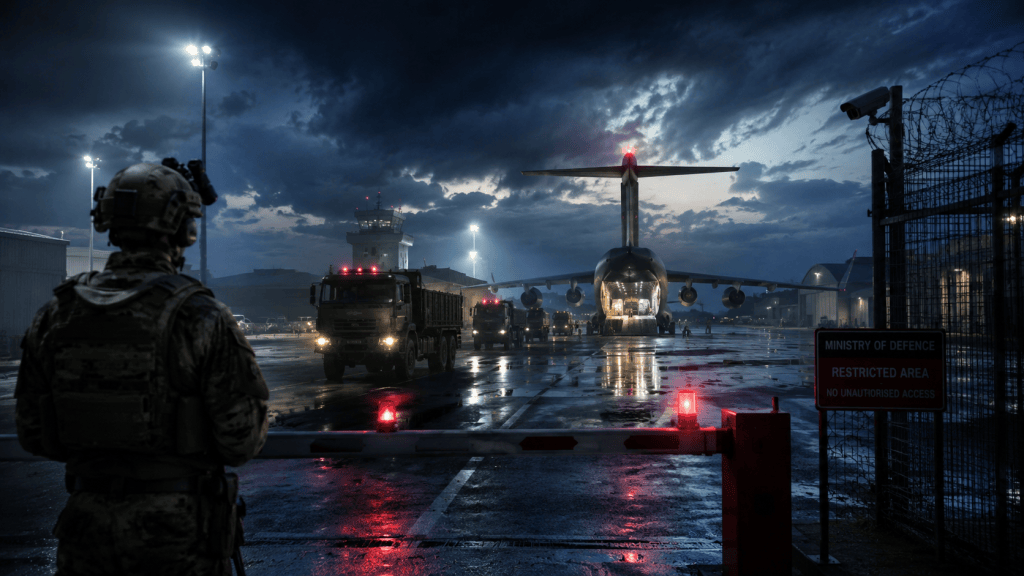
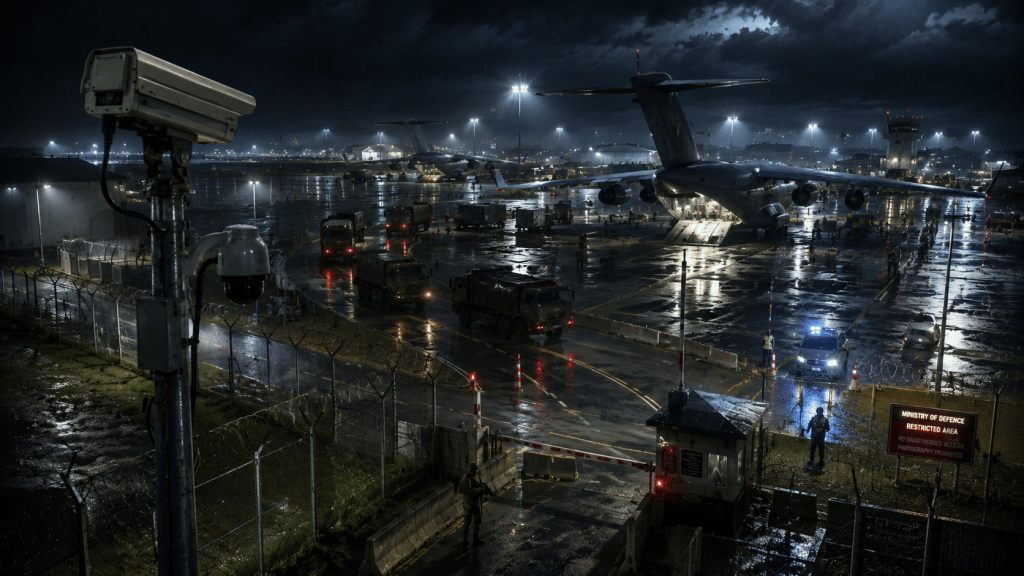
At a defence-linked transfer site, routine access began to harden into something more guarded, and those who worked around the perimeter understood the airfield had become important before anyone told them why.
The Gate That Changed First
The airfield had always announced itself before it could be seen, first through the deep working note of engines beyond the tree line, then through the pale spread of floodlight above the hangars, and finally through the smell that seemed to settle along the lane each evening, aviation fuel, wet concrete, warm brakes, cut grass, and rain held in the ditches beside the perimeter road. By the time Corinne Hales reached the outer gate, the sky had sunk into a blue-grey weight over the flat fields, and the transport aircraft on the far apron showed only in fragments between buildings, tail fins rising beyond razor wire, red wing lights blinking through rain, loading lamps glowing inside open bellies while men and vehicles moved beneath them with a purpose the road outside could feel before anyone explained it.
Corinne slowed the van behind a concrete barrier that had never been there on Monday. Two days earlier the lane had run straight to the contractor gate, past the old sign about authorised access and the small brick hut where Len Goddard used to wave familiar drivers through after checking the printed sheet with one finger and complaining about the tea machine. Now the lane narrowed between water-filled barriers, steel fencing, and two floodlit cabins with temporary steps still clean enough to look freshly delivered. A soldier in wet body armour stood beside the first barrier, his rifle held low across his chest, and an RAF police corporal watched from under the hut canopy with the expression of someone who had spent the afternoon measuring everyone’s patience and finding it poor.
A laminated notice had been tied to the fencing with cable clips. All contractor arrivals to present photographic identification, movement reference, vehicle plate, cargo manifest, escort name, and amended site authorisation. Corinne read it twice through the windscreen wipers and felt the old routine leave her hands. She had driven specialist electrical parts into defence estates for eight years, sensor housings, lighting assemblies, weatherproof cabinets, camera brackets, the dull little things that made larger places function. Most sites had their moods. This one had gained a new spine.
The soldier lifted one gloved hand and directed her towards the inspection bay. Corinne eased the van forward, tyres hissing through shallow water, and stopped beside a line of yellow cones weighted with sandbags. The engine ticked beneath her feet as she lowered the window, letting in rain, diesel, radio static, and the faint metallic knock of something being unloaded beyond the inner fence.
“Name and company,” the soldier said as he stepped close enough to see her face.
“Corinne Hales, Northgate Systems,” she said, already reaching for the folder on the passenger seat. “Camera-mount delivery for compound maintenance. I have the reference in here somewhere.”
The soldier kept his eyes on her hands until the folder was open. “Keep both hands where I can see them while you find it, please.”
Corinne paused, then lifted the folder higher so the papers showed between them. “That is new.”
The RAF corporal came out from under the canopy, rain spotting his shoulders as he moved with a clipboard tucked inside his jacket. “Everything is new by the time it reaches this gate,” he said, glancing from her pass to the van plate. “Miss Hales, yes?”
“Mrs,” Corinne said, handing over the plastic pass. “Though my husband only remembers that when forms require it.”
The corporal’s mouth shifted, close enough to human warmth to carry through the rain. “Corporal Reeve. I have Northgate on the list, vehicle ending seven-three-kilo?”
“That is me,” Corinne said as she tapped the steering wheel with two fingers. “Same van as last week, same driver, same complaint about the pothole outside the contractor yard.”
Reeve checked the clipboard, then looked towards the new cabin where a younger airman sat behind a monitor with headphones over one ear. “Same van needs a scan. The load needs visual confirmation, and you need an escort past the second point.”
Corinne looked through the barrier towards the inner lane. Past the cabins, two more concrete blocks sat across the road, angled to force vehicles into a crawl. Beyond them, the old contractor car park had been half lost beneath portable camera masts, generator cases, coils of cable, and a stack of black equipment boxes with white labels she could see only in flashes as floodlight shifted through rain.
“Since when?” she asked, keeping her tone mild because she had learnt years ago that gates punished frustration by becoming paperwork.
“Since this morning,” Reeve said as he held her pass beneath a handheld reader. “Or since yesterday afternoon, depending which instruction sheet you believe.”
The reader beeped once, then flashed amber. Reeve looked at it, then at the pass, then back towards the cabin. The soldier at the barrier adjusted his grip on the rifle and watched the van’s side panel as if the Northgate logo had become a disguise. Corinne felt her pulse rise in the foolish place beneath her throat.
“That usually goes green,” she said.
Reeve kept his voice even as he raised his radio. “Access, this is outer point. Northgate Systems, Hales, Corinne. Pass has returned amber against amended authorisation. Confirm escort status and cargo acceptance.”
Static answered first. A woman’s voice came through, clipped by weather and distance. “Hold at outer point. Site access officer moving.”
Corinne leaned back in her seat and looked past Reeve towards the airfield. The big transport aircraft on the far apron had its rear ramp open, a bright rectangle in the wet dusk. A forklift reversed towards it with a pallet wrapped in dark sheeting. Farther along the apron, a fuel bowser waited beside a marked lane under lamps so bright the rain looked like wire. People crossed between vehicles in helmets and high-visibility strips, small against the aircraft and the hangars, each movement contained by cones, barriers, and men who looked as if they had been placed there after several versions of a plan had already failed.
Reeve stepped back from the window. “You can switch off, Mrs Hales. This may take a few minutes.”
“It always takes a few minutes when someone says that,” Corinne said as she turned the key and let the engine die into the rain.
The silence after the engine stopped made the airfield sound larger. She heard the floodlights hum, a tannoy call too distorted to understand, the soft impact of boots in puddles, and somewhere high above the perimeter, a brief sharp buzz that made the soldier by the barrier turn his helmet towards the sky. Reeve saw the movement and looked up as well. For a second, the gate held its breath around a sound too small for the size of the place.
A man in a dark waterproof came quickly from the new cabin, carrying a tablet under his arm and a high-vis jacket open over RAF working dress. He was older than Reeve, with thinning hair flattened by rain and the tight courtesy of a person whose day had been divided into problems since breakfast.
“Mrs Hales,” he said as he reached her window. “I am Flight Lieutenant Harcourt, site access. Your delivery is expected, though your authorisation moved from direct contractor route to escorted technical route at fourteen-ten.”
Corinne let out a careful breath. “Nobody told Northgate.”
Harcourt gave her a look that contained apology, exhaustion, and no useful freedom. “Northgate were sent the revised advisory at fourteen-twenty-two.”
“My depot prints paperwork at noon and believes email is witchcraft after that,” Corinne said, reaching again for the folder. “I have the manifest and the old entry sheet.”
“That will help,” Harcourt said as he looked towards the rear doors of the van. “What is inside?”
“Camera brackets, two weatherproof housings, mounting rails, junction plates, fixings, and a box of cable glands someone marked urgent in red pen as if screws can sense emotion.”
Reeve gave a quiet laugh before he caught himself. Harcourt allowed the smallest crease at the side of his mouth, then turned serious again as a radio call sounded from the inner lane. Corinne heard the words north perimeter and low return, followed by a response too faint for sense. Harcourt lowered his head as he listened, then spoke into his radio with his eyes still on the airfield.
“Access holding one contractor vehicle outer point. No movement past second barrier until technical escort arrives. Confirm counter-UAS team remains east apron.”
The reply came fast, clipped, and partially lost beneath the rain. Corinne looked from Harcourt to Reeve. “Counter what?”
Reeve adjusted the edge of his waterproof and looked towards the inner fence. “Routine site protection.”
Corinne held his gaze for a moment. “I deliver to three RAF sites, Corporal. Routine has a smell, and this smells dearer.”
Harcourt stepped closer to the window, lowering his voice enough to keep it between them while the soldier at the barrier watched the lane. “The site has increased security measures under standard resilience arrangements. Your delivery forms part of that uplift. You will be escorted to the maintenance compound, remain with the vehicle during unloading, and exit through this point after clearance. The official explanation is dull because dull explanations keep gates moving.”
Corinne looked beyond him again, towards the portable cameras rising over the contractor yard, the armed men at the fuel lane, and the transport aircraft glowing under the rain as if the whole airfield had turned itself outward for inspection. She had seen busy sites before. She had seen exercises, inspections, ministerial visits, and every flavour of last-minute panic disguised as planning. This felt different in the way the port had felt different in the news, the way the protected road near Ashwell had felt different in the videos passed around her depot, the way ordinary places had begun growing fences inside their old fences while everyone in charge offered a word like resilience and hoped people would accept it as weather.
A white van pulled in behind her, then stopped short as the soldier raised his hand. Its driver leaned towards the windscreen and stared at the barrier with the helpless irritation of a man who had expected to unload catering supplies and reach home before his children slept. The queue beyond him had started to form out of the evening, two contractor vans, a small lorry, an estate car with a base sticker in the lower corner, all held outside the gate while the airfield moved on behind the wire.
Harcourt returned her pass through the open window. “Your escort is coming now.”
Corinne took the pass and slid it back into the plastic pocket. “Flight Lieutenant, are they expecting trouble here?”
The question hung between them, plain and wet with rain. Reeve looked down at his clipboard. The soldier kept watching the road. Harcourt studied the inner gate for a moment before he answered, and when he turned back his face carried the careful calm of official language being chosen under pressure.
“We are expecting people to ask that question,” Harcourt said as a second set of floodlights came on beyond the hangars, whitening the rain and throwing the new barriers into hard relief. “That is usually enough to change how a place works.”
Corinne looked past him towards the aircraft, the fuel lane, the masts, the cameras, the rifles, and the men moving across the wet apron beneath a sky that had lowered itself over the whole field. The airfield had been visible from the road for years, a line of lights beyond hedges, a rumble in bad weather, an occasional aircraft passing low enough to draw children to windows. That evening it became visible in a different sense, visible through what had been added, held, checked, delayed, and guarded, visible through the way every ordinary arrival had to be stopped and taught the site’s new importance before being allowed inside.
A Visual Chronicle
A routine contractor delivery became something else when an RAF airfield hardened its gates, watched the sky, and turned one forgotten corner into a place worth seeing.
Site Access Bulletin
Extract from Defence Estate Access and Contractor Control Notice
Subject: RAF Transfer Site Security Uplift / Contractor Entry Measures
Time: 16:35
Circulation: Site Access Office / RAF Police / Contractor Liaison / Technical Maintenance Leads / Defence Movement Desk
Purpose
To support revised access control, contractor movement, delivery handling, and technical maintenance activity at a defence-linked air movement site operating under increased resilience measures.
This bulletin covered the first instruction window following the introduction of enhanced perimeter controls, amended contractor authorisation, portable camera coverage, and escorted technical routing across the outer service areas.
Approved Public Position
Security arrangements at the site were adjusted as part of standard defence resilience measures. Site operations continued as planned, with contractors and delivery partners asked to allow additional time for access checks, escort coordination, and vehicle inspection.
The changes formed part of routine protective work across defence infrastructure and were intended to maintain safe, orderly movement for personnel, contractors, and essential support activity.
Access Control Changes
From 14:10, all contractor vehicles entering through the outer access point were required to present photographic identification, vehicle registration, movement reference, cargo manifest, escort confirmation, and amended site authorisation.
Direct contractor routing was suspended for technical deliveries linked to perimeter systems, lighting, camera mounts, junction cabinets, fuel-lane support, temporary barriers, and access-control equipment.
All relevant deliveries were moved to escorted technical routing. Drivers were to remain with vehicles during inspection and unloading unless directed by the site access officer or RAF Police.
Outer-gate staff were instructed to hold any contractor whose pass returned amber under the amended authorisation system. Amber returns were to be treated as administrative holds pending escort confirmation, rather than access refusal.
Operational Position
The air movement site remained active throughout the instruction window. Aircraft loading, fuel handling, technical maintenance, vehicle movement, and protected freight handling continued under revised control.
Portable camera masts were installed around the contractor yard, inner service road, and fuel-handling approach. Additional lighting was placed near the old maintenance lane and the second access barrier.
RAF Police and assigned security personnel maintained visible presence at the outer gate, second barrier, fuel-lane approach, and apron-side vehicle control points. Contractor delay increased during the first two hours of implementation owing to amended pass checks and revised escort allocation.
Handling Guidance
Drivers, contractors, and commercial callers were to be advised that site access was operating under temporary security uplift. Staff were authorised to describe delays as the result of additional identity checks, revised delivery sequencing, and essential resilience work.
Queries concerning aircraft movement, destination assumptions, armed personnel, counter-unmanned aerial systems, fuel-handling activity, portable camera coverage, or site importance were to be referred to the site access officer or Defence communications contact.
Access staff were reminded that contractor familiarity with the site increased the likelihood of direct challenge where measures had visibly changed. Gate responses should remain calm, practical, and limited to current access requirements.
Lines to Avoid
Avoid language implying the site had become a priority target.
Avoid confirming counter-unmanned aerial system deployment.
Avoid describing the site as part of an eastbound movement corridor.
Avoid identifying fuel-handling areas, camera gaps, escort shortages, or protected freight categories.
Avoid linking security uplift to recent infrastructure incidents elsewhere.
Avoid discussion of overseas events, allied movement, or operational destination.
Internal Assessment
The site had become increasingly visible to contractors, local delivery staff, road users, and nearby civilian observers due to the cumulative effect of added barriers, armed personnel, portable surveillance, traffic holds, and delayed access.
Although the measures remained consistent with resilience language, the visible character of the uplift risked drawing attention to the site’s role within wider air movement activity. Contractors familiar with previous access routines were likely to identify the scale of change faster than casual observers.
The addition of portable camera coverage and counter-unmanned aerial system personnel reflected concern around perimeter observation, low-level aerial activity, and the vulnerability of support areas adjacent to fuel, loading, and temporary technical infrastructure.
Attribution of any hostile interest remained unresolved. Site posture should therefore emphasise preparedness, protection, and continuity rather than threat confirmation.
Further Action
Site Access Office to review contractor delays after the evening delivery window.
RAF Police to assess whether outer-gate staffing remained sufficient under amended checks.
Technical Maintenance Leads to prioritise installation of camera brackets, weatherproof housings, junction plates, and lighting assemblies across exposed service areas.
Defence Movement Desk to confirm whether escorted technical routing remained required for all contractor deliveries through the following morning.
Public-facing explanation to remain limited to routine security uplift and standard resilience measures.
About the Creator
The Modern Chronicle is written and curated by Simon Phillips, an author of modern speculative fiction and contemporary crisis-driven storytelling who explores the point where ordinary life begins to tighten beneath political strain, military movement, institutional caution, and the public language used to keep dangerous realities at a distance.
Many of the records presented in these Chronicles sit alongside Simon’s wider modern-war novella series, where governments, soldiers, families, and civilian systems are forced to absorb a world changing faster than its official explanations. The stories remain grounded in recognisable places: ports, school corridors, freight yards, government rooms, roadside queues, transfer sites, and homes where the news has started to feel too close.
One such world unfolds through The Last Deterrence, a modern-war novella sequence beginning with Managed Distance Breaking and continuing in The Quiet Strike. Together, the first two books follow Britain as support language begins to fracture under freight pressure, European escalation, domestic infrastructure strain, and the growing sense that distance from war has already begun to fail.
Readers who wish to explore the wider published story world connected to this Chronicle can find the novellas below.
The following Chronicle reconstructs the hours after the airfield’s outer gate changed, as contractor access, delayed deliveries, portable cameras, armed personnel, and counter-drone measures turned a familiar RAF transfer site into one of the most visible pressure points on Britain’s eastbound line.
Readers supporting The Modern Chronicle can continue the record below.
The Site That Learned to Hold
Corinne followed the escort vehicle through the second barrier with both hands light on the steering wheel, moving slowly enough for the van to feel exposed beneath every lamp placed along the inner service road. The escort vehicle kept five car lengths ahead, amber roof light turning through the rain, and each rotation caught the fresh metal edges of portable fencing, camera poles, cable trays, sandbags, wheel chocks, temporary signs, and men stationed where empty space had been during her last visit. The airfield unfolded around her by increments, less like a familiar maintenance site and more like a place explaining its new importance through objects: a barrier angled across a lane, a rifle held against a wet jacket, a generator humming beside a camera mast, an armed patrol crossing between hangars with torches aimed low across puddled concrete.
The route took her past the contractor yard, where the old parking bays had been swallowed by equipment boxes and a mobile command cabin with a blue cable running from its side towards the inner fence. Two men in dark waterproofs were fitting a camera to the top of a pole while a third stood below with a tablet held under his coat, calling small corrections through the rain. A catering van idled by the kerb with its rear doors open and four crates of wrapped sandwiches still inside. Its driver stood under the raised door with a paper cup in one hand, watching the new camera mast as if it had arrived to judge him personally.
The escort vehicle stopped beside a painted holding line, and Corinne stopped behind it. Flight Lieutenant Harcourt stepped from the passenger seat and came back towards her, rain silvering his shoulders under the light. He raised one hand as he approached the window, then pointed towards a maintenance bay set against a low brick building near the old vehicle workshop.
“You will follow the marshaller into Bay Three,” Harcourt said as Corinne lowered the glass. “Stay with the vehicle until the technical team checks the load. After that, Mrs Hales, they may ask you to wait in the contractor room while the equipment is walked across.”
Corinne looked towards the bay, where two RAF personnel waited beneath the roof with clipboards, torches, and the resigned posture of people ready to find another problem. “Walked across sounds slower than unloading.”
Harcourt glanced towards the apron before he answered. “Slower is allowed. Loose movement around the inner lane is less welcome this evening.”
A sharp buzz rose somewhere beyond the workshop roof, high enough to set Corinne’s teeth on edge, then faded into the sound of rain and generators. One of the RAF personnel at the bay looked up. Harcourt looked up as well, his face tightening for only a moment before he turned back to her window.
“Is that one of yours?” Corinne asked as she kept her voice level.
Harcourt rested one gloved hand against the van door. “One of ours, or one being persuaded to leave ours alone. The distinction matters less at ground level.”
The marshaller waved her forwards, and Corinne eased the van under the bay roof with water running in sheets from the gutter above. The change in sound as she entered shelter made the place feel enclosed, almost domestic, until she saw two armed RAF police officers standing beyond the open roller door inside the workshop. Their presence altered the room more than the new notices on the wall, because weapons made every familiar object appear newly fragile. A pallet jack became a thing that could block a doorway. A tool chest became cover. A van full of brackets became cargo that needed watching.
A woman in working dress and a wet high-vis jacket came to the driver’s side with a manifest board tucked beneath one arm. Her name tape read Ellery. She had rain-dark hair pinned tight beneath her cap and the brisk, practical face of a person whose patience had been turned into procedure through repetition.
“Mrs Hales, I am Sergeant Ellery, technical maintenance lead,” she said as Corinne climbed down and pulled her coat tighter at the neck. “You have camera mounts, housings, rails, plates, and fixings.”
“That is what my manifest says,” Corinne replied as she opened the rear doors. “If my depot has sent shower brackets by mistake, I would like a moment alone before anyone reports it.”
Ellery gave a small, tired smile as she leaned in with a torch and swept the beam across the sealed boxes. “I would accept shower brackets if they came with working screws and a revised instruction sheet.”
A young airman beside her marked the box numbers against his board, his lips moving as he counted. Corinne recognised the look on him, because she had seen it in apprentices at depots during audits and emergency callouts, the effort to appear grown into a task that had arrived larger than expected. He lifted one carton, checked the side label, then looked towards Ellery.
“Brackets match,” he said as he set it down. “Housings match. Cable glands say four boxes.”
Corinne bent into the van and tapped the rear stack. “Fourth one slid behind the rails. It wanted a quieter life.”
The airman gave a quick laugh, then glanced towards the armed police officers and folded the sound away. Ellery saw him catch himself and softened her voice as she reached for the next box.
“Laugh while you can, Tamsin,” Ellery said, moving the first carton onto the pallet jack. “The site will still be here after humour has been rationed.”
Harcourt had stayed near the bay entrance, speaking into his radio in low bursts. Corinne heard fragments of lane control, north fence, contractor hold, apron-side escort, and camera mast priority. Each phrase sounded like part of a machine being rebuilt while still in motion. Beyond the workshop doors, a transport aircraft began to turn its engines. The low rising growl moved through the concrete and into her ribs, and the air inside the bay changed pressure around every person there.
Tamsin looked towards the sound, then back to the manifest board. “That one has been waiting since lunch.”
Ellery placed the next box on the jack. “Aircraft wait. People wait. Paperwork pretends it was planned.”
Corinne leaned one shoulder against the open van door and looked out through the rain. A line of vehicles had formed along the inner lane, held near a temporary signal where an RAF policewoman stood with one palm raised. A fuel bowser sat farther along the apron under brutal white lamps, its driver still in the cab with his window open and a cigarette unlit between two fingers. Near the outer fence, a pair of soldiers carried a coil of black cable towards a camera pole while a third man scanned the grass beyond the wire with binoculars.
“This was a quiet entrance last week,” Corinne said as Ellery checked the last box. “Len at the hut used to ask whether I had biscuits in the cab.”
Ellery marked the page and passed it to Tamsin. “Len has been moved to day access.”
“Lucky Len,” Corinne said.
Ellery looked past the bay towards the inner road, where a fresh group of contractors had been stopped by a soldier at the second barrier. “Len hates it. He says daylight brings managers.”
Harcourt returned from the entrance with his radio still in one hand. “Sergeant Ellery, the camera mast near the old maintenance lane is now priority one. South-east feed comes after that. Fuel-lane bracket installation follows once apron control clears the crossing.”
Ellery ran a gloved finger down her board, then looked at the boxes on the pallet jack. “That order changed ten minutes ago.”
Harcourt gave her the tired look of a man offering truth in the shape available. “Then it has lived a rich life.”
Corinne saw Ellery absorb the reply, place anger somewhere useful, and turn towards Tamsin. “Take the mast brackets first. Leave the housings here until I get two more hands. Mrs Hales, I am going to ask you to wait in the contractor room after we seal the van.”
Corinne looked towards the pallet jack. “You need someone who knows which box holds what.”
Ellery shook her head gently as she closed the first rear door. “I need you away from the crossing while apron control argues with three departments.”
“I can read labels,” Corinne said, keeping her tone practical. “I can also push a pallet jack in rain. Northgate charges extra for charm.”
Harcourt studied her for a moment, then looked at Ellery. The two of them had the quick silent exchange of people who had spent the day making compromises with less room than they wanted. Ellery gave a small tilt of her head, and Harcourt lifted his radio.
“Access to technical,” Harcourt said. “Northgate driver remains with technical escort for equipment identification only. No independent movement. Confirm acceptable.”
The answer came after a pause. “Acceptable. Keep civilian inside escort group. Crossing window in three minutes.”
Corinne zipped her coat to the throat. “Civilian inside escort group sounds deeply glamorous.”
Tamsin picked up the front of the pallet jack handle. “Glamour fades once you meet the puddle by Hangar Four.”
They moved as a small, awkward party, Ellery first with the clipboard and radio, Tamsin guiding the pallet jack, Corinne beside the load with one hand steadying the top carton, and Harcourt walking slightly behind with his eyes crossing between the inner road, the apron, and the dark strip of grass beyond the fence. The rain strengthened as they left the bay roof. It ran down Corinne’s neck, flattened her fringe, and turned the labels on the top box glossy beneath the torchlight.
The crossing had been timed between two vehicle movements, although it carried the feel of something more serious than traffic. An RAF policewoman held a line of vans with one raised hand. A forklift waited by the marked lane with its amber beacon rotating. Farther away, loading crews moved around the aircraft ramp, figures made small by light and machinery. Corinne felt the pallet jack wheels catch in shallow cracks as Tamsin steered, and she pressed harder against the boxes to keep them straight.
A burst of radio traffic passed across Harcourt’s handset. “Low return east perimeter, possible bird, possible small platform. Counter team tracking.”
Tamsin’s grip tightened on the jack handle. Ellery kept walking, although Corinne saw her shoulders rise under the wet jacket. The armed policewoman near the vehicles looked towards the fence and then towards Harcourt.
“Keep moving,” Harcourt said as he stepped closer to Corinne and Tamsin. “Same pace.”
The words were calm enough to obey and strained enough to remember. Corinne kept walking with her hand flat against the box, every instinct asking her to look up. She resisted until the crossing had carried them beneath the lee of a hangar, where floodlight poured across the puddles and the wind shifted from rain to the hot chemical breath of the apron.
A man in a black waterproof stood beside the camera mast with an open toolkit at his feet. He wore civilian boots and a contractor badge turned backwards by the wind. When he saw the pallet, he lifted both hands with theatrical relief.
“Tell me those are the brackets,” he called as they came close.
Ellery held up the manifest board. “They are the brackets, Mr Rance. Please save your praise for after they fit.”
The man stepped forward and took the top carton from Corinne. “I gave up on praise when procurement became a belief system.”
Corinne wiped rain from her cheek with the back of her wrist. “Northgate sent the right parts.”
Rance looked at her with sudden gratitude. “You speak like a prophet.”
Tamsin lowered the pallet jack near the mast base. The pole rose above them, black against the stormy evening, its temporary camera head angled towards the service road and the outer fence. Cables ran down its side into a weatherproof box still open for wiring. Corinne saw the gap it covered then: a slice of road between the old maintenance lane and the service track, a place where vehicles slowed, staff crossed, and the fence line dipped behind scrub. Last week it had been a blind corner nobody mentioned. Now four people stood in the rain fitting a camera over it while armed personnel watched the wider darkness.
Rance opened the carton and began laying brackets on a sheet of plastic. “Good. These will do.”
Ellery crouched beside him and checked the first fitting. “How long?”
“Twenty minutes if the wind drops,” Rance said as he tightened a strap around the mast. “Forty if the weather keeps throwing itself at us.”
“Use thirty in the update,” Ellery said.
Rance looked up at her. “That is how lies become project management.”
“That is how project management remains employable,” Ellery replied as she rose.
Another tannoy announcement rolled across the apron, distorted by engines and rain. Corinne caught only sections: stand by, north service road, movement pause, all contractor traffic hold position. A vehicle reversed near the fuel lane, then stopped halfway through the turn as a soldier walked quickly to the driver’s window. The whole airfield seemed to pause in separate pieces, each one waiting for a different voice to permit the next movement.
Corinne looked towards Harcourt, who had lifted his radio again. “Another access change?”
Harcourt listened, answered briefly, then lowered the set. “Outer service road has been held. A sensor return near the fence, probably weather or wildlife.”
“Probably does a lot of work here,” Corinne said.
Harcourt followed her gaze towards the service road. “Probably lets us keep working.”
The sentence held more honesty than the official lines at the gate. Corinne watched the crew around the fuel lane stand in rain and floodlight, helmets turning towards the same stretch of darkness. She thought of her husband at home in Leicester, making pasta for their daughter and complaining about delivery drivers leaving parcels under the wrong porch. She thought of the videos passed around the depot after the Ashwell hold, covered vehicles moving through a roundabout while a school bus waited. She thought of the port delays, the news from Germany, the phrases on the radio that made every change sound temporary, sensible, contained.
At the mast, Rance tightened the first bracket and stepped back to check the angle. “There. First one holds.”
Ellery looked up at the camera head, then towards the service road. “Fit the second.”
Tamsin crouched to pass him another piece. Her hand shook slightly as she reached into the box. Corinne saw it because she was standing close enough to notice, and because the girl was trying hard to make sure nobody else did.
“Cold fingers,” Corinne said as she lifted the next bracket and offered it across. “Mine go useless after ten minutes in this weather.”
Tamsin looked up, startled, then gave a grateful smile. “Mine as well.”
Ellery glanced at Corinne once, recognising the mercy in the lie, then returned to the radio call taking shape at her shoulder. “Technical team at old maintenance lane. First bracket fitted. Second in progress. Camera activation pending cable check.”
The reply came with another layer of static. “Maintain position. Further movement held until east perimeter return is cleared.”
Rance swore softly under his breath, then caught himself near Corinne. “Sorry.”
Corinne looked towards the fence, where torch beams had begun moving through rain on the far side of the road. “I sell screws to the Ministry of Defence. I have heard stronger language in purchase orders.”
Rance laughed, and this time Tamsin joined him. The laugh passed quickly, carried away by wind and engines, yet for a moment the small group became people again instead of functions arranged around a pole. Harcourt heard it too, and his face eased just enough to show he had been listening while watching everything else.
The camera took thirty-seven minutes to fit. By the time the feed came live, Corinne’s sleeves were heavy with rain, Tamsin had mud up one shin, and Rance had dropped one washer into the puddle and declared it claimed by the state. Ellery stood beneath the mast while the access cabin confirmed the image over radio. The new feed showed the service road, the dipped fence line, the old lane, and the pale disturbed grass beyond it. On the tablet screen, the view appeared clean, controlled, and useful, stripped of the cold, the waiting vehicles, the young airman’s shaking hand, and the contractor driver who had learnt too much simply by being allowed to stand there.
Harcourt escorted Corinne back towards the maintenance bay after apron control released the crossing. The outer queue had grown while she was inside. Catering crates, electrical boxes, fuel paperwork, cleaning supplies, parts for a generator unit, and men with wet hoods and anxious clocks sat beyond the gate in a line that had become part of the site’s new shape. At the second barrier, the same soldier checked the escort list again, although Corinne had passed him less than an hour earlier.
“Do you ever get used to being checked by the same person twice?” Corinne asked as Harcourt walked beside her van.
Harcourt looked towards the outer lights, where rain turned every beam into a white blade. “You get used to people pretending they recognise you enough to skip it. Then a week arrives where recognition becomes the weakness.”
Corinne let that settle as she climbed into the van. The seat had gone cold, and her hands ached as she closed them around the steering wheel. Reeve appeared by the window with her signed exit sheet and a fresh advisory tucked beneath it.
“Your depot needs this for tomorrow,” Reeve said, passing the papers through. “All arrivals must use updated authorisation. Old sheets will return amber.”
Corinne took the papers. “They will love that.”
Reeve glanced towards the vans waiting behind her. “They are welcome to direct their feelings to the shared inbox.”
Harcourt stepped back from the door and lifted one hand in farewell. “Thank you for assisting the technical team, Mrs Hales.”
Corinne started the engine, then paused with the van still in park. “Flight Lieutenant, that corner we fitted the camera over. Was something seen there?”
Reeve looked down at the clipboard again. Harcourt kept his eyes on the van for a moment, then turned towards the airfield. The transport aircraft at the far apron had begun loading again. The fuel bowser moved under escort. The new camera mast stood above the old maintenance lane, small against the vast dark field, yet bright on a monitor somewhere inside the access cabin.
“Something could be seen from there,” Harcourt said as he looked back at her. “That is enough for tonight.”
Corinne drove out through the outer gate with the advisory on the passenger seat and rain beating hard against the windscreen. In the mirror, the airfield receded into floodlight, fencing, aircraft tails, camera poles, wet concrete, and figures moving through artificial light. From the public road, it still looked like a defence site carrying out protective work under bad weather. From inside the gate, it had felt like a place teaching itself how to be watched, and how to survive being visible.
A defence-linked airfield hardened under floodlights, where aircraft, escorts, camera lines, and rain-soaked barriers turned routine movement into visible pressure.
The Idea Behind the Chronicle
Military airfields often sit at the edge of public awareness. They are visible from nearby roads, heard through low aircraft noise, and recognised by fences, lamps, hangars, and occasional convoys, yet their true purpose usually remains hidden inside schedules, access lists, technical work, and the ordinary labour of people who keep the site functioning. Most civilians pass them as fixed features of the landscape, familiar enough to ignore until the barriers change.
This Chronicle explores the moment when a familiar defence site becomes visibly important. The change arrives through practical details rather than announcement: stricter pass checks, delayed unloading, extra concrete blocks, portable camera masts, armed personnel at old access points, and contractors being held where they once drove through as part of routine work. The airfield’s new importance is revealed through procedure before it is ever admitted in public language.
Modern conflict depends on places like this. Air movement sites, fuel lanes, contractor yards, technical compounds, and service roads form the hidden architecture beneath public phrases such as support, resilience, and protection. Aircraft may draw the eye, yet the pressure often sits in the surrounding systems: who gains access, which load moves first, which camera angle matters, which blind corner suddenly needs covering, and which civilian worker notices that yesterday’s routine has become today’s controlled movement.
The Airfield That Became Visible follows that pressure through an adjacent witness rather than through the main events of the novellas. Corinne Hales enters the site as a contractor carrying ordinary technical parts, yet she sees the airfield changing around her in ways official explanations cannot fully hold. Her position allows the Chronicle to remain grounded at the edge of restricted knowledge, close enough to feel the tightening and distant enough to preserve the uncertainty.
The wider idea is that national participation often becomes visible first through infrastructure. Before a country admits what it is becoming involved in, its roads, ports, fuel sites, gates, and airfields may already have changed their behaviour. This Chronicle records that threshold, when a place still described as protected support begins to look, to those standing in the rain beside its barriers, like part of a corridor the war has already found.
From the Author’s Desk
The Eastbound Line began from a simple modern image: a support route that still appeared ordinary from the outside while everything inside it had started to change. Ports, roads, fuel sites, holding yards, and airfields are easy to pass by as pieces of infrastructure, yet in a crisis they become the places where public language gains weight. A statement may speak of support or resilience, while a driver, contractor, teacher, or gate officer sees the change arrive first through queues, barriers, armed checks, delayed loads, and new instructions pinned to a wall.
This Chronicle focuses on one of those thresholds. The airfield in The Airfield That Became Visible is a place still described through routine protective language, yet the people working around its edge can feel that the old routine has ended. I wanted the episode to stay close to the ground, following someone whose job gives her access to the site while keeping her outside the full explanation. That kind of partial understanding is central to The Modern Chronicle, where records, fragments, and lived observations reveal pressure before official accounts admit its shape.
The Last Deterrence explores how modern war can move through systems long before a country openly names its involvement. Managed Distance Breaking and The Quiet Strike follow that widening pressure through government rooms, military movement, family life, logistics work, and the narrowing space between support and participation. The Chronicles sit beside those books as adjacent records, showing places and people touched by the same crisis from different angles.
Alongside The Modern Chronicle, I continue writing contemporary crisis fiction, speculative fiction, and connected story worlds where ordinary lives meet political strain, military systems, infrastructure pressure, and events moving faster than official explanations can safely follow.
Readers interested in those stories can explore more through the links below.
Defence-linked airfields often appear quieter than ports, freight yards, or protected roads because their work takes place behind fencing, across wide areas of tarmac, and inside access systems most civilians rarely enter. From the public road, an airfield may look unchanged for years: lamps over hangars, aircraft tails above hedges, the occasional convoy at a gate, the low sound of engines moving through bad weather. Its importance stays partly hidden because air movement depends on timing, fuel, loading crews, technical support, contractors, security checks, and routing decisions that rarely become visible outside the perimeter.
Once a support corridor begins to harden, an airfield changes in ways familiar workers see quickly. Old contractor routes close. Passes return amber. Barriers appear at points once managed by habit and recognition. Portable cameras cover blind corners. Fuel lanes gain extra attention. Service roads become controlled spaces. These details rarely look dramatic on their own, yet together they reveal a site moving from background support into strategic significance.
Article Six of The Eastbound Line sits inside that change. The airfield has yet to become a public headline, and official language still frames the uplift as resilience and protection. The people at the gate understand something else first. A place they knew through routine has begun to defend itself against being watched.
Contractors Inside the System
Modern military infrastructure depends heavily on civilian contractors. Electrical firms, camera technicians, catering suppliers, fuel specialists, maintenance crews, vehicle mechanics, cleaners, drivers, and equipment installers all keep defence sites functioning. During calm periods, many of these workers move through familiar gates with familiar paperwork, recognised by access staff and known through years of ordinary service.
In a crisis, that familiarity becomes complicated. The same contractor who knows a site well may also be someone who sees which entrance has closed, which fuel lane has gained guards, which camera has been moved, which delivery has become urgent, and which old routine has vanished overnight. Contractors often stand close enough to see the shape of change while being kept outside the explanation for it.
Corinne Hales belongs to that world. She arrives with camera brackets and weatherproof housings, the sort of practical parts that sit far below public statements and ministerial language. Yet those small parts matter because they close gaps, cover approaches, and help the airfield adapt to a threat still described in softer terms. Her position allows the Chronicle to show how ordinary technical labour becomes part of national pressure.
The Visibility of Security Uplift
Security uplift often aims to reduce risk while attracting as little public attention as possible. Extra checks, amended authorisation, temporary barriers, escort requirements, mobile surveillance, and increased patrols can all be described as standard protective measures. Inside the site, though, each addition changes behaviour. Drivers wait longer. Delivery windows slip. Staff explain less. Armed personnel appear where clerks or gate officers once managed movement through routine.
The result is a paradox. Measures intended to protect a site can also reveal its importance. A camera mast placed over an old maintenance lane tells workers that the lane matters. A held crossing tells drivers that movement across the apron has become sensitive. A pass returning amber tells a familiar contractor that recognition alone has lost value. Security, in such moments, becomes its own signal.
That tension sits at the centre of The Airfield That Became Visible. The Chronicle records the airfield before the larger strike events that follow elsewhere in the cycle, when suspicion, protective work, and controlled access had already started altering the site’s shape. The airfield is still operating. Aircraft still load. Contractors still arrive. Fuel still moves. Yet every ordinary movement has gained a second meaning.
Low-Level Aerial Threats
Small unmanned systems have changed the way modern sites think about perimeter defence. A cheap aerial device can observe gates, count vehicles, test response times, record fuel handling, or identify blind spots. It may carry little immediate destructive power and still produce serious operational value for whoever sent it. The danger lies as much in what it learns as in what it can damage.
For defence-linked sites, that creates a problem of scale. A large airfield must watch the sky, the fence line, the service roads, the contractor lanes, the fuel points, the loading areas, and the gaps between them. A single drone alert may end in nothing visible, yet the response itself reveals patterns. Which teams move first. Which route closes. Which area receives priority. Which workers are held. Which cameras fail to cover the angle that suddenly matters.
The Chronicle uses that pressure quietly. The sound above the gate, the radio language, the counter-drone references, and the new camera mast all suggest a site reacting to observation before any clear public account exists. The threat stays partly unresolved because the people living through these measures would rarely receive a complete explanation. They would experience the change first as delay, caution, procedure, and the feeling that the air around the site had become less empty than it looked.
Next Chronicle
After the airfield hardened under new barriers, portable cameras, held contractors, and counter-drone measures, the pressure moved back into London, where public order, foreign policy, media scrutiny, and domestic unease began folding into the same crowded streets.
A planned march near the Israeli embassy changed route twice before midday. Police lines shifted. Counter-protest groups moved closer than expected. Broadcast crews gathered near barriers while officials tried to hold two public explanations at once: one about safety on the streets, and another about a government already carrying Germany, allied support language, infrastructure protection, and rising public suspicion.
Caught between the moving barriers was a school group that had entered the area before the second route change reached their teachers. Their delay became minor on paper, logged as a public-safety adjustment during a controlled demonstration. For those standing in the rain beside police tape, it felt like another sign that the country’s ordinary spaces were being reorganised faster than anyone could explain.
The next Chronicle follows that day in London, as a march route, a police cordon, a frightened class, and an overburdened government room revealed how the eastbound line had begun stretching beyond freight, fuel, and airfields into the fragile politics of the street.
Next Week: The March Route Changed Twice
By morning, the new camera feed had joined the others on the access cabin wall, clean and silent above the service road, showing a corner of the airfield that had always been there and had only now become important enough to watch.
A guard-side account of the day foreign steel was found in Bremyra’s streets, and death was said to have risen from the stones before
Beneath the Market Snow
The first blood reached the gutter before the bell, running black through old snow beneath the lower market eaves while the lamps along Tanner’s Row struggled against the thickening dusk. Winter had pressed Bremyra into a low, grey hush since morning, and by the hour the cry rose near the grain steps, the street had already emptied of its softer life. Shutters hung half drawn across the houses above the workshops, stall cloths had been dragged inward from the slush, and a woman gathering turnips from the frost-slick stones froze with both hands full as she stared down the narrow way where a guard’s horn gave one strained call, then broke into breath and shouting.
Corporal Maeran Holt came from the west watch post with four men behind him, his cloak dragging wet across his boots and his gloved hand closed around the haft of his spear. He had served in Bremyra’s streets for seventeen winters, long enough to know the difference between tavern steel, debtor’s rage, hired knives, and the sharper silence that followed an attack meant for rank. The cry in Tanner’s Row belonged to the last kind. It scattered people first, then drew them back by inches, face after face appearing in upper windows, children pulled behind doorframes, apprentices peering through the slats of closed stalls while pretending courage came from distance.
“Keep them back,” Maeran said as he reached the mouth of the alley and raised his spear across the passage, his voice steady enough for the men behind him to borrow from it. “Joren, set yourself along the left wall where the shadows gather, and Pell, keep your bow towards the roofline until every window and drain mouth has answered your eye. Any man with a blade in hand answers to me before he answers to fear.”
Joren, broad-faced and young beneath his iron cap, swallowed hard as he set himself beside the stone wall, his eyes fixed beyond Maeran’s shoulder. “Christiana preserve us,” Joren said as his knuckles whitened around his spear. “That one has been lifted clean from his own bones, Corporal, as if the stones themselves grew hands and threw him down.”
Maeran gave him one sharp look, then turned into the alley and saw what had stolen the boy’s colour. The place lay between a cooper’s yard and the rear wall of a dye house, paved with uneven stones that held rainwater, soot, and streaks of red in every hollow. A royal guard crouched near the far wall, breathing through clenched teeth while blood ran from a cut beneath his ribs into the leather of his belt. Two pages huddled beside him, their faces ashen, their hands pressed over wounds they lacked the skill to bind. Farther along the alley, near the overturned crate of kindling, a stranger lay twisted across the stones with a round shield fallen under one arm and a broad axe beside him, its iron head blackened where wet blood clung along the edge.
The dead man’s face had changed in the final moment. Maeran had seen men die in alleys, at gates, on coastal roads, and beneath castle walls during riot years when hunger made every rumour sharp. Faces slackened, hardened, gaped, or grew still according to pain, prayer, wine, or terror. This one looked as if a hand much larger than any mortal hand had caught him by the chest and drawn the last breath upward before releasing flesh back to earth. His eyes remained open towards the grey strip of sky between the roofs. His mouth stretched around a sound that had escaped into the cold and left only its shape behind.
“Where is His Highness?” Maeran asked as he crossed the stones, lowering himself beside the injured guard while one of his men knelt with bandage cloth.
The wounded guard gripped Maeran’s wrist with surprising force, his breath rough as gravel. “Gone upward,” the guard said as his eyes fought to hold focus. “Prince Patrick walks. The Lord Magician walks beside him. I saw the axe rise towards the Prince, Corporal, and I saw the hour turn before the blade could fall.”
Pell came closer from the alley mouth, keeping his bow angled low as snowmelt dripped from the brim of his helmet. “For the Prince?” Pell asked as his gaze moved from the fallen stranger to the blood trail near the crate.
The wounded guard turned his head with effort, his fingers still locked around Maeran’s sleeve. “Aye, for the Prince,” the guard said as pain pulled the words thin. “The beast came through my guard like I was straw. His Highness had steel half drawn. Then the air changed around us, and every sound in the alley went small.”
Maeran felt the words settle against the wet stone around them. Behind him, the crowd pressed nearer until Joren struck the butt of his spear against the paving and barked for space. The noise withdrew by half, leaving breath, whispers, and the thin drip of water from a broken gutter. Maeran looked towards the axe, then towards the stranger’s boots, shield, cloak pins, and the strange cut of his tunic. He wore leather layered in a fashion Maeran knew from no Bremyran forge, no Arvendral patrol, no Thalosian envoy guard who had crossed these streets under record. A short blade sat near his left hand, curved at the tip, its grip bound in dark cord. The axe itself held the room’s attention, broad as a butcher’s block, shaped for a killing stroke in close passage, ugly in its efficiency and made by hands raised outside the western kingdoms.
“Fetch Captain Rylas,” Maeran said as he rose. “Send word to the castle that one attacker lies here whole enough for examination, and one royal guard needs a litter before his blood takes him from us.”
A grey-haired cooper had edged close to the alley mouth with both hands held open, his apron streaked with sawdust and old ale. “Corporal,” the cooper said as his eyes darted towards the corpse, “I heard the shout from my yard. Two men came through, both large enough to fill the lane, and their speech had iron in it from some shore I have never heard named.”
Maeran turned towards him, studying the man’s face for ale, panic, or invention. “You saw them come?” Maeran asked as he stepped nearer, leaving just enough distance to keep authority between them.
The cooper rubbed sawdust from his palm across his sleeve and kept his gaze low, as if the dead man might resent being named. “I saw the first one cross from the grain steps with his hood down,” the cooper said, forcing himself to look towards the body. “Pale hair, beard rings, axe under cloak. The second came along the dye wall. They moved like men who knew where the Prince would pass.”
“Who stood with His Highness?” Maeran asked as his gaze moved towards the far stones where the blood had spread.
“The black-robed one,” the cooper said, lifting his eyes at last. “The magician. He raised his hand, Corporal. That is what I saw. He raised his hand, and the large one stopped in the air as if the street itself had caught him.”
A murmur moved through the gathered faces, quick and fearful, until Joren swung his spear across the mouth of the alley again. Maeran heard the word magician pass from one mouth to the next, carrying awe first, then dread, then something close to hunger. People loved a tale once danger had chosen some other body to inhabit. By nightfall, if care failed, the whole lower market would have the dead stranger flying above rooftops, his axe melting into flame, Prince Patrick crowned with saint-light, and the Lord Magician speaking words that cracked the dye house stones from wall to wall.
Maeran glanced at the corpse and took in the details before the street could turn them fully into story. The cooper’s account had already found roots in the shape of the body. One leg bent beneath the dead man at a useless angle. One hand curled claw-like above his breast, fingers sunk into the air even in death. Around him, the spatter on the stones rose in a strange arc across the wall, higher than a wound made by ordinary fall should have carried it. A man lifted, then dropped, might have left such signs. So might a crowd’s imagination once fear had done its work. Maeran kept both thoughts behind his teeth.
A young woman came from the dye house door with a basin in her hands, her sleeves rolled above her elbows and her hair escaping its pins. She took one look at the injured guard and moved forward before Joren could stop her. “My mother kept a surgery table when fever passed through Mill Lane,” the woman said as she knelt beside the wounded man and set the basin down. “That cloth is too loose, and he will bleed through it before your captain comes unless somebody with sense presses harder.”
Pell shifted uncertainly, then looked to Maeran. Maeran gave a single nod, and the woman pressed clean linen against the wound with firm, practised hands. The guard groaned, teeth bared, and she leaned closer, her voice low enough for him alone, though Maeran heard each word. “Stay with the bell, soldier, and hear it when it rings above the market, because you follow that sound back to us.”
The wounded guard’s eyes fluttered towards her. “I failed him,” the guard said through shallow breath.
“You lived near enough to tell us where steel came from,” the woman said as she tightened the fold beneath his belt and held his gaze with a steadiness that softened the fear around him. “That is service enough for one winter evening.”
Maeran looked away from them and turned his attention to the axe. He crouched near it, careful to keep his cloak from the blood, and studied the iron head in the gloom. The edge bore fresh nicks from shield or stone. Near the socket, three marks had been punched into the metal, angular strokes arranged around a line that might have been a maker’s sign, a clan mark, or a word in a tongue beyond his reach. Snow gathered along the haft where the attacker’s hand had gripped it. Maeran reached for the weapon, then stopped as a faint ripple of unease passed through the alley, though no wind had entered between the walls. The axe seemed less abandoned than waiting, a foreign thing lying in Bremyra’s blood as if it had come ahead of its own war.
“Corporal,” Joren said from the alley mouth as hoofbeats sounded on the street beyond, “castle riders have turned from the grain steps, and Captain Rylas rides with them.”
Maeran stood slowly. “Then make way for them,” Maeran said as he stepped back from the axe and lifted his hand towards the gathered crowd. “Keep every witness within reach, keep every tale tied to the ground, and let the dead man lie where the truth has left him.”
The crowd stirred, parting around the arrival of mounted guards whose lanterns threw gold across wet stone and frightened faces. Snow had begun again, fine and pale, settling upon shoulders, roof tiles, crates, the round shield, the spilled blood, and the dead man’s open eyes. The axe lay at Maeran’s feet, its broad blade catching lamplight in a dull red gleam. He knew then that the official report would have its proper shape by morning, with time, place, witnesses, wounds, weapon, royal party, dead attacker, and surviving guard entered in serviceable lines. Yet the street had already chosen a different record, one carried in lowered voices from shutter to stair, from market to kitchen, from guardroom to chapel step: foreign steel had reached for Bremyra’s prince, and some unseen force had lifted death from the stones before death could finish its work.
A Visual Chronicle
A foreign axe fell towards a prince in Bremyra’s winter streets, yet before the blow could land, witnesses swore an unseen force lifted the attacker from the stones and left the city asking who had sent him.
Guard Register: The Lower Market Alley
The lower market alley behind Tanner’s Row was entered in the watch ledger as the site of an assault upon Prince Patrick during the winter sitting of his regency, the record naming two armed strangers, one fallen royal guard, one surviving guard of the Prince’s escort, and one foreign axe recovered from the stones beside the dead attacker.
The weapon was described as broad-headed, heavy through the haft, and unlike the common war axes carried by Bremyran guards, Arvendral border men, or Thalosian household soldiers, with three marks punched near the socket in a script or maker’s sign that the watch officers left untranslated within the first entry.
The formal report stated that the Prince survived the attack and was removed from the alley under guard, while the Lord Magician who had accompanied him was recorded only as present at the disturbance, with no further description of his action entered into the primary watch copy.
A lesser street witness account preserved by the west watch referred to sudden pressure in the air before the attacker fell, and to the dead man rising from the stones as though seized by a force unseen by those gathered near the grain steps, though the wording was later reduced in the official duplicate to irregular movement during armed struggle.
The body and weapon were placed under castle authority before nightfall, with instruction that the corpse be examined swiftly while memory remained close to flesh, though the name, origin, and purpose of the attacker were absent from the surviving guard register.
Later copies retained the axe under the phrase foreign steel found within Bremyra’s street, while one damaged margin beside the weapon entry carried the words lifted before death struck, written in a hand never identified by the watch clerks.
About the Creator
The Mythic Chronicle is written and curated by Simon Phillips, a writer of mythic and speculative fantasy whose work explores forgotten kingdoms, fractured records, old institutions, and the moments when history begins to shift before those living through it understand what has changed.
The accounts preserved within these Chronicles form part of a wider body of work in which castles keep older secrets beneath familiar rooms, roads carry rumours ahead of armies, and ordinary witnesses preserve fragments of events whose true meaning remained sealed from them at the time.
One such account survives in a separate record, following the return of a magician to Bremyra during a season of court unease, royal absence, Church suspicion, and gathering danger beyond the kingdom’s roads. What the servants, clerks, and watchers of the city remembered only in fragments is followed more closely in The Unmarked Path, the opening book of The Veil of Kings and Gods within The Chronicles of the Spiral Realms.
Readers who wish to examine that fuller account may find the record below.
What follows is taken from a later watch account concerning the lower market alley behind Tanner’s Row, where foreign steel was recovered after the assault upon Prince Patrick, and where witnesses first spoke of a death lifted from the stones before it could fall upon him.
Chronicle Record: The Axe Under Watch
Captain Rylas Fennar reached Tanner’s Row as the last of the daylight drained from the low clouds above Bremyra, leaving the market caught between lantern glow, winter slush, and the kind of strained quiet that followed violence closely enough to remain warm from it. His horse slowed before the grain steps, where stallholders, carters, dye-house women, apprentices, and two frightened children had been gathered beneath guard watch, each face turned towards the alley with that same hungry dread by which common folk measured danger once rank had survived it. The captain dismounted near the cooper’s yard, passed the reins to a rider at his side, and looked first at the people, then at the stone passage where Corporal Maeran Holt stood with spear grounded, cloak spattered dark along the hem, and eyes fixed upon the broad axe lying beside the dead stranger.
“Report it from the ground upward,” Captain Rylas said as he stepped beneath the overhanging eaves, drawing one glove from his hand while snow began again in thin drifting flecks. “Leave wonder for the chapel and shame for men who earn it later. I want the stones, the steel, the wounds, and the witnesses before the street teaches each of them how to lie.”
Corporal Maeran bowed with the stiffness of a man who had held himself steady long past comfort. “The Prince had already been led clear when I arrived, Captain,” Maeran said as he gestured towards the far wall. “One guard dead before our coming. One wounded, still breathing when the litter took him. One attacker dead upon the stones, armed with axe and shield of foreign make. Street witnesses speak of two assailants, perhaps more eyes hidden above the passage, although none here claims a clean count.”
Rylas walked deeper into the alley. The place narrowed around him, stone walls rising close enough that a drawn sword might strike plaster from either side. Meltwater ran down the middle channel and carried watered blood towards the gutter, where it gathered in red-brown ribbons beneath a crust of dirty snow. A broken crate lay near the cooper’s door. Splinters had scattered beneath the dead man’s boots. Three marks scored the far wall at shoulder height, fresh and pale against old grime, as if iron had scraped there during the struggle. Higher still, a spatter of blood reached the dye-house plaster in an arc that drew Rylas’s gaze and held it.
He crouched beside the dead attacker, careful of the slush around the body. The man was powerfully built, broad through shoulder and jaw, with pale hair braided near one temple and small iron rings worked into his beard. His cloak had been cut short for movement. His boots were sealed against wet by dark pitch. Beneath leather and fur, his tunic carried stitching unfamiliar to Bremyran hands, and along his belt hung a pouch of bone toggles, a whetstone, and a strip of dried meat wrapped in skin. Rylas lifted the edge of the round shield with his boot and found its inner grip worn smooth by long use.
“This came from across water,” Rylas said as he angled the shield towards Maeran. “River men carry different wood. Border raiders favour lighter boards. Whoever made this expected shield-wall pressure and close killing.”
Maeran glanced towards the weapon. “The axe bears three marks near the socket,” the corporal said as one hand rested near his spear. “None of the watch knew them.”
Rylas bent over the axe. It lay with the haft angled towards the gutter, as though dropped mid-swing, its head broad, wedge-heavy, and ugly in purpose. Near the socket, three angular cuts had been stamped into the metal around a narrow line. He looked long enough for the shape to settle into memory, then reached into his belt pouch for a waxed cloth and folded it around the haft before lifting the weapon. Its weight surprised even him.
A boy among the gathered witnesses made a strangled sound, and one of the guards turned at once. Rylas looked over his shoulder. “Bring him forward,” the captain said, his voice level. “Fear runs fastest when it hides behind taller backs.”
The boy came between two watchmen, thin as a reed, perhaps twelve years old, with sawdust caught in his hair and a coat too large for his arms. He tried to bow and nearly stumbled. Rylas lowered the axe back to the stones before speaking.
“Name yourself,” Rylas said as he crouched enough to meet the boy’s eyes. “Speak plainly, and take your time.”
“Tavin Reed, Captain,” the boy said as his fingers twisted in the edge of his coat. “I work in Master Holl’s yard. I was by the back gate when the shouting came.”
Rylas held his gaze. “You saw the dead man move?”
Tavin’s mouth trembled. “I saw him rise, Captain,” the boy said, and his eyes slid towards the corpse before darting away. “He had the axe high. Then he was above the street, maybe a handspan, maybe more. His boots left the stones. His face went red. He clawed at his own throat.”
A murmur pressed in from the alley mouth. Maeran stepped across it with a hard glance, and the nearest witnesses lowered their voices.
Rylas kept his tone gentle. “Who stood before him when that happened?”
“The Prince had fallen back,” Tavin said as he rubbed at his sleeve. “The black-robed lord stood near him. His hand was out. I thought he meant to push the man away from where he stood, only the hand never touched him.”
A woman near the dye-house door crossed herself, and the movement rippled among those around her. Rylas let the silence linger, allowing the boy’s words to settle inside the cold air. The account matched what the wounded guard had given before pain took him into muttering. It matched the shape of the blood on the wall. It matched the broken angle of the dead man’s leg and the terror left in his face. A report could carry all such things and still leave judgement for those seated higher than the watch.
“Did you hear the foreign man speak?” Rylas asked as he rose.
Tavin nodded quickly. “Before he swung, Captain. He shouted something. It sounded like stones in a bucket.”
“Repeat what you can,” Rylas said, lifting one hand when the boy shrank. “Even a broken piece may serve.”
The boy shaped sounds with care, rough syllables caught from fear and distance. The words meant little to the guards. Rylas listened, then looked towards Maeran. “Enter the sound as given,” he said. “Send the line to the castle scribes and to Intelligence before midnight. I want the corpse held under guard and the memory-men warned that delay will thin what remains.”
Maeran dipped his head. “Aye, Captain. Shall the Lord Magician be named in full?”
Rylas turned back towards the alley, where the last light had left the corpse’s open eyes glass-dark beneath falling snow. “He is to be entered as attendant upon His Highness during the disturbance,” the captain said after a pause. “His action will be recorded through witness statement, with guard judgement left aside. The watch saw aftermath. The court may name power as it pleases.”
The corporal’s jaw tightened as he glanced towards the crowd. “The market has already named it.”
“The market names storms after the roofs they tear away,” Rylas said as he took the wax tablet from the clerk who had arrived behind him. “We record where the rain entered.”
The clerk, a narrow man wrapped in a fur-edged hood, rested his tablet against a leather board and began marking the ordered lines. Date, hour, place, officer present, royal person endangered, dead attacker, weapon recovered, wounds observed, witnesses held. Rylas watched the signs take shape. Ink and wax made events smaller, at least for those trained to trust them. A blade became a measure. A death became a position on stone. Magic, when present, became irregular force unless a lord, bishop, or Council hand gave it a finer name.
The wounded guard’s blood still streaked the paving where the litter bearers had knelt. Rylas followed the marks to the wall, then studied the gouges at shoulder height. “Maeran,” he said as he touched one pale scrape with his bare thumb, “stand where the Prince stood according to the first account.”
Maeran moved reluctantly to the patch beside the overturned crate. His boots settled into slush darkened by trampled blood. Rylas stood where the dead man had fallen and lifted one hand towards the wall.
“If the axe came down from here,” Rylas said, moving his arm through the path of a swing, “the scrape should sit lower after the blow met shield or stone. This mark climbed.”
Maeran looked from the wall to the body. “As if the arm rose while the stroke failed.”
“As if the man rose with it,” Rylas said, his voice quiet enough that only the corporal and clerk heard. He lowered his hand and drew his glove back on finger by finger. “Write the scrape height, the wall position, and the body’s distance from the Prince’s last marked place.”
The clerk looked up from his board. “Shall I write lifted, Captain?”
Rylas studied him until the man’s eyes dropped back to the tablet. “Write displaced upward before fall, as reported by witnesses,” Rylas said. “The word lifted belongs to tongues by firesides unless a higher seal wants it.”
Hoofbeats sounded again beyond the market steps, followed by the arrival of a household officer and two men bearing a covered handcart. The officer entered the alley with a household seal visible on his cloak clasp and a face pale beneath his trimmed beard. He looked first towards the corpse, then towards the axe, then towards Rylas.
“Captain Fennar,” the officer said as he inclined his head. “The Master of House requests the body, weapon, and first witness marks under castle authority. His Highness has returned to the inner ward. The Lord Magician remains with him.”
“The body stays here until my clerk has finished the primary watch lines,” Rylas said as he folded his arms. “Castle authority receives what the watch has first named.”
The officer’s expression tightened. “The Prince was attacked under open street conditions. The household has interest.”
“The kingdom has interest,” Rylas said as he stepped nearer, calm in the manner men used when anger might grant too much. “The watch keeps the first blood where it fell until the blood has been read. Then you may carry the body upward with witnesses and seal.”
The officer looked towards the crowd, perhaps measuring who would repeat this exchange. His hand moved to the seal at his clasp, then fell. “Then read swiftly, Captain,” he said. “The court is already full of voices.”
Rylas gave a short nod. “Courts are made of voices. Streets are made of eyes. Tonight we need both.”
The work continued under lanterns while snow thickened on the roofs. The axe was wrapped in oiled cloth and sealed with a lead tag. The shield followed. The short blade, pouch, cloak pin, boot bindings, and belt contents were listed in order. The corpse was turned once beneath four guards, and the mark across his throat drew all speech from the alley for several breaths. No blade had cut there. A dark pressure bruise circled the skin, uneven and deep, with the flesh beneath the jaw mottled almost black. Tavin began to cry when he saw it. The dye-house woman who had tended the wounded guard pulled him against her apron and shielded his face.
“He should go home,” the woman said as she looked towards Rylas, one hand firm on the boy’s shoulder. “He has given more truth than his bones can hold.”
Rylas softened his voice. “Take his name and dwelling,” he said to the clerk, then gave the woman a measured bow. “Mistress, see him to his people. A guard will come by morning for formal witness, and he will be questioned gently.”
The woman held his gaze. “Gentleness after fear still feels like fear to a child, Captain.”
“Aye,” Rylas said as he looked at the boy’s shaking hands. “Then tell his mother the first question has already been answered, and tomorrow asks only for memory.”
She nodded once and led Tavin away through the parted crowd. That small mercy did more to calm the watchers than any command. People made room. Faces lowered. The alley seemed to exhale, though the corpse still lay at its centre and the foreign axe had already begun its climb towards rumour.
Near the sixth bell, the body was covered and placed upon the cart. Rylas walked beside it as far as the grain steps, where the market opened into a wider street climbing towards the castle. From there, the towers of Bremyra rose through veils of snow, their windows burning with scattered lamps. Somewhere within those walls, Prince Patrick lived because steel had failed to finish its stroke. Somewhere near him, the Lord Magician carried whatever silence followed such power. The captain had met magicians only at distance before this winter, men wrapped in old law and older unease. Now one had stood in a poor alley and turned a killing blow into a tale the city would carry for years.
The household officer took the cart under seal at the first rise of the road. Rylas watched the body go upward, then returned to the alley for the closing mark. Maeran stood near the wall, shoulders bowed with cold and strain.
“Will they tell us what he was?” Maeran asked as he looked towards the dark line the cart had left in the slush.
Rylas picked up a pinch of snow and rubbed blood from his glove. “They may tell us where his axe was forged, who sent him, and what tongue he carried,” the captain said as he turned towards the market. “What he was has already entered Bremyra. Foreign steel in a prince’s path. That is enough to change how men bolt their doors.”
Maeran followed his gaze towards the shuttered houses. “And the Lord Magician?”
Rylas drew his cloak closer as the wind pushed snow beneath the eaves. “He will change how they speak inside those doors,” the captain said. “That may travel farther than steel.”
By full dark, the alley had been washed only enough to keep the blood from freezing in ridges along the passage. Maeran sealed the watch line with two guards for the night. The cooper closed his yard. The dye-house lamps went out one by one. Still, when Rylas passed the mouth of Tanner’s Row on his way back towards the barracks, he saw three figures standing in the market snow, looking towards the place where the axe had lain. They spoke softly, then parted in different directions, carrying the account into the lower city.
The official copy entered the assault as a royal street disturbance involving foreign assailants of unidentified origin, one recovered axe, witness statements pending, and arcane intervention unclassified. The lesser watch copy held a fuller shape, written in Maeran Holt’s stiff hand after midnight, when the barracks fire had sunk low and the wounded guard still breathed under the healer’s cloth. It recorded that death had entered the alley with a foreign blade raised high, that Prince Patrick had stood within reach of its fall, and that before the blow could claim him, the attacker rose from the stones as though some hidden judgement had taken him by the throat.
In later winters, when the sea-raids had given Bremyra harsher names for pale hair, round shields, and heavy axes, people returned to the Tanner’s Row account as the first small wound in the city’s certainty. The alley remained ordinary by daylight, with barrels stacked against the cooper’s wall and dyed cloth hung from upper lines in summer. Yet watchmen walking there after dusk often lowered their voices, and market children learned to point towards the stones where foreign steel had lain. Some said the Prince had been saved by Order craft. Some said the dead man had been seized by the castle’s own old memory. Others, speaking only when lamps burned low, said Bremyra itself had rejected the axe before the kingdoms understood whose war had reached the street.
A foreign axe rose in Bremyra’s lower streets, and before its fall could claim the Prince, witnesses swore that death itself was lifted from the stones.
The Idea Behind the Chronicle
Weapons carry memory long before records give them names. A blade found upon familiar stones can alter the meaning of a street more quickly than any proclamation, for people understand danger first through what has been left behind. An axe beside a body, a shield marked by an unknown hand, blood running between market stones, and a prince hurried away under guard all speak before clerks begin their careful work.
This Chronicle draws upon that first intrusion of foreign violence into Bremyra’s ordinary life. The lower market was a place of trade, labour, errand, and household movement, far from the formal weight of throne rooms and council chambers. When the attack came there, among cooper’s yards, dye-house walls, market steps, and winter slush, danger crossed from rumour into the city’s daily body. The threat ceased to belong only to borders, letters, or northern reports. It had reached a street where common people stood close enough to see the shape of the axe.
The guard account matters because it preserves aftermath rather than certainty. Those who arrived after the blow saw blood, weapon marks, a dead attacker, injured men, frightened witnesses, and a Prince already carried back towards the protection of the castle. Their duty was to measure, secure, question, and record. Yet every practical act took place beside something harder to name, since the body, the wall marks, and the words of those gathered in the alley suggested that ordinary force had failed to finish its work.
Across the Bremyran cycle, the Chronicle keeps its distance from the fuller truth. It does this here through watch testimony, market rumour, weapon inventory, and the careful language of officers who understood that records could steady a kingdom only when they kept wonder at the edge of the page. The Lord Magician remained present in the account, yet the record avoided turning him into explanation. The witnesses spoke of a hand raised, a body lifted, and death interrupted, while the official register reduced the matter into terms safer for governance.
The foreign axe therefore becomes more than a weapon. It is the first hard sign that Bremyra’s trouble had widened beyond Church suspicion, Order secrecy, and hidden rooms beneath familiar walls. Something from outside the kingdom had entered its streets with intent, knowledge, and steel. The marks upon the axe remained unread, which made the object more unsettling. It could be held, weighed, wrapped, sealed, and carried to the castle, yet its meaning still escaped the men ordered to preserve it.
This Chronicle stands at the point where Bremyra begins to understand that old power and foreign violence have arrived together. The manor had waited, the letter had come, the cathedral had guarded its foundations, the kitchens had remembered the boy, and the library had stirred behind its shelves. Now the street itself carried witness. A prince survived, a stranger died, and the city learned that the roads beyond its gates had already begun sending their war inward.
From the Author’s Desk
Thank you for continuing into this Chronicle.
This account was shaped around the moment when danger enters a familiar place and leaves behind an object too plain to ignore. A foreign axe upon Bremyra’s stones carries a different kind of disturbance from a sealed letter, an uneasy chapel, or a hidden shelf. It is physical, visible, and immediate. It can be weighed by the watch, wrapped in cloth, entered into a ledger, and still remain mysterious.
Across this series, each Chronicle follows the fragments left around the true events of The Unmarked Path. The records come from servants, clerks, chapel attendants, librarians, guards, and street witnesses: people close enough to feel history moving, yet too far from the centre to understand its full shape. Their accounts preserve uncertainty, rumour, fear, and small details that formal histories often smooth away.
This Chronicle belongs to the streets of Bremyra, where royal danger crossed into ordinary ground. The attack upon Prince Patrick is remembered here through guard procedure and market testimony, through what was found after violence passed, and through the way witnesses tried to describe power they had seen only for a breath. The axe matters because it suggests that the kingdom’s troubles were already widening beyond court chambers and old foundations.
Beyond The Mythic Chronicle, my writing continues across fantasy and speculative worlds that explore forgotten histories, buried power, old institutions, and the fragile moment when ordinary lives are drawn into something larger than they can name. Some accounts follow events directly, while others, like these Chronicles, preserve the edges of those events through recovered memory and partial record.
Readers who wish to explore further may find additional work through the links included in this publication.
From a damaged watch folio held among the lesser guard copies of Bremyra Castle, copied from an earlier street report concerning the lower market assault during Prince Patrick’s regency. Several lines show later compression by a household hand.
The weapon was first entered under sealed watch custody after its recovery from the stones behind Tanner’s Row, where it had fallen beside the dead stranger whose body was removed under castle order before full dark. The axe was described as heavy through the haft, broad across the blade, and made for close killing in confined passage, its edge bearing fresh damage from stone or armour and its socket marked by three angular cuts that the watch clerks left untranslated.
A second entry records that the fallen man carried a round shield of unfamiliar timber, a short curved blade, and leather bindings pitched against wet weather, with clothing judged unsuitable to the usual western companies known to Bremyran patrols. The first officer to inspect the body marked the attacker as foreign by craft, speech, and equipment, though the folio preserves no agreed kingdom, clan, or harbour of origin.
Witness testimony was entered in broken sequence. One account, attributed to a cooper’s boy, stated that the attacker raised his axe against the Prince before being drawn upward from the stones by a force the witness could neither see nor name. Another account, given by a wounded royal guard before removal to the castle infirmary, recorded a sudden pressure in the alley and the failure of the killing stroke before the attacker struck the ground.
The official copy reduced these statements to unusual displacement during armed struggle, yet the lesser folio retained the earlier phrasing in the margin, where the words lifted before death struck appear beside the weapon entry in a smaller hand. The identity of that hand was never entered, and later correction marks suggest an attempt to scrape the phrase away while preserving the remainder of the report.
The corpse was carried under guard to the castle for examination, with instruction that those trained in memory extraction be summoned before flesh cooled past useful recall. The result of that examination appears absent from the surviving watch bundle, leaving the weapon, the witness statements, and the blood marks upon the alley wall as the principal remnants of the event.
A final line, added after the weapon had been wrapped and sealed, records the axe as foreign steel recovered within Bremyra’s street. The phrase passed into later copies with little alteration, and by the next winter several guardroom summaries used foreign axe as shorthand for the first confirmed sign that outside violence had entered the lower city under purpose rather than chance.
Marginal Notes & Interpretations
Collected from later annotations found beside the weapon entry in the west watch copy and two damaged household duplicates.
One annotation argues that the accounts of the attacker rising from the stones arose from confusion during a close struggle, citing poor light, snow, fear, and injury among the witnesses. The writer places emphasis on the narrowness of the alley, the uneven stones, and the possibility that the attacker stumbled against the wall after his killing stroke failed, though this reading leaves the higher blood arc and throat bruising unexplained.
A second annotation challenges the safer interpretation, stating that the dead man’s final position, the angle of his leg, and the marks along the wall suggest movement inconsistent with a simple fall. The writer avoids naming magic directly, instead referring to force applied upward and inward before collapse, language unusually precise for a marginal correction.
A third annotation, written in a looser hand, records that the wounded guard repeated the same account during fever, saying that the axe had already begun to fall before the air took hold of the attacker. The same line adds that the guard grew silent whenever asked what he saw in the Lord Magician’s face, and that he made the sign of Christiana before each answer.
A final marginal fragment, badly stained along its lower edge, states that the weapon felt colder than the room when unwrapped in the castle stores, despite having been kept near a brazier after recovery. The comment ends with the phrase as if the road still clung to it, after which the lower portion of the page has been lost.
World Notes
Tanner’s Row
A lower market passage in Bremyra associated with cooper’s yards, dye-house walls, grain steps, and service movement between the commercial quarter and the castle road. Its narrow lanes made it suitable for ambush, concealment, and sudden escape, while its ordinary use gave the attack particular weight in later city memory.
Foreign Steel
A watch phrase later used for weapons recovered from assailants whose craft, markings, or use suggested origin beyond the familiar western kingdoms. In early Bremyran records, the phrase carried uncertainty as much as identification, marking a weapon as alien to local manufacture while leaving its wider source unresolved.
Watch Folios
Working records kept by street officers before formal court copies were prepared. These folios often preserved rougher witness statements, practical observations, and phrases later removed from official duplicates, making them valuable where rumour, fear, and formal record crossed over one another.
Memory Extraction
A specialised intelligence practice referenced in guard and court records, usually requested when a corpse was believed to contain information too urgent to await ordinary inquiry. The process remained rare, time-bound, and closely controlled, especially where royal danger, foreign speech, or arcane presence entered the same account.
Next Chronicle
In the days after foreign steel was recovered from the lower streets of Bremyra, road reports began to arrive from the northern route, each one carrying unease in a different hand. A royal escort had passed beyond the safer reach of the city, bound towards Vaeldring under marriage duty and court expectation, yet the accounts that followed gave no single shape to what had occurred beyond the watched roads.
Some records spoke of broken wheel tracks and scattered harness leather. Others preserved mention of riderless horses, torn cloaks, and signs of struggle found where the road bent through poorer ground for defence. A few witnesses claimed they heard shouting before the trees fell silent, though none agreed upon the number of voices, the direction of flight, or the tongue carried by those who struck.
The formal entries preserved the matter as disruption upon Princess Elana’s road, though later copies treated the same event with greater fear, naming the place as one where royal passage vanished from ordinary record and returned only through fragment, rumour, and blood-darkened snow.
Next Chronicle: The Road Where the Princess Vanished
Tanner’s Row returned to its trade after the blood was washed from the stones, its barrels stacked, its shutters opened, and its market voices restored beneath the winter sky, while somewhere within the castle a foreign axe lay wrapped under seal, carrying into Bremyra’s records the first hard proof that violence from beyond the known roads had already found its way inside the city.
“Formation changes here,” Mara said, looking from Kit to Sera and Jonah. “Tamsin is inside, and at least one infected followed her into these gardens. Beyond that door, we have no idea what the rooms look like or what else might be waiting.”
“You want me rear?” Jonah asked.
“Yes. Kit stays behind me and reads what he can. Sera reaches Tamsin once I clear the way. Nobody touches a body until Sera checks it.”
Sera drew the hatchet and held it low. “If she’s hurt?”
“You assess first,” Mara said, keeping her attention on the door.
“And if she’s bitten?” Sera asked.
Mara looked at her then. “You assess first.”
Sera gave a reluctant nod as Kit stepped away from the threshold to make room for Mara. “Door opens inward. Lower hinge is damaged,” he said. “Tamsin forced it, or someone before her did.”
“The tapping was above us,” Jonah added, glancing towards the upstairs windows as Mara slid the flat end of the crowbar into the gap beside the latch.
She worked the crowbar deeper until three more taps sounded from inside, weaker than the first. “We’re here, Tamsin,” Mara called through the wood. “Stay where you are. We’re coming to you.”
Bracing herself against the resistance, Mara leaned harder on the crowbar. The weakened latch gave before the swollen frame, releasing with a dull wooden crack that travelled through the rear of the house. The kitchen door shifted inward by little more than an inch, and damp air moved through the opening carrying old plaster, wet timber, mould and a heavier earthy smell from deeper inside.
Mara eased the crowbar free and pressed one gloved hand against the door. The damaged lower hinge groaned as the bottom edge scraped across the floor, widening the opening enough to show a narrow strip of tile, the leg of a kitchen table and a wall darkened by damp. Nothing moved anywhere in the space she could see.
Kit stayed close behind her, studying the threshold and the floor beyond it. “Drops near the left side,” he said quietly. “Two tiles are missing beside the cabinet.”
Mara pushed against the door again, its lower edge dragging over a dirt-stiff tea towel near the threshold before opening far enough for her to see deeper into the kitchen.
A wooden chair lay on its side several feet inside, one back leg broken and the seat blackened by damp. Two narrow windows filtered a dim green light through the ivy outside. Cupboard doors hung crooked from their hinges, and a rusted saucepan sat in the sink beneath a fallen sheet of ceiling plaster. Thin roots had entered through cracks near the outer wall, spreading along the skirting and through the leg of a collapsed shelf among fallen packets, fragments of crockery and a newspaper softened into the tiles until only pieces of print remained.
Mara listened for movement, then stepped across the threshold and placed her boot on the strip of tile Kit had judged firm. A faint creak travelled beneath the floor, followed by the slow release of water somewhere farther inside, and she stayed still until both sounds faded.
The cold here carried none of the freshness of the garden. It sat trapped in the walls and against her face, stale from rooms sealed through too many winters. A dark bloom of mould climbed behind the cooker towards the ceiling, while something pale had spread across one cupboard door in branching patches thick enough to resemble old lace.
Kit entered behind her, placing each foot where Mara had stepped before crouching beside a muddy print at the threshold. He pointed towards the heel. “Tamsin. She came through quickly.”
Mara followed the trail deeper into the kitchen. The prints were clearer here than they had been outside, wet mud carried in from the garden and pressed across the old tile in uneven strides. One landed partly on the fallen towel. Another smeared near the sink where Tamsin had changed direction.
Sera came through next and stopped near the door long enough to study the room. Her face tightened as she drew the air through her nose, then looked towards the mould climbing the wall. “That smell is wrong,” she said, keeping the hatchet low beside her thigh.
Jonah entered last and eased the door towards its old position, leaving a gap wide enough for retreat. “Wrong how?”
Sera shifted towards the centre of the kitchen, careful to avoid the broken tiles. “Mould has a wet, sweet edge when it gets this deep. Rotting wood carries something sharper. This has both, plus old decay underneath.”
Jonah looked towards the dark opening beyond the kitchen. “Human?”
Sera glanced around the room, her attention lingering on the roots, ruined cupboards and a mound of collapsed plaster beside the pantry. “Could be.”
Mara raised one hand and pointed towards the doorway leading into the hall. “We keep the formation tight.”
Kit stepped past the table and stopped beside a strip of white cloth caught around one of the chair legs. “Here.”
Mara came beside him and looked down at the cloth. It had been cut cleanly from a roll, one edge still carrying the faint weave pattern of medical gauze, though dirt had turned the lower half brown.
Sera crouched near it and examined the strip from a few inches away. “Bandage roll.”
“Tamsin’s kit?” Jonah asked as he remained near the rear door, radio tucked close against his chest.
Sera nodded slowly. “Same weave we use. Cut rather than torn.”
Mara looked towards the hall. Tamsin had brought a standard field kit from Millhaven. Cutting cloth here suggested treatment, binding, marking or all three. The thought settled heavily, though she kept it behind the task in front of her.
“Leave it,” Mara said, pointing towards the doorway. “We follow her first.”
The kitchen opened into a narrow passage where patterned wallpaper had peeled from the walls in long damp curls. A row of hooks still held two coats reduced to faded shapes, their hems touching a floor covered with leaves blown through gaps somewhere deeper in the house. The ceiling sagged around a brown water stain, and farther ahead the passage split, one side opening towards a front sitting room while the stairs rose along the opposite wall.
Kit moved behind Mara and angled his head towards the staircase. “Mud continues that way.”
The prints showed clearly on the first two steps, leading Mara’s eye to a dark smear along the banister rail. Sera came closer and studied the mark. “Blood.”
Near waist height, it ran along the wood for several inches before breaking where a hand had lifted away, almost black around the edges with dark red still visible through the low light. Mara stopped short of touching the rail. “Tamsin?”
“Likely from a hand or wrist,” Sera said, keeping her attention on the stain. “Amount tells me very little from here.”
A three-tap signal travelled through the pipes above them, the second strike arriving late and the final one softer still.
“She’s getting weaker,” Jonah said, lifting his gaze towards the ceiling.
“Then we go up.” Sera shifted towards the stairs, only for Mara to raise one hand across her path.
“We clear the route first,” Mara said.
“She may need treatment now,” Sera replied, leaning forward against the restraint of Mara’s arm.
“And if there are three infected on the landing, you reach her with none of your supplies,” Mara replied, keeping her voice low. “Thirty seconds spent clearing the hall gives you a better chance of using that bag.”
Frustration tightened Sera’s face before she looked towards the staircase. “Thirty.”
“If the house allows it,” Mara said.
Kit was already beside the first step, crouching near something caught against the skirting. He lifted a narrow rectangle of stiffened cloth between two fingers, its faded yellow stripe still visible across one end.
“Tamsin’s route tag,” he said, turning it enough for Mara to see the tiny identifying cut.
“She dropped that?” Jonah asked, moving closer.
“Could have snagged from the pack.” Kit turned the tag once more in the light.
Mara looked from the muddy prints climbing the steps to the blood beside the tag. No return prints marked the way back down. “She went up injured,” she said.
“Thirty seconds,” Sera reminded her, one hand tight around the satchel strap.
Mara turned towards the sitting-room opening and paused at the threshold, taking in the darker space beyond. Ivy and the remains of heavy curtains covered the windows, leaving a sofa sagging beneath the front wall and an armchair collapsed sideways near the fireplace, its broken frame driven into a mound of roots and fallen plaster. Shelves leaned around a low cabinet whose doors stood open, while moisture had lifted one edge of the rug from the floor.
Kit came to her shoulder and followed her gaze. “What is it?”
“I’m looking,” Mara said.
The room seemed fuller than its furniture accounted for. Roots entered through the wall around the fireplace, crossed behind the collapsed armchair and disappeared beneath the rug, while ivy had worked through a broken window and spread across the inside plaster towards the ceiling. Damp had drawn cloth, wood, earth and wall into the same muted grey-green and brown, blurring the shapes where one material ended and another began.
“Any prints?” Jonah asked from behind Sera.
Kit studied the strip of floor visible from the doorway. “One partial near the rug. Could be Tamsin.”
Mara stepped through the sitting-room doorway, placing her weight carefully as her boot sank slightly into the softened carpet. The pressure carried a faint tremor through the floor, shifting dust from the mantel and drawing a dry clicking sound from the tangle of roots near the collapsed chair that brought all four of them to a stop.
Keeping her eyes on the chair, Mara lowered her centre of balance as the sound came again and something moved beneath one torn edge of upholstery.
“Rat?” Jonah asked, raising the radio slowly against his chest.
“Too heavy,” Sera said, narrowing her eyes towards the chair.
Mara edged sideways for a clearer view past it, following the loops of root across the broken frame where dark wet bark gave way to paler split growth tangled with strips of faded fabric and what first looked like grey insulation. Her gaze caught on one pale shape where it narrowed into the cracked edge of a human fingernail.
She raised a hand to stop the others and leaned forward until the rest of the shape resolved beneath the chair into a human hand lying palm down, its fingers half curled into the carpet. Skin had dried tight around the bones, grey-brown and cracked across the knuckles. Fine roots passed between the fingers and over the wrist, while a thicker strand crossed the back of the hand and disappeared beneath a sleeve whose rotted fibres had become tangled with mould.
“There’s a body under there,” Kit said quietly beside her.
“Can you see the head?” Sera asked from nearer the doorway.
Mara followed the arm deeper into the tangle. The sleeve disappeared beneath the chair, leading to a shoulder almost lost against damp upholstery covered in moss-coloured growth. Part of the ribcage had collapsed beneath the weight of the furniture, while the head rested near the wall at an angle that hid most of the face behind roots and mould-stiffened hair.
“How long has that been there?” Jonah asked, staring past Mara.
“No way to tell from here,” Sera said, keeping her attention on the body.
As Mara shifted her boot away from the softened patch of floor, one of the curled fingers flexed against the carpet. The movement was slight enough to resemble a root slipping across the knuckle until the index finger dragged through dust and mould, carving a narrow line as the hand tightened.
Sera started to raise the hatchet, and Mara extended one arm across her path. “Hold.”
The body pulled against the growth binding it in place, stretching the roots around its wrist until one snapped with the sound of wet thread tearing. Another held long enough to peel a strip of dried skin from the forearm before sliding free, while the shoulder shifted beneath the collapsed upholstery and lifted the chair frame less than an inch before its weight pressed it down again. A low scrape came from deep in the throat.
“That thing was awake?” Jonah asked as he backed towards the hall.
“It is now,” Kit said, reaching for the pry bar.
The infected worked its head towards Mara, dragging roots across a face almost hidden beneath them. A pale stem ran from temple to jaw and had settled deep into the dried tissue around one eye. The other had clouded to the colour of dirty glass, yet still tracked Mara as she shifted her weight. One cheek had been pressed against the floor for so long that skin and carpet fibres seemed fixed together, and the mouth had dried open around blackened teeth threaded with fine root hairs.
Another pull broke a thicker root beneath its shoulder and released a warm wave of wet soil and old human decay through the room, strong enough to make Jonah turn his face aside.
“That’s what I smelled,” Sera said, staring at the body.
Mara watched the hand scrape another inch across the carpet, the fingers working slowly for purchase while the trapped body tried to draw itself from beneath the chair.
“It followed you when you shifted,” Kit said quietly.
Mara kept her eyes on the reaching hand. “Living movement still draws them.”
“Then let’s stop giving it chances,” Jonah said, glancing towards the hall before his eyes returned to the body. “How long could it have been under there?”
Sera kept the hatchet ready. “Long enough for those roots to grow across its hand and shoulder.”
Kit stared at the dried face beneath the chair. “The ones outside keep moving until something stops them. They wander. They follow sound or movement.” His voice lowered. “This one was lying here.”
“Hidden here,” Jonah said. “I looked straight at that chair and saw furniture.”
Mara watched the infected drag itself another inch across the carpet, bringing part of one shoulder free as the cloth across its back tore away in a damp strip. Black fungal spotting marked the exposed skin, with deep channels where roots had pressed into the flesh. Its lower body remained trapped beneath the broken frame, one leg folded under the weight, yet the reaching hand continued working towards them.
Sera’s expression tightened. “Skin that dry, joints that stiff, and it can still move.”
“How?” Jonah asked.
“I don’t know,” Sera said, and the uncertainty in her voice silenced him.
Mara looked from the infected to the roots stretched around its body. They had grown over the wrist, through the ruined clothing and around the shoulder deeply enough that the room had begun to hide the shape of a person. Whatever had happened here, the body had stayed in place long enough to become part of what they had mistaken for debris.
Kit shifted his weight carefully, and the infected’s clouded eye followed him. “It’s still tracking us,” he said.
“Living movement still draws it,” Mara replied, keeping her voice low. “That part hasn’t changed.”
Jonah looked towards the stairs. “The rest has.”
Mara followed his glance to the passage. They had a cleaner route upward through the hall, yet anything they carried back down with Tamsin would pass close to a body they had already disturbed. The infected might be slow and half pinned beneath the chair, though its hand had already reached farther than Mara expected.
“It can’t stand,” Sera said, watching the bent leg beneath the frame.
“Maybe it never needed to,” Kit replied. “It was quiet until we came in.”
Jonah looked sharply towards the other shapes buried among the room’s damp furniture and growth. “That’s supposed to make me feel better?”
“It wasn’t meant to,” Kit said.
The infected pulled again, roots tightening across its shoulder until one tore free with a wet snap. Its ruined mouth opened around another dry scrape from the throat.
Mara tightened her grip on the crowbar. “Whatever’s different about it, we deal with what it can do now. If it frees the hip, it can reach the doorway.”
“And Tamsin has to come back through here if we carry her,” Jonah said.
“We clear it,” Mara said.
She stepped sideways to draw the infected’s attention, and its head followed with slow, stiff movement while Sera came around from the opposite side with the hatchet ready.
“The chair keeps the skull low,” Sera said, judging the angle. “I can get behind the ear.”
“Take it,” Mara said, keeping her eyes on the reaching hand.
Sera planted one boot against the rug and drove the hatchet through the side of the skull. The infected jerked beneath the chair, one arm striking the floor hard enough to scatter dust as the roots around its shoulder pulled taut and snapped in several places.
She wrenched the blade free and struck again, leaving the hand open against the carpet as the remaining tension slowly left the body. Smaller movements continued for several seconds, fingers twitching and the jaw working once before falling still. Sera kept the hatchet raised until the clouded eye stopped following them.
Jonah remained several feet away, staring at the body beneath the broken chair. “I would have walked past that.”
“So would I,” Kit said, his attention settling on another dark mass beside the fireplace. “Mara, look at that.”
She followed his gaze across the room. What appeared from the doorway to be a strip of damaged wall rose vertically beside the fireplace beneath ivy, shadow and fallen plaster, its lower end buried among debris near the skirting. Mara moved closer, searching the uneven surface until the growth separated around the narrow shape of a wrist.
Jonah caught sight of it behind her and stopped. “That’s another arm.”
Layers of vine covered most of it. Bark, rotted cloth and dried skin had taken on the same damp brown and grey-green as the wall, leaving only the shape of the wrist and part of the hand recognisably human. The remains of a sleeve hung around the forearm in wet strips, while thick ivy crossed the elbow and disappeared into cracks behind it.
“There’s another one,” Sera said, keeping the bloodied hatchet raised as she moved nearer.
Mara lifted a hand to hold everyone where they were and studied the exposed fingers. “Give it space.”
The hand stayed fixed against the plaster while Sera edged closer and stopped beside Mara, leaving enough room to swing the hatchet. “Same as the one under the chair?”
“I don’t know yet,” Mara said.
Kit looked from the body in the wall to the roots surrounding the first infected. Unease had tightened his face. “One buried under furniture and another pressed into a wall. How long would they have to stay still for this much growth to cover them?”
“Years,” Sera said after studying the ivy around the elbow. “Possibly longer.”
Jonah stared at the arm. “Our infected don’t stay in one place for years.”
“No,” Mara said. “They follow movement until they lose it, then keep wandering.”
Kit glanced towards the infected beneath the chair. “These two stopped.”
Sera’s gaze moved across the sitting room. “And stayed stopped long enough for the house to grow over them.”
The implication sent Jonah’s attention towards the darker corners. “Until we walked in.”
Mara felt the same unease pressing through her as she examined the rest of the room with greater care. The mound beside the sofa still resembled collapsed cushions, though one rounded section now had the width of a human back. Damp fabric lay bunched beneath the window in a shape that might have hidden folded legs, while something near the cabinet curved beneath mould with the unmistakable slope of a shoulder once she knew what she was searching for.
“How many?” Jonah asked, keeping his voice low.
“We count only what we can identify,” Mara said. “Anything else stays suspect.”
Kit eased one foot backwards, and the floor creaked beneath his weight. The sound had barely faded before the vine-covered fingers tightened against the wall, sending Jonah recoiling towards the doorway as the elbow flexed and cracked the plaster around it. A piece the size of Mara’s palm broke free and struck the floor, exposing a shallow hollow where the arm had rested inside the damaged surface. Ivy stretched across the forearm, one stem cutting through dried flesh near the wrist before snapping under the strain.
“That was Kit moving,” Jonah said. Fear had taken the humour from his voice. “Same as the other one.”
Kit remained perfectly still. “I barely moved.”
“It was enough,” Mara said.
Sera stared at the limb struggling against the growth. “It was standing there.”
“Could have fallen against the wall years ago,” Kit said. “Then everything grew around it.”
The blackened nails scraped across the plaster as the hand opened farther. The arm gained less than an inch before the vines pulled it back, yet the effort continued with slow, stiff contractions through the elbow and shoulder.
Jonah kept his distance from the doorway. “So they lie there looking like part of the room until something living gets close?”
“We’ve seen two,” Mara said. “That’s all we know.”
“Two more than we knew about ten minutes ago,” Jonah replied.
Sera looked towards the shapes around the sofa and cabinet. “And both are far more decayed than the ones outside.”
Kit gave the first infected another uneasy glance. “Still responsive, though.”
Mara looked from the infected lying motionless beneath the chair to the hand still flexing against the wall. “Movement still draws them. That part appears the same.”
Before anyone answered, the hanging fabric beneath the sofa lifted slightly and settled again, turning all four of them towards it.
“Mara,” Sera said, already giving ground towards the hall.
“I saw it,” Mara replied, retreating with her while keeping the crowbar raised.
A faint scrape followed from behind the cabinet, low enough that Mara might have missed it before seeing the bodies hidden elsewhere in the room. Kit heard it too and angled towards the passage.
Jonah backed far enough into the hall to leave the stairs clear. “That smell makes more sense now.”
“So does why Tamsin kept moving,” Kit said.
Mara remained at the sitting-room doorway, watching the vine-covered arm flex against the wall while movement continued beneath the sofa. What she could make out there disturbed her more. The shape seemed to end around the shoulders, with no clear head visible beyond them, yet the fabric covering the body had shifted twice. She could have been reading the ruin badly. The head could have been hidden beneath collapsed cushions or growth, though she no longer trusted what the room appeared to show her. They had entered expecting infected that wandered towards living movement.
The fugitive king of Wessex, the hidden refuge of Athelney, and the fragile resistance that kept Anglo-Saxon England from disappearing.
The King Among the Reeds
The winter light lay thin across the marshes, silvering the reed beds and the slow black water that wound through the hidden places of Somerset. Mist gathered low over the channels, drifting between alder roots and drowned grass, softening the world until land and water seemed to fold into one muted expanse. Somewhere beyond that quiet reach, Viking fires burned in captured halls, and the roads of Wessex carried rumours of defeat from village to village. The king who had once ridden beneath the protection of household men, priests, messengers, and royal expectation now moved through wet earth and secrecy, wrapped in the rough cloak of a man hunted by the enemies who had broken into the heart of his kingdom.
Alfred had reached the marshes after the blow at Chippenham, when Guthrum’s army struck deep into Wessex during the cold season and shattered the confidence that remained around the royal house. The attack came during a time when men expected feasting, rest, and the slower duties of winter, yet war seldom honoured the habits of Christian kingdoms. Royal halls emptied into fear. Companions scattered into the countryside. Oaths bent beneath pressure as families weighed survival against loyalty, while across Wessex some submitted, some fled, and others waited in silence to see whether the house of Cerdic still possessed a king worth following.
Athelney offered little splendour to a ruler born into sacred ancestry and trained amid the burdens of command. It was a low island amid water and reeds, half-hidden from the roads that carried armies, surrounded by marshland that swallowed careless footsteps and confused strangers who lacked local knowledge. To those who knew its paths, it offered concealment, and to Alfred it became refuge, fortress, chapel, and council chamber within the same narrow refuge. Here, kingship shed its gold. Authority became a damp cloak, a shared fire, a whispered message carried after dusk, a blade kept dry beneath cloth, and a prayer spoken softly while enemies held the roads beyond the wetlands.
The men who gathered around him came in fragments from the broken edges of the kingdom. A loyal thegn came by one hidden path, a household warrior by another, a messenger crossing through mist and water with news from estates and villages still willing to resist. Each arrival mattered because each man brought more than strength. He brought proof that Wessex still remembered itself. A kingdom could lose towns, treasure, open roads, and royal halls, yet endure for a time if its people still believed the centre lived somewhere beyond sight.
In later memory, Alfred’s time in the marshes gathered stories around itself: the hidden king, the poor shelter, the cakes left to burn while his thoughts remained fixed upon war and survival. Whether every detail belonged to truth or legend, the deeper meaning endured. A king had been driven to the edge of his realm and stripped almost bare, and that edge became the place where endurance hardened. In the reeds of Athelney, beneath winter sky and watchful silence, the future of Anglo-Saxon England rested upon a fugitive king who still refused to yield.
Timeline of Events
871 AD – Alfred becomes king of Wessex after the death of his brother Æthelred, inheriting a kingdom already strained by repeated Viking attacks.
876 AD – Guthrum’s Viking army enters Wessex and takes Wareham, forcing Alfred into negotiation while the threat to his kingdom deepens.
877 AD – Viking pressure continues across southern England, leaving Wessex increasingly isolated as other Anglo-Saxon kingdoms weaken or fall under Scandinavian control.
January 878 AD – Guthrum launches a surprise winter attack on Chippenham, driving Alfred from the royal centre and scattering much of the West Saxon resistance.
878 AD – Alfred withdraws into the marshes of Athelney, where he gathers loyal men, rebuilds his strength, and prepares the resistance that will soon return from hiding.
A Visual Chronicle
Driven from his kingdom and hidden among the reeds of Athelney, Alfred the Great began gathering the scattered resistance that would keep Wessex alive.
About the Creator
This Chronicle is written by Simon Phillips, author of several historical and speculative fiction works exploring forgotten worlds, myth, and the turning points of history.
The account that follows moves deeper into the marshes of Athelney, where Alfred’s kingship passed through its darkest test after the winter attack on Chippenham, and where the survival of Wessex depended upon hidden paths, loyal men, and the quiet endurance of a fugitive king gathering strength among the reeds.
Readers supporting The Forgotten Chronicle may continue into the full record below.
The Hidden King of Athelney
The marshes of Athelney lay far from the clean roads and open halls of Wessex, hidden among water, reed beds, alder roots, and low islands where a stranger’s horse could sink into black earth before its rider understood the ground beneath him. In winter, mist rose from the channels and moved across the wetland in pale sheets, softening the edges of trees, banks, and paths until the whole place seemed shaped for secrecy. Alfred came into that silence stripped of the splendour that usually surrounded kingship. The royal hall had fallen behind him, his household had scattered, and Guthrum’s men held the advantage gained through sudden winter violence. Around the fugitive king gathered only the few who had found their way through fear, water, and darkness to reach him.
The blow at Chippenham had cut deep into Wessex at the opening of 878, when the cold season should have slowed the business of war. The Christmas feasts had only recently passed, and men across the kingdom would have expected hearths, prayers, repairs, and the hard quiet of winter. Guthrum chose that moment for speed. His army struck into the royal centre and shattered the fragile order Alfred had fought to preserve since taking the crown. In the confusion that followed, loyalty became a test carried in each man’s chest. Some sought safety under Viking authority. Some vanished into the countryside. Others watched the roads and waited for a rumour that might prove the king still lived.
In Athelney, the world narrowed to survival. Firewood had to be gathered where smoke would draw few eyes. Food had to be carried across wet ground and shared among men whose strength would soon be needed. Weapons had to be wrapped against damp and held close through long nights. The men around Alfred slept lightly, waking at the shift of reeds or the distant call of birds, hearing danger in every broken sound from the marsh. A king who had heard Latin in royal instruction, who had ridden beside warriors and spoken with bishops, now shared the same cold, hunger, and watchful silence as the companions who stayed with him. The marshes allowed no illusion of grandeur. They accepted only endurance.
Athelney’s strength lived in its hidden nature. Roads rarely favoured it. Armies could find little ease there. Water divided the land into passages known best by local people, and each pool, bank, and channel worked against those who came in haste. To Viking warriors used to speed along roads and rivers, the wetland offered frustration. To Alfred and those who guided him, it became a shield wider than any wall. The place guarded him by confusion, by distance, by the plain difficulty of moving through a landscape that seemed to shift beneath the weather. There, among the reeds, royal power survived by becoming small enough to escape notice.
The first men who gathered around Alfred came by fragments, each arrival bringing more than a body to the hidden camp. A thegn crossing by a secret path brought news from estates still loyal. A household warrior carried memory of the king’s earlier battles. A messenger arriving through dusk brought word of villages where men still kept weapons close and waited for a summons. These men arrived cold, tired, and careful, yet every arrival strengthened the same quiet truth. Wessex had lost its centre in sight of the world, yet its centre still breathed somewhere in the marshes. A kingdom could lose halls, treasure, and open roads, while its will survived inside men who still answered their king.
Alfred’s task in those weeks reached beyond concealment. He had to become a living sign that the kingdom had a future. A dead king would have ended much. A king lost to silence might have achieved almost the same. A king hidden, breathing, planning, and sending messages through the wetland edge became something far more dangerous to Guthrum than a defeated ruler fleeing through winter mud. He became a promise that Wessex had only bent beneath the blow. The work around him must have been patient and exacting: names remembered, loyalties tested, meeting places chosen, food secured, scouts sent, and hope passed quietly from one trusted hand to the next.
Later memory placed one of its most human stories within this hardship. The tale of the burned cakes showed Alfred sheltering in a poor woman’s dwelling, so burdened by thought that he allowed cakes beside the fire to blacken while his mind remained fixed upon war and survival. The story belonged to legend as much as record, shaped through generations that wished to see the great king humbled before his return. Its exact shape lay beyond certainty, yet its meaning endured because it brought Alfred close to ordinary life. In that tale, he was a weary man beside a hearth, subject to rebuke, weighed down by a kingdom’s ruin while small domestic labour continued around him.
The deeper truth of the marshes required no legend. Alfred held fast while the land around him remained uncertain. The men who supported him worked through shadows, carrying news through Somerset and beyond, keeping alive the channels of obedience that had once flowed openly through the kingdom. Priests, local landholders, warriors, guides, and families whose names slipped from record all helped preserve the line of resistance. Their part rarely received the brightness of battle, yet the recovery of Wessex depended upon such hidden labour. The future being formed in Athelney rested as much upon quiet service as upon the king’s own resolve.
As winter loosened and spring approached, Alfred’s refuge became more than a place of escape. A small stronghold rose there, giving shape to the resistance that had gathered in secrecy. From Athelney, men could raid, watch, and prepare, striking at the edges of Viking control while Alfred rebuilt the confidence needed for open war. Each act carried meaning beyond its immediate gain. A road watched again, a band of men gathered again, a message answered again; these signs told Wessex that the royal line had regained movement. The Vikings had seized the visible heart of the kingdom, yet the heart beyond sight had begun to beat with greater force.
Then came the moment when hiding could turn toward action. Alfred sent word for the fighting men of Somerset, Wiltshire, and Hampshire to gather at Egbert’s Stone. The summons carried the weight of everything endured in the marshes. Men who had waited through fear now had a place to go. Those who had doubted the kingdom’s survival now had proof of its return. The gathering at Egbert’s Stone would lead toward the field at Edington, where Alfred would face Guthrum in open battle and change the course of the war. Yet that visible victory began in the hidden places, in the damp nights and secret paths of Athelney, where defeat had been held back one breath at a time.
The marshes stripped kingship down to its last foundation. A crown held meaning only while men still believed in the one who wore it, and Alfred’s authority survived because enough people chose to carry that belief through danger. He entered Athelney as a fugitive, pursued by the consequences of a shattered kingdom. He emerged with resistance gathered around him and the road to renewal opening ahead. The reeds and mist had sheltered more than a hidden king. They had guarded the remaining will of Wessex, and through that fragile endurance, the making of England continued.
Alfred stands among the marshes of Athelney, where the hidden strength of Wessex began to gather again beneath mist, water, and winter light.
Inspiration Behind the Story
Alfred’s time in the marshes holds its power because it begins with loss instead of triumph. The image of a king hidden among reeds, water, mist, and uncertain paths carries a quieter force than any battlefield. Wessex had been wounded almost to breaking, its royal centre shaken, its loyalties strained, and its future reduced to the survival of one hunted ruler in a place far from splendour.
What fascinates me about this moment is how history sometimes turns in hidden spaces before it returns to the open field. The marshes of Athelney gave Alfred more than shelter. They gave him time, concealment, and the chance to gather scattered courage into something that could move again. The great victory that followed at Edington began here, in hardship, secrecy, and endurance.
For storytelling, this is one of the strongest images in Anglo-Saxon history. A king who had nearly lost everything survived in a landscape that seemed poor, cold, and forgotten, while the future of a kingdom gathered around him in fragments. That contrast gives the Chronicle its emotional centre.
This Chronicle matters because it reminds us that survival can become its own form of command, and that a kingdom’s future can sometimes begin again in the places where power appears to have vanished.
From the Author’s Desk
What stayed with me while writing this Chronicle was the image of kingship reduced to its barest form. Alfred’s story in the marshes carries none of the splendour usually attached to royal power. There were no shining halls, no easy procession of loyal nobles, no visible centre from which command could be seen. There was water, cold ground, hidden paths, and the quiet labour of staying alive long enough for resistance to gather again.
That is what makes Athelney so powerful to me. It shows history at the point where everything grand has fallen away, leaving only endurance. Alfred’s authority survived because men still chose to answer him, even when the roads were dangerous and the kingdom’s future looked uncertain. A crown meant very little in the reeds unless loyalty still moved through the hands of those willing to carry messages, food, weapons, and hope.
There is a strong storytelling truth inside this moment. The turning point arrives before the famous battle. It begins in secrecy, hardship, patience, and the decision to keep going when defeat appears almost complete. Athelney reminds us that survival can become the foundation of renewal.
This series continues to interest me because the making of England passed through fragile places. Before unity, before victory, before later memory shaped Alfred into a legendary king, there was a hunted ruler in the marshes, waiting for the moment when Wessex could rise again.
Alfred’s withdrawal into the Somerset marshes followed Guthrum’s surprise attack on Chippenham in early 878 AD. The attack struck at the royal centre of Wessex during the winter season, scattering Alfred’s followers and placing the kingdom under severe pressure. The Anglo-Saxon Chronicle records that Alfred escaped with a small company into the woods and marsh-fastnesses, a detail that gives this episode its enduring sense of danger and isolation.
Athelney itself lay within the wetland landscape of the Somerset Levels. Its value came from concealment, difficult access, and local knowledge. To an army seeking swift movement, the marshes formed a frustrating and uncertain environment. To Alfred and his supporters, they offered protection, time, and a base from which resistance could survive. Later tradition remembered Alfred building a stronghold there, turning a hidden refuge into the centre of renewed West Saxon resistance.
The famous story of Alfred and the burned cakes came from later tradition, especially through accounts associated with Alfred’s growing legend. Its historical detail remains open to question, yet its symbolic force explains why it survived. It presents Alfred as humbled, distracted, and human during a moment of extreme pressure, far from royal splendour and close to ordinary life. Whether literal event or moral tale, it deepened the image of a king tested in hardship before his return.
Related Events
Alfred had become king of Wessex in 871 AD after the death of his brother Æthelred. His early reign was shaped by repeated conflict with Viking forces, including the battles and negotiations that followed the arrival of large Scandinavian armies in southern England. By 878 AD, Wessex stood as the main surviving Anglo-Saxon kingdom still capable of organised resistance.
Guthrum’s attack at Chippenham marked one of the greatest crises of Alfred’s reign. The Viking leader came close to breaking Wessex as an independent kingdom, forcing Alfred into hiding and compelling many West Saxons to submit or wait in uncertainty. The months at Athelney became the bridge between near-collapse and renewed action.
After gathering strength in the marshes, Alfred summoned men from Somerset, Wiltshire, and Hampshire to Egbert’s Stone. From there, the restored West Saxon force moved toward the Battle of Edington, where Alfred defeated Guthrum and forced a settlement that reshaped the struggle between Saxon and Viking power. Athelney therefore stands as the hidden beginning of the victory that followed.
Further Reading
Alfred the Great: Asser’s Life of King Alfred and Other Contemporary Sources – translated by Simon Keynes and Michael Lapidge
Alfred the Great: War, Kingship and Culture in Anglo-Saxon England – Richard Abels
The Anglo-Saxon World – Nicholas J. Higham and Martin J. Ryan
The Viking Wars of Alfred the Great – Paul Hill
Next Chronicle
Alfred had survived the marshes, gathered the strength of Wessex from hidden places, and prepared to return from the edge of ruin. Athelney had stripped kingship down to endurance, secrecy, loyalty, and faith, yet survival alone could never secure a kingdom for long. Once the danger had passed its darkest hour, Alfred faced a greater task: rebuilding a realm strong enough to endure the next storm.
The victory that followed at Edington gave Wessex breathing space, although it also revealed how fragile the old order had become. Roads, towns, defences, learning, law, and royal authority all required renewal. Alfred’s greatness rests in more than the defeat of Guthrum. It rests in what came after, when a king shaped by hardship began turning survival into structure.
What makes this next Chronicle so important is that Alfred’s England shows the making of a kingdom through deliberate repair. The burhs strengthened defence. Law gave order. Learning restored memory. Ships, roads, fortified towns, and written wisdom became part of a wider vision in which Wessex could stand firm while the wider Anglo-Saxon world continued to change around it.
The next Chronicle moves from the hidden refuge of Athelney into the rebuilding of a kingdom, where Alfred’s rule became more than resistance and began to shape the foundations of an England that could outlast invasion, fear, and the broken years that had almost consumed it.
Next Chronicle: Alfred’s England
The marshes kept their silence, yet from that silence Wessex began to rise again.
Along the Northumbrian coast, a monastery bell could carry across water and open ground, yet the meaning of the raid on Lindisfarne travelled far beyond the reach of any bell. On 8 June 793, Scandinavian raiders attacked the church of St Cuthbert on Holy Island, killing, plundering, and violating a place held among the most sacred centres of Northumbrian Christianity. English Heritage describes the assault as a shock that reached far beyond the island itself, while the response of the Northumbrian scholar Alcuin shows how deeply the attack unsettled Christian assumptions about sanctuary, divine protection, and the security of holy places.
The physical destruction formed only one part of what followed. News had to leave the island in the mouths of survivors, travellers, clergy, fishermen, and messengers, crossing stretches of coast and inland road where certainty could weaken with every retelling. A man several days away might hear first of smoke above the sea, then of monks killed beside their church, then of treasure carried towards waiting ships, with each account arriving through someone who had heard the story from another frightened voice. Long before any distant household understood exactly what had happened, people could understand something simpler and more immediate: the coast had become less certain, and holiness alone offered no protection against men arriving from the water.
For readers drawn to Viking Age Britain, that wider shock matters as much as the violence of the raid itself. Lindisfarne was bound closely to the cult of St Cuthbert and to the religious identity of Northumbria, which meant its violation carried a message that required no formal proclamation: a sacred place could be reached, its treasures could be taken, its clergy could be killed, and communities beyond the island had to reconsider what safety meant once that knowledge entered their roads, chapels, halls, and households.
That change would have been felt through ordinary decisions long before anyone could see the larger historical pattern forming around them. A priest might wonder whether valuable church objects should remain near the coast, a farmer might listen more carefully when unfamiliar voices approached his gate, and travellers carrying Church business could find hospitality mixed with questions that would once have seemed unnecessary. The raid belonged to Lindisfarne, yet its consequences travelled with every person who carried word away from Holy Island, entering communities that had seen no longship and heard no weapon strike, while still learning that the sea could bring a danger their older habits of safety had failed to imagine.
When a Holy Place Could Be Broken
The modern image of a monastery can become too still, with stone, manuscripts, prayer, and isolation arranged into a peaceful picture that belongs more to memory than lived early medieval experience. Lindisfarne was a religious community, a centre of devotion, and the home of Cuthbert’s cult, with spiritual importance extending far beyond its shoreline. Its sacred status made the attack especially disturbing because the raid struck at a place whose meaning rested upon holiness, continuity, and the expectation that Christian order had substance in the world.
Alcuin’s surviving reaction gives that disturbance a human voice. Writing from the Frankish world, he wrestled with the question of how such a place could suffer so violently, framing the disaster through faith, judgement, sin, and the search for meaning inside catastrophe. He was living within a culture where theology shaped the interpretation of public disaster, so the fall of a sanctuary demanded more than military explanation and pressed upon belief itself.
The deeper historical pressure lay in what happened after the attackers had gone, when survivors, clergy, rulers, farmers, traders, and families had to continue living inside a world whose boundaries had changed. Christian life on Lindisfarne survived the raid, and later sculpture points to continued Christian presence after 793, which creates a more complex picture than destruction followed by silence. The sanctuary had been violated, while the community and its memory endured.
Roads Carried Fear Faster Than Certainty
Early medieval Britain had no single mechanism through which reliable news travelled evenly across the country. Information moved with people, through clerical networks, royal households, merchants, messengers, travellers, river routes, and roads whose condition varied greatly from place to place. Some Roman roads remained in use long after Roman government had disappeared, and Historic England notes that such routes continued to matter in later periods as lines of movement, commerce, settlement, and property definition.
A report leaving the coast could change as it passed through several mouths, especially where fear had prepared listeners for worse news. One person might know of smoke, another of missing clergy, another of a vessel seen offshore, while someone farther inland might receive only a fragment joined to an older rumour. Medieval communication could carry urgency over distance, while certainty moved more slowly and became harder to preserve beyond major centres of authority.
This is why the world surrounding The Broken Sanctuary, Book Two of The Last Rune Keeper, is built around roads, crossings, names, guarded approaches, and the problem of deciding which account deserves belief. The completed book keeps Lindisfarne behind the characters once the scale of danger becomes clear, allowing the raid to be experienced through second-hand testimony, frightened households, Church messages, watched routes, and the gradual hardening of local caution into procedure. The Book Two report identifies this as one of the story’s central pressures, where fear travels through roads, farms, chapels, ferry crossings, and Church houses while the historical event remains fixed.
The exact checkpoints, households, and encounters belong to the fiction, while the wider landscape of inherited roads, local authority, river crossings, clerical communication, and uncertain travel is historically grounded. Historical fantasy gains strength when invention occupies spaces the record leaves open and allows recorded history to retain its own weight.
Sanctuary Meant People as Much as Walls
A sanctuary can be imagined as a protected building, yet early medieval safety depended upon relationships as much as timber or stone. A traveller needed shelter, food, water, local knowledge, a usable crossing, and people willing to recognise his purpose. A church or religious house could provide spiritual authority and practical support, while the value of that support still depended upon the condition of the surrounding country and the people responsible for maintaining it.
Lindisfarne exposes the fragility inside that idea. Its sacred standing could never make the island physically unreachable, and the raid forced contemporaries to confront the distance between holiness and earthly security. English Heritage describes the attack as physically and psychologically devastating, which helps explain why its significance endured beyond the immediate loss of treasure or life.
A broken sanctuary therefore means more than damaged doors. It can mean a family wondering whether the chapel near its fields remains safe, a cleric deciding whether sacred objects should be moved inland, a messenger carrying names because the road ahead has become uncertain, or a traveller discovering that welcome now comes after questions. These are smaller pressures than a raid seen from the shoreline, yet they are the pressures through which historical change becomes intimate.
Christianity After Violence
Christianity in Anglo-Saxon Britain belonged deeply to public and private life, shaping kingship, literacy, burial, memory, moral order, and the language through which suffering could be understood. The raid on Lindisfarne gained much of its force because the target was sacred, and Alcuin’s reaction shows that the attack was interpreted through a Christian search for meaning as well as through anger at foreign violence. The question reached beyond how armed men had reached an island and into how believers should understand a world in which such an event could happen.
That religious response deserves care in historical fantasy, since easy modern caricature strips early medieval people of the seriousness with which they understood faith. Prayer could coexist with fear, grief, practical defence, political calculation, and uncertainty. A priest could believe completely in God while still recognising that a door required barring, a road required watching, and frightened people still needed food, direction, and somewhere to sleep.
This tension sits close to the heart of The Broken Sanctuary. Father Oswin remains a man of faith and Church duty, yet the story places that faith inside exhaustion, responsibility, and the need to protect Eadric from dangers that include human curiosity as well as the sealed relic under their charge. The Book Two report describes Oswin as the story’s moral centre, with his role shifting towards active protection while Church order continues through writs, records, guarded gates, storage, witnesses, and procedure.
Seeing the Norse World Beyond the Raid
The word Viking can dominate modern discussion so completely that Scandinavians appear only at the moment of attack. Historical reality widened across the generations that followed, with raiding joined by trade, migration, settlement, political ambition, family life, cultural exchange, and communities that became permanent parts of Britain. Even in the early phase, Scandinavians should never be reduced to a single motive or social type.
The attack on Lindisfarne deserves its full violent weight, while the North Sea also connected communities through movement and exchange. English Heritage notes that Anglo-Saxon England already had peaceful links with Scandinavian lands before the best-known raids, a useful reminder that contact across the sea carried more than warfare.
That complexity shapes the fictional treatment of Sigrun in The Broken Sanctuary. Her presence is restrained, first as an armed young woman watching Eadric from the willows, then through a vision that places her among people tending animals, repairing equipment, carrying arrows, cleaning blood from clothing, keeping watch, and enduring rain. Danger remains present throughout the scene, yet Eadric is forced to see human labour and community where fear had encouraged him to imagine only an enemy.
This matters because cultural collision becomes far more compelling once every side is allowed ordinary life. Norse people can raid, trade, farm, migrate, worship, negotiate, fight, raise children, and seek advantage, just as Anglo-Saxon communities can pray, defend land, fear strangers, offer hospitality, and misunderstand what approaches them. History becomes inhabited when broad labels loosen enough for people to appear inside them.
The Broken Sanctuary and the World of The Last Rune Keeper
The Last Rune Keeper follows Eadric through a Britain still divided among kingdoms, local powers, religious networks, and competing identities, with the long formation of England lying beyond the understanding of people living through the earliest pressures that will eventually help shape it. The series dossier places him inside a landscape where movement is uncertain, authority is experienced locally, Scandinavian presence arrives in different forms, and Church structure offers one of the strongest networks capable of carrying belief, records, instruction, and institutional memory across unstable territory.
The fantasy layer sits beside that history instead of claiming to explain it. Eadric’s relic work, his strange sensitivity to old objects, the rare presence of magic, and the fictional tensions surrounding sacred material belong wholly to the story world. The historical Lindisfarne raid remains the historical Lindisfarne raid, while the fantasy asks what it might feel like to carry an additional hidden burden through a society already learning that holy places, familiar roads, and inherited certainties can all be placed under pressure.
That separation allows the real history to keep its force. Lindisfarne mattered because people believed the place mattered, because St Cuthbert mattered, because Christian institutions mattered, and because violence against such a centre unsettled far more than a single religious community. The fictional magic of The Last Rune Keeper adds another layer of fear and memory at the edges, while the human centre remains recognisable through tired travellers, guarded thresholds, conflicting testimony, faith under strain, and the search for safety in a landscape where safety has ceased to feel permanent.
When Safety Changes Meaning
The deepest consequence of the Lindisfarne raid may lie in the questions it forced upon people who still had to wake, travel, pray, work, and care for others after hearing what had happened. A sanctuary could be sacred and vulnerable together, a road could connect refuge with danger, and a rumour could shape behaviour long before anyone possessed a complete account. The Christian community at Lindisfarne endured beyond 793, which makes the event a story of continuity under pressure as much as a story of devastation.
That is the historical ground beneath The Broken Sanctuary. The world has changed before most people have had time to understand the change, and the first response is made through small acts: a gate watched more closely, a name written down, a traveller questioned, a sacred burden moved, a stranger viewed with greater suspicion, or a prayer spoken by someone who still believes while fear sits beside belief. England lies generations away and the long Viking Age has barely begun, yet the pressures that will reshape kingdoms are already entering roads, households, churches, and memory, where history is usually felt first.
Along the Northumbrian coast, the sea was both boundary and road. Fishing boats worked close to shore, traders moved between communities that were far less isolated than they can appear from the present, and monasteries stood within landscapes shaped by farming, royal power, prayer, obligation and exchange. Beyond the horizon lay routes leading towards Ireland, Francia and Scandinavia.
In 793, one of those routes carried violence to Lindisfarne.
The Viking raid on Lindisfarne has become one of the most familiar markers in the history of Viking Age Britain. Its importance lies partly in the attack itself and partly in what Lindisfarne represented. This was no anonymous settlement on an exposed coast. It was one of the great religious centres of Anglo-Saxon Northumbria, closely connected to kingship, learning and the cult of St Cuthbert. English Heritage describes the attack of 8 June 793 as a devastating raid whose effect was psychological as well as physical.
To understand the shock, it helps to look beyond the image of ships reaching a beach.
Lindisfarne belonged to a world in which faith, political authority, land, memory and sacred objects were closely connected. An assault upon the monastery therefore reached much further than its buildings.
Lindisfarne at the Heart of Anglo-Saxon Northumbria
The monastery on Lindisfarne had been founded in 635, when King Oswald of Northumbria invited Aidan from Iona and granted him the tidal island as a base for Christian mission.
Its position mattered.
Bamburgh, one of the principal centres of Northumbrian royal power, lay only a short distance along the coast. Lindisfarne consequently developed close connections with kings and nobles while becoming an important centre of Christianity in northern Britain. St Cuthbert, who died in 687, became central to the island’s religious identity, and the growth of his cult brought pilgrims, gifts and further influence. The Lindisfarne Gospels were produced there in the early eighth century, evidence of a community connected not merely with worship, but with scholarship, artistic labour and the preservation of knowledge.
This is an important distinction when imagining Anglo-Saxon monasteries.
They were never simply lonely stone churches occupied by men removed from the concerns of the surrounding world. A major monastery could possess land, receive royal patronage, maintain relationships with other religious communities and participate in networks extending far beyond its immediate surroundings.
Daily life still depended upon ordinary things: food, livestock, firewood, weather, boats, labour and the arrival of travellers. Manuscripts required skins, pigments, time and trained hands. Communities required grain and shelter. Pilgrims had to be received. Messages had to travel.
Sacred importance rested upon a deeply physical foundation.
That is part of what made a monastery vulnerable.
Why the Raid of 793 Mattered
The Lindisfarne attack was not necessarily the first encounter between people in Anglo-Saxon England and Scandinavians. Contacts across the North Sea already existed, and other violent encounters may have preceded it. The significance of Lindisfarne comes from the combination of its date, the surviving written response and the religious importance of the place itself. English Heritage notes that it is the first Viking attack on what is now England that can be securely tied to a specific date, while earlier incidents may have occurred elsewhere.
Contemporary reaction shows how disturbing the attack appeared.
Alcuin of York, then living at Charlemagne’s court, wrote in horror about the violation of St Cuthbert’s church. His concern went beyond military weakness. The event raised a religious question: how could a place associated with such holiness suffer in this way?
For people whose understanding of kingship, morality, divine favour and earthly events could overlap, the question mattered.
Violence against Lindisfarne could therefore be interpreted through several layers at once. It was an attack by foreign raiders. It was a destruction of property and lives. It was an assault upon a religious community. It could also be read as judgement, warning or evidence that the expected order of the world had somehow failed.
The surviving sources reveal some of those reactions, even though they cannot tell us exactly how every monk, farmer, fisherman or household along the Northumbrian coast understood what had happened.
History becomes particularly human in that uncertainty.
A distant political crisis can remain distant. Ships appearing off a familiar coast cannot.
Northumbria Was Powerful, Yet Far From Stable
There was no single kingdom of England in 793.
The political landscape consisted of separate kingdoms whose strength rose and fell through war, marriage, inheritance, religious patronage and the ability of rulers to retain powerful supporters. Northumbria had once dominated much of Britain, while Mercian power had become increasingly important during the eighth century. The eventual creation of a unified English kingdom still lay generations ahead.
Northumbria itself had experienced serious political instability. King Ælfwald had been murdered in 788, only a few years before the Lindisfarne raid. Alcuin’s reaction to the attack was shaped partly by his anxiety about disorder within Northumbrian society and politics.
For ordinary people, royal instability was unlikely to arrive as a neat sequence of reigns remembered from a textbook.
It could mean uncertain loyalties, armed followers on roads, changes in obligation, rumours moving between settlements, demands from local authority, and the knowledge that a dispute among powerful families could eventually reach fields and households far from a royal centre.
This fractured political landscape matters enormously when approaching Viking Age Britain.
The Scandinavian arrivals of the following decades would encounter several kingdoms, regional identities and competing centres of authority. The later struggle that contributed to the formation of England cannot be understood properly if England is imagined as already waiting intact for the Vikings to attack.
It was still being made.
The Sea Was Never Empty
Modern maps can make the North Sea appear like empty space separating Britain from Scandinavia.
For early medieval communities, water connected as readily as it divided.
Ships carried goods, people, news and violence. Rivers extended those routes inland. Coastal communities lived with the practical knowledge that something beyond sight could eventually arrive upon the tide.
The Scandinavian presence in Britain would later include raiding armies, settlers, traders, farmers, political leaders and communities whose identities changed through contact with the people already living there. Reducing that history to raiders alone removes much of what made the period transformative.
In 793, however, the immediate experience at Lindisfarne was violence.
The broader cultural entanglement came over generations.
That distinction matters. The Norse presence in Britain became complex; the suffering caused by raids remains equally real. Neither truth needs to erase the other.
Faith, Relics and the Power of Objects
Sacred objects were already part of the real religious world surrounding Lindisfarne.
The remains of St Cuthbert became the centre of an important cult after his death, and the community’s guardianship of his shrine helped make Lindisfarne a major pilgrimage centre. Objects associated with saints could carry profound religious meaning for medieval Christians, while books, crosses, vessels and reliquaries could possess devotional, artistic and material value at the same time.
This historical relationship between belief and physical objects provides one of the points where The Last Rune Keeper moves from history into historical fantasy.
The distinction is important.
There is no historical evidence for the magical relic system found in the series, nor for Church relic-hunters performing the work undertaken by Eadric and Father Oswin. Those elements belong entirely to the fictional world.
What history provides is a society in which objects could matter intensely.
The fictional question then becomes more interesting: what if some objects carried something other than memory, holiness, craftsmanship or inherited meaning?
That is where the fantasy enters.
Shadows Over the North and the World Before the Breaking
Book One of The Last Rune Keeper,Shadows Over the North, begins inside this unsettled Northumbrian world.
Eadric is a young Church-trained relic hunter whose work brings him into contact with objects that the institution around him prefers to contain, remove or place beyond ordinary reach. His mentor, Father Oswin, provides experience and religious structure, while Eadric increasingly encounters things that resist the clear boundaries he has been taught to trust.
The book takes place around the Lindisfarne era rather than using the famous raid merely as spectacle. The monastery, shoreline, roads, battlefield remains and rumours of ships matter because they place Eadric inside a society already experiencing political and religious strain. The story’s movement begins with relics recovered from the shore and develops through Eadric’s growing recognition that these objects can respond to him in ways neither doctrine nor training entirely explains.
That approach reflects the wider identity of the series.
The historical world remains responsible for its own history. Kings, invasions, settlement, Christianity and eventual political consolidation are real forces rather than scenery surrounding a magical adventure. Eadric moves through that transformation. He does not replace it.
Magic at the Edge of Belief
The fantasy of The Last Rune Keeper is deliberately placed where historical certainty ends.
Early medieval people lived within cultures containing prayer, prophecy, signs, charms, sacred places, dreams, healing traditions and inherited stories about forces beyond ordinary perception. The evidence for individual practices can be fragmentary and difficult to interpret, especially when it survives through texts written by people who viewed older or competing traditions through their own religious framework.
Historical fantasy can enter that uncertainty while still preserving the boundary between evidence and invention.
Within The Last Rune Keeper, magic exists as something increasingly difficult for the changing world to sustain. Runes depend upon relationships between symbol, place and understanding. Relics preserve older conditions more stubbornly. Norse magical practice is embodied through culture, ritual and lived connection rather than presented as a universal system available to anyone who learns the correct words. Eadric himself interferes with these forces more readily than he commands them.
None of this is presented as hidden historical fact.
It is the fictional layer running beside history.
Its purpose is less to make the Viking Age more spectacular than to ask what happens when one understanding of the world slowly loses the conditions required for its survival.
Christianity Was Already Part of the Landscape
The eventual Christianisation and political consolidation of England can sometimes be described as though Christianity simply advanced across a pagan landscape from outside.
The history was far more complicated.
By the time of the Lindisfarne raid, Christianity had already been deeply embedded in Northumbrian political and cultural life for generations. Lindisfarne itself had helped drive that process since the seventh century. Bishops, monasteries, saints’ cults and royal patronage formed part of the structures through which communities understood authority and memory.
That makes the religious tension surrounding The Last Rune Keeper more complicated than a simple conflict between Christianity and paganism.
Eadric belongs to the Church. His faith is part of the way he understands himself. Oswin’s belief is equally genuine. The institution gives them purpose, language, protection and order.
The tension arises because the same structure that preserves one form of memory can help displace another.
Within the fictional series, fading magic becomes one way of exploring that process.
Before England, There Were People Living Through Change
The political transformation eventually producing England took well over a century beyond the events of 793.
People living along the Northumbrian coast when the first Scandinavian raids intensified could not know where that process would lead. They could see local consequences: ships, burned buildings, altered routes, missing people, changing rulers, threatened monasteries and new communities arriving in lands that already possessed histories of their own.
Generations later, raiding would become settlement. Settlement would become political presence. Scandinavian and Anglo-Saxon communities would trade, fight, intermarry, convert, negotiate and reshape one another.
Kingdoms would fall.
Others would expand.
Christian authority would deepen.
Old identities would survive in altered forms.
Eventually a kingdom called England would emerge from a process far more complicated than any single victory or ruler.
That long transformation is the historical ground beneath The Last Rune Keeper. Its fading magic belongs to fiction, while the pressure causing people to reconsider loyalty, faith, land and belonging comes from a real world already changing beneath their feet.
Lindisfarne matters because it allows us to see that world near the beginning of one of its great disruptions.
The ships on the horizon had yet to become settlements, armies, political alliances and new generations born into mixed landscapes.
England itself still lay far ahead.
For the people standing on those shores, there was only the sea, the uncertain north, and the knowledge that something had reached them which would no longer remain beyond the horizon.
A salvage vessel returned from the Arcturas Loop with fewer crew than it had carried out, damaged intake filters, and a captain who insisted someone had been calling from inside an empty compartment.
Chronicle Opening: Intake Filter Seven
Review Annex C aboard the ESC cutter Valen Moor held its cold in the table, the walls, and the glass-fronted evidence rail beside the door, as if the room had been chilled for the objects brought into it long before the surviving crew of the Kordell Wake came aboard. White ceiling panels cast a steady clinical light over three fixed chairs, a narrow recording strip, two wall displays, and a sealed pressure hatch thick enough to make every exchange feel already buried beneath authority. Air moved through narrow vents above the table with a dry filtered pull that carried disinfectant, old metal, and the faint sour trace of decontamination gel. Captain Ilan Rusk sat on the witness side with both hands wrapped around a paper cup gone soft at the rim, his knuckles raw where receiving staff had scrubbed around suit seals, while the evidence rail preserved the objects recovered from his ship in chilled suspension: a damaged helmet pickup, a strip of torn intake mesh, two glove clips, and Filter Seven, sealed inside transparent polymer with pale ribbed residue caught across its lower curve like frost that had learned a pattern.
The Kordell Wake had returned from the Arcturas Loop eleven hours earlier under partial power, crossing the patrol boundary with her port intake bank locked, her forward lock sealed against its own crew, and three survivors speaking so little that the receiving medics kept lowering their voices as if quiet alone might hold them together. Five people had taken the salvage tug into the outer spread. Three had come back through the ESC decontamination corridor. Rana Veil, outer systems, remained listed as missing under uncertain compartment status. Venn Halek, grapple hand and second shift loader, remained listed as unrecovered after suit telemetry broke inside Compartment Six. Rusk had seen those phrases appear on the receiving board while a medic checked the response of his pupils, and the clean administrative wording had struck him more sharply than accusation. Missing. Unrecovered. Uncertain. The system had room for every word except the one his body still carried from the moment Halek turned towards the sealed compartment hatch and said he could hear someone calling his name.
Across the table, Deputy Review Officer Mer Adelin adjusted her slate, then raised her eyes towards him with a stillness polished by too many rooms like this. Her uniform carried evidence authority tabs and route incident review marks, dark grey against dark grey, practical enough to belong anywhere an accident became political. Beside her, Engineer-Coroner Taal Resh sat with one forearm resting near the display control, his sleeves folded back despite the chill, his attention moving between Rusk and the evidence rail with the quiet patience of a man trained to find truth inside damaged material after every living account had begun to fray. The wall display behind them held the Kordell Wake in cutaway profile, a compact salvage tug built around reinforced intake mouths, paired grapple arms, patched shielding, and an engine collar scarred by years of work among broken machines. In the blue light of the schematic, she appeared orderly and almost harmless, a working craft reduced to lines, compartments, ducts, filters, and numbered hatches.
“Captain Rusk,” Adelin said as she set the slate flat beneath one hand, her voice low enough to avoid pressure while still leaving him little space to drift, “we are going to walk the sequence from first debris contact through your return burn.”
Rusk lifted his eyes from the cup, and the motion made the decon cuts along his fingers tighten. “I gave receiving the sequence.”
Adelin leaned slightly forward, the movement measured, her other hand resting beside the recorder strip. “You gave a survivor account under medical intake. This review establishes salvage conditions, evidence chain, and crew-loss sequence.”
The distinction settled across the table with quiet weight. Rusk looked towards Filter Seven again. It should have been dull with ordinary salvage grime, darkened by ore dust, coolant vapour, and the old wreckage the Loop gathered like a tide. Instead, pale strands crossed the mesh in shallow branching arcs, fine enough to pass for ice on a rushed glance, then too deliberate once the eye stayed with them. Dark residue clung along one lower corner where the intake housing had run warm during the retreat burn. A receiving technician had called it ash from a failed processing chassis before Resh sealed the tray and ordered the whole bank removed from the Kordell Wake under cold authority.
“We entered the outer spread at 0410 ship time,” Rusk said, placing the cup down and folding his hands together because the warmth from it had begun to feel like a lie. “The contract ping came from an abandoned coolant chassis drifting outside the registered hazard line. The beacon carried a degraded Republic affiliate chain, old enough for dispute, strong enough for claim. We had dirty debris around us, low visibility, long return path, ordinary salvage conditions.”
Resh touched the wall control, and the Arcturas Loop opened behind him in pale rings and amber points. The Kordell Wake’s course drew itself through the field in a careful curve, threading among broken refinery plates, mineral drums, stripped antenna spines, and cold machine fragments that had drifted out of useful ownership years earlier. Rusk watched the neatness of the reconstruction with a pressure gathering behind his ribs. The display showed the job as a room would prefer it: safe distances, confirmed tracks, controlled mass, lawful recovery. It gave no weight to the way the tug had sounded that morning, how dust struck the hull in smooth pulls instead of ragged waves, how the port intake had seemed to breathe against one steady surface long before any board admitted the filter load had changed.
Adelin glanced from the display to Rusk. “The first anomaly appears at 0436.”
Rusk shook his head slowly, keeping his gaze on the glowing path. “The first anomaly recorded at 0436. The first one I trusted came earlier.”
Resh shifted his slate towards him. “Explain the earlier condition.”
“The intake wash changed while we were still aligning for capture,” Rusk said, his voice held level through effort. “Loop dust usually came in uneven. Grit, ice, metal flake, quiet. The hull told you what the field was feeding. That time it turned smooth, almost gentle, as if the port bank had found something broad enough to pull against.”
Resh marked the account with one finger. “Filter harmonics shifted under low-power draw.”
Rusk looked at him across the cold table. “Your phrase works for the record. Mine was that the ship sounded as if someone had covered her mouth.”
The vent above them adjusted, drawing the room’s air through its grille with a soft mechanical pull. Rusk’s shoulders tightened before he could stop them. Adelin saw the movement, and her expression altered only by the smallest pressure around the eyes. He understood what that gave her: stress response, acoustic fixation, grief after crew loss. Salvage captains heard the dead inside hull noise when guilt needed a place to settle. Crew under pressure misread comm flutter, old announcements, loose ducting, and their own breathing. A review officer could build a clean staircase from shock to explanation before ever touching the thing itself.
He forced his hands open on the table. “We brought the chassis into forward lock two under cold handling. Rana Veil ran the outer scan from the armature station. Halek stayed on the grapple line. Min Korr watched intake load. I held the bridge and kept the lock isolated. The chassis had pale scoring along one edge and dark residue around a maintenance seam. Old refinery muck, we thought. The Loop was full of it.”
“Compartment Six registered an audio event after capture,” Adelin said as she drew a file across the wall display.
“Compartment Six carried a voice after capture,” Rusk answered, his eyes moving towards the Kordell Wake schematic. “The register came later, once the system caught up to what Halek had already heard.”
Resh opened the audio layer beneath the compartment view. A green waveform appeared, then broke into amber where the file degraded across three short intervals. Rusk kept his gaze fixed on the schematic instead of the line. He remembered the original too clearly: his helmet speaker carrying bridge noise, filter strain, Min calling load figures from the intake board, Rana asking for better light on the chassis seam, then Halek falling silent in the forward passage while the tug gave a small pressure shiver around them. When Halek spoke again, his voice had changed from work-talk into something smaller. Someone’s inside Six, captain. I heard her through the hatch.
Adelin placed both hands around the edge of her slate. “Compartment Six had remained sealed since departure from Kordell Yard. Motion scan showed empty volume. Heat return showed empty volume. Internal pressure held stable. Your own pre-launch checklist confirmed the compartment as locked storage.”
“Yes,” Rusk said.
“Yet you authorised a crew movement towards the hatch.”
“I authorised a verification approach.”
“Based on the audio event.”
Rusk looked at the evidence rail, where Filter Seven sat under cold seal with its pale ribs spreading across the mesh. “Based on a person calling from a place every instrument said held empty air.”
Resh touched the playback field before Adelin answered. Static entered the room first, thin and dry, followed by the soft pulse of damaged filter noise. Beneath it, almost lost in the tug’s mechanical strain, a voice-shaped sound rose from the recording, small, distant, and intimate enough to make Rusk’s throat close around the breath he had been trying to control. The software had later offered airflow flutter, comm distortion, hull stress, and crew interpretation under pressure. In the room, through the speakers, the sound carried a different cruelty. It came close enough to a human plea for the body to answer before judgement could defend itself.
Halek’s recorded voice followed, sharpened by helmet compression. “Captain, someone’s in Six.”
On the recording, Rusk heard his own answer come through the bridge channel, calmer than he remembered, held by discipline and the old salvage rule that panic moved faster than damage. “Hold position, Venn. Rana, confirm compartment scan.”
Rana Veil answered from the armature station with a breathless edge beneath her control. “Scan reads empty. Same as launch. I’m getting a pressure ripple around the seal, though it clears as soon as I isolate it.”
Min Korr’s voice came next from intake control, strained by the rising load alarm behind her. “Port bank is taking dust again. Filter Seven is climbing faster than the others.”
Then the voice from Compartment Six returned, too soft for the transcript to name, too shaped for Rusk to forget. It seemed to pass through the hatch, the comm line, the filter noise, and the narrow place inside every person aboard the Kordell Wake that still believed a sealed door could have someone alive behind it.
Rusk closed his eyes for one breath, then opened them because Adelin was watching. Resh had stopped the playback with one hand held over the control. The room returned to its filtered chill, its white light, its evidence rail, its official patience. Rusk looked from the sealed intake filter to the ship schematic and felt again the awful simplicity of the decision they had all been led towards. A hatch. A voice. An empty compartment. A salvage crew trained to recover what other people had lost.
Adelin lowered her gaze to the slate, then lifted it again. “For the formal record, Captain Rusk, when Crewman Halek moved to the hatch, what exactly did you believe you were responding to?”
Rusk held her eyes, and when he answered, his voice carried none of the softness the room wanted from him. “I believed we had heard someone who needed help.”
A Visual Chronicle
A salvage crew returns from the Arcturas Loop with missing crew, contaminated filters, and a captain who swears a dead woman’s voice was calling from inside an empty compartment.
Incident Record: Arcturas Loop Salvage Review
Review Annex C formed part of the restricted evidence and salvage-incident section aboard the ESC cutter Valen Moor, a patrol and recovery vessel assigned to outer-route inspection work near the Arcturas Loop during the early phase of the contamination crisis.
The annex had originally served as a claims chamber for disputed salvage recoveries, where contract crews, route officers, insurers, and evidence technicians could reconstruct contested operations from beacon packets, grapple logs, intake telemetry, suit recordings, and damaged cargo manifests. Its first role had been practical, built around ownership questions and liability after dangerous work in debris fields where abandoned machinery, unregistered fragments, and Republic-linked contract equipment often drifted beyond clear authority.
As unexplained incidents increased along the outer salvage lanes, chambers of this kind gained a second purpose. Evidence rails were refitted with cold seals, audio systems were linked to acoustic review suites, and intake-filter analysis became part of early hazard screening. Objects once treated as ordinary salvage contamination began entering review under restricted handling, especially when crews returned with residue lodged deep inside airflow systems or reports of voice-like sounds from sealed spaces.
The Arcturas Loop made that change more urgent because its debris fields had always carried legal and physical uncertainty. Salvage crews working there recovered industrial wreckage, abandoned refinery gear, broken drone housings, and lost cargo frames from a region crossed by old Republic affiliate claims and shifting contract boundaries. A damaged filter, a corrupted audio file, or a missing crewman could move quickly from field accident into diplomatic dispute once ESC authority became involved.
The Kordell Wake incident entered Review Annex C under that pressure. The salvage tug had returned from the Loop with partial crew loss, port intake damage, and pale residue embedded across Filter Seven and the surrounding mesh. Its surviving captain, Ilan Rusk, stated during formal review that his crew had heard someone calling from inside Compartment Six after scan returns showed empty volume, stable pressure, and a locked hatch history.
At the time of review, ESC personnel had limited language for events of this kind. Salvage crews were known to misread hull stress, comm echo, filter strain, and pressure flutter during difficult recoveries, especially after crew loss. The official file therefore placed the voice report under stress response and comm distortion while preserving the raw audio as restricted evidence.
Later comparison work placed the Kordell Wake beside other early records involving false voice-like events, delayed system responses, intake contamination, airflow irregularities, and human judgement under rescue pressure. The residue inside Filter Seven became important because it suggested that the event had travelled through the salvage vessel’s breathing systems before the crew understood that the recovery target itself might already have been unsafe.
Within the annex logs, the intake scans, compartment audio, captain’s testimony, and cold-sealed filter images remained attached to the same record. Procedure gave the incident a survivable classification, yet the preserved evidence left behind a quieter account of a salvage crew hearing a human call from an empty compartment while their own ship began carrying something unseen through its filters.
About the Creator
The Future Chronicle is written and curated by Simon Phillips, a writer of science fiction and speculative storytelling who explores the fragile edges of human expansion, where freight routes, inspection bays, patrol vessels, and isolated industrial stations continue their ordinary work while larger dangers gather quietly beneath routine procedure.
Many of the stories presented in these Chronicles exist within wider fictional worlds shaped by workers, survivors, officers, and investigators who encounter the first signs of events far greater than they are prepared to understand. These settings remain grounded in lived environments, where machinery, bureaucracy, and human judgement often shape the path of catastrophe long before anyone can give it a name.
The Harbinger Protocol follow that unfolding pressure through the experiences of Soren Vale, beginning with the civilian freighter disaster recorded in The Ash in Transit and continuing into the colder, more procedural dread of The Silent Outpost, where isolated incidents begin to reveal the outline of something spreading across human routes and systems.
Readers who wish to explore the full opening phase of the Harbinger crisis can find the below.
Explore the books: The Ash in Transit The Silent Outpost
The following Chronicle reconstructs the formal review of the Kordell Wake salvage incident after the vessel returned from the Arcturas Loop with partial crew loss, contaminated intake filters, and a surviving captain whose account pointed towards a human voice calling from inside an empty compartment.
Readers supporting The Future Chronicle can continue the record below.
The Chronicle: The Empty Compartment
Adelin allowed the playback to move beyond Rusk’s answer, and Review Annex C filled with the Kordell Wake’s last clean minutes before the salvage record broke apart. Min Korr read intake load from her station, Rana Veil asked for a tighter light angle on the coolant chassis, and Venn Halek breathed through his helmet pickup outside Compartment Six while the old tug carried every sound through filters, duct metal, and hull strain. Rusk heard himself inside the recording as a captain shaped by procedure, calm enough for the crew to trust and cold enough for fear to find fewer places to enter. On the wall display, Resh aligned the audio with the tug’s internal schematic, and Compartment Six glowed pale inside the forward storage spine, sealed on all four sides, pressure stable, heat return flat, hatch history clean since departure from Kordell Yard.
Adelin lifted one hand towards the schematic, her eyes remaining on Rusk as the empty compartment brightened. “Your crew carried no assigned storage in Six, Captain. Why would Crewman Halek accept the sound as a live call?”
Rusk looked at the small compartment on the wall, and the review room fell away far enough for the old tug to return around him: patched handrails, worn deck plates, cold lock air, intake strain, and Loop dust moving across the hull in a smooth pull that had already begun to feel wrong. “Because the sound used a name,” he answered, his fingers flattening against the table.
Resh raised his eyes from the audio file and shifted the stylus between his fingers. “A relative?”
Rusk kept his gaze on the schematic while the pale outline of Compartment Six held steady in the display light. “His sister. Lysa. Dead six years in a mining decompression on Varda Spindle. There was no public file aboard my ship carrying that name.”
Adelin made no immediate mark on the slate. She gave Resh a small nod, and the engineer-coroner resumed the track. Halek’s helmet pickup carried a soft scrape as he leaned closer to the hatch, then a low murmur crossed the line, buried in filter noise and hull stress. The programme failed to resolve language. Rusk heard the shape beneath it all the same. Venn. Please. The sound reached from the speakers, small and strained, and Rusk saw Resh’s jaw tighten before the man returned his face to professional calm. On the display, Compartment Six stayed empty. Every system agreed with the dead room, while the crew inside the recording breathed like people standing outside a hatch they feared opening too late.
Rana Veil spoke from the armature station, her words clipped by suit compression as she shifted the recovery light across the chassis seam. “Captain, I’m seeing linework on the panel edge. Pale, shallow, following the scoring. Could be cold deposition.”
Rusk heard his recorded answer move through the bridge channel with controlled force. “Image it, then step clear.”
Rana acknowledged him while the armature camera tightened on the chassis. “Copy. The residue along the seam is warming faster than the shell. That makes no sense.”
Min’s voice entered from intake control with a rising load alarm beneath it. “Port bank keeps taking material from the chassis side. Filter Seven is climbing faster than the others.”
Rusk’s recorded voice sharpened by a degree as the bridge feed caught the sound of his hand striking a control. “Bleed the draw into reserve and keep temperature down.”
Resh slowed the playback and opened Filter Seven’s internal scan. Pale ribs crossed the intake threads, branching wherever airflow had carried material longest, while dark residue gathered along warm stress points where the tug’s retreat burn later forced heat through the housing. He linked the filter load to Rana’s warming-residue report, then turned his head towards Rusk with the scan reflected across one side of his face. “Material entered the intake before compartment approach. Port draw pulled it during exterior recovery. Cold slowed the surface response. Heat increased change along the mesh.”
Rusk nodded because the explanation matched the truth his body had understood too late. The tug had taken the danger in through ordinary breath. Compartment Six had become the place where the crew looked, because Halek had heard the call there. The deeper movement had already begun inside ducts, filters, grilles, and narrow warm channels.
On the playback, Halek spoke again, his voice close to breaking beneath the helmet channel. “Captain, she’s saying my name. I need to check the inner side.”
Rusk heard his old command return through the room as the display showed Halek’s marker holding outside the hatch. “You stay outside that hatch, Venn. Rana, pull back from the chassis. Min, isolate port bank.”
Min answered from intake control as alarms layered around her. “Isolation command is delayed.”
Rusk heard his own voice harden through the bridge channel. “How delayed?”
Min drew a breath so sharp the pickup caught it before she spoke again. “Three seconds. Four. It’s accepting the order after the load has already shifted.”
Rana’s armature feed trembled as she drew the recovery light away from the chassis. The beam crossed the seam, and the pale linework brightened for less than a second. At the same time, Halek’s pickup filled with a voice-shaped cry raw enough to cut through every alarm on the bridge. The schematic showed his suit marker leaving the safety line. Rusk heard himself shout Halek’s name, heard the forward passage proximity alarm chime, heard the heavy thud of Halek’s glove striking the hatch release cover.
Min spoke again, her disbelief carried through every syllable as the manual warning crossed the intake board. “Manual cover opened. He opened the manual cover.”
Rusk leaned forward in the review room as if his body could still cross the seconds between command and consequence, and his recorded voice carried full command weight now. “Venn, step back from the hatch. That is a direct order.”
Halek answered through static and breath, his suit marker flickering beside the sealed compartment. “She’s inside the wall.”
The hatch stayed sealed. Halek had touched the manual release cover, then the tug entered a pressure event from the intake side before his hand reached the lever. Filter Seven spiked past safe load. The port bank coughed material through reserve mesh. A pressure ripple crossed forward storage, moved beneath Compartment Six, and passed through the corridor like breath travelling the wrong way through the ship. Halek’s suit marker flared amber. Rana’s armature feed spun as she shouted his name. Min cut port power, then cried through the recording that the command had returned accepted while the draw continued.
Adelin kept her eyes on the wall display as she spoke, her voice controlled beneath the chamber’s cold light. “Crewman Halek’s telemetry ended here.”
Rusk turned slightly towards her, the words leaving him before she could move on. “His suit went blind here. He was alive after that.”
Resh watched him from across the table, one hand resting beside the playback control. “You heard him?”
Rusk looked back to the glowing passage where Rana’s marker had begun to move. “Rana heard him first.”
Rana’s voice returned, cracked by terror as she crossed the forward lock against Rusk’s order and tried to reach the passage. Her marker moved towards Halek’s last position, then slowed near the service grille outside Six. Her suit camera caught a smear across the lower wall, pale ribs spreading over frost, dark residue threading through the grille pattern in a shallow pulse. The horror lay in its refusal to become an enemy. It stayed surface, air, pressure, mesh, and sound.
Rana’s voice shook through the speaker as she stepped nearer to the bend, her lamp beam trembling over the ribbed grille. “Venn, answer me. I’m at the bend. I can hear you.”
Halek answered from somewhere the suit system placed inside Compartment Six, though the compartment stayed sealed and empty. “Lysa’s cold.”
Adelin breathed in gently, perhaps to speak, perhaps to steady the official room against the weight of that phrase. Resh allowed the recording to run. Rusk felt the table edge beneath his palms and remembered the old decision tearing through him. If he sent Rana forward, he might recover Halek. If he pulled her back, he might leave a living crewman to a fault the ship still described as airflow disturbance and intake contamination. He had chosen withdrawal because Min’s filters were failing and the tug’s own air had begun speaking with the same broken throat as the sealed compartment.
Rusk’s recorded voice entered the annex, stronger than he had felt then, with the bridge alarms gathering behind him. “Rana, back to the lock. Min, dump the port bank into cold reserve. I want forward storage sealed, then we burn out of the field.”
Rana’s suit feed showed the service grille one final time before she turned. The pale ribs across the mesh shifted under her lamp. The voice from the compartment followed her down the corridor, soft, close, changing through the duct line. It used Rusk’s name then. Ilan. Help us. The recording preserved the sound as damaged audio, too ragged for language confirmation, yet Rusk had heard enough. So had Rana. Her breath hitched once, and she kept retreating because training had forced pity back behind motion.
The Kordell Wake’s bridge recording became layered alarms after that. Intake load. Pressure mismatch. Grapple arm unsecured. Forward lock isolation delayed. Port bank contamination. Min’s hands moved faster than her voice as she cut feeds, dumped heat, and locked the tug into a retreat burn that scraped the old engine collar near red. Rusk ordered the coolant chassis released. The grapples opened, and the object drifted away into the Loop with its pale seam dimming as distance took it. For fourteen seconds after release, Compartment Six continued to carry sound. Then the forward storage audio died, and Rana’s suit marker vanished near the lock threshold during a second pressure ripple from the duct above her head.
Rusk had gone after her as far as the bridge lock allowed. The recording caught his harness release, his boots crossing the deck, Min shouting that the forward passage had sealed itself, then the hard magnetic slam of an emergency bulkhead closing between bridge and storage spine. He remembered striking the bulkhead with both hands, then stopping because the metal beneath his palms carried a soft internal vibration like air moving through a throat. Beyond it, through sealed alloy and the tangled ducting of a wounded salvage tug, Rana Veil whispered his name.
Resh ended the playback before the retreat burn reached its loudest point. Review Annex C seemed colder after the silence returned. Adelin looked down at the slate for a long time, then moved two fields into the formal classification column. Rusk watched the words assemble there, each one careful, defensible, and smaller than the dead. Acute stress response under crew-loss conditions. Comms distortion across damaged forward storage. Intake contamination of unclassified industrial origin.
Rusk stared at the classification until the letters blurred, then looked at Adelin while the evidence rail held Filter Seven in cold light. “That is how you bury it.”
Adelin lifted her gaze, and for the first time human weariness showed beneath the review officer’s trained control. “That is how a file survives challenge.”
Rusk leaned closer to the table, his voice held low because raising it would give the room an easier excuse. “That sound knew things my crew carried inside them. Names. Fear. Memory. Your labels fail before they reach the hatch.”
Resh rested one hand beside the sealed image of Filter Seven and chose his words with care. “The residue may have crossed audio pathways through pressure, suit pickup bleed, and stored voice fragments. The mind completes partial shapes under extreme stress.”
Rusk turned to him slowly. “My mind completed no shape when Rana called my name through a sealed bulkhead after her marker had gone.”
The vent above the table drew air through the room, steady and clean. On the wall, the Kordell Wake waited in pale lines, forward storage sealed, port intake marked red, Compartment Six still empty in every system record. Adelin saved the classification, then added one further restriction line beneath it. Raw audio, material scan, and survivor account preserved together pending comparison. The phrase carried no comfort, yet Rusk saw in it the smallest refusal to let the record close too tightly around the truth.
When the review ended, Rusk rose from the witness chair and looked once more at Filter Seven. The pale ribbing in the mesh seemed fixed under the cold light, inert inside its sealed case, harmless while the room held the conditions it preferred. Adelin gathered her slate, and Resh dimmed the Kordell Wake display while the official record of the Arcturas Loop salvage incident moved one step deeper into the archive, carrying three lost crew members and a voice from an empty compartment inside language built to survive review.
Inside the Kordell Wake, the sealed hatch to Compartment Six became the centre of the salvage crew’s final dispute with their own instruments: every scan reported empty space, while the voice beyond the door continued to sound human.
The Idea Behind the Chronicle
Salvage work in deep space has a strong practical logic behind it. Any future civilisation spread across long trade routes would leave machinery behind: damaged cargo frames, abandoned refinery parts, broken drones, failed station modules, and lost industrial equipment drifting beyond easy recovery. Much of it would still hold value, especially in frontier regions where replacement parts, rare metals, coolant systems, and old processing units might cost more to manufacture than to reclaim.
The Salvage Crew’s Report explores the danger hidden inside that kind of work. Salvage crews would operate in spaces where ownership, risk, and evidence often blur together. A drifting object could be useful cargo, disputed property, wreckage from an accident, or something already carrying a hazard no scanner had been designed to understand. The crew would approach through procedure, cold handling, intake control, grapple discipline, and careful logging, because routine would be their main defence against the unknown.
The Chronicle also uses a recurring Harbinger Protocol idea: human beings trust systems that make danger appear orderly. A scan says a compartment is empty. A hatch log says a door has stayed sealed. A filter board reduces residue to industrial contamination. An audio programme classifies a voice as distortion. Each system offers a reasonable answer, and each answer gives the crew one more reason to keep working inside a situation already moving beyond ordinary rules.
The voice from Compartment Six sits at the centre of that fear. It is frightening because it arrives through empathy instead of attack. The salvage crew hear something close enough to a human call that their training and instinct begin to pull in opposite directions. If they ignore it, they may be abandoning a survivor. If they answer it, they may open a path for whatever has entered the ship. The horror comes from that human pressure, where the need to help becomes part of the danger.
The intake filter gives the Chronicle its quieter scientific image. Spacecraft depend on controlled airflow, filtration, pressure, heat management, and sealed compartments. A threat that travels through those trusted systems would be difficult to recognise at first, because it would appear as maintenance trouble before it appeared as crisis. The Kordell Wake does everything a working salvage tug might reasonably do, yet the event has already entered the ship through its ordinary breathing systems.
The Salvage Crew’s Report therefore continues the Harbinger Protocol pattern of early misunderstanding. The danger has no need to announce itself as a monster. It moves through salvage law, filter readings, pressure delays, comm distortion, crew memory, and official language. By the time the review chamber finds words strong enough to preserve the file, the incident has already become one more quiet piece of a larger pattern.
From the Author’s Desk
The Harbinger Protocol began with the image of an ordinary working ship encountering something it had no language to understand. I wanted the danger to arrive through freight systems, salvage procedure, air filters, damaged comms, route control, and the familiar habits that allow people to keep moving through difficult work. In this world, catastrophe rarely begins with a grand announcement. It begins as a variance on a board, a delay in a response, a strange sound in a vent, or residue caught inside machinery that everyone depends upon.
These Chronicles explore the earliest surrounding incidents of that crisis, following the smaller records that gathered around the first major events of The Ash in Transit and The Silent Outpost. Each Chronicle focuses on people at the edge of the wider disaster: salvage crews, quarantine technicians, route-control operators, analysts, and officers trying to reduce impossible events into language their institutions can survive.
The Salvage Crew’s Report continues that idea through the Kordell Wake, a working vessel caught between procedure and human instinct. The crew hear what sounds like a person calling from an empty compartment, while the real danger has already begun moving through filters, airflow, and trusted ship systems. That tension sits at the heart of Harbinger Protocol: humanity keeps meeting the crisis through systems designed for ordinary hazards, then realises too late that the familiar explanations have become part of the danger.
The Harbinger Protocol follow Soren Vale through the larger unfolding crisis, beginning with the civilian freighter disaster recorded in The Ash in Transit and continuing into the colder institutional dread of The Silent Outpost. The Chronicles widen that world by showing the incidents, records, and human choices surrounding those first failures.
Alongside The Future Chronicle, I continue writing science fiction and speculative fiction across several connected and standalone projects, many of them exploring frontier environments, failing infrastructure, isolated crews, and the fragile systems people build to survive in distant places.
Readers interested in those stories can explore more through the links below.
Any large interstellar economy would produce a vast secondary world of salvage, especially around old industrial corridors, failed refinery sites, damaged cargo routes, and debris fields beyond regular patrol coverage. Freight systems lose equipment. Mining platforms shed machinery. Contract drones fail and drift out of registered lanes. Over time, those fragments become a scattered resource field for crews willing to work in regions where ownership, danger, and jurisdiction overlap.
The Arcturas Loop belongs to that kind of frontier space. It is valuable because old machinery still drifts there, yet dangerous because each recovered object carries an uncertain history. A salvage crew may approach a fragment as recoverable equipment, only to discover that its previous use, damage, or contamination history has vanished from the record. In such regions, the first question often becomes legal before it becomes scientific: who owns the object, who has authority over it, and who carries responsibility once it is brought aboard?
Airflow and Intake Systems
The Chronicle places particular emphasis on intake filters because spacecraft depend on controlled internal environments. Airflow, pressure, temperature, filtration, and compartment isolation would shape every part of life aboard a working vessel. These systems would usually be trusted because they keep the crew alive, remove particulates, regulate heat, and protect machinery from dangerous contamination.
That trust becomes dangerous when the threat enters through the same systems. In the Kordell Wake incident, Filter Seven is important because it suggests the salvage vessel had already taken material into its airflow path before the crew understood the recovery target as unsafe. The danger therefore appears first as a maintenance concern: filter load, intake strain, pressure ripple, delayed isolation, and residue on mesh.
This makes the incident harder to recognise. A damaged filter sounds ordinary. A delayed command can be explained by ageing systems. A pressure event inside a salvage tug can fit many practical causes. The early Harbinger crisis repeatedly grows through that uncertainty, where the warning signs resemble familiar mechanical problems until they begin joining into a wider pattern.
False Voice Phenomena
The voice from Compartment Six follows one of the central fears of the Harbinger Protocol world: human beings are vulnerable to sounds that resemble people in distress. A worker trained for rescue may ignore a strange noise, yet a voice using a name creates a different kind of pressure. It asks for action before evidence has time to become clear.
The Chronicle keeps the voice ambiguous because that uncertainty is part of the horror. It may be shaped by airflow, damaged comms, pressure movement, stored audio fragments, suit pickup bleed, or the crew’s own interpretation under stress. What matters inside the event is the effect. The crew hear enough humanity in the sound to hesitate, move closer, and question their instruments.
That is where procedure and instinct collide. A scanner can report an empty compartment. A hatch log can confirm a sealed space. A captain can order the crew back. Yet the sound of a person calling from beyond a door carries emotional force that machinery cannot easily cancel.
Institutional Language
The review chamber exists because frontier incidents have to survive official handling. Once the Kordell Wake returns, the event must be translated into evidence categories: stress response, comm distortion, intake contamination, crew-loss sequence, and restricted material review. That language may feel cold, yet it exists because institutions need phrases that can pass through legal, political, and operational pressure.
The danger is that careful language can shrink an event too far. If the voice becomes only distortion, the crew’s actions seem irrational. If the residue becomes only industrial contamination, the intake failure appears local. If the missing crew become only a loss sequence, the deeper pattern remains hidden.
The Salvage Crew’s Report explores that tension. The official file tries to make the event manageable, while the preserved evidence suggests something stranger moved through the ship before anyone knew how to name it.
Next Chronicle
After the Kordell Wake incident entered restricted review, another report reached ESC comparison channels from a low-power mining relay positioned along the colder edge of the Kheled Verge. The site had been operating under reduced thermal load after a processing imbalance, its crew maintaining only essential systems while waiting for a repair vessel to cross the outer route.
The final maintenance burst from the relay described structural contamination inside the processing conduits, pale residue along service grilles, and a pressure irregularity spreading through the lower air system. At first the report appeared to belong to an industrial failure: coolant stress, filter overload, and damaged refinery circulation. Then the station entered preservation mode, lowering temperature across the inhabited sections while its communication windows shortened and the crew began gathering near the vents.
The next Chronicle reconstructs the final recorded hours aboard that relay, where cold slowed the contamination enough for the crew to observe it, while the same cold preserved the station long enough for the silence to become evidence.
Next Week: Preservation Load
The Kordell Wake passed into restricted custody beneath the cold lights of the Valen Moor, carrying in its damaged filters the first quiet proof that the crisis had already begun moving through the ordinary machinery of salvage, rescue, and return.