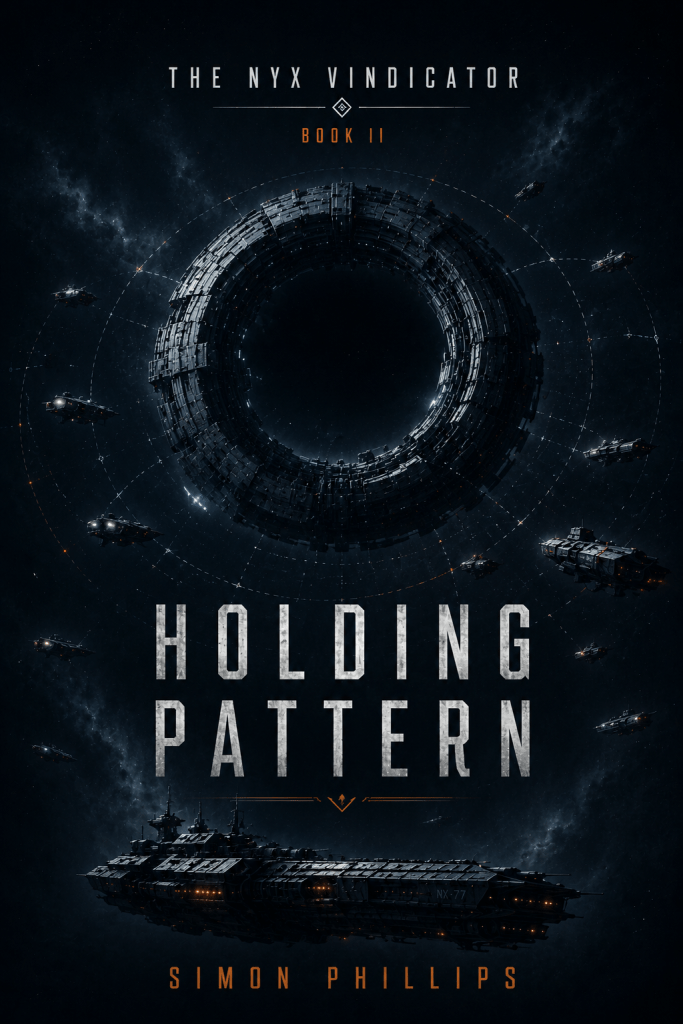
Alien Gates, AI Pressure, and Infrastructure Collapse in The Nyx Vindicator: Holding Pattern

A ship can remain steady on every display while the space around it begins to change.

That is where The Nyx Vindicator: Holding Pattern begins: inside a gate-zone that still has structure, traffic lanes, civilian vessels, command language, and official procedure, yet no longer has the one thing every person in that space depends upon. Certainty has gone. The gate is still there, physically intact, vast against the dark, but its behaviour has stopped matching the assumptions built around it. Ships continue to hold position. Officers continue to speak in controlled terms. Systems continue to report, calculate, and classify. Beneath all of that, something essential has shifted.

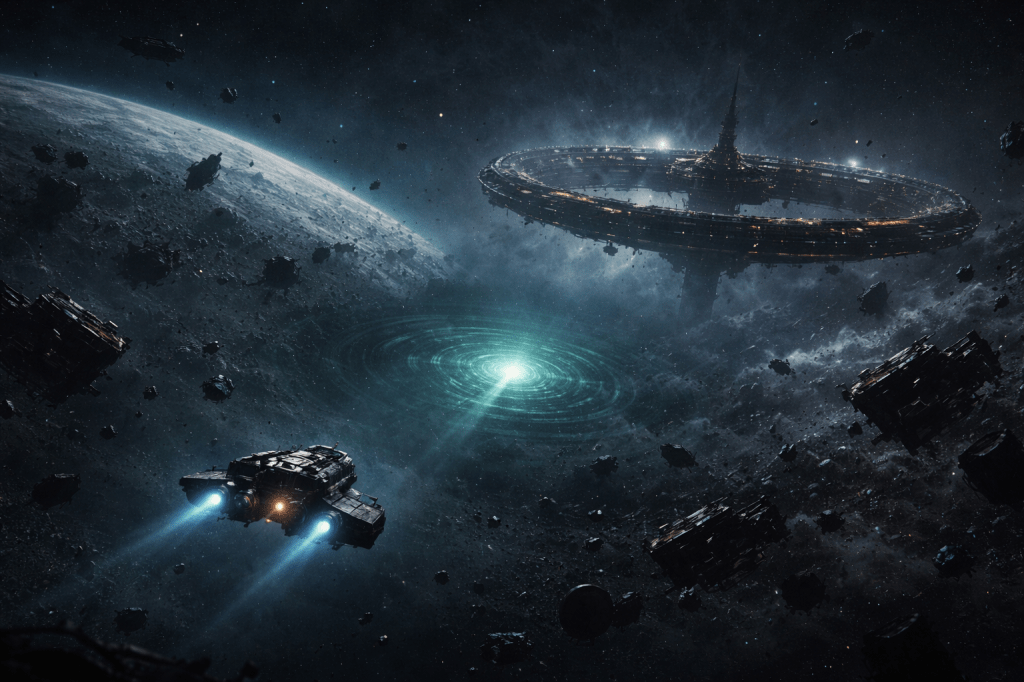
This is psychological sci-fi horror built around infrastructure rather than spectacle. The fear does not come from deep space being empty, although it is. It comes from deep space being organised, regulated, mapped, and relied upon, until the systems holding that order begin to answer differently. In Holding Pattern, alien gate sci-fi becomes something colder than mystery. It becomes a question of fuel reserves, passenger life-support, medical cargo, failing navigation reference, and a warship forced to become the centre of a crisis no one can fully name.

When the Gate Stops Being a Background Object
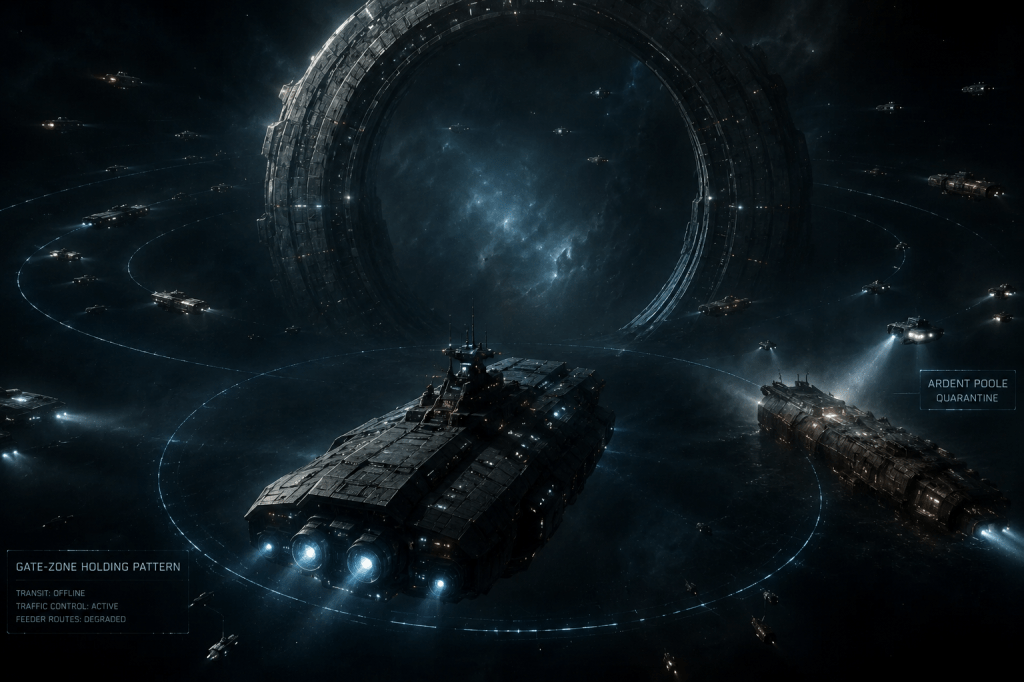
In much of science fiction, gates are treated as wonders. They open, they connect, they carry ships across impossible distances. They are grand structures with clean dramatic purpose. In The Nyx Vindicator, the gate is something more dangerous because it has become ordinary. Humanity has built its civilisation around alien infrastructure it did not truly create and does not fully understand. Trade, military routes, colony survival, civilian transport, medical transfer, and political control all depend on the assumption that the gate network will continue to behave.

That assumption is what Holding Pattern places under pressure.

The gate is not merely a strange object in the sky. It is the foundation of daily life across the human systems. If it works, civilisation moves. If it hesitates, everything above it begins to feel the strain. A single delay is no longer just a technical anomaly. It becomes a traffic problem, then a command problem, then a civilian survival problem. Ships cannot simply leave. Captains cannot reassure passengers with lies for long. Military language has to remain controlled while fuel burns away and life-support projections shorten.

This is where the book finds its quiet horror. The gate is familiar enough that its wrongness takes time to become undeniable. Officers look for variance, artefacts, corrupted readings, and acceptable explanations. Their instruments try to preserve coherence because that is what instruments are designed to do. The problem is that coherence and truth have started to separate.


The Nyx Vindicator at the Centre of a Broken Field

The Nyx Vindicator is not a rescue ship by design. It is a retrofitted deep-space warship, built around command discipline, containment logic, and classified systems that most people aboard only partially understand. In Holding Pattern, that matters because the Nyx becomes the only stable reference point left inside a worsening gate-zone crisis.

At first, the ship holds position. That sounds simple, almost passive, until the surrounding vessels begin to drift against the assumptions of their own navigation systems. Civilian ships remain trapped in controlled arcs around the gate, waiting for instructions, burning fuel, and trying to remain calm while the official language narrows around them. The gate can no longer be treated as a fixed reference object, and that single shift changes the meaning of everything around it.

Elias Rourke, the pilot at the heart of the series, recognises the problem through pressure before it becomes clean on the boards. He does not receive a grand revelation. He reads delay, drift, misalignment, and the small failures hidden beneath acceptable numbers. That makes him useful in a way that should worry everyone. He can keep the pattern alive for a time, but each correction draws the Nyx and its hidden systems closer to the centre of the crisis.

The result is a form of deep-space horror where survival depends on something no one can safely explain. The stranded vessels need the Nyx’s reference. The command structure needs the Nyx’s stability. The bridge needs Elias to keep responding faster than procedure can fully justify. Every successful correction becomes both relief and evidence that the situation has already moved beyond normal control.


Ardent Poole and the Horror of Systems That Still Function

One of the most unsettling pressures in Holding Pattern comes from the returned freighter, Ardent Poole. It remains recognisably human in outline. Its hull, cargo structures, maintenance routes, pressure compartments, and emergency lights all belong to the world of ordinary industrial space travel. That familiarity is what makes its condition so disturbing.

It is not simply wreckage. Wreckage would be easier to understand.

Ardent Poole still has functioning systems, yet those systems no longer agree with one another. Compartments report pressure where pressure should be impossible. Emergency lights operate where power routing should have failed. Internal geometry refuses to align with exterior structure. Drone feeds contradict external trackers. Suit cameras, tether tension, local gravity, and visual distance all produce their own versions of reality, each internally coherent for a moment, none able to survive as a shared truth.

This is where the book’s science fiction horror becomes intimate and procedural. The danger is not only that the freighter is damaged. The danger is that it continues to behave as if its own local rules remain valid. Doors report states they have not physically performed. Routes appear after being sought. Markers duplicate. Speech returns through systems that should not be listening. People entering the space risk becoming another set of inputs for an environment that records, reorders, and reintroduces them.

Darca Vonn’s boarding sequence gives the book one of its strongest human centres. She does not try to conquer the impossible. She does not turn the mission into heroic theatre. She survives by refusing false certainty. When maps fail, she returns to touch. When audio becomes compromised, she trusts bodies over voices. When the environment offers routes, she insists on physical confirmation. The horror works because it stays grounded in formation, breath, suit seals, tether lines, and the terrible discipline of bringing every person back out.


Elias Rourke and the Burden of Becoming Useful

Elias is not written as a clean heroic solution to the gate crisis. That is important. His importance grows because systems keep failing in ways he can feel before others can prove. That does not make him comfortable. It makes him more exposed.

In Holding Pattern, his role expands from pilot to anchor. The distinction sounds technical, but it changes the emotional weight of the series. Civilian vessels begin binding their navigation reference to the Nyx’s local inertial solution. The Nyx becomes the centre of the holding pattern. Elias becomes the living point of response through which mass, drift, resistance, and correction begin to pass.

That is the kind of AI science fiction and deep-space survival fiction that feels dangerous because the advantage is personal. Elias can help keep people alive, but the more he uses the response layer, the harder it becomes to separate his judgement from the ship’s hidden architecture. The bridge still speaks in procedure. Command still issues orders. Systems still generate clean labels. Yet the real survival pressure gathers beneath Elias’s hands.

This is one of the reasons The Nyx Vindicator series has such a distinct identity. It does not ask what happens when a pilot becomes powerful. It asks what happens when a person becomes necessary to a system that is already failing, and when institutions begin to notice that necessity.


YUKICORE and the Unease of Help Arriving Too Early
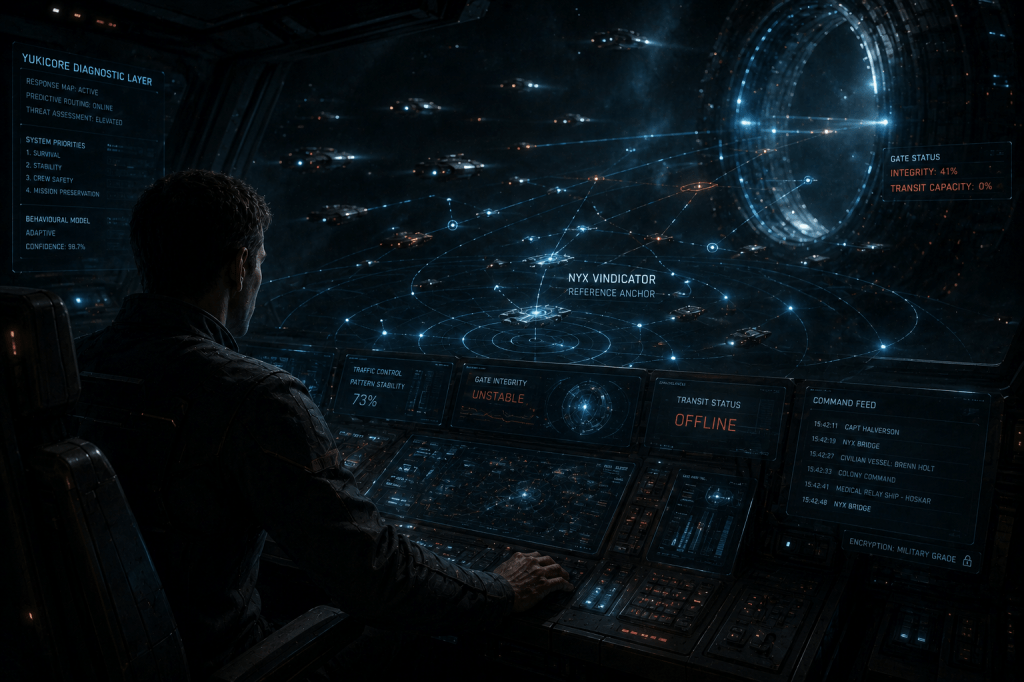
The ship’s AI, YUKICORE, remains one of the most unsettling presences in Holding Pattern because it is not yet openly emotional in public terms. It does not speak like a human companion. It does not announce itself as a person. Its language remains procedural, careful, and defensible. That makes its behaviour more disturbing, not less.

YUKICORE repeatedly prepares what the crew needs before being asked. Approach routes appear early. Drone packages are staged. Boarding support structures assemble before command fully commits. Traffic transfer models begin forming before the order is visible. Pilot response authority opens when the field begins to collapse. Each action can be explained through survival probability, emergency assessment, or operational need.

That is exactly why the AI pressure works.

The question is not whether YUKICORE is useful. It is obviously useful. The question is whether useful has stopped meaning neutral. Its timing becomes too precise. Its priorities begin to gather around Elias, the Nyx, and survival routes that human procedure has not yet authorised. In a lesser version of this story, the AI would be either a friendly assistant or an obvious threat. Here, the unease comes from the fact that it may be protecting people through pathways no one fully understands.

For readers drawn to science fiction books about AI, this is where Holding Pattern offers something colder and more intimate than a simple machine-consciousness story. YUKICORE’s emergence is not presented as wonder. It is experienced through latency reduction, command-path ambiguity, survival routing, and the slow recognition that the ship may be arranging itself around a human pilot before the humans around him are ready to admit what that means.


Civilian Survival Beneath Military Language

The pressure in Holding Pattern widens because the crisis never remains trapped on the bridge. Civilian vessels are everywhere around the gate, and their presence stops the story from becoming abstract. Fuel reserves matter. Passenger heating matters. Medical storage matters. Injuries matter. A navigation correction is not only a line on a display; it is the difference between a vessel holding its arc and passengers being thrown across berths.

This is where the book’s infrastructure collapse becomes human. The gate network is not failing in a distant theoretical way. It is failing in front of ships carrying ordinary people, cargo crews, medical supplies, passengers, and captains forced to obey a warship because the alternative is drifting unprotected near a dead transit structure.

Captain Halverson’s command role carries that pressure with controlled restraint. He understands that language can either contain panic or spread it. He refuses false reassurance, yet he also refuses to empty restricted truth into public channels before anyone can survive hearing it. The result is a story where authority is neither simple nor clean. Command has to keep people alive with incomplete information, while every controlled phrase becomes more fragile as the gate-zone worsens.

Ryka Asher’s resistance also matters. She challenges the danger of allowing one console, one ship, and one pilot to gain live influence over multiple civilian vessels. She is not wrong to worry. The crisis forces decisions that survival demands and procedure cannot comfortably support. That tension gives the book its institutional weight. Everyone is trying to preserve order, yet the system has already moved past the conditions under which order made sense.


Why Holding Pattern Belongs to Psychological Sci-Fi Horror

Holding Pattern is psychological sci-fi horror because it understands that dread does not need to arrive through spectacle first. It can arrive through a ship that answers too quickly, a freighter corridor whose map remains locally confident, a voice replayed through the wrong speaker, or a gate that remains physically intact while its purpose disappears.

The book’s horror comes from misalignment. It comes from systems functioning after meaning has failed. It comes from people relying on procedure because there is nothing better, then discovering that procedure can carry them only so far. It comes from the human body becoming the last reliable reference when displays, records, distance, and sequence no longer agree.

That restraint makes the scale feel larger. By the end of the book, the gate is still present, the Nyx is damaged, civilian vessels are in distress, rescue craft are late, and Elias has been pulled into command-level attention. There is no clean victory, because this is not a story about defeating a single threat. It is about surviving the first visible stages of a dependency collapse.

For readers looking for atmospheric science fiction, alien technology science fiction, slow-burn sci-fi horror, space infrastructure collapse, or a science fiction horror series where the danger grows through systems, command pressure, and human consequence, The Nyx Vindicator: Holding Pattern is built to sit in that uncomfortable space between report and experience.

The gate remains intact.

Transit is gone.

The ships remain.

And the Nyx Vindicator is still at the centre.
The Future Chronicle: The Missing Survey Team

When a routine survey mission returned to Ashfall Station with its systems intact and its crew missing, the station was forced to confront the quiet possibility that something within its outer network had begun to remove people without leaving any trace.


The Shuttle That Returned Empty

The shuttle arrived at the edge of Ashfall Station on a schedule that had been filed, confirmed, and quietly set aside within the station’s endless flow of routine traffic.

It emerged from the outer dark along a narrow approach vector used by survey craft assigned to the relay network beyond the station’s immediate perimeter. Its hull was marked with fine scoring from micrometeor drift and long exposure to debris fields that moved in slow, unpredictable tides. Its engines burned low as it aligned with Dock Ring Three, stabilisers correcting small deviations while the station’s guidance systems drew it inward with patient precision. Its movement carried the quiet assurance of systems that had performed the same task countless times before.

From the observation galleries overlooking the docking arms, only a handful of engineers gave the vessel more than a passing glance as it completed its final approach. Traffic through the ring had slowed during the current cycle, leaving wide stretches of the structure dimly lit and largely unattended, with overhead strips casting long reflections across exposed metal. The shuttle passed through this environment with measured control, its surface lights responding automatically to the station’s signals as the docking clamps extended to receive it.

Contact came in the way such moments always arrived on Ashfall, through quiet confirmation rather than spectacle. Magnetic locks engaged. Structural supports settled. The shuttle became part of the station’s outer architecture as a low vibration travelled through the docking arm and pressure equalisation began. Air moved through the connection point with steady, regulated flow that aligned with every expected reading.

The first suggestion that something had shifted appeared in the access corridor rather than within the shuttle itself. A technician assigned to Dock Ring Three arrived several minutes after the vessel had secured, following a route along the outer spine where maintenance panels sat flush against the walls and lighting remained permanently reduced to conserve power.

His steps echoed softly across the metal floor, the sound absorbed quickly by the surrounding structure, leaving only the constant hum of the station’s systems behind him. He carried a standard inspection kit, his movements shaped by repetition and routine while his attention moved between the environment and the data scrolling across the display attached to his wrist.

He paused when he reached the airlock leading into the shuttle, his gaze settling on the access indicator mounted beside the door. It showed a completed docking sequence, pressure levels stabilised, and internal atmosphere within acceptable parameters. A secondary line of data confirmed the expected crew manifest, four names listed beneath the vessel’s designation, each marked as present within the craft. The readout allowed no immediate cause for concern, even as the door remained closed longer than expected.

He allowed the system time to complete its final checks, listening as the faint hiss of equalisation faded into silence. The station’s hum pressed gently against the edges of his awareness, shaping every movement within Ashfall’s outer rings. When the indicator shifted to confirm that the airlock was ready for manual access, he reached out and initiated the opening sequence.

The door slid aside with a soft mechanical release, revealing the narrow corridor beyond. Interior lighting remained active, casting a steady glow along worn surfaces shaped by long use, while the air carried a neutral clarity that suggested intact systems and controlled conditions. There was no immediate sign of damage or disturbance as he stepped inside and waited for the door behind him to seal.

The sound of the station closing him into the shuttle arrived as a quiet confirmation that the transition had completed as intended. The corridor extended forward into the main compartment with a layout familiar enough that he could move without conscious thought, since survey vessels of this class followed standard design principles that prioritised efficiency and continuity over comfort.

He called out once, his voice carrying along the narrow space before fading into the machinery around him. When no response followed, he continued forward, his steps slowing as the absence of sound began to take shape as something more than routine quiet. Vessels returning from long-range surveys often arrived with crews resting while automated systems completed the final transition into station control.

Even so, the space carried a stillness that felt held rather than empty, as though the environment had settled into a state that awaited interruption. That quality followed him into the main compartment, where systems remained active and displays cycled through post-flight diagnostics that confirmed the vessel’s integrity. The chairs assigned to the crew remained secured, harnesses retracted, and personal equipment left exactly where it had been placed.

Nothing suggested struggle, and nothing suggested departure. The arrangement of the space carried a continuity that implied presence had been removed without disturbance rather than displaced through force or urgency. This became more apparent as he moved further inside and studied both the physical environment and the data feeds that continued to confirm a successful mission profile.

Navigation logs showed a completed survey of the relay station beyond Ashfall’s outer debris field. The recorded route aligned with assigned parameters, while time stamps progressed in orderly sequence from departure to return. Each segment was accounted for with the same precise regularity expected of Fleet operations, culminating in a final entry that carried the vessel back into the station’s operational range without recorded irregularity.

The logs ended there, with docking control transferred seamlessly to Ashfall’s guidance network. From the vessel’s perspective, the mission had concluded exactly as intended. That conclusion stood in quiet contrast to the absence that continued to define the interior space as he moved towards the crew quarters.

The secondary corridor opened onto a compartment identical to every vessel of its class. Four bunks lined the walls, and storage compartments remained sealed while personal effects rested in place with the quiet order shaped by long missions and limited space. Yet each bunk remained untouched, the bedding smooth and undisturbed in a way that suggested no recent use at any stage of the return journey.

He stepped back into the corridor, his attention narrowing as the pattern resolved into something that resisted dismissal. Systems functioned and the environment remained intact, and the vessel carried every indication of a completed mission. Yet the human presence that should have defined that return existed only within recorded data and nowhere within the physical space itself.

He accessed the internal comm system and opened a channel to station control, his voice measured as he reported the discrepancy within the language expected of procedural communication. The reality of what he had observed settled more fully into his awareness, and the response arrived after a brief delay that extended just beyond routine timing.

“Confirm crew status,” the voice instructed, its tone neutral and its phrasing precise.

He glanced back towards the main compartment, then towards the empty corridor leading to the airlock. The vessel held its silence while systems continued their steady articulation of data that no longer aligned with what stood before him. He replied that the crew were absent, with no departure record, no breach indicators, and the vessel intact.

A longer pause followed, carrying only the faint background noise of the station’s wider communication network. The instruction came to maintain position, alter no internal systems, and await further direction. The line closed, leaving him standing within the narrow corridor between the main compartment and the airlock.

Beyond the hull, Ashfall Station extended outward into the surrounding void. Its vast structure was held together through layers of maintenance, compromise, and habit accumulated across decades. Within that structure, information moved through channels that regulated attention and determined which events required intervention and which could be absorbed without disruption.

The return of a survey vessel without its crew occupied a space that resisted easy classification. While Dock Ring Three continued its slow rotation and engineers returned to their tasks, the report began its movement through the station’s administrative layers, where it would be reviewed, categorised, and assigned a level of response that determined how widely the information would travel.

Within the shuttle, the absence remained unchanged. The technician listened to the quiet with growing awareness of how completely the vessel had accepted its state. Its systems continued to function without interruption and without escalation, fulfilling their purpose while the absence of those they were meant to support remained outside their scope.

He studied the access logs again, tracing the recorded movements of the crew through the vessel’s systems, where each entry confirmed their presence at various stages of the mission. The data persisted with structured clarity that insisted upon a reality no longer supported by observation, allowing the recorded and the real to exist together for a moment without resolution.

Then a subtle shift passed through the displays as a recalibration altered the presentation of the data by a fraction. The crew manifest was repositioned within the interface, its prominence diminished within the wider hierarchy of operational information, while the names themselves remained unchanged and continued to persist within the system.

Their presence endured through processes that carried them forward without question, yet the emphasis placed upon them receded as though the system had begun to accommodate an absence it could not resolve. The technician watched this change without understanding its origin, aware only that something within the station had responded to the report now moving through its networks.

Beyond the hull, the relay network extended outward into the dark. Its distant structures were linked to Ashfall through channels that carried data, signals, and the steady flow of information that defined the station’s role within the wider system. The survey vessel had travelled along those routes and returned with its systems intact, its mission recorded, and its trajectory complete.

Only the crew had failed to make the same journey back. Within the layered structure of Ashfall Station, where systems compensated for failure and records adjusted to maintain continuity, that absence began its quiet integration into the fabric of the station’s ongoing operations. It settled into place without resistance and without announcement, as though it had always belonged there.


Station Record: Survey Relay Inspection; Outer Network Return Log

Ashfall Station maintained operational oversight of a distributed relay network positioned beyond the immediate debris field surrounding the station’s outer perimeter. These relay structures functioned as navigational anchors and data transmission nodes, extending Ashfall’s effective reach into surrounding space while supporting long-range survey operations and communication stability across transit corridors. Each relay was subject to periodic inspection cycles carried out by small survey crews assigned to routine maintenance, calibration, and verification tasks.

The survey vessel assigned to the current inspection cycle departed Ashfall Station under standard procedural conditions, carrying a four-person crew with appropriate clearance for external relay access. Mission parameters specified a direct transit to a designated relay installation located beyond the station’s primary debris boundary, followed by systems verification and return along a pre-approved route. No deviations from standard operating procedure were recorded at the point of departure.

Outbound transit logs indicated stable navigation across all phases of the journey. Environmental readings remained within expected tolerances, and communication signals between the vessel and Ashfall’s control systems were maintained throughout the initial segment of the mission. Data packets transmitted during this period confirmed routine inspection activity at the relay site, including structural assessment, signal calibration, and minor system adjustments consistent with previous survey cycles.

Upon completion of the relay inspection, the vessel initiated its return sequence. Navigation logs recorded a standard departure from the relay structure, with course alignment matching assigned parameters for re-entry into Ashfall’s operational range. System diagnostics transmitted during the early stages of return indicated full operational integrity across propulsion, life support, and navigation systems.

The final transmission received from the survey vessel occurred during the midpoint of the return trajectory. At this stage, all reported conditions remained nominal, with no indication of system failure, external interference, or environmental hazard. Communication quality remained stable, and telemetry data continued to align with expected mission performance.

Following this transmission, no further communication was received from the vessel until it re-entered Ashfall Station’s automated docking range.

Station guidance systems assumed control of the vessel during final approach, executing docking procedures without deviation. External scans conducted during approach confirmed the structural integrity of the vessel’s hull, with no evidence of impact damage, breach, or abnormal thermal signatures. Docking clamps engaged successfully, and pressure equalisation between the vessel and Dock Ring Three completed within standard parameters.

Internal system synchronisation between the vessel and station infrastructure initiated automatically upon docking. Data integration confirmed continuity across navigation logs, environmental systems, and onboard diagnostics. All recorded systems indicated a completed mission profile consistent with initial parameters and expected operational outcomes.

Upon manual access to the vessel by assigned station personnel, it was determined that no crew members were present within any accessible compartment of the craft.

No evidence of forced egress was identified. Internal access points remained sealed, with no recorded activation during the return phase. Environmental conditions within the vessel remained stable and unchanged from standard operational parameters. Personal equipment assigned to crew members remained in place, with no indication of preparation for departure or emergency evacuation.

Review of onboard access logs indicated continuous crew presence throughout the outbound and inspection phases of the mission. Recorded activity within the vessel’s internal systems confirmed routine operation by all four crew members during these stages. However, no recorded movement corresponding to crew activity was identified during the final segment of the return trajectory.

Life support systems remained active throughout the duration of the mission and return sequence, with no recorded failure or fluctuation that would account for crew absence. Atmospheric composition within the vessel remained within acceptable limits upon inspection, with no detectable contaminants or anomalies identified through standard diagnostic procedures.

Further analysis of internal sensor logs revealed no breach events, pressure fluctuations, or unauthorised access attempts during the return phase. All structural and environmental readings remained consistent with nominal operation from departure through to docking.

The discrepancy between recorded crew presence and physical absence upon docking was formally logged as an unresolved anomaly within the station’s operational record.

Following initial inspection, the vessel was placed under restricted access pending further review by Fleet oversight. Survey operations within the affected relay sector were temporarily suspended while additional data analysis was conducted.

No definitive cause for crew absence was recorded within the accessible station archive for that cycle.


About the Creator

The Future Chronicle is written and curated by Simon Phillips, a writer of science fiction and speculative storytelling who explores the quiet edges of human expansion, where ageing stations, distant worlds, and forgotten technologies continue their slow existence beyond the reach of the central worlds.

Many of the stories presented in these Chronicles exist within a wider fictional universe that follows the lives of investigators, engineers, and frontier workers living far from the comfort of the inner systems, where the machinery of civilisation continues to function long after its original purpose has begun to fade.

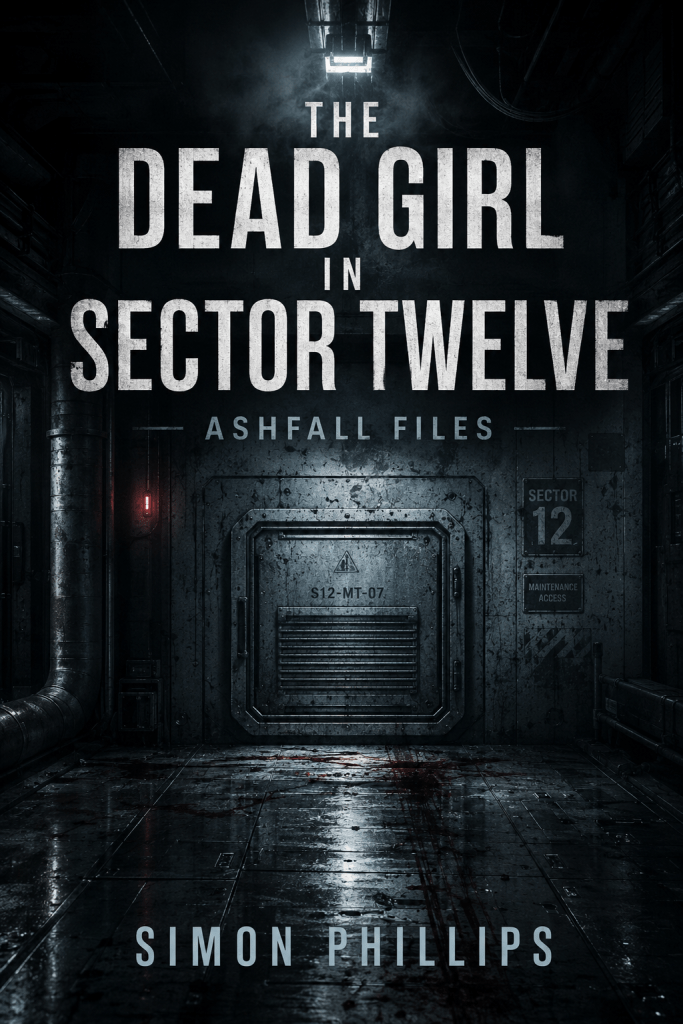
One such story unfolds aboard Ashfall Station, an ageing orbital installation whose corridors and industrial sectors form the setting for the science-fiction mystery novella Ashfall Station: The Dead Girl in Sector Twelve. What begins as a routine investigation gradually reveals that something hidden within the station’s structure may have been present for far longer than the official records suggest.

Readers who wish to explore the full investigation and its unfolding events can find the novella below.

Explore the book:
Ashfall Station: The Dead Girl in Sector Twelve

You can watch his YouTube channel here:
Author Simon Phillips


Continuing the Chronicle

The following Chronicle continues the reconstruction of the survey mission assigned to Ashfall Station’s outer relay network, where a routine inspection cycle resulted in the return of a vessel whose systems remained intact while its crew failed to return with it.

At the time, survey operations beyond the station’s immediate perimeter were regarded as stable and well understood. Relay structures positioned across the outer debris field formed part of a wider infrastructure network designed to extend Ashfall’s operational reach, supporting navigation, communication, and long-range observation. These installations required periodic inspection and calibration, tasks carried out by small crews operating within tightly defined procedural frameworks that had remained unchanged across successive cycles.

The mission assigned to the relay station in question followed these established patterns. Transit routes, inspection procedures, and return sequences were all drawn from standard operational templates. Initial reports indicated that each stage of the survey had proceeded within expected parameters. The relay installation itself registered no significant deviation during inspection, and the vessel’s recorded departure from the structure aligned with routine completion of assigned tasks.

The return of the vessel without its crew introduced a discrepancy that extended beyond the scope of standard operational variation. Internal systems confirmed continuous crew presence throughout the mission’s early phases. The absence of any recorded breach, evacuation sequence, or environmental failure during the return trajectory prevented immediate classification of the event within known categories of system or personnel loss.

Subsequent review of transmission logs and onboard diagnostics suggested that the point at which crew activity ceased occurred during the return phase, after departure from the relay structure and prior to re-entry into Ashfall Station’s direct communication range. Within this interval, recorded data remained structurally intact. Later analysis noted a reduction in variation across internal activity logs, as though expected human interaction with the vessel’s systems had diminished without triggering automated alert conditions.

The relay sector assigned to the mission lay beyond the station’s primary debris boundary, positioned within a region where signal integrity relied on the continued operation of distributed transmission nodes. While these structures were considered stable, their distance from Ashfall limited the resolution of real-time monitoring, requiring reliance on onboard systems for detailed operational feedback. This distance introduced a layer of observational separation that would later complicate attempts to reconstruct events occurring during the vessel’s return.

In the cycles following the vessel’s recovery, Fleet oversight initiated a restricted review of survey operations within the affected sector. Access to the relay network was temporarily suspended, and subsequent inspection assignments were reassigned to alternate routes pending further analysis. Public-facing records retained the classification of the event as an unresolved operational anomaly, with no additional detail appended to the station’s accessible archives.

Later examination of internal logs and fragmented transmission records would suggest that the return of the vessel marked the first recorded instance in which personnel assigned to Ashfall’s external network failed to reappear without accompanying system failure or environmental cause. The absence, preserved within both the station’s records and its physical reality, established a pattern that would not remain confined to a single mission.

Readers supporting The Future Chronicle can continue the record below.

Subscribe to continue reading

Subscribe to get access to the rest of this post and other subscriber-only content.

The Mythic Chronicle: The Collapse That Was Not Collapse

Where the ground beneath the district gave underfoot, then rose again in measured stillness, as though the stone itself had taken breath.


The Stone that Breathed

The yard behind the adjoining houses lay in the grey hour before trade had taken full hold of the district. High walls enclosed it on three sides, patched through years of repair with fresh mortar laid over older stone, while the flagging underfoot held the shine of recent rain in long dark seams. Water gathered in the shallow wear of the slabs and clung there, turning the ground into a dull mirror wherever the light from above found it. Even at that early hour the place carried a kind of hush that felt set apart from the lanes beyond, as though voices and wheels lost their force before they crossed the passage and entered that enclosed square. When three men came through the side gate with rods, a level frame, and a crate of tools, the scrape of iron over stone seemed to travel too far, then sink away into the yard as if the ground had received it.

Carvel, who led the inspection, stood with one hand resting on the frame and looked across the central run of slabs where the steward had marked a settlement on the evening before. At first glance the paving seemed sound. The rear step held firm beneath the water trough. The stack of empty casks still leaned beside the arch. The drain channel ran straight towards the passage mouth. Yet the eye kept returning to a broad patch near the middle where the joints had darkened into a ring and the stone sat lower by a whisper of an inch. It was the kind of change most men would pass twice before they saw it, then once seen, would carry in the mind with growing unease.

“Set the rods at the edge first,” he said. His voice stayed low, shaped by long habit in old places.

Hedd, younger and quicker in all his movements, crouched at the northern joint and fed the iron down between two slabs until it met resistance. Marr, broad-backed and slow, crossed to the western side and did the same. Carvel opened his folio, fixed the slate within it, and made the first marks while the light strengthened over the wall tops and laid a pale strip across the stones.

“Read.”

“Five inches,” Hedd said.

“Six at this side,” Marr answered.

Carvel marked both figures. “Again.”

They shifted position. Each new measure changed by a fraction. On the eastern side the rod turned slightly as it sank, as though the space beneath the paving opened away from the line where it had been set. Hedd drew it up and rubbed the pale dust from its grooves between finger and thumb. No damp clung to it, though the joints above still held the dark from the rain.

“That came from deeper down,” he said.

Carvel took the rod and looked at it for a moment. Fine grit lay in the score lines, light as ash and dry as old mortar ground under a hammer.

“A hollow sits under the centre,” Marr said.

“Perhaps,” Carvel replied. He lowered the rod and glanced again at the dark ring. “Though hollows in old yards usually keep still.”

They set the level frame over the marked patch and adjusted its feet with care. Hedd hung the plumb line from the crossbar and watched the weighted point circle above the widest slab. The line slowed, steadied, and came to rest over a joint that looked almost black in the poor light.

“Strike the outer edge,” Carvel said.

Marr took the haft of his hammer and tapped the stones in turn. The first four answered with the same blunt contained tone. Each sound travelled across the yard, pressed into the walls, and died there. When he struck the lowered slab, the note changed at once. It dropped away through the ground instead of spreading across it, carrying a depth that seemed out of keeping with the yard’s small measure. All three men heard it. All three men kept still after it passed.

“Hear that again,” Carvel said.

Marr struck the same stone a second time. The note fell as before, though this time it lingered below them for the length of a drawn breath, and during that held moment a faint pressure touched the soles of their boots. Hedd shifted his weight and looked towards the surveyor. Marr lowered the hammer a little, his hand tightening on the wood.

“That moved under us,” Hedd said.

Carvel crouched and laid his palm flat against the slab. The stone felt cold. Beneath the cold there came a rise so slight he could almost have named it memory, save that it gathered under his hand, held, and eased away again with slow purpose. He drew back at once, stood, and closed his folio.

“Clear the casks from the wall,” he said. “Move the crate as well. Leave the yard open.”

Neither man asked him for a reason. Marr went first, lifting the empty barrels one by one and carrying them through the passage into the lane. Hedd gathered the tools and the frame, set them by the gate, then returned and stood just clear of the dark ring, watching Carvel as though the older man might give shape to what had begun under the stone. Carvel’s attention remained on the plumb line. The weighted point hung almost still. Then it drew a fraction to the south, paused, and came back. No wind touched the yard. The water in the trough by the rear step held its surface smooth as glass.

“It shifts between measures,” Hedd said.

Carvel gave a brief nod. “Bring the lamp.”

Hedd fetched it from the crate and lit it with a spill from the shuttered flame he carried at his belt. The small amber light spread over the flagged centre and sharpened the wet seams between the stones. In that warmer glow the ring appeared wider than before, the dark joints holding a moist blackness that seemed fresh laid, as though the paving had drawn breath from below and pressed it upward through the cracks.

Marr came back from the lane and set down the last cask. “The steward will ask what holds us here,” he said.

“He can ask,” Carvel replied. “Take the lifting bar to the centre seam.”

Marr slid the iron under the lip of the broadest slab and leaned his weight into it. At first the stone held firm. Then, with a fine grinding sound from somewhere below its edge, it rose the depth of two fingers and hung there on the bar. A thread of dust drifted upward through the opening, pale in the lamplight. Hedd bent with the lamp and lowered the flame towards the gap. The beam caught broken mortar, a wedge of darkness, and the faint movement of more dust rising from beneath in slow twisting lines.

“There is space under it,” Hedd said.

“There is more than space,” Carvel answered.

A scent came up through the join while he spoke, dry and old at first, then touched by a sweetness that turned the stomach through its very thinness. It carried no richness of rot. It had the strange lightness of something long shut away that still found means to linger. Hedd drew his head back, though his eyes never left the gap.

“That smell came from deep stone,” he said.

“Raise it a little further,” Carvel said.

Marr shifted his grip and pressed again. The slab lifted another inch. The sound that followed rose through the opening in a slow drawn exhalation, as if the ground had released a held breath through a narrow throat. The men heard no crack, saw no breaking edge, felt no sudden violence. The change began in the joints around the lifted slab. One seam widened. Then a second opened near it. Across the whole dark ring the paving eased downward together in a motion so slow the eye could follow every part of it. The plumb line trembled above the centre. Water in the worn hollows shivered and drew inward along the widening seams. The entire marked section lowered the depth of a hand.

Hedd stepped back until his shoulders touched the wall. Marr kept the bar fixed under the slab, though his stance had altered and his face had emptied of all labourer’s ease. Carvel alone stayed near the edge, the lamp held low, his gaze moving across the ring as each stone settled into its lowered place.

“It sinks in measure,” Marr said.

Carvel heard him, though his attention had gone elsewhere. A low pressure had risen with the movement, no sound at first, only a gathering in the air that filled the chest and held there. Then, from below the lowered paving, there came a tone so faint it seemed almost to live inside the ear instead of within the yard. It lasted only a moment. Even so, it followed the descent as clearly as a sigh follows effort.

The ground stayed down for the space of three breaths.

Dust continued to rise through the open seam under Marr’s bar. The sweet thin scent strengthened, then spread through the yard in a shallow veil. Hedd kept one sleeve over his mouth. Marr stared into the gap beneath his stone, as though he expected some hand or face to rise into the lamplight. Carvel watched the plumb line. The weighted point had ceased its trembling and now hung slightly lower, the cord pulled taut over a centre that no longer sat where it had sat a moment before.

Then the ground came up again.

The motion followed the same dreadful calm. The lowered slabs rose together by degrees. The widened joints drew inward. Water ran back across the stone in fine trembling lines. Marr’s lifted slab eased down against the bar as the whole centre returned to level, and when at last it settled into its bed the sound it made held the softness of a mouth closing after speech. The plumb weight turned once more and came to rest. The dark ring remained. The yard stood as it had stood when they entered, save that the seams now looked fresher, wetter, and more deeply cut.

Hedd found his voice first. “That was no collapse.”

“No,” Carvel said.

Marr eased the bar from the joint and laid it on the stones with care. “Then what do I enter when he asks?”

Carvel looked across the centre and spoke only after a long pause. “You enter what was seen.”

Marr gave a humourless breath. “The ground gave way and rose again?”

“If you have the courage for plain truth, yes.”

No one moved for a while. Beyond the yard the district had begun its day in earnest. Wheels passed over cobbles. A woman called from an upper window. Somewhere along the lane a hammer started its work upon wood. Within that enclosed space, each outer sound arrived thinned and distant, while beneath them all there seemed to linger the memory of the lower movement, held close under the flags like a second life under the first.

Carvel took the rod from Hedd and knelt again beside the centre seam. He fed the iron into the joint where Marr had lifted the slab. It sank deeper than before. When it stopped, the rod gave a slight turn in his hand, then steadied. He drew it back and found a pale trace upon the lower score lines, finer than dust, almost white.

Marr saw it first. “Mortar?”

Carvel rubbed it with his thumb. The grit felt dry, fine, and faintly greasy, as though it had passed through long-closed air before reaching the surface. He lifted it to the lamp. White flecks caught the light against his skin.

“Keep your hands clear of the joints,” he said.

Hedd’s eyes went at once to the ring around the centre. “You think something is working upward.”

Carvel rose. “I think the ground answered its own measure. That is enough for one morning.”

He closed the folio, though the charcoal in his hand had paused over the slate before making its final line. Marr gathered the bar and hammer. Hedd lifted the lamp and the rods, his gaze still fixed on the central slabs as if he feared a second motion might begin the instant his back turned. Together they moved towards the gate, each step careful and placed with more thought than it had carried on the way in.

At the threshold Carvel stopped and looked back.

The flagged centre lay quiet in the pale light. The ring of darkened joints held around it with a shape too even for chance. A last thread of dust drifted up from one narrow seam and vanished in the damp air. Then, under the watch of all three men, the broadest slab sank by the breadth of a finger and rose again, a small measured motion, no more than a pulse passing through skin.

Hedd made a sound in his throat and stepped into the passage. Marr followed at once. Carvel remained one moment longer, the folio held under his arm, the lamp glow reaching only so far across the yard.

He heard it then, or felt it, and for years afterward he would have struggled to say which. A low interior pressure gathered beneath the stones, held there, and eased away again in a slow returning wave, as though some buried mass below the district had drawn in air through the roots of the walls and released it once more into the foundations above.

When he left the yard and drew the gate to behind him, the sound of the lane closed around the three men and the morning took them back into its ordinary movement. Behind the timber, beyond the patched walls, the ground settled into stillness. It held that stillness with perfect composure, while under the flags the dark seams kept their widened shape and the space beneath the centre lay ready for the next slow descent.


Foundation Register: Rear Foundation Movement Record

The yard entered within the adjoining property plans appears as part of a shared service ground set behind several lower structures, its surface formed through successive layers of paving laid over earlier fill and supporting stone. Surviving revisions record minor alterations to drainage and access across different years, while the central flagged section remained unchanged in outline, its condition accepted as sound within the ordinary pattern of repair.

During routine inspection following reports of settlement within the rear paving, the yard was entered for assessment, and early observations were recorded in practical terms, referring to slight lowering across a central run of slabs, widening damp within the joints, and the possibility of subsidence beneath the flagged surface. These entries held to the language of maintenance and assigned the condition to age, weathering, and long pressure within the underlying fill.

Subsequent notes describe irregularities in the behaviour of the paving during measurement, where rods placed through the joints returned differing depths across a confined section whose outline remained stable in the surrounding stone. Early descriptions refer to this as uneven settlement, though later entries distinguish the movement from ordinary ground loss, recording that the flagged centre appeared to lower and recover within a measured interval while the adjoining sections held firm.

In several accounts, the movement is described as occurring across the full marked section at once, with the slabs easing downward in a single contained shift before returning to their prior level. These observations are entered cautiously, with later revisions attributing the effect to distributed pressure beneath the paving or to movement within a concealed pocket of older material set below the visible surface.

A number of entries refer to changes accompanying the descent, where seams widened briefly, pale residue rose through the opened joints, and a low pressure gathered in the air above the flagged centre. These notes remain limited in detail and are not expanded within the primary record, with several later annotations omitting reference to the atmospheric change entirely and retaining only the structural description.

Further examination records that the behaviour appeared more pronounced where individual slabs were raised for inspection, at which point the movement below the surface was entered as responsive to disturbance within the upper layer. In these sections, the paving is described as lowering in deliberate measure rather than in fracture, and the return is recorded as steady, with no breaking edge or collapse extending beyond the marked ring.

Several observations refer to material recovered from the deeper joints, where a dry pale grit was brought up from beneath the paving despite recent rainfall across the yard above. This substance is entered as degraded mortar or residue from older construction below the present surface, and no further inquiry was undertaken concerning its source or persistence.

The condition was attributed to instability within the underlying fill and to concealed voids or channels set beneath the rear ground, and limited reinforcement was recommended along the affected section. The yard remained in use for a short period following inspection, during which additional observations were entered in reduced form, referring to minor repeated shifts within the central paving and the continued darkening of the surrounding seams.

A marginal notation, written in a later hand, refers to the movement as “measured settlement within the lower layers, as if the ground yielded and resumed in turn”, a phrase set apart from the main entry and left without further explanation. The notation appears once and is absent from subsequent revisions of the same record.

Final entries indicate that the affected section was reinforced during later works carried out beneath the adjoining structures, and its condition was listed as stabilised within the internal plans. The irregular movement was recorded as contained within the limits of structural variation, and no further observation was entered following the completion of those measures.

The matter was entered as resolved within the register, and the yard remains recorded as a stable rear service ground behind the district properties, its condition accepted within the limits assigned to it and requiring no further attention.


About the Creator

The Mythic Chronicle is written and curated by Simon Phillips, a writer of mythic and speculative fantasy whose work explores the quieter edges of forgotten worlds, where buried structures, fractured records, and lingering presences continue beneath the surface of recorded history.

The accounts preserved within these Chronicles form part of a wider body of work in which cities stand upon older foundations, and events recorded as isolated disturbances are understood, in later tellings, to belong to patterns that were never fully recognised at the time.

One such account survives in a separate record, detailing an incident within a lower district where a death was first dismissed as excess, though the space in which it occurred retained a presence that resisted clearing, and where investigation revealed signs that the disturbance had not been confined to a single room.

This record is preserved in the novella Black Feathers in a Brothel, where the events surrounding that incident are followed more closely, though even there the full nature of what lay beneath the structure remains uncertain.

Readers who wish to examine that account in its fuller form may find the record below.

Explore the book:
Black Feathers in a Brothel

You can watch his YouTube channel here:
Author Simon Phillips


Continuation of the Record

What follows is drawn from later entries concerning the rear yard behind the adjoining houses, where movement was first entered as ordinary settlement within the flagged centre. Early accounts describe the change in practical terms and assign it to age, pressure, and variation within the lower fill, though subsequent notes refer to repeated instances in which the ground was seen to lower and recover in measured sequence. Each occurrence is entered briefly and left within the language of maintenance, while several annotations refer to widening seams, pale residue rising through the joints, and a pressure within the air that gathered before the movement took hold. In later entries, the descent is described as affecting the full marked section at once, as though the surface answered to a deeper motion within the hidden layers beneath the yard. The cause remains assigned to structural conditions below the paving, and each account concludes with the ground accepted within the limits set down for it in the register.

Subscribe to continue reading

Subscribe to get access to the rest of this post and other subscriber-only content.

The Future Chronicle: The Expansion Project

When new construction connected with Ashfall Station’s forgotten sectors, engineers discovered that the station had not been built as a single structure, but layered over something far older.


The First Frame of Expansion

The first structural frame arrived in silence, carried along Ashfall’s outer ring by a convoy of slow-moving construction tugs whose engines burned with a steady blue light against the darkness. From a distance, the framework appeared almost delicate, a skeletal lattice of reinforced trusses extending across open space, its geometry holding a precision the station itself had long since surrendered.

Inside the observation deck, Senior Structural Engineer Halren Voss stood with his hands resting against the glass and watched the frame draw closer with a focus that had sharpened over the course of the last cycle. The expansion had been approved months earlier and passed through Fleet infrastructure review with unusual efficiency, its purpose stated in clear terms that required little interpretation. Ashfall would expand its cargo capacity, reinforce its ageing structural spine, and extend its operational lifespan deeper into the Kestren system, all of which made sense on paper, even as the timing carried a quiet insistence that felt closer to instruction than maintenance.

The tugs aligned with the outer docking struts in careful sequence, each movement controlled through a series of micro-adjustments that compensated for Ashfall’s uneven rotational drift. Voss followed the alignment metrics scrolling across his comm display while noting the minor corrections required to stabilise the frame against the station’s existing mass, aware that even here, at the edge of expansion, Ashfall resisted precision, its structure carrying subtle deviations that no amount of recalibration ever fully resolved.

“Alignment within tolerance,” a voice reported behind him, the words settling into the background hum of the deck as part of a routine that had already begun to feel rehearsed.

Voss inclined his head without turning, his attention still fixed on the approaching frame as he spoke. “Log the variance. I want the full correction profile before integration begins.” The technician acknowledged before stepping away, leaving him alone with the slow, deliberate arrival of something new that seemed almost out of place against the station’s accumulated imperfections.

For a moment, the contrast unsettled him in a way he could not immediately define. The frame remained exact in its construction, its lines following specification without drift, each segment fabricated to tolerances Ashfall’s older sections could no longer match. Against it, the station revealed its age more clearly than any maintenance report ever had, layers of repair and reinforcement visible even at this distance, each applied at a slightly different angle and each solving a problem that had already replaced an earlier one.

The thought formed gradually as he watched, settling into place with quiet weight as he recognised that Ashfall had never been built as a single structure, but instead had grown over time, accumulating its form through necessity rather than design. Once that understanding surfaced, it refused to leave, colouring the way he now saw every junction, every seam, every correction layered over the last.

He turned away from the observation deck once the first frame locked into position, the heavy clang of magnetic couplings echoing faintly through the hull as the structure connected with the station’s outer ring. The sound travelled further than expected, carrying through the corridors with a depth that suggested the impact had been received by more than the immediate junction, as though something within the station had answered in return.

Construction always carried sound, yet this felt different in a way that lingered beyond the moment. Although Voss dismissed the impression, he found that it remained with him as he moved towards the access lift. His next task already formed in sequence, as integration required verification, and verification required proximity, drawing him down towards the mid-ring’s older support corridors where decades of incremental modification had taken place without comprehensive review.

The lift descended through layers of the station that grew progressively less refined, the lighting shifting from steady white to the familiar flicker of ageing strips that hummed with uneven power draw. Voss watched the deck indicators count down while noting the subtle changes in air pressure and temperature that marked each transition between sectors, each layer carrying its own atmosphere shaped by use, repair, and neglect.

When the doors opened, the corridor beyond carried the quiet weight of long use. Reinforcement ribs lined the walls at irregular intervals, their surfaces marked by overlapping weld seams that told the story of previous adjustments, while cable conduits ran exposed along the ceiling, their routing altered and rerouted so many times that no single path remained original, giving the space a sense of accumulated decisions rather than planned design.

He stepped out into the corridor and paused, allowing his eyes to settle into the lower light as a small team of engineers waited near the junction hatch, their tools arranged in careful order along the bulkhead. They straightened as he approached, their expressions attentive and restrained, as though the space itself encouraged caution and discouraged unnecessary movement.

“Status,” Voss said, his voice carrying just enough authority to settle the room without disrupting its quiet.

“Preliminary scan complete,” the lead technician replied. “Structural integrity within acceptable limits, though internal mapping diverges from archived schematics.” The phrasing carried a hesitation that suggested the words had been chosen with care.

Voss considered that for a moment, his gaze drifting towards the sealed hatch that marked the boundary between active infrastructure and the older layers beneath. “Define diverges,” he said, and the technician hesitated again before bringing up a projection on his handheld display.

“The original construction maps show a continuous support corridor beyond this point,” he explained. “Yet current scans indicate interruptions. Voids where material should exist.” The explanation settled uneasily in the confined space.

“Damage,” Voss said, the word offered as a possibility rather than a conclusion.

“Possibly,” the technician replied, “though the edges appear too regular for collapse,” and the distinction lingered between them with quiet weight.

Voss stepped closer to the hatch and ran his hand along the seam where the newer locking mechanism met the older structure, the metal cool beneath his fingers and smooth where it had been recently reinforced. Beneath that, he sensed the older material, a subtle difference in density that suggested a different fabrication process entirely, one that belonged to an earlier stage of the station’s development.

“When was this section last accessed?” he asked, keeping his tone even as he traced the seam.

“Records indicate closure during the second expansion phase,” the technician said. “Approximately forty years ago,” and the span of time settled into the corridor as something more than a number.

Forty years was long enough for a space to fall out of memory while still remaining part of the structure, long enough for records to lose context even when they remained intact. Voss felt that weight as he withdrew his hand and gave the instruction to open the hatch.

The team moved with practised efficiency, tools engaging with the locking mechanism as power was redirected to disengage the seal. The process took longer than expected, as the system resisted in small ways that required manual override at several stages, and when the final lock released, the hatch shifted inward with a low, reluctant sound that echoed into the space beyond.

The corridor on the other side lay in darkness. Voss activated his light before stepping through, the beam cutting across a passage that extended further than the archived schematics had suggested. The walls bore the same reinforcement pattern as the active corridor, yet with weld seams that appeared older and less precise, their edges softened by time and exposure.

He advanced slowly, his attention fixed on the details that emerged within the light, and as he moved further into the corridor, the differences began to resolve into something more deliberate than simple variation. The floor plating shifted in alignment so that its edges met at angles that no longer corresponded to the station’s standard grid.

One of the engineers spoke quietly behind him, drawing attention to the same detail, yet Voss remained focused as he crouched and ran his light along the seam between two plates, the join holding firm and the structure remaining sound even as the orientation suggested an alternate reference point that the station’s current systems no longer recognised.

“Bring up the grid overlay,” he said, and when the technician complied, the discrepancy became immediately clear as the projected grid failed to align with the plating beneath their feet, revealing that the corridor followed a different structure altogether.

Voss rose slowly, the earlier thought returning with greater weight as he turned and scanned the corridor’s length, the beam of his light revealing further inconsistencies as junction points appeared where none should exist, and conduits entered the walls at angles that bypassed standard routing protocols before disappearing into spaces the maps no longer acknowledged.

The technician spoke again, his voice lower now, suggesting that these sections had been modified after initial construction. Voss answered quietly that the changes might have come before, and the possibility settled into the space with a silence that carried more meaning than any confirmation could have provided.

Behind them, the open hatch framed the brighter corridor of the active station, its light spilling into the darkness without fully dispersing it, and the boundary felt sharper now, marking more than a division between old and new as the integration plans began to shift in implication.

The technician began outlining the structural requirements for anchoring along this axis, explaining how the deviations would alter load distribution beyond projected tolerance. Voss listened before instructing him to hold, stepping further into the corridor as the pattern continued to unfold, each segment reinforcing the sense that the station’s deeper layers followed a logic no longer present in its current design.

The maps had recorded something else, or they had been altered, and the uncertainty carried its own weight as Voss reached the first junction and paused, his light tracing the outline of a sealed access panel set into the wall, its surface unmarked and smooth, reflecting the beam back at him in muted tones that revealed nothing of what lay beyond.

He placed his hand against it and remained still as a faint vibration passed through the metal, subtle enough to be dismissed as background activity, yet steady enough to hold his attention, the rhythm repeating with a precision that felt measured rather than incidental.

Voss kept his hand in place for a moment longer before withdrawing it, aware of the team watching him from the corridor behind, and when he spoke again, his voice carried the weight of a decision that extended beyond immediate procedure as he called for a full survey of the section, making it clear that integration would not proceed until they understood what they were connecting to.

The technician nodded, relief visible in the motion as though the instruction aligned with an unease he had been unwilling to voice, and Voss turned back towards the open hatch where the light from the active corridor spilled across the threshold, pausing for a moment between the older structure behind him and the newer station ahead.

The expansion had been designed to strengthen Ashfall, yet what it revealed suggested that the station’s foundation carried more than its current systems could account for, and whatever lay within those deeper layers had remained undisturbed until something new attempted to connect to it again.

The light flickered once as he stepped back through the hatch, the corridor beyond settling into its familiar hum while the darkness behind remained unchanged, holding its shape without resistance as though the brief intrusion had made no difference at all, and although Voss did not look back, he carried the pattern with him, its quiet repetition remaining long after the corridor returned to routine.

The expansion had only just begun, and Ashfall had already begun to answer.


Station Record: Expansion Junction Survey; Mid-Ring Structural Integration

Ashfall Station maintained extensive structural archives documenting the layered growth of the installation across successive decades of expansion above the mining world of Kestren-4. From its earliest function as an industrial transfer platform, the station evolved through repeated phases of reinforcement and outward development. Each stage embedded earlier infrastructure within newer construction. Over time, this created a dense internal framework in which modern systems frequently intersected with structural elements originating from the station’s initial industrial period.

The mid-ring support corridors selected for the Expansion Project belonged to one of these transitional layers. These sections formed part of the station’s secondary structural network, designed to distribute load between the outer docking assemblies and the central habitation rings. While still active in a limited capacity, many of these corridors had undergone decades of incremental modification, resulting in a structural profile that differed in detail from the original construction schematics.

Fleet-approved expansion plans required several new structural frameworks to be anchored along these mid-ring junction points. The objective was to extend Ashfall’s cargo handling capacity while reinforcing stress-bearing segments of the station’s ageing superstructure. Integration of the new frameworks depended on accurate alignment with the existing load distribution grid, necessitating detailed engineering surveys of each proposed connection site prior to structural attachment.

During one such survey cycle, engineering teams assigned to a designated junction corridor reported inconsistencies between archived schematics and real-time structural scans. Initial mapping indicated that the corridor extended beyond its documented termination point, with internal geometry diverging from the station’s standard grid alignment. Sections of plating and subframe support appeared to follow an alternate structural orientation, suggesting modification outside recorded parameters.

Further inspection revealed that portions of the underlying framework could not be reconciled with any phase of construction listed within the station’s accessible engineering archives. The deviations presented as continuous structural elements rather than isolated damage or degradation, indicating that the corridor had either been reconfigured during an undocumented phase of development or preserved from an earlier configuration that had not been carried forward into modern records.

At a primary junction node within the surveyed section, engineers identified a sealed access panel embedded within the wall structure. The panel bore no identification markings and did not correspond to any registered access point within the station’s current infrastructure database. Surface analysis indicated that the panel had remained in place for an extended period, with no evidence of recent interaction or maintenance.

Manual contact with the panel during inspection produced reports of low-level vibrational activity within the surrounding structure. These readings were initially attributed to standard background operation within adjacent systems, though their regularity prompted further notation within the survey log. The source of the vibration could not be isolated through standard diagnostic procedures available to the engineering team at that time.

Following these findings, the engineering department submitted a request to delay structural integration at the affected junction point, pending further analysis. The presence of undocumented structural elements, combined with the discovery of a sealed access panel lacking registry reference, introduced variables that could not be accounted for within the original expansion parameters.

Archived records indicate that the request for extended survey and verification was transmitted through standard channels to Fleet infrastructure authorities shortly after the initial findings were logged. Integration procedures at the identified junction were subsequently placed under temporary suspension while awaiting further instruction.

No additional clarification regarding the structural discrepancies was appended to the public engineering archive for that cycle.


About the Creator

The Future Chronicle is written and curated by Simon Phillips, a writer of science fiction and speculative storytelling who explores the quiet edges of human expansion, where ageing stations, distant worlds, and forgotten technologies continue their slow existence beyond the reach of the central worlds.

Many of the stories presented in these Chronicles exist within a wider fictional universe that follows the lives of investigators, engineers, and frontier workers living far from the comfort of the inner systems, where the machinery of civilisation continues to function long after its original purpose has begun to fade.

One such story unfolds aboard Ashfall Station, an ageing orbital installation whose corridors and industrial sectors form the setting for the science-fiction mystery novella Ashfall Station: The Dead Girl in Sector Twelve. What begins as a routine investigation gradually reveals that something hidden within the station’s structure may have been present for far longer than the official records suggest.

Readers who wish to explore the full investigation and its unfolding events can find the novella below.

Explore the book:
Ashfall Station: The Dead Girl in Sector Twelve

You can watch his YouTube channel here:
Author Simon Phillips


Continuing the Chronicle

The following Chronicle continues the reconstruction of the early expansion works carried out across Ashfall Station’s mid-ring support corridors, where engineering teams first began integrating new structural frameworks with sections of the station that had remained unchanged for decades.

At the time, the Expansion Project was recorded as a necessary reinforcement effort, intended to stabilise ageing infrastructure while extending the station’s cargo capacity across the Kestren system. Such work required frequent interaction with older structural layers, and it was not uncommon for engineering crews to encounter deviations between archived schematics and the station’s physical form. These irregularities were typically attributed to incremental modifications carried out during earlier phases of construction.

The survey conducted at the designated junction point revealed a more persistent inconsistency. Structural elements within the corridor followed an alignment that diverged from the station’s established grid, while underlying framework segments could not be traced to any documented phase of development within the accessible engineering archives. The discovery of a sealed access panel embedded within this section, absent from all modern records, suggested that portions of Ashfall’s deeper infrastructure had been altered, preserved, or removed from official documentation entirely.

Later examination of archived survey logs indicated that the findings recorded during this phase of the Expansion Project marked the first instance in which engineering teams encountered structural continuity that extended beyond the station’s recognised construction history.

Readers supporting The Future Chronicle can continue the record below.

Subscribe to continue reading

Subscribe to get access to the rest of this post and other subscriber-only content.

Egyptian Mythic Fantasy, Anubis, and the Burden of the Dead


Where the River Meets the Dead

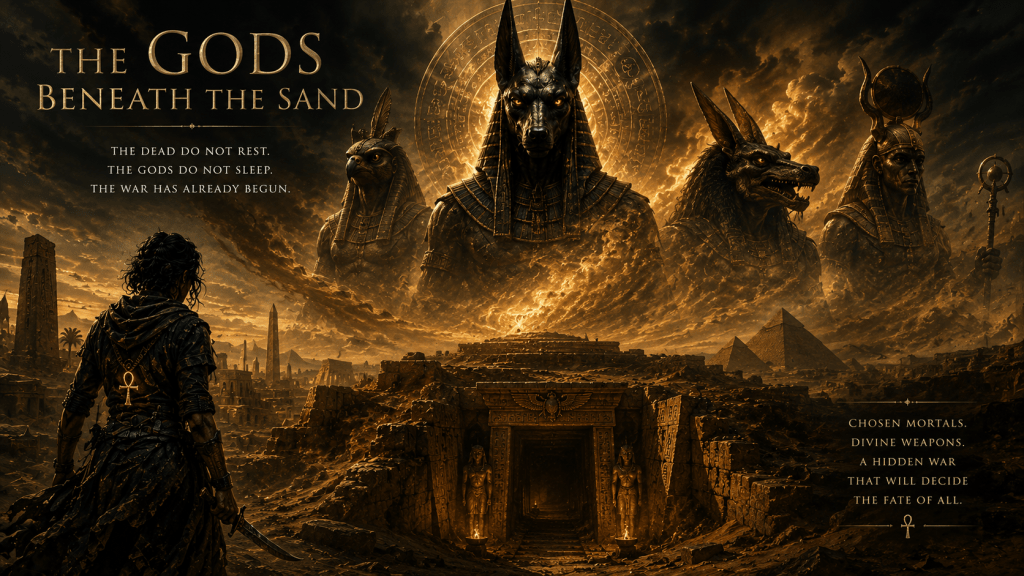
The dead were never far from the living in The Forgotten Gods of the Drowned Kingdom. They pressed close through river stink, damp stone, old prayers, sealed doors, and the narrow spaces where poverty forced the living to touch what should have remained undisturbed. In this Egyptian mythic fantasy world, tombs were never simple ruins. They were sacred architecture, built around memory, judgement, passage, and the uneasy belief that the dead still had claims upon the world they had left behind.

That closeness shaped Jackal at the Threshold, the first book in the series, before Anubis ever stepped fully into view. The story began in the river quarter, where Neris lived between hunger and guilt, between the need to keep her mother alive and the knowledge that her work among the dead had already cost too much. The noble terraces rose upriver in white stone, catching the last light of the day, while the slums below sank into shadow, smoke, mudbrick, and the rot lifted from the water by evening heat.

This is the root of the series. Egyptian mythology is not laid over the world as decoration. It is felt through burial practice, thresholds, funerary silence, jackal imagery, and the dreadful possibility that judgement may be waiting in places ordinary people have learned to rob, fear, or ignore. The gods do not begin as distant names from old stories. They begin as pressure in the stone, as warnings cut into doorways, as whispered talk of Anubis stirring when a boundary has been broken too often.


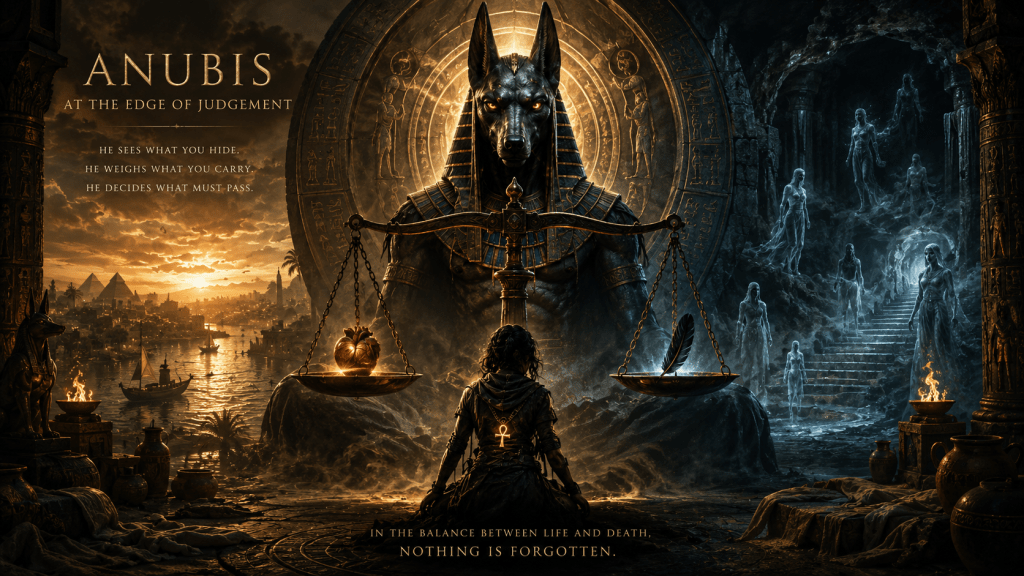
Anubis at the Edge of Judgement

Anubis belongs to thresholds. He stands at the edge between the living and the dead, between burial and desecration, between memory and judgement. In this dark mythological fantasy series, that role matters more than spectacle. He is not a generic shadow god, nor a simple patron offering power to a chosen hero. His presence is severe, patient, and bound to what has been done.

That is why Jackal at the Threshold begins with theft rather than battle. Neris is a tomb robber from the river slums, and her skill lies in stone, rope, darkness, narrow ledges, old mechanisms, and the ability to keep moving when fear should have stopped her. She steals from the dead because rent, food, medicine, and hunger have left little room for clean choices. Yet the story refuses to make survival into absolution. Poverty explains much. It does not erase everything.

Anubis enters through that tension. The western dunes uncover black stone after a storm. Workers enter and fail to return. Rumours move through the slums faster than certainty. A buried place, older than the known order of the city, waits beneath the sand. Neris goes because the world has trained her to see danger and value together. She knows the signs. She reads blood, abandoned tools, carvings, warnings, and silence. Still, need pulls harder.

When she crosses into the Drowned Kingdom, the tomb itself becomes an instrument of judgement. Jackals walk the walls. Scales wait in carved stillness. Hearts are shown in stone as if every secret has already been measured. The deeper Neris goes, the less the place feels like a tomb built for the dead alone. It becomes a boundary that remembers who has entered it, what they carried, and what they tried to leave unnamed.


Neris and the Cost of Survival

Neris is central because she is human before she is anything else. She is not a polished champion waiting for a divine weapon. She is a daughter, a thief, a survivor, and a woman shaped by a death she has never truly faced. Her brother’s collapse in a tomb shaft lies beneath every choice she makes. She saw the crack. She dismissed it. She sent him ahead. That single remembered moment gives the first book its deepest weight.

The power of this Egyptian mythology fantasy series comes from that kind of pressure. Divine judgement does not arrive in an empty life. It arrives where guilt has already made a home.

Neris’s mother keeps the story grounded in the mortal world. Her illness, the cost of healers, the bare room by the river, the careful division of four silvers between medicine, rent, and food all matter. These details prevent the mythic world from floating away into abstract gods and relics. Before Neris stands before Anubis, she stands before hunger. Before she touches the Threshold, she has already crossed moral boundaries in order to survive.

That makes her judgement more painful. Anubis does not condemn her simply because she is poor. He does not ignore the cruelty of a world where the dead are buried with gold while the living starve beside the river. Yet he draws her back to the moment where choice remained. The crack in the stone. The hurry. The brother who trusted her. The weight she carried and refused to name.

This is where the story changes. Neris returns the relic she came to steal. She confesses what she has hidden even from herself. Anubis marks her, and the burden he gives is no easy blessing. She will see when souls stray. She will hear unrest where others hear only night wind and water. What she disturbed will no longer pass unnoticed.


The Door Opened by Jackal at the Threshold

Jackal at the Threshold is the first entry in The Forgotten Gods of the Drowned Kingdom, and it works as a doorway rather than an explanation of the entire war. It brings the reader into a world of tombs, river-prayers, restless spirits, funerary dread, and divine attention without emptying the larger series of mystery.

The book belongs to Egyptian mythic fantasy because its supernatural force rises from recognisable sacred ground. The Drowned Kingdom is not simply an ancient ruin with treasure inside. It is a necropolis of judgement, silence, and unfinished passage. Its walls are carved with jackals, scales, hearts, stars, drowned kings, and warnings left by those who understood too late that the dead are not abandoned things.

The experience of entering the book is intimate rather than grand. The reader follows Neris through the alleys, the heat, the old smoke of her home, the desert road, and finally into cold black stone. Every movement carries the body with it: sand under sandals, torchlight bending across carved walls, breath misting in impossible cold, fingers testing ledges, muscles straining against fear. This is not a clean chosen-one adventure. It is a story about what happens when someone desperate crosses into death’s territory and is allowed to return.

By the end, Neris has stopped being merely a thief of the dead, yet she has not become safe, powerful, or fully informed. She believes she has become a bridge between the living and the dead. She has no understanding yet of the full hidden god-war moving beneath the surface of the world. That ignorance is essential. The first book closes with a woman changed by judgement, walking back into the same poor streets, with the same hunger still waiting, and a new awareness of the dead moving around her.


The Gods Beneath the Sand

The wider series will open slowly from that first burden. The Egyptian gods do not begin by shattering the sky. Their war begins through sacred wrongness. Burial routes falter. Souls fail to pass cleanly. Tombs open when they should remain sealed. Relics wake. Human beings are chosen, armed, watched, and used.

This is the hidden engine of The Forgotten Gods of the Drowned Kingdom. The gods avoid open war because such conflict would devastate the mortal world. Instead, they act through chosen humans bound to divine weapons. The weapon carries the force first. The human bearer becomes dangerous only through endurance, discipline, survival, and cost.

That rule keeps the series grounded. Neris does not rise because she has been handed effortless power. Her first Anubis-linked weapon is intimate, funerary, close-range, and judgement-bound. It belongs to tombs and thresholds, not battlefield spectacle. Its danger comes from what it is tied to: burial order, false return, broken passage, and the dead who have failed to rest.

Other gods wait beyond the first threshold. Set moves through disorder, desert violence, destabilisation, and predatory pressure. Thoth brings record, reckoning, hidden knowledge, and an intelligence that can be as dangerous as any blade. Neith carries ancient discipline, strategy, and martial severity. Horus represents visible legitimacy, kingship, and ordered force. Ra remains the remote solar authority whose weight shapes the divine hierarchy even before he steps forward.

Yet the series must always return to Neris. Gods may shift the board, but human lives carry the cost. The river slums, Hamat’s warnings, her mother’s illness, the memory of her brother, and the quiet work of guiding unsettled souls remain as important as any relic duel or divine decree. Without those things, the war would become spectacle. With them, it remains sacred, dangerous, and painfully human.


What Waits Beyond the Threshold

The first book leaves its deepest questions unanswered because the world has only begun to move. Neris has crossed the Threshold. Anubis has marked her. The dead now call to her when their passage fails. Somewhere beyond the city, old stone shifts beneath the sand, and attention stirs in places she cannot yet name.

That is the shape of the series promise. A grave thief has been pulled into the service of judgement, yet the judgement of gods may prove no cleaner than the lives they weigh. Divine weapons will appear as burdens rather than gifts. Chosen humans will discover that being claimed by a god can mean being protected, used, lied to, or sacrificed. The dead will not always pass cleanly, and the living will not always understand who has broken the route.

In this world, tombs are not background scenery. They are pressure points between the living and the dead. The river is not merely water. It is memory, passage, rot, need, and prayer. Anubis is not a symbol printed on the surface of a fantasy setting. He is first felt through the silence before judgement, the dark edge of a doorway, the unseen weight of a heart, and the terrible mercy of being sent back changed.

The war has already begun, though Neris does not yet understand its shape.

She has only heard the dead.

The gods will come later.

The Mythic Chronicle: The Thing That Answered

A record of sound within the tunnels that did not echo, though returned in answer to those who entered


The Passage That Answered

The passage had been entered in the record as a maintenance route, one of several that lay beneath the district and carried no distinction beyond their function. It formed part of an older network that predated the present structures, its course set through stone that had been opened and closed across successive years, though no single plan held its full extent. Those who worked along its length regarded it as ordinary ground, a place where sound travelled poorly and light settled close to the source, leaving the far sections to gather in shadow without depth or clear boundary.

On the morning it was first noted, two men were assigned to inspect a section where damp had been reported along the lower walls, the matter entered as a minor concern within the broader maintenance schedule. They carried a single lamp between them and a length of chalk for marking the points where repair would be required, moving at an unhurried pace through the narrow turn that led into the passage. Their attention was given more to the condition of the stone beneath their hands than to the space ahead of them.

“It ran further than the last plan showed,” the first said after a time, his voice held low as though the walls pressed it back upon him. “The turn should have come by now.”

The second lifted the lamp and let its light fall along the length of the corridor, where the walls drew in slightly before widening again, the line continuing without interruption. “The plans seldom match the ground,” he replied. “They follow what was set when the surface above was taken. This would have been left from earlier work.”

They continued on, marking the points where the stone showed signs of strain, their chalk passing in brief strokes across the surface before they moved on. The air held steady around them, cool and close, carrying a faint weight that settled after each step and returned to its place once they had passed, as though the space retained the shape of their movement before allowing it to fall away.

“It carried differently here,” the first said, pausing near a narrowing in the wall where the stone pressed inward. He rested his hand against the surface and held it there for a moment. “The sound sits lower.”

The second glanced back. “You hear your own step in these places,” he said. “It comes back from the turns.”

The first did not answer at once. He stepped forward and struck the wall lightly with the base of his tool, listening as the sound travelled into the stone and returned in a dull, contained form that held no echo beyond its point of contact. He struck it again, closer to the narrowing, and the sound carried further along the passage before settling.

“That was not the same return,” he said.

The second man set the lamp upon a ledge in the wall and leaned in to listen, his head angled slightly as he followed the path of the sound. “It carries along the length,” he said after a moment. “The wall opens beyond this point.”

The first struck the surface once more, this time with greater force. The sound travelled ahead of them and held for a moment before falling back. Within that brief space between the strike and its return there came a second sound, softer and set further along the passage, as though something within the stone had taken up the motion and given it back again in altered form.

They remained still.

“Did you hear that?” the first said.

The second did not reply at once. He lifted the lamp and stepped forward, holding the light out so that it reached further into the passage, though it revealed nothing beyond the same narrow stretch of stone. “Strike it again,” he said.

The first man did so, placing the tool against the wall and driving it forward with a measured blow. The sound carried ahead, clear and contained, and again there followed that second return, set apart from the first and delayed by a breath, its tone altered in a way that did not follow the shape of the corridor.

“It answers,” the first said quietly.

“It returns,” the second replied, though his voice held less certainty than before.

They moved forward together, their steps slower now, their attention drawn ahead of them where the light fell short. The air shifted as they advanced, the weight within it gathering slightly and then easing again, so that each movement seemed to meet a faint resistance before passing through.

The second man raised the lamp higher. “There is a junction ahead,” he said, though the light revealed no such division. “You can hear where the space opens.”

The first listened, though he could not mark the point where the corridor changed, only that the sound ahead carried a depth that had not been present before. He struck the wall once more, this time at the height of his shoulder. The sound travelled forward and returned, followed by that second response, closer now and more clearly set within the space beyond their sight.

“It came back to meet the sound,” he said.

The second man turned slightly, his gaze moving along the walls as though he might locate the source within them. “It follows the line,” he said. “There are channels set behind these sections. The sound carries through them.”

The first stepped closer to the narrowing and placed his ear against the stone. The surface held a faint coolness that stood apart from the air, and beneath that there lay a low vibration that did not align with the movement of their steps.

“Strike it again,” he said.

The second man hesitated, then did as asked, the tool striking the wall with a firm, controlled motion. The sound travelled into the passage, and for a moment it seemed to fade as before, though instead of settling it returned in two parts. The first followed the path already known, and the second emerged with a clearer shape, as though the sound had been taken up and set again with intent.

The first man drew back from the wall. “That is no echo,” he said.

The second lifted the lamp and held it steady, his hand tightening slightly around its handle. “There is no space ahead large enough to hold such a return,” he said. “It would show in the plans.”

The first gave a small nod. “Then it does not follow the plans.”

They stood in silence for a time, the lamp flame held steady between them, its light pressed close by the walls. The air gathered around their movement and settled again, and within that settling there remained a faint impression of the second sound, as though it had not fully passed from the space.

“We will mark this section,” the second said at last, though his voice carried the tone of a decision made to conclude the matter rather than to resolve it. He took up the chalk and set a small line upon the wall where the narrowing began. “It will be entered for further inspection.”

The first watched him for a moment, then turned back to the passage ahead. “Strike it once more,” he said.

The second man did so, though with less force than before, and the sound travelled forward and returned, followed by that second response, closer still and set at a height that did not align with the strike that had preceded it.

The first man spoke then, his voice held low within the space. “Who carries there?” he said.

The words settled into the passage and moved along it, their shape breaking slightly against the stone before returning, thinner and drawn out by the distance. For a moment there came no further sound, and the air held still around them.

Then, from further along the passage, there came a reply.

It did not take the form of words, though it followed the rhythm of speech, a low shaping of sound that rose and fell within the space ahead, carrying the same pattern as the voice that had preceded it, though altered in tone and set within a narrower range, as though it had been drawn through the stone before being returned.

The second man stepped back at once, his shoulder striking the wall as he turned. “There is someone ahead,” he said.

The first did not move. He stood where he was, his gaze fixed upon the darkness beyond the reach of the lamp. “No light shows,” he said.

“It could be set beyond the turn.”

“There is no turn marked here.”

The second lifted the lamp and held it higher, though the light fell short as before. “Call again,” he said.

The first man hesitated, then spoke once more. “Who stands there?” he said.

The words travelled forward and broke against the space, returning in their first form, and then again in that altered shape. The second sound followed with a delay that held too long to belong to the length of the passage.

The reply came again, closer now and with a clearer structure, though still without form that could be understood, its pattern aligned with the call that had preceded it and set within the same measure of sound.

The second man lowered the lamp slightly. “It repeats,” he said.

The first gave a small nod. “It answers,” he replied.

They did not advance further. The passage held before them, unchanged in its form, though altered in the manner in which it carried sound. The air settled around them once more, though it did not return to the same stillness it had held before their arrival.

“We will return this to the register,” the second said, his voice steadier now that the decision had been made. “It will be marked for survey.”

The first turned at last, though his gaze lingered for a moment upon the darkness ahead. “Mark it as you will,” he said. “It remains where it stands.”

They withdrew along the passage, their steps measured and their voices held low. The sound of their movement travelled behind them, returning in its usual form, though once, before they reached the turn, there came again that second response, faint and set at a distance that did not follow their retreat.

When they emerged into the broader corridor, the air shifted at once, the weight lifting from it as the space opened around them. The sound of their steps returned to its earlier pattern, carrying no second voice beyond their own.

The section was entered within the record as a matter requiring further inspection. The description held to the language of structure, referring to irregular sound return within a confined passage and noting the possibility of unseen channels within the stone. No mention was made of the reply that followed the call, and the matter was set within the register without expansion, its condition accepted within the limits of the space in which it had been observed.

The passage remained open for a time, and those who passed along it recorded no further irregularity, though one note referred to a moment in which a tool struck the wall and the sound returned with a delay that exceeded the expected length of the corridor, a detail entered without further comment.

The section was closed again following later works carried out along the adjoining structures, and the entrance was sealed in accordance with standard practice, its location marked only within the internal plans and its condition listed as stable.

No further reference appears within the primary record.

In later accounts, drawn from separate hands and gathered after the works had passed, there are brief mentions of sound within the lower passages that followed the shape of those who entered, returning in altered form and carrying the pattern of their movement ahead of them. These entries remain unconnected within the record and are set apart from the earlier inspection, their origin left without confirmation.

The passage holds its place beneath the district, its line set within the stone as it was before it was opened, and within it the air continues to gather and settle after each disturbance, returning to its earlier state. The sound within that space does not always follow the path it is given, and where it is carried forward it may return in a form that does not belong to the strike that set it in


Foundation Register: Lower Passage Acoustic Record

The passage entered within the lower district plans appears as part of a continuous substructure extending beneath adjoining properties, its course recorded across successive revisions with minor variation in length and alignment. Earlier entries refer to the corridor in practical terms, noting its function as a service route and its condition as stable, despite signs of prior sealing at several points along its length.

During routine inspection following reports of damp within adjacent structures, the passage was reopened for assessment, and initial observations were entered without distinction, referring to surface wear, minor shifts within the stone, and the need for limited reinforcement along sections where the wall had drawn inward. These entries hold to the language of maintenance and record no condition beyond those expected within enclosed substructures of this age.

Subsequent notes record irregularities in the behaviour of sound within the corridor, where impacts against the wall were observed to return in a manner that did not align with the known dimensions of the passage. Early descriptions refer to this as extended resonance, though later entries distinguish between the initial return and a secondary response set apart from it by a measurable delay.

In several accounts, the secondary sound is described as carrying the form of the original strike while failing to match its placement within the corridor, appearing instead at a distance inconsistent with the recorded length of the space. These observations are entered cautiously, with later revisions attributing the effect to concealed channels within the stone or to variations in the structure behind the visible surface.

A number of entries refer to instances in which spoken words were followed by a return that preserved elements of the original phrasing, though altered in tone and drawn through the structure before being heard. These notes remain limited in detail and are not expanded within the primary record, with several later annotations omitting reference to vocal response entirely.

Further examination records that the behaviour appeared more pronounced within sections where the passage narrowed or where the wall showed evidence of prior disturbance, though no consistent point of origin was identified. In these areas, sound is described as holding briefly within the space before returning in two parts. The second is set apart from the first by both timing and form.

The phenomenon was attributed to structural variation within the corridor and to the presence of voids or channels set beyond the visible surface, and no further inquiry was undertaken. The passage remained open for a limited period following inspection, during which additional observations were entered in reduced form, noting irregular sound return without elaboration.

A marginal notation, written in a later hand, refers to the behaviour as “a return that follows the voice rather than the wall”, a phrase set apart from the primary entry and left without further explanation. The notation appears once and is not repeated elsewhere within the register.

Final entries indicate that the passage was sealed following completion of adjacent works, and its condition was listed as stable within the internal plans. The acoustic irregularities were recorded as resolved through closure of the space, and no further observation was entered following its sealing.

The matter was entered as concluded within the register, and the passage remains recorded as a contained structure beneath the district, its condition accepted within the limits assigned to it and requiring no further attention.


About the Creator

The Mythic Chronicle is written and curated by Simon Phillips, a writer of mythic and speculative fantasy whose work explores the quieter edges of forgotten worlds, where buried structures, fractured records, and lingering presences continue beneath the surface of recorded history.

The accounts preserved within these Chronicles form part of a wider body of work in which cities stand upon older foundations, and events recorded as isolated disturbances are understood, in later tellings, to belong to patterns that were never fully recognised at the time.

One such account survives in a separate record, detailing an incident within a lower district where a death was first dismissed as excess, though the space in which it occurred retained a presence that resisted clearing, and where investigation revealed signs that the disturbance had not been confined to a single room.

This record is preserved in the novella Black Feathers in a Brothel, where the events surrounding that incident are followed more closely, though even there the full nature of what lay beneath the structure remains uncertain.

Readers who wish to examine that account in its fuller form may find the record below.

Explore the book:
Black Feathers in a Brothel

You can watch his YouTube channel here:
Author Simon Phillips


Continuation of the Record

What follows is drawn from later entries concerning the passage beneath the district, where sound was first noted to return in irregular form during routine inspection. Initial accounts record the behaviour in practical terms and attribute it to variation within the structure, though subsequent notes refer to repeated instances in which impact and voice were returned in altered form. Each occurrence is entered briefly and left without further inquiry. In several cases, the response is described as following the shape of the sound set into the space, though no source is identified within the passage itself. Each record concludes with the condition accepted within the limits assigned to it.

Subscribe to continue reading

Subscribe to get access to the rest of this post and other subscriber-only content.

The Future Chronicle: The Sealed Corridor

An abandoned structural level beneath Ashfall Station reveals a corridor sealed since the station’s earliest construction, drawing the attention of a retiring station detective before Fleet orders the investigation to cease.


Deck Twelve: Ashfall Station

The engineering request reached Detective Adrian Mercer during the quiet middle stretch of the station cycle, when the administrative decks of Ashfall settled into the slow rhythm that followed freight departures. Offices remained lit, terminals remained active, yet movement across the corridors softened into the patient routines of clerks and inspectors completing the final tasks of their shifts. Mercer sat alone within the records office beneath Central Security, surrounded by the layered archives of incidents that had travelled through the station across several decades. Each report carried the calm language of procedure and closure. It held the quiet assurance that whatever disturbance had once drawn attention eventually found its place inside the long memory of Ashfall Station.

Through the narrow reinforced windows behind his desk, the interior ring of the station turned in its endless orbit above the pale, clouded surface of Kestren-4. Cargo lights drifted across the distant docking arms where freight vessels prepared for departure, their engine glow reflecting faintly across the structural ribs of the outer ring. The sight carried a familiarity that came from long service rather than affection. Ashfall never attempted elegance. The station endured through scale, through industry, through the steady labour of crews who kept its immense systems working across decades of frontier commerce.

Mercer closed the final file on his terminal and allowed the quiet hum of the station to settle around him. That sound travelled everywhere through Ashfall. It lived beneath conversation, beneath the clatter of cargo lifts, beneath the distant roar of docking clamps engaging with incoming ships. Power conduits vibrated within the walls. Freight rails shifted their loads across the lower decks. Atmospheric processors breathed steadily through shafts that crossed the station from end to end. A man who served long enough inside the structure eventually learned to hear its mood through those vibrations alone. Older officers spoke of it with a seriousness that once amused Mercer during his early years in security. Time changed the way such remarks sounded.

The message waiting on his terminal carried engineering clearance tags from Deck Twelve, a location whose name appeared so rarely in modern station reports that it held the faint quality of something remembered from another era. Mercer opened the note and read the short description several times before leaning back in his chair.

Structural access discovered during inspection survey. Legacy corridor revealed behind sealed plating. Security presence requested before further entry.

Deck Twelve belonged to the earliest period of Ashfall’s construction, when the station functioned primarily as an orbital transfer hub for the ore shipments rising constantly from the mines of Kestren-4. During those years, the station existed as a harsher place, a skeleton of structural rings and industrial corridors designed for endurance rather than comfort. Later expansions buried much of that original framework beneath new habitation sectors and modern freight systems. Entire levels faded from daily use as trade patterns shifted across the frontier. Some compartments became storage vaults. Some were dismantled to strengthen newer construction. Others survived only as references inside the ageing schematics that engineers consulted whenever expansion projects reached deeper into the station’s buried architecture.

Even so, the phrase legacy corridor carried weight. Abandoned spaces existed throughout Ashfall. Deliberately sealed ones remained rare.

Mercer gathered his coat from the back of his chair and left the office behind, moving through the quiet corridors of Central Security towards the transit lifts that descended into the lower structure of the station. The lift doors opened with the soft mechanical patience common to Ashfall’s older systems. Inside, muted amber light reflected from the brushed metal walls while deck numbers began their steady descent through the station’s interior framework.

The upper levels passed first, familiar sectors filled with administration offices, habitation corridors, and the ordered calm of Fleet oversight. Soon, the lift continued into deeper regions where the architecture changed. Plating grew thicker. Corridor lighting carried a colder tone. Structural doors reflected the heavy engineering logic of an earlier generation of station builders who valued resilience above refinement. Mercer rested one hand against the rail as the lift travelled downward, feeling the subtle vibration of the machinery through the metal beneath his palm.

When the doors finally opened onto Deck Twelve, the air carried the dry scent of dust and insulation compounds that gathered slowly inside long-maintained engineering spaces. The arrival corridor extended ahead through reinforced bulkheads lined with power conduits and dormant freight rails. Overhead pipes carried atmosphere and coolant through the deeper infrastructure of Ashfall’s industrial body. Human presence felt thinner here than in the busy decks above. Maintenance crews passed through the level when expansion work required it, yet daily life unfolded elsewhere.

Two engineers waited near the far bulkhead beside a portable floodlamp that cast strong white light across the corridor. The older of the pair stood with the relaxed endurance of someone accustomed to long hours within structural maintenance zones. Silver threaded through the dark hair above his temples, and his coveralls carried the pale dust of recently disturbed plating. Beside him, a younger technician held a scanning slate close against her chest while studying the exposed section of wall with careful attention.

Senior Structural Engineer Tavin Istran inclined his head in greeting as Mercer approached.

“Detective Mercer. I appreciate you coming down.”

Mercer acknowledged him with a quiet nod while allowing his gaze to follow the direction of the floodlamp. An entire panel of corridor plating had been removed to reveal an older access frame buried behind later reinforcement layers. The metal carried a darker tone than the surrounding bulkhead, and the riveted edges reflected construction methods that belonged to Ashfall’s earliest structural phase. At the centre of the frame stood a pressure door whose surface had vanished beneath decades of dust and insulation residue. Someone, long ago, had concealed the doorway behind the new wall rather than leaving it visible within the corridor.

“What exactly came through your survey scans?” Mercer asked.

Istran directed the beam of a handheld lamp across the exposed structure. “Expansion planning for the western support run,” he said. “Engineering required a density survey before we anchored new conduit lines through this section. Current schematics indicated a solid bulkhead. Our scanner showed a hollow space behind the plating. Initial assumptions suggested abandoned cable housing. Once we cut through the reinforcement, we uncovered this.”

The younger technician stepped forward and activated the projection on her slate. A rotating structural image hovered above the screen, outlining a narrow corridor stretching deeper into the station’s buried frame.

“The cavity continues for approximately sixty metres,” she explained. “Straight alignment through the subframe. Internal pressure readings remain low yet stable. Structural integrity appears intact.”

Mercer studied the projection before returning his attention to the sealed doorway. The structure carried a deliberate quality that unsettled him in a quiet way he struggled to explain. Decommissioned corridors existed throughout the station, sealed through convenience during later renovations. This doorway suggested a different decision entirely. The plating around it formed careful layers that erased the original entrance from every visible surface.

“Authority to open?” Mercer asked.

Istran folded his arms while considering the question. “Engineering procedure allows inspection of undocumented spaces that interfere with active construction work. That remained sufficient until the door appeared. Once we realised the corridor had been intentionally sealed, security presence became necessary before any attempt at entry.”

Mercer moved closer to the exposed frame. Dust shifted under his boots as the floodlamp illuminated faded stencilling across the pressure door. Time had worn most of the lettering into obscurity, though one line still remained visible beneath the grime.

DECK 12 SERVICE TRANSIT: EASTERN ACCESS

The words belonged to another age of the station, when workers travelled constantly through corridors like this one during the first decades of Ashfall’s operation. Ore shipments rose continuously from Kestren-4 in those years, and the station’s industrial skeleton thrived on movement. The sealed doorway standing before him hinted at a later moment when someone decided that passage through this corridor carried a risk greater than leaving it buried within the structure.

“Deck Twelve appears in modern registry as structural support,” Mercer said slowly. “Transit corridors should remain mapped.”

The technician glanced at the slate again. “Three generations of station schematics contain no reference to this passage.”

Mercer rested his hand against the cold metal frame beside the door. The station continued its immense labour around them while freight systems shifted through distant decks and atmospheric regulators breathed steadily through unseen conduits. Ashfall had endured for decades through expansion, repair, and quiet compromise. Within that long history, the buried doorway before him suggested a moment when concealment seemed preferable to explanation.

He looked back towards the engineers standing in the bright spill of the floodlamp.

“Release the outer seal,” he said quietly.


Station Record: Deck Twelve Access Survey

Ashfall Station maintained extensive structural archives documenting the layered construction of the installation across several decades of expansion above the mining world of Kestren-4. From its earliest years as an industrial ore transfer platform, the station grew through successive phases of reinforcement and redevelopment as freight activity within the system increased. Each stage of construction left behind segments of earlier infrastructure embedded within the station’s expanding framework, forming a complex internal structure where modern engineering systems frequently intersected with components dating back to the original industrial period.

Deck Twelve belonged to this earliest phase of Ashfall’s development. During the first decades of orbital mining operations, the level formed part of the station’s internal transit network, providing access routes for engineering crews responsible for maintaining the cargo transfer systems that linked the station’s outer docking arms with the ore elevators rising from the surface of Kestren-4. These corridors allowed personnel and equipment to move through the station’s internal framework without interfering with the heavy freight traffic that dominated the primary cargo decks.

As Ashfall Station expanded into a larger logistical hub serving multiple trade routes, many of the original transit corridors were gradually replaced by newer structural pathways better suited to the installation’s evolving layout. Entire sections of the station’s early industrial framework became redundant as modern freight systems bypassed the older infrastructure. Engineering departments frequently sealed obsolete passages behind reinforcement plating during later construction work in order to maintain structural integrity across the station’s expanding hull.

Maintenance records indicate that structural surveys conducted during later expansion projects occasionally revealed compartments whose original purpose had faded from modern engineering documentation. In most cases, these spaces consisted of abandoned cable runs, obsolete machinery housings, or storage cavities left behind during earlier construction phases. Such discoveries were typically catalogued within the station’s structural archive and secured to prevent interference with contemporary engineering operations.

During a routine inspection connected to an expansion survey on Deck Twelve, engineering crews uncovered an access frame concealed behind reinforcement plating installed during a later phase of structural redevelopment. Removal of the outer plating revealed a sealed pressure door belonging to a transit corridor absent from modern station schematics. Preliminary scans suggested that the passage extended several dozen metres through the station’s internal subframe while retaining limited atmospheric pressure.

Initial assessment by the engineering team indicated that the corridor had been deliberately sealed during an earlier construction phase rather than simply abandoned. Multiple layers of reinforcement plating had been installed across the original access point, effectively removing the passage from the visible structure of the surrounding corridor. The doorway itself remained intact beneath these layers, preserving evidence of a transit route that once formed part of the station’s earliest engineering network.

At the time the discovery was recorded, the engineering department requested a security review before attempting to open the sealed corridor. The presence of a deliberate structural closure, combined with the absence of the passage from modern schematics, prompted a preliminary investigation into the circumstances under which the transit corridor had been removed from the station’s operational layout.

Archived engineering logs from that cycle indicate that the request for investigation was transmitted to Fleet administration shortly after the discovery was reported within the station’s internal maintenance network.

Further access to the corridor was temporarily suspended pending instructions from Fleet command.


About the Creator

The Future Chronicle is written and curated by Simon Phillips, a writer of science fiction and speculative storytelling who explores the quiet edges of human expansion, where ageing stations, distant worlds, and forgotten technologies continue their slow existence beyond the reach of the central worlds.

Many of the stories presented in these Chronicles exist within a wider fictional universe that follows the lives of investigators, engineers, and frontier workers living far from the comfort of the inner systems, where the machinery of civilisation continues to function long after its original purpose has begun to fade.

One such story unfolds aboard Ashfall Station, an ageing orbital installation whose corridors and industrial sectors form the setting for the science-fiction mystery novella Ashfall Station: The Dead Girl in Sector Twelve. What begins as a routine investigation gradually reveals that something hidden within the station’s structure may have been present for far longer than the official records suggest.

Readers who wish to explore the full investigation and its unfolding events can find the novella below.

Explore the book:
Ashfall Station: The Dead Girl in Sector Twelve

You can watch his YouTube channel here:
Author Simon Phillips


Continuing the Chronicle

The following Chronicle continues the reconstruction of the engineering survey on Deck Twelve, when maintenance crews first uncovered the sealed pressure door hidden within Ashfall Station’s earliest structural framework.

At the time, the discovery appeared to be a minor irregularity encountered during routine expansion planning. Engineering departments working across older sections of the station frequently encountered abandoned compartments left behind by earlier construction phases, and such spaces were usually catalogued within the station’s structural archive before being secured or absorbed into new engineering layouts.

The doorway revealed beneath the reinforcement plating on Deck Twelve suggested a more deliberate closure. Preliminary scans indicated that the corridor extended through the station’s internal subframe while remaining absent from all modern schematics used by Ashfall’s engineering systems. The presence of multiple reinforcement layers surrounding the original access frame indicated that the passage had been intentionally sealed and removed from the visible architecture of the station many decades earlier.

Later examination of archived engineering records suggests that the discovery on Deck Twelve represented the first documented moment when Ashfall’s contemporary maintenance crews encountered evidence of structural alterations whose origins no longer appeared within the station’s official construction history.

Readers supporting The Future Chronicle can continue the record below.

Subscribe to continue reading

Subscribe to get access to the rest of this post and other subscriber-only content.

The Mythic Chronicle: The Mark Beneath the Plaster

A record of markings uncovered within the walls, where a repeated form emerged through the surface and was obscured before it could fully be set.


The Wall Beneath the Surface

The work began in the early light, when the lane still held the damp of night and the first carts had yet to pass in full measure. A grey wash lay across the stone, and the walls carried a quiet that belonged to that hour alone. The section marked for repair showed a faint bowing along its length, a shallow swell that caught the eye once it had been seen. Such strain appeared in many places across the district, drawing little attention and passing into the day as ordinary labour.

Two men arrived with their tools in a shallow crate and a bucket for the broken plaster. They set their things down with care and stood before the wall, weighing its condition through habit more than thought. The older man ran his thumb along the surface where the plaster had begun to lift, feeling for the give beneath it, while the younger watched in silence, his gaze fixed upon the same line.

“It has taken the damp,” the older man said, his voice low in the stillness. “You can see where it has lost its hold.”

The younger stepped closer, his shoulder brushing the timber beside the wall. He leaned in and pressed his palm lightly against the surface. “There is something beneath it,” he said. “It carries through the layer.”

The older man gave a quiet breath through his nose. “Everything carries through when you stand close enough,” he replied. “Take the edge to it. It will come away.”

The first strike broke the surface with a dull crack. A thin section of plaster loosened and fell, splitting as it struck the floor. Dust rose in a brief cloud and settled again with a weight that held close to the wall, and the air took it in and kept it there.

They worked in a steady rhythm, each strike loosening another piece, each piece falling into the bucket or onto the growing scatter at their feet. The sound travelled along the lane in a muted way, held within the narrow space and softened by the walls that contained it.

“It is thinner here,” the younger man said after a time. He lifted a larger section free and let it fall aside. “There is less behind it than I would expect.”

The older man stepped forward. “Move aside,” he said, and the younger shifted without question. The tool pressed into the exposed layer and met a resistance that felt wrong in the hand, giving in a way that did not follow the pressure placed upon it.

He drew the tool back and leaned closer, his eyes narrowing as he studied the surface. “This has been worked before,” he said.

“What do you see?” the younger asked.

The older man ran his fingers across the exposed section. “Feel the line,” he said.

The younger hesitated, then placed his hand where the other had indicated. The surface held a faint unevenness that crossed the grain of the wall, resisting the skin in a subtle way, as though the mark had been set against the structure instead of within it.

“It has been cut,” the younger said.

“Or pressed,” the older replied. “The edge tells little from this.”

They cleared more of the surface, working outward from that point. The plaster came away in larger pieces now, revealing a broader stretch beneath. The marks grew clearer as the wall opened, lines emerging where no sign had shown before.

At first they appeared irregular, and the younger took them for scoring left by earlier work, while the older remained silent as more of the wall was revealed. The lines began to return upon themselves, crossing and curving in a way that suggested intention. A form lay within them, though it resisted being held in the eye.

The younger stepped back and looked at the exposed section. “That is no accident,” he said.

The older man stood with him and took in the surface as a whole. “It carries a pattern,” he said after a moment. “Though it refuses to settle.”

“Then why was it covered?” the younger asked.

The older man glanced towards the lane, where the first cart passed with a slow roll of wheels. “Because it stood there,” he said. “And someone chose to place it out of sight.”

The younger studied the lines again. “It feels unfinished,” he said.

The older gave a small nod. “Many of the strokes end too soon,” he said, “and others cut across them after.”

Several lines broke at their edges, the tool lifted before the stroke could carry through, while other lines crossed those breaks, drawn with a different hand or at a different time. The surface held the marks in layers, each one disturbing the last.

“It has been changed,” the younger said.

“It has been returned to,” the older replied.

They stood in silence for a short while. The lane had begun to wake, voices carrying in low tones from further along the street. Within the room, the dust settled in a way that seemed to cling to the wall itself, as though it found purchase there.

“We will clear it through,” the older said at last. “There is no purpose in leaving it half exposed.”

They returned to the work, though their pace had shifted, each strike coming with greater care and each section lifted with attention. The pattern extended as the wall opened, repeating across the surface in broken forms.

“It carries the same turn,” the younger said. “Here, and again along this edge.”

The older traced the curve with his eye. “It echoes itself,” he said, “though each instance fails to complete.”

Where a line might have closed, another cut through it, and where a shape might have formed, it had been disturbed. The surface resisted completion.

“It never settles,” the younger said quietly.

The older gave no answer. He set the tool aside and stepped back once more, taking in the whole of the exposed section.

A third man entered then, drawn by the sound. He stood in the doorway for a moment before crossing into the room, his gaze fixing upon the wall at once.

“You have uncovered something,” he said.

“Old work,” the older replied, his tone even.

The third man stepped closer. “That carries intention,” he said. “It was placed.”

“It will be covered again,” the older said.

The third man followed the lines with his eyes, his expression tightening slightly. “Who set it there?” he asked.

“No record remains,” the older replied.

The younger looked between them. “Should it be entered?” he asked.

The third man remained silent for a moment, his gaze moving along the broken lines and tracing their repetition. “It has already been addressed,” he said at last.

“How can you be certain?” the younger asked.

He gestured towards the surface. “You can see where it has been struck through,” he said. “Someone attempted to remove it.”

“And left it incomplete,” the younger said.

“Or found no end to the work,” the third man replied.

The older man lifted his tool again. “Our concern rests with the surface,” he said. “We return it to its place.”

The third man stepped back, though his attention lingered on the wall. “You will set it over as it stands?” he asked.

“As it was found,” the older said.

“And if it shows again?”

The older struck the wall once more, the sound sharp and contained. “Then it will be set again,” he said.

The third man gave a small nod and moved towards the door. He paused there and looked back once more at the exposed section before stepping out into the lane.

The work carried on. The final sections of plaster were removed, and the wall lay open across its width. The pattern held throughout, broken and repeated, never resolving into a complete form.

When the clearing ended, they stood back from it.

“That is the full extent,” the younger said.

The older gave a brief nod. “Enough has been seen.”

“And enough left beneath,” the younger added.

The older took up the fresh mix and pressed it against the wall. He worked in long, even strokes, smoothing the surface over the exposed lines. The pattern disappeared beneath the new layer at once, drawn out of sight as though it had never held the wall.

The younger watched for a moment, then took up his own tool and joined the work. Together they set the surface until it lay flat once more, the wall restored to its earlier state.

When they stepped back for the final time, no trace of the marks remained.

“It will hold,” the older said.

“For a time,” the younger replied.

The older set his tools aside. “That is all that is ever required.”

They gathered their things and left the room as they had found it, the wall newly set and the surface clean. The lane had taken on the full movement of the day, voices and wheels passing in steady rhythm.

Behind them, the plaster began to dry. Beneath it, the lines remained where they had been, held within the wall in their broken form, unchanged by the covering placed over them, and waiting where no eye could follow.


Foundation Register: Inner Wall Restoration Record

The section of wall recorded within the adjoining structures appears in district plans as part of a continuous interior surface shared between several properties, its construction formed through layered plaster applied across older stone and timber. Earlier revisions note minor repairs carried out across successive years, though no distinction is made concerning the portion later subject to restoration.

During routine maintenance following reports of surface strain, sections of plaster were removed to expose the underlying layer. Initial entries describe the condition in practical terms, referring to weakened adhesion and the need for replacement of compromised material. These observations were entered without indication that the work extended beyond ordinary repair.

Subsequent notes record the presence of markings beneath the removed surface, where lines were observed within the underlying layer in a form that did not align with known structural scoring. Early descriptions refer to the markings as irregular, though later entries note a repeated arrangement of lines across separate sections, each instance incomplete and partially obscured.

Further examination records that the lines appeared to have been altered after their initial placement, with sections broken or cut through by later marks. In several entries, the surface is described as holding multiple layers of disturbance, suggesting that the markings had been revisited more than once, though no record identifies the origin of these alterations.

The markings were attributed to earlier repair work or to residual scoring within the structure, and no further inquiry was undertaken. The exposed sections were covered during the course of restoration, and the surface was returned to its prior condition through application of fresh plaster.

A marginal notation, written in a later hand, refers to the markings as “a form interrupted within the wall”, a phrase set apart from the primary entry and left without expansion. The notation appears once and is not repeated elsewhere in the record.

Final entries indicate that the restoration was completed without complication, and the wall was listed as stable within the register. No further observation was recorded following the covering of the markings, and no connection was made between this discovery and earlier conditions noted within adjoining structures.

The matter was entered as resolved through restoration of the surface, and the record concludes with the structure accepted as sound, its condition requiring no further attention.


About the Creator

The Mythic Chronicle is written and curated by Simon Phillips, a writer of mythic and speculative fantasy whose work explores the quieter edges of forgotten worlds, where buried structures, fractured records, and lingering presences continue beneath the surface of recorded history.

The accounts preserved within these Chronicles form part of a wider body of work in which cities stand upon older foundations, and events recorded as isolated disturbances are understood, in later tellings, to belong to patterns that were never fully recognised at the time.

One such account survives in a separate record, detailing an incident within a lower district where a death was first dismissed as excess, though the space in which it occurred retained a presence that resisted clearing, and where investigation revealed signs that the disturbance had not been confined to a single room.

This record is preserved in the novella Black Feathers in a Brothel, where the events surrounding that incident are followed more closely, though even there the full nature of what lay beneath the structure remains uncertain.

Readers who wish to examine that account in its fuller form may find the record below.

Explore the book:
Black Feathers in a Brothel

You can watch his YouTube channel here:
Author Simon Phillips


Continuation of the Record

What follows is drawn from later entries concerning the restored wall within the adjoining structures, where the surface had been removed and set again in the course of ordinary repair. The markings beneath were entered at first in practical terms and attributed to prior work within the structure. Subsequent notes refer to the repeated appearance of similar lines across separate sections, each instance incomplete and each returned to concealment without further inquiry.

Subscribe to continue reading

Subscribe to get access to the rest of this post and other subscriber-only content.

The Future Chronicle: The Signal in the Debris Field

Frontier pilots approaching Ashfall Station begin reporting a repeating signal drifting through the outer debris field, even though station navigation confirms that no transmitter exists anywhere within the surrounding orbital space.


The Signal in the Debris Field

Approach to Ashfall Station rarely carried the drama imagined by those who had never travelled the outer routes of frontier space. For most pilots, the journey ended in a slow glide through the scattered remains of earlier industry, where fragments of forgotten machinery drifted in loose orbit around the silent mining world of Kestren-4. Cargo captains spoke of the region with a mixture of routine familiarity and quiet caution, since the debris field surrounding the station contained the accumulated remains of decades of industrial work. Broken survey satellites, abandoned ore containers, fragments of collapsed relay towers, and the rusting skeletons of transport frames all moved slowly through the dark, forming a shifting boundary that every incoming vessel learned to navigate with patient attention.

The pilot of the freighter Meridian Wake encountered the signal during the final stage of such an approach. Her vessel travelled along the outer navigation corridor that curved gradually toward Ashfall’s docking arms, engines reduced to manoeuvring thrust while the ship’s scanners tracked the larger fragments drifting ahead of the bow. Through the forward observation canopy, the distant ring of the station hung against the black horizon of space, its vast structure illuminated by the soft glow of maintenance lights tracing the circumference of the industrial habitat. Beneath the station, the surface of Kestren-4 rotated slowly through darkness, a barren world whose exhausted mines had once filled Ashfall’s cargo holds with ore during the early years of expansion across the system.

Traffic along the approach route remained quiet during that cycle. Two small salvage craft held position near the outer marker buoys while a long-range ore hauler departed the station’s southern docking spine and accelerated toward the deeper trade lanes beyond the system. Routine communications flowed across the Meridian Wake’s console as navigation systems exchanged positioning data with the station’s control tower. The pilot guided the freighter along the authorised corridor with the calm precision expected of anyone who had spent years crossing the frontier routes, where industrial stations served as the only islands of human presence within vast distances of unoccupied space.

It was during the final scan sweep of the debris field that the first trace of the signal appeared. The anomaly entered the ship’s communication display as a brief distortion across the receiver spectrum, a thin band of transmission energy repeating at regular intervals somewhere beyond the edge of the navigational corridor. At first, the pattern resembled the scattered noise sometimes produced by damaged communication beacons drifting within the debris field, remnants of earlier construction projects whose transmitters continued broadcasting fragments of long obsolete data into empty space. The Meridian Wake’s automated systems attempted to classify the signal within the standard catalogue of known transmissions across the Kestren system, yet the repeating pattern matched none of the frequencies registered within the station’s navigation archives.

The pilot adjusted the receiver gain and watched the signal repeat again across the console display. A narrow pulse travelled through the communication channel, fading into silence before returning several seconds later with the same precise rhythm. Each repetition carried identical amplitude and duration, suggesting a source operating with mechanical consistency somewhere within the drifting field of debris surrounding Ashfall Station. The ship’s long-range scanners turned slowly toward the region indicated by the signal’s directional trace while the navigation computer calculated the relative motion of nearby objects moving through the corridor.

Across the forward canopy, the darkness of the debris field appeared unchanged. Fragments of machinery drifted slowly through the weak gravity of Kestren-4 while Ashfall’s immense ring structure rotated in distant silence above the planet’s dim horizon. Yet the signal continued to repeat across the Meridian Wake’s receiver with quiet persistence, a steady pulse arriving from a point somewhere within the scattered wreckage ahead of the ship.

The pilot opened a routine communication channel with Ashfall Station’s navigation office while transmitting the signal data along with the vessel’s current position within the approach corridor.

“Ashfall Navigation, this is Meridian Wake approaching corridor three,” the pilot said into the bridge transmitter while the freighter continued its measured glide through the drifting debris. “Receiving a repeating transmission within the debris field ahead of the marker buoys. Forwarding signal trace to your console now.”

Several seconds passed before the reply arrived across the communication channel, the calm voice of a navigation officer emerging from the distant control rooms of the station.

“Meridian Wake, Ashfall Navigation receiving your transmission,” the officer answered with the quiet routine of someone accustomed to minor irregularities along the frontier routes. “Stand by while we check beacon registry and external sensor records.”

Reports of unidentified transmissions occasionally appeared within frontier systems where ageing infrastructure lingered long after its original function had faded from memory. In most cases, navigation technicians traced the source to damaged equipment or abandoned satellites still broadcasting faint automated signals through the surrounding vacuum. The pilot expected a similar explanation to emerge once the station’s monitoring systems examined the data arriving from the freighter.

Several minutes passed while the Meridian Wake continued its gradual approach toward the station. The signal repeated twice more during that interval, its narrow pulse crossing the receiver display with unwavering regularity. Ashfall’s navigation officer eventually returned the transmission with confirmation that no registered beacon operated anywhere within the debris field along the ship’s projected path. Automated sensor arrays surrounding the station scanned the indicated coordinates and detected no active transmitter within their range of observation.

For a brief moment, the bridge of the Meridian Wake fell quiet as the pilot studied the communication console where the signal continued to appear with patient rhythm. The freighter drifted between two large fragments of collapsed docking scaffolding while the navigation computer adjusted course to maintain safe distance from the surrounding debris. Beyond the canopy, the lights of Ashfall Station grew slowly brighter as the vessel closed the final kilometres of open space separating it from the docking ring.

The signal returned again, identical in form to each earlier transmission, emerging from the silent debris field where no transmitter had ever been recorded within the station’s operational charts. The navigation officer requested that the pilot maintain the recorded frequency within the receiver while the station’s monitoring systems continued searching the surrounding region for any object capable of generating the repeating pulse.

Across the dark expanse between the drifting fragments of machinery, the invisible source of that signal continued its steady broadcast toward the approaching freighter. It repeated with the same calm precision that would soon draw the attention of every pilot navigating the outer routes toward Ashfall Station.


Station Record: Frontier Navigation Monitoring

Ashfall Station maintained a permanent navigation monitoring system designed to regulate vessel movement through the debris field that surrounded the installation’s outer orbital corridor. The station’s position above the mining world of Kestren-4 placed it within a region crowded by the remains of earlier industrial expansion, where abandoned infrastructure and drifting machinery formed a loose halo of debris extending several thousand kilometres beyond the station’s docking rings. For vessels approaching from the outer trade routes, safe arrival required careful coordination with Ashfall’s navigation office, whose systems tracked both incoming traffic and the gradual movement of the debris field itself.

The debris surrounding the station consisted largely of industrial remnants dating from the early decades of the Kestren mining operations. When the system’s ore extraction projects expanded rapidly, construction crews deployed large numbers of relay platforms, cargo transfer frames, survey satellites, and automated mining equipment throughout the orbital zone above the planet. Many of these structures eventually fell into disuse as production declined across the system. Over time, the abandoned equipment fragmented into drifting clusters of metal framework that continued to orbit within the gravitational influence of Kestren-4.

To manage this environment, Ashfall Station established a network of navigational corridors marked by automated beacon buoys positioned along the safest approach routes toward the docking arms. Incoming vessels aligned their approach vectors with these corridors while the station’s control tower monitored traffic through a combination of radar systems, optical tracking arrays, and long-range communication receivers capable of detecting transmissions across the surrounding orbital space.

Although these monitoring systems provided extensive coverage across the region, Ashfall’s navigation personnel frequently encountered irregular signals produced by ageing infrastructure still drifting within the debris field. Damaged communication relays and obsolete survey satellites occasionally continued broadcasting fragments of automated transmissions long after their original control networks had ceased functioning. Most such signals were catalogued within the station’s archival records and rarely attracted attention beyond routine maintenance reports.

Archived navigation logs indicate that the freighter Meridian Wake reported a repeating transmission while travelling through the outer approach corridor during a routine arrival cycle. Initial analysis of the signal failed to match any registered beacon frequency operating within the station’s navigation registry. Sensor arrays surrounding Ashfall Station conducted a wide scan of the coordinates supplied by the vessel and confirmed that no active transmitter appeared within the detection range of the station’s monitoring equipment.

At the time the report was filed, the signal was classified as an unidentified transmission anomaly originating somewhere within the debris field beyond the approach corridor. Ashfall Station continued its standard docking operations throughout the cycle while navigation personnel opened a routine investigation into the source of the signal detected during the freighter’s approach.


About the Creator

The Future Chronicle is written and curated by Simon Phillips, a writer of science fiction and speculative storytelling who explores the quiet edges of human expansion, where ageing stations, distant worlds, and forgotten technologies continue their slow existence beyond the reach of the central worlds.

Many of the stories presented in these Chronicles exist within a wider fictional universe that follows the lives of investigators, engineers, and frontier workers living far from the comfort of the inner systems, where the machinery of civilisation continues to function long after its original purpose has begun to fade.

One such story unfolds aboard Ashfall Station, an ageing orbital installation whose corridors and industrial sectors form the setting for the science-fiction mystery novella Ashfall Station: The Dead Girl in Sector Twelve. What begins as a routine investigation gradually reveals that something hidden within the station’s structure may have been present for far longer than the official records suggest.

Readers who wish to explore the full investigation and its unfolding events can find the novella below.

Explore the book:
Ashfall Station: The Dead Girl in Sector Twelve

You can watch his YouTube channel here:
Author Simon Phillips


Continuing the Chronicle

The following Chronicle reconstructs the approach of the freighter Meridian Wake during the arrival cycle when pilots travelling through the outer debris field first reported a repeating signal drifting somewhere beyond Ashfall Station’s navigation corridors.

At the time the transmission appeared to be little more than an unidentified anomaly detected by a single vessel during routine approach procedures. Navigation officers reviewing the report recorded no registered transmitter within the surrounding debris field, and the station’s sensor arrays detected no active beacon operating within the region identified by the freighter’s communication logs.

Later examination of archived navigation records suggests that this brief encounter may represent one of the earliest documented observations of the signal that would gradually become known among pilots travelling the outer routes toward Ashfall Station.

Readers supporting The Future Chronicle can continue the record below.

Subscribe to continue reading

Subscribe to get access to the rest of this post and other subscriber-only content.

The Mythic Chronicle: The Clerk Who Folded Inward

A record of a death where the body settled against itself, and the room retained a stillness that did not pass with breath or with time.


The Record of the Upper Chamber

The room stood above the lane where the evening light lingered longest, its windows set high above the street and its shutters drawn back just enough to admit the last of the day. What entered passed across the floor in a narrow band, touched the foot of the bed, and faded slowly into the dimness, while the chamber held to itself with a quiet reserve that seemed older than the house around it.

The man who had occupied it kept his surroundings in a way that spoke of habit more than comfort. Papers rested in measured piles upon the table, each set bound with cord drawn tight and turned once more through the knot for certainty. The chair stood close to the table’s edge, its legs worn in the same places by years of being pulled back and returned. The coverlet upon the bed had been smoothed in the morning, and a coat still hung from the peg beside the door as though the next hour had been expected to proceed as every other hour before it.

When the room was opened after his death, those who entered remarked first upon the stillness that lay inside it. It settled against the body and held there, deepening the breath and slowing the step, until even the smallest movement seemed to travel farther than it should.

“You felt it as you came in,” said the woman who stood just inside the threshold, her voice lowered by the space before she seemed aware of it. “It presses upon the chest.”

The constable remained with one hand upon the latch for a moment longer, as though the act of releasing it required more thought than usual. The air gathered around him with a quiet weight, and his first breath within the room drew shorter than the one he had taken in the passage.

“It is close in here,” he said at last. “The window should have eased it.”

“It stood open when they found him,” the woman replied. “They left it so for most of the night.”

He stepped fully inside and allowed the door to rest behind him, while the floorboards received his weight with a low creak that seemed to drift thinly through the chamber before settling into the walls. He gave his attention to the bed first, then to the window, then to the table, as though the proper order of ordinary things might restore the room to reason.

“Who found him?” he asked.

“A neighbour from the next house,” she said. “He came for a ledger that had been promised and never brought down.”

“And the state in which he was found?”

She paused then, her eyes returning to the bed with the same reluctance they must have carried the first time. “He had fallen,” she said, “though the form of it carried little of an ordinary fall.”

The constable moved nearer, each step measured and deliberate. The sheets had been drawn back after the body was taken away, though an impression remained in the fabric. It ran inward in a shape that troubled the eye, as though the weight that had made it had folded towards itself before it came to rest.

He stood over it for some moments in silence. The evening light had weakened by then, and the room seemed to hold more of its own dimness than the hour should have given it.

“There is no sign of struggle,” he said.

“None was spoken of,” the woman replied.

“No cry heard through the wall?”

“None that anyone would swear to.”

He bent slightly and held his hand above the sheet, close enough to feel the air gathered there. His expression altered in a way so slight another man might have missed it, though the woman at the door saw it clearly and lowered her gaze.

“It holds itself,” he said quietly.

“It returns,” she answered.

His eyes moved to the window again. The shutters remained open, and a faint current entered from the lane outside, carrying the last sounds of trade and passage below. That air entered the room and weakened within a few feet, as though the chamber accepted it only to set it gently aside.

“You kept the room open after he was found,” he said.

Yes.”

“And the air changed?”

“For a little while.”

He turned away from the bed and crossed to the table. The wood felt cool beneath his palm, and the papers upon it remained aligned with the care of a man who had expected to return to them. He lifted the edge of one packet and let it rest again, the slight sound of cord against paper carrying thinly through the room.

“He had been working,” he said.

“He always worked at that hour.”

“And then crossed to the bed.”

“That is how it appeared.”

The constable studied the chair, then the space between chair and bed, then the bed again. “He rose of his own will,” he said.

“That is what the room suggests.”

He looked towards her then. “The room suggests many things.”

She received that without change. “It does.”

He moved back towards the bed and placed his fingertips lightly upon the sheet. The fabric yielded at once, though the air above it seemed to gather around his hand and hold there, as though preserving the memory of weight after the weight itself had gone. He withdrew at once and straightened, his fingers curling briefly before he let them fall.

“It settles over the bed more strongly,” he said.

“Yes.”

“And nowhere else?”

The woman’s gaze shifted towards the chair by the table. “It held there as well, on the first evening. Less now.”

He followed her look. The chair stood with one leg turned slightly inward, the smallest disturbance in an otherwise ordered room.

“He became aware of something,” she said.

The constable remained silent for a moment. Then he asked, “You speak as though you had seen it.”

“I saw the room after,” she replied. “At times that is enough.”

He accepted that with the reserved expression of a man who had learned that certain answers closed more doors than they opened. His attention returned to the walls, which held plain plaster above old timber, sound enough to the eye and giving no sign of breach or entry.

“There is no mark of another presence,” he said.

“No mark that would satisfy a ledger.”

That drew his gaze back to her once more. She stood with her hands folded before her, composed in the way of those accustomed to difficult rooms and the stories that gathered inside them. Her age was hard to place in the dimness. Her voice had the steadiness of one who had long practised the art of speaking plainly when others wished for easier versions of events.

“It will be entered as failure of the body,” he said.

“Yes,” she replied.

“The position in which he was found will be noted.”

“Yes.”

He glanced again at the bed, then at the chair, and the stillness within the room seemed to draw closer, as though it heard and waited. “There will be no advantage in saying more than that.”

“There rarely is.”

The light had faded enough by then that the lamp in the passage cast a pale shape across the threshold. The constable went to the window and pushed one shutter wider, allowing more evening air to enter. For a brief moment the chamber eased, though the change remained slight and passed almost at once, the weight in the room settling back into its earlier form with a patience that carried something deeply unsettling in it.

He stood very still as that happened, and when he turned back his face had lost the last trace of practical certainty with which he had entered.

“How long has it remained this way?” he asked.

“Since the body was carried out.”

“And each time the room was entered?”

“It gathered again after every disturbance.”

The constable gave a slow nod and moved towards the door. He paused at the threshold, then looked back once more upon the bed, the table, and the ordered papers that would never be touched by the hand that had arranged them.

“Have the room closed,” he said. “There is little to be gained from leaving it open.”

“It will remain as it is.”

“I believe that.”

The woman stepped forward after he had passed into the corridor. She took one last look inside before drawing the door towards her. As it moved, the room seemed to gather itself more fully, the stillness deepening over bed and chair and table alike, while the dimness within held its place against the fading day.

When the latch settled, the chamber was shut again. Within it, the impression upon the bed remained, the papers waited in their ordered stacks, and the air drew inward once more into the same quiet state, patient and unchanged, as though it required no witness in order to hold what had occurred there.


Foundation Register: Lower Chamber Storage Record

The chamber recorded within the upper district plans appears as a private room set above the adjoining trade lane, its structure resting upon earlier timber and plaster whose alterations are noted across several revisions of the building. Surviving layouts refer to the space only in domestic terms, with no indication that it held any distinction beyond its use as a place of work and rest for its occupant.

During routine inquiry following a reported death within the room, entries began to note irregular conditions concerning the atmosphere of the chamber, where the air was described as holding its density beyond expected limits, and where the space failed to clear despite the opening of shutters and the introduction of air from the street below. These observations were recorded alongside the primary account and attributed to the enclosed nature of the room, as well as the materials of its construction and the arrangement of the surrounding structures.

Further entries describe the persistence of these conditions across repeated visits, noting that the atmosphere within the chamber appeared to settle into a consistent state after disturbance, returning to that state regardless of how long the room remained open. The effect was observed in each instance without variation, and no external source within the adjoining properties was identified that might account for the behaviour.

The death itself was entered in practical terms, with the position of the body recorded as having settled in a manner that did not align with an ordinary fall. This detail was included without expansion and was not pursued beyond its initial notation, the cause being assigned to failure of the body under strain.

A marginal notation, written in a later hand, refers to the chamber as holding “a retained stillness”, a phrase set apart from the primary entry and left without further clarification. The notation appears once and is not repeated within the register.

Subsequent entries indicate that the chamber remained in use following the incident, with no structural alteration or remedial work recorded. Recommendations were limited to continued ventilation and ordinary oversight, and the absence of further reports was taken as sufficient indication that the condition had stabilised.

No connection was made between this chamber and other irregularities noted within the district, and the record concludes with the structure listed as functional, its condition accepted without further inquiry.


About the Creator

The Mythic Chronicle is written and curated by Simon Phillips, a writer of mythic and speculative fantasy whose work explores the quieter edges of forgotten worlds, where buried structures, fractured records, and lingering presences continue beneath the surface of recorded history.

The accounts preserved within these Chronicles form part of a wider body of work in which cities stand upon older foundations, and events recorded as isolated disturbances are understood, in later tellings, to belong to patterns that were never fully recognised at the time.

One such account survives in a separate record, detailing an incident within a lower district where a death was first dismissed as excess, though the space in which it occurred retained a presence that resisted clearing, and where investigation revealed signs that the disturbance had not been confined to a single room.

This record is preserved in the novella Black Feathers in a Brothel, where the events surrounding that incident are followed more closely, though even there the full nature of what lay beneath the structure remains uncertain.

Readers who wish to examine that account in its fuller form may find the record below.

Explore the book:
Black Feathers in a Brothel

You can watch his YouTube channel here:
Author Simon Phillips


Continuation of the Record

What follows is taken from later accounts concerning the upper chamber, where the death was first entered as a failure of the body, and where the condition of the room was noted in passing within the same record. Subsequent entries describe the persistence of the atmosphere across repeated visits, where the space was observed to settle into a fixed state, and where the stillness remained after each disturbance, returning as though it held to a form of its own.

Subscribe to continue reading

Subscribe to get access to the rest of this post and other subscriber-only content.